Reset After a Bad Week of GCSE Arabic Revision
Reset after a bad week of GCSE Arabic revision with a realistic seven-day plan for every skill, proper rest and a manageable GCSE maths workload.
A missed session becomes three. The vocabulary list stays closed. By Sunday evening, the problem no longer feels like GCSE Arabic; it feels like proof that you are falling behind in everything.
If you searched for how to reset after bad week GCSE Arabic revision, the practical answer is this: do not try to recover every missed hour. Spend one short session identifying what slipped, complete one manageable task, and build a realistic seven-day plan covering listening, speaking, reading and writing.
The aim is not to manufacture a perfect week. It is to restore a routine you can repeat while leaving enough time and energy for GCSE maths and your other subjects.
Your GCSE Arabic reset checklist
Use this before planning anything ambitious:
- Accept that the previous week has finished.
- Check your actual Arabic specification and teacher's priorities.
- Choose one small task you can complete today.
- Cover all four language skills across the next seven days.
- Use active recall rather than only rereading notes.
- Keep Arabic and maths in separate, protected revision blocks.
- Mark or check your work so mistakes shape the next session.
- Leave catch-up space instead of filling every evening.
- Protect sleep, meals, movement and time away from revision.
That is the whole reset in outline. Everything else is refinement.
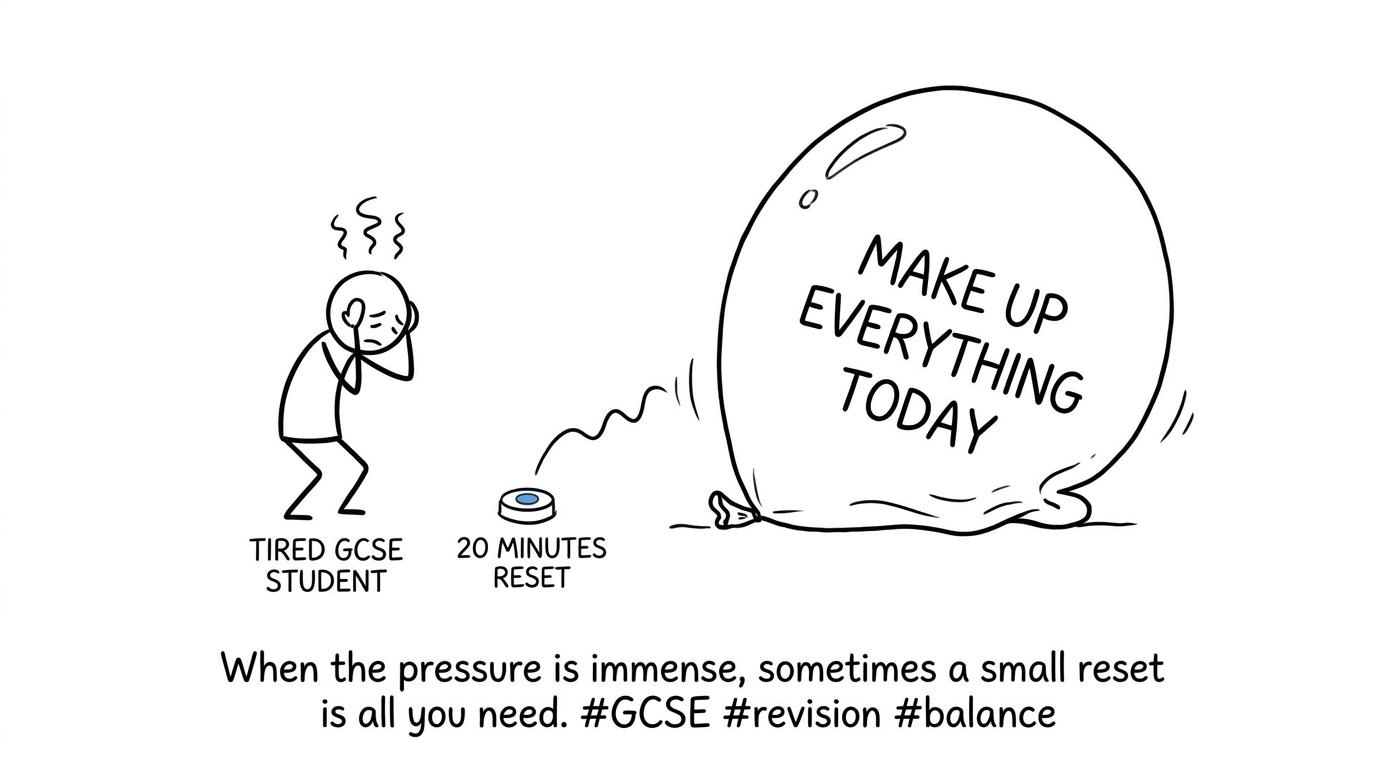 A student chooses a small reset button instead of an impossible catch-up timetable
Start with evidence, not guilt
Guilt is vague. Evidence is useful.
Take a blank page and write down what genuinely happened last week. Perhaps you missed two vocabulary sessions, avoided speaking practice and did not finish a writing task. Those are three identifiable gaps. They are not a judgement about your ability.
Now sort the gaps into three groups:
- Urgent: work required soon by your teacher or needed for an approaching assessment.
- Important: weak knowledge that repeatedly costs marks.
- Optional: extra tasks that would be useful but can wait.
Choose no more than three priorities for the new week. A plan with twelve priorities is usually a disguised wish list.
This diagnostic approach works for maths too. MathsGenie's guide to finding your weakest GCSE topics explains why revision should begin with evidence from questions rather than whichever topic feels most comfortable.
Make the first session deliberately small
After a disrupted week, your first obstacle is often starting rather than understanding Arabic. Lower the entry cost.
Set a timer for 202020 minutes and choose one defined action:
- retrieve a small vocabulary set without notes;
- read one short text and identify its main message;
- record a brief spoken response to a familiar theme;
- correct one previously marked paragraph; or
- listen to a short extract and note the key details.
Finish by writing the next action on a piece of paper. Tomorrow's session should begin with a decision already made.
A short session is not a weak session. It creates evidence that the routine has restarted. If brief structures help across your subjects, the 20-minute GCSE revision routine offers a similarly simple learn, practise, mark and plan cycle for maths.
Rebuild around the four GCSE Arabic skills
For Pearson Edexcel GCSE Arabic, the qualification assesses listening, speaking, reading and writing in four externally examined papers. Each skill contributes 25%25\%25% of the qualification. Papers are available at Foundation and Higher tier, and candidates are entered for one tier across all papers.
Always check your own entry and current specification with your teacher. Do not assume that advice for an International GCSE, a different language or an old specification applies to your course.
Your reset week should touch every assessed skill without forcing all four into every day.
Listening
Use a short, level-appropriate recording. Listen once for the overall meaning, then again for details such as opinions, time references, reasons and negatives. Check the transcript or answers afterwards if they are available.
Do not stop at recognising familiar words. Ask what the speaker actually communicates. One missed negative can reverse the meaning of an answer.
Speaking
Speaking improves through speaking. Prepare a response, say it aloud and record it. Listen for hesitation, unclear pronunciation and answers that end before you have justified an opinion.
Keep a small bank of adaptable phrases, but practise changing the details. Memorising one fixed paragraph can leave you exposed when a question is phrased differently.
Reading
Read with a purpose. On one day, retrieve the main idea. On another, locate evidence for an opinion or infer meaning from context. Record unfamiliar vocabulary only when it is likely to be useful again.
Translation practice should remain precise. Preserve the complete meaning rather than replacing the sentence with a rough summary.
Writing
Start with one paragraph rather than an entire timed paper. Check whether you have answered the task, communicated opinions clearly and used an appropriate range of vocabulary and grammatical structures.
Corrections matter more than copying. Rewrite the faulty phrase correctly, then return to it later without looking at the answer.
Use a realistic seven-day reset plan
A reset timetable should be light enough to survive an ordinary school week. Adapt this structure around homework, lessons and assessments:
| Day | GCSE Arabic focus | Length | Finish with |
|---|---|---|---|
| Monday | Vocabulary retrieval and a short reading task | 252525 minutes | Record five uncertain items |
| Tuesday | Listening for overall meaning and key details | 252525 minutes | Check errors and replay difficult sections |
| Wednesday | Speaking response recorded aloud | 202020 minutes | Note one pronunciation and one content fix |
| Thursday | Rest or catch-up space | No planned task | Prepare Friday's materials |
| Friday | One focused writing paragraph | 303030 minutes | Correct it using feedback or criteria |
| Saturday | Mixed practice across two weaker skills | 404040 minutes | List the next three priorities |
| Sunday | Brief retrieval and planning | 151515 minutes | Set up the coming week |
This is a framework, not a rule. If speaking is your urgent weakness, give it two sessions. If your teacher has set a reading assessment, move reading earlier. The important feature is the rhythm: attempt, check, correct and revisit.
Make retrieval part of the restart
Rereading a vocabulary list can feel reassuring because every word looks familiar. Recognition, however, is not the same as being able to retrieve and use a word independently.
Close the book. Try to recall the Arabic from an English prompt, the English meaning from Arabic, or a complete phrase from a topic cue. Then check your answer and correct it immediately. Revisit uncertain material after a delay rather than cramming it into one long sitting.
Evidence reviews discussed by the Education Endowment Foundation support the potential of retrieval and spaced practice, while also stressing appropriate difficulty and feedback. That final part matters: practising an incorrect answer repeatedly can strengthen the wrong version.
This principle transfers directly to maths. The GCSE maths mini tests provide quick feedback, while the main GCSE maths revision hub brings together topic resources, papers and questions for different exam boards.
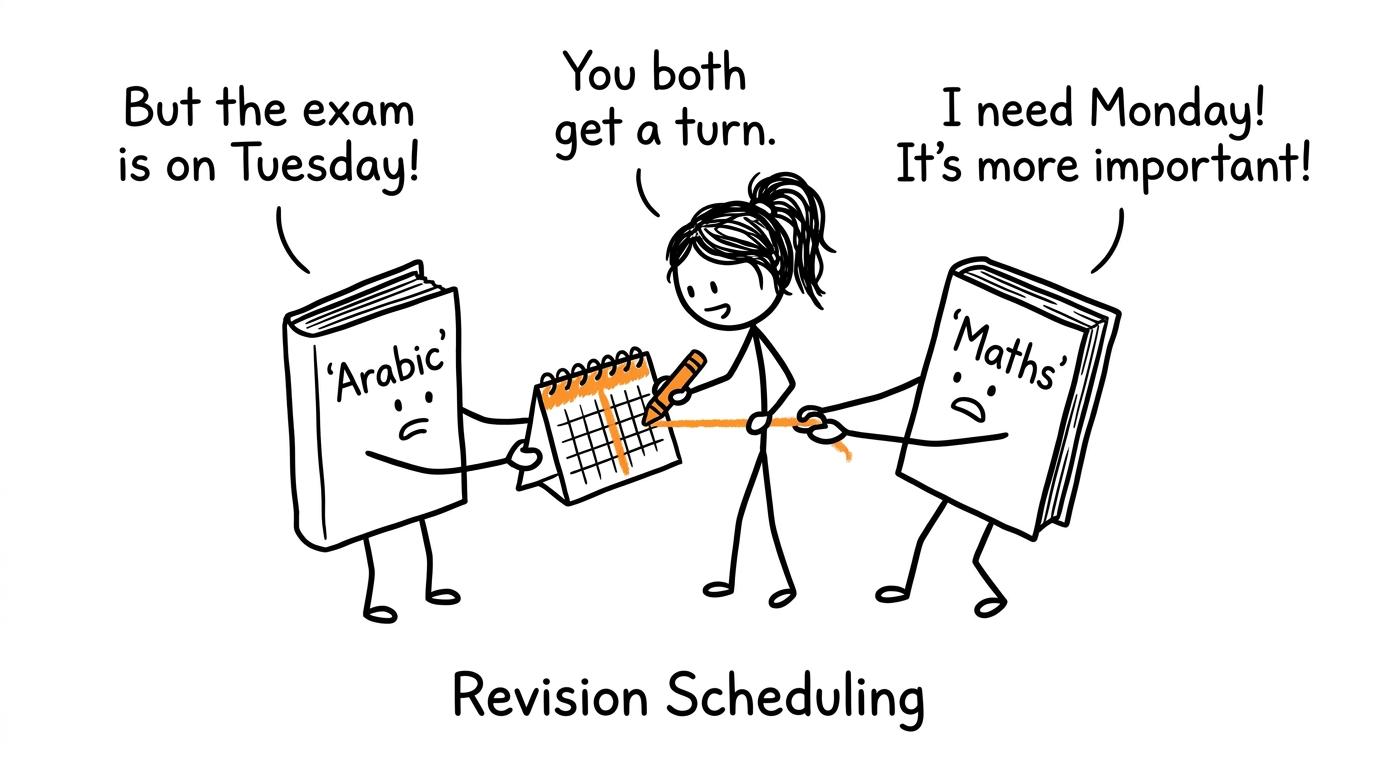 Arabic and maths books negotiate for space on a student's calendar
Balance GCSE Arabic with maths revision
The original bad week may have happened because every subject was competing for the same evening. The answer is not to let Arabic consume the following week and create a new crisis in maths.
Give each subject a defined block. For example, an Arabic retrieval task can sit before dinner, while maths gets a separate question-based session later or on another day. Avoid switching repeatedly between vocabulary, algebra and messages on your phone. Each switch adds friction.
For maths, choose one specific topic and use a simple sequence:
- open a revision lesson;
- complete practice questions;
- check the mark scheme or video solution;
- record the exact cause of each lost mark;
- retest the topic later.
The GCSE maths revision timetable guide can help you organise Foundation or Higher tier work without overloading the week. Once topic knowledge is steadier, use the advice in how to use GCSE past papers properly to build timing and exam technique.
Protect the conditions that make revision possible
A bad week is sometimes a planning problem. Sometimes it is exhaustion, illness, family pressure or anxiety. A timetable cannot solve every cause.
The NHS advises making revision manageable, taking regular breaks and seeking support when exam stress becomes difficult to handle. It also notes that most teenagers need around 888 to 101010 hours of sleep and that sleep supports thinking and concentration. An all-night catch-up session is therefore unlikely to be a sensible reset.
Tell a parent, carer, teacher or another trusted adult if you are struggling. Ask your Arabic teacher which task matters most. Ask your maths teacher which weakness should come first. Clear priorities reduce the burden of deciding alone.
If anxiety or low mood is severe, persists or interferes with everyday life, speak to a trusted adult and seek appropriate professional support. Revision advice is not a replacement for healthcare.
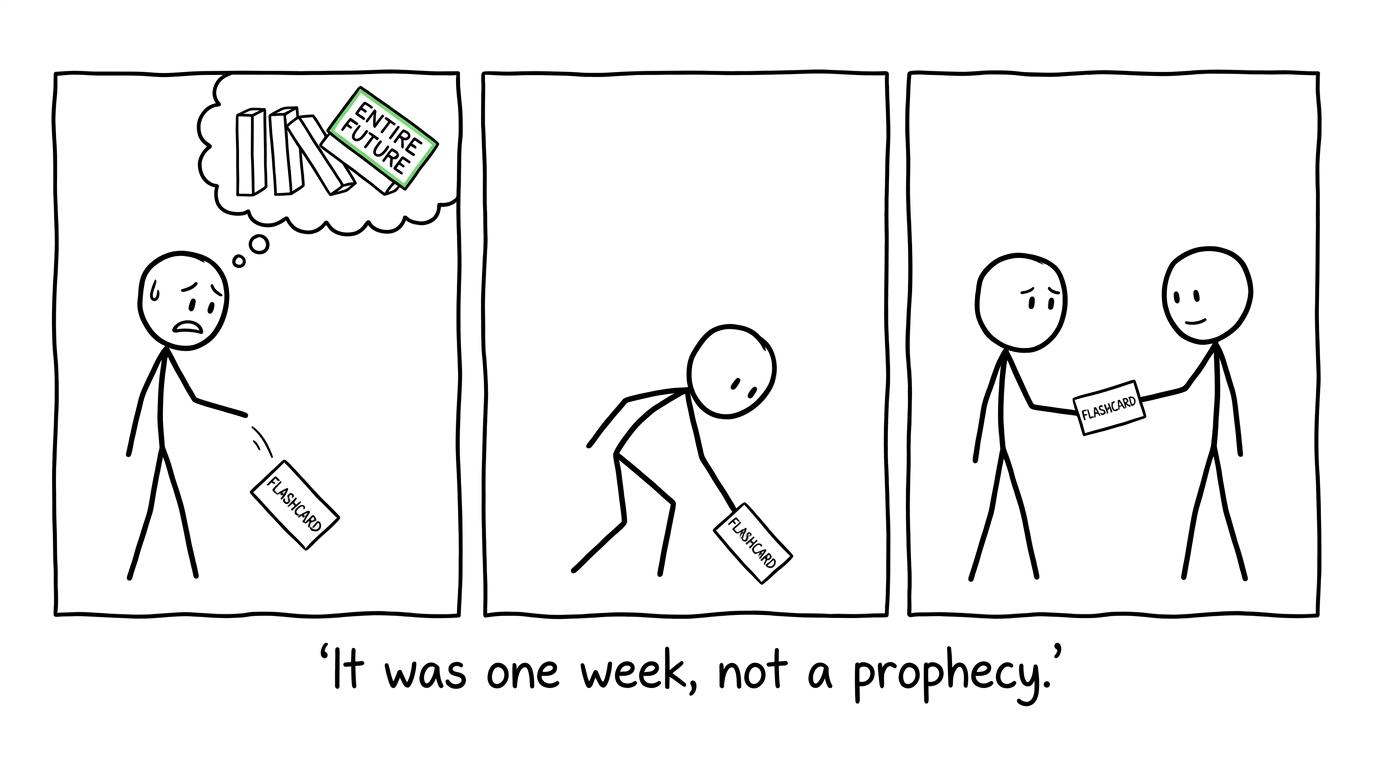 One dropped flashcard is calmly rescued before it becomes an imaginary disaster
Common mistakes when restarting GCSE revision
Trying to repay every missed hour
Revision is not a debt ledger. Compressing a week's abandoned work into one weekend often produces tired, low-quality practice. Prioritise what matters now.
Building a timetable with no spare space
Unexpected homework, appointments and difficult days happen. Keep at least one catch-up block open so one disruption does not destroy the whole plan.
Revising only vocabulary
Vocabulary matters, but GCSE Arabic also assesses listening, speaking, reading and writing. Words need to be understood and used in context.
Avoiding the weakest skill
It is tempting to organise flashcards when speaking feels uncomfortable. Start small, but make sure the difficult skill appears in the plan.
Counting time instead of checking learning
A completed hour tells you that time passed. It does not show what improved. End sessions with evidence: corrected errors, a recording, a marked response or successful retrieval.
Letting Arabic displace every other subject
A rescue plan should not create another bad week elsewhere. Maintain focused maths practice, particularly if a mock or paper is approaching. Near the exam period, MathsGenie's Edexcel GCSE maths predicted papers can provide fresh timed practice, but they should complement rather than replace real past papers.
A bad week is information, not identity
One failed plan can reveal something useful: perhaps your sessions were too long, your tasks were vague, or you left speaking until you were already tired. Use that information to design a smaller and more durable routine.
Begin today with one 202020-minute GCSE Arabic task. Check it. Write down tomorrow's action. Then protect a separate block for maths rather than allowing guilt in one subject to consume the rest of your timetable.
For your maths reset, make MathsGenie's free GCSE revision resources your starting point. Use revision lessons to rebuild weak methods, practise with topic questions and mini tests, then progress to past papers and predicted papers. Mark your work with the available mark schemes and use video solutions to understand exactly where your method changed course.
You do not need to recover the old week. You need to make the next useful decision.