Remote Learning GCSE Economics Results: The Data
Remote learning GCSE Economics results reveal higher pandemic-era grades, learning disruption and a return to normal assessment. See what the data means.
A results chart can look certain while hiding an uncertain story. GCSE Economics grades rose sharply during the pandemic, even though many students had less classroom teaching, uneven access to remote lessons and fewer chances to practise under exam conditions.
So what do remote learning GCSE Economics results actually tell us? The careful answer is that school closures probably reduced learning overall and affected disadvantaged pupils most severely. Yet GCSE grades increased in 2020 and remained unusually high in 2021 because normal examinations were cancelled and alternative grading arrangements were used. Those grades cannot be treated as direct evidence that economic understanding improved.
Since then, written examinations have returned, grading has moved back to pre-pandemic standards, and Economics outcomes have settled much closer to their earlier pattern. For today’s GCSE students, the useful lesson is not to compare yourself with an exceptional cohort. It is to rebuild the quantitative and exam skills that current papers reward.
The evidence at a glance
Here is the short version:
- Schools in England closed to most pupils from March 2020, with another major period of remote education in early 2021.
- Government and Ofqual research found widespread learning loss, although its size varied between pupils, schools and subjects.
- Disadvantaged pupils were generally affected more because access to technology, quiet space, teaching time and support was unequal.
- Normal summer GCSE examinations did not take place in 2020 or 2021.
- Results rose under centre-assessed and teacher-assessed grading, so grades were not a clean measure of learning during those years.
- Examinations returned in 2022 with more generous transitional grading.
- Pre-pandemic grading standards returned in 2023, with protection for that disrupted cohort.
- Normal grading continued in 2024 and 2025.
- The latest Economics results are broadly consistent with the post-transition pattern rather than the exceptional pandemic years.
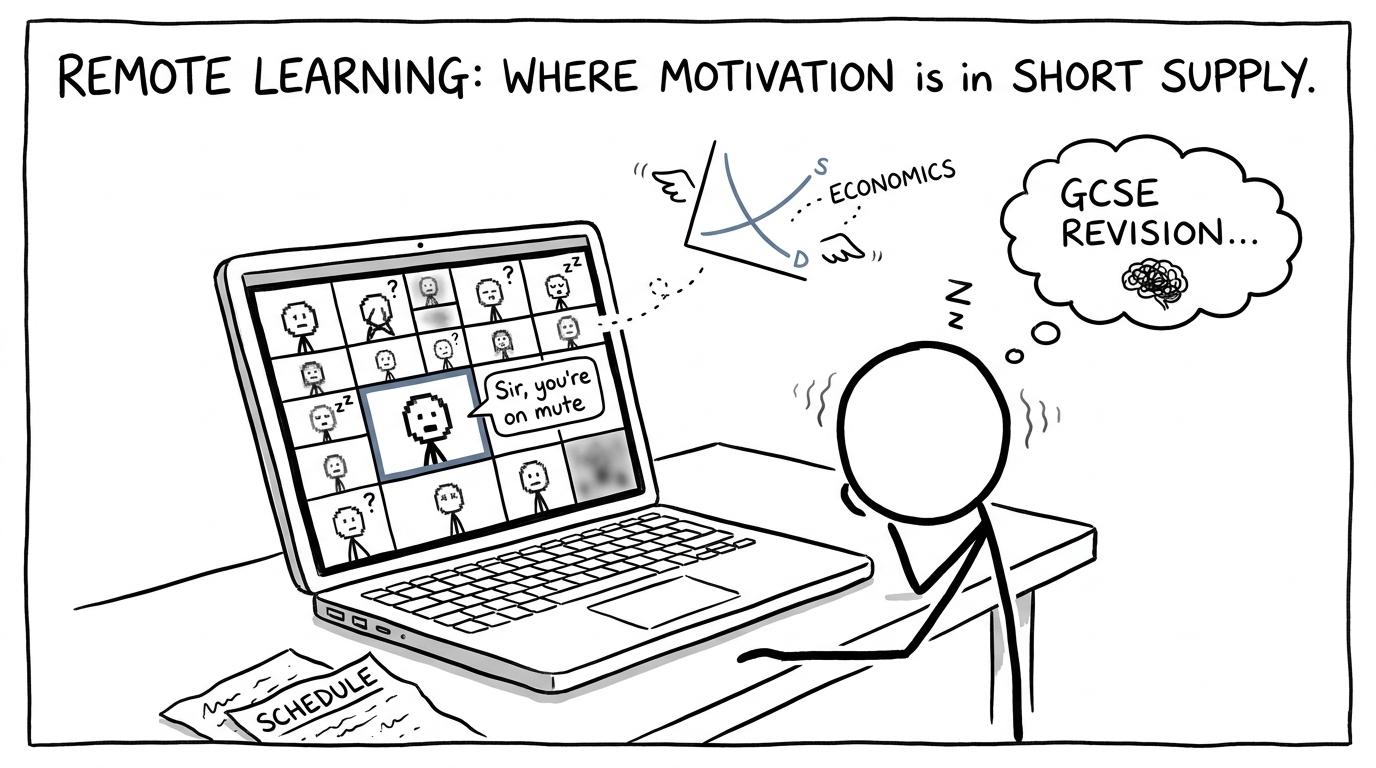 A remote Economics lesson where the graph escapes from the laptop
What happened to GCSE Economics results?
Official results tables reveal two different stories: one about grades awarded and another about what students had an opportunity to learn.
For GCSE Economics in England, official 2020 tables recorded approximately 46.8%46.8\%46.8% of entries at grade 777 or above and 92.6%92.6\%92.6% at grade 444 or above. The corresponding 2019 figures were approximately 31.8%31.8\%31.8% and 81.6%81.6\%81.6%.
That is an increase of:
46.8%−31.8%=15.0 percentage points46.8\%-31.8\%=15.0\text{ percentage points}46.8%−31.8%=15.0 percentage pointsat grade 777 or above, and:
92.6%−81.6%=11.0 percentage points92.6\%-81.6\%=11.0\text{ percentage points}92.6%−81.6%=11.0 percentage pointsat grade 444 or above.
These are large changes, but they do not prove that remote learning improved performance. Summer examinations were cancelled in 2020, and grades were determined through an exceptional assessment process. Teacher-assessed grades replaced examinations in 2021 as well.
Later JCQ data illustrate what happened as the system moved back towards normal assessment:
| Exam year | Assessment context | Grade 777 or above | Grade 444 or above |
|---|---|---|---|
| 2022 | Examinations with transitional grading | About 43.5%43.5\%43.5% | About 87.0%87.0\%87.0% |
| 2023 | Return to pre-pandemic standards with grading protection | About 32.3%32.3\%32.3% | About 80.3%80.3\%80.3% |
| 2024 | Normal grading arrangements | About 32.0%32.0\%32.0% | About 80.7%80.7\%80.7% |
| 2025 | Normal grading arrangements | About 33.1%33.1\%33.1% | About 82.2%82.2\%82.2% |
These figures are UK subject outcomes and should be read alongside changes in entries and cohort composition. They show a clear reduction from the transition year to 2023, followed by relative stability and a modest rise in 2025. They do not isolate the effect of remote education.
That distinction matters. A result is produced by learning, assessment design, grading policy, cohort characteristics and entry patterns. When several of those change together, one percentage cannot identify a single cause.
Why higher grades did not mean more learning
During ordinary examination years, GCSE results reflect performance in externally marked papers. The grade boundaries may change because paper difficulty changes, but the assessment framework remains broadly comparable.
The pandemic broke that chain of comparison. Students in 2020 and 2021 did not sit the usual summer papers. Schools and teachers had to judge attainment using the evidence available under extraordinary conditions. Ofqual subsequently designed 2022 as a transition year, with outcomes intended to sit between 2019 and 2021. The return to pre-pandemic grading was completed in 2023.
This is why the pandemic-era rise should not be described simply as an improvement. Research reviews commissioned or published by government found that most pupils experienced some loss of learning, with maths and literacy frequently identified as areas of concern. The evidence also indicated that pupils from disadvantaged backgrounds were disproportionately affected.
Economics-specific national data cannot tell us exactly how many months of learning were lost in this one subject. GCSE Economics has a much smaller and more selective entry than compulsory subjects such as maths and English. Differences between cohorts can therefore have a noticeable effect on percentages.
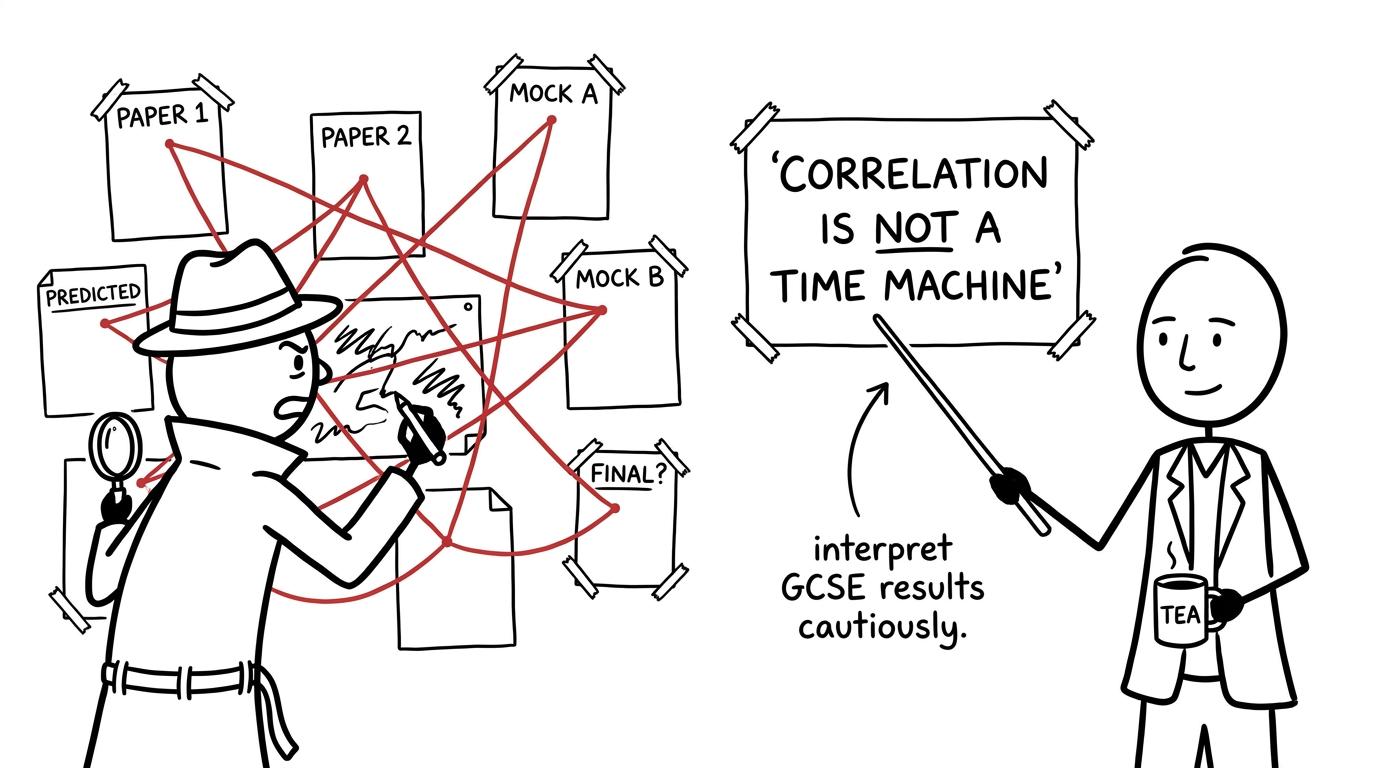 A student detective learns that correlation is not a time machine
How school closures could affect Economics performance
Economics depends on more than remembering definitions. Students must apply ideas to unfamiliar contexts, interpret evidence, analyse chains of reasoning and make supported judgements. Those skills develop through questioning, feedback and repeated exposure to exam-style material.
Remote education could interrupt that process in several ways.
Less immediate feedback
In a classroom, a teacher can spot when a student has confused a movement along a demand curve with a shift of the curve. Online, that misunderstanding may survive for longer, particularly if cameras are off or work is submitted less frequently.
Unequal access to learning
Remote learning was not one shared experience. Some pupils had live lessons, reliable internet and a quiet workspace. Others shared devices, worked from phones or had caring responsibilities. National research consistently warns that this variation contributed to unequal learning losses.
Weaker examination routines
Knowing Economics and producing a high-mark answer are related but different skills. Students need practice with command words, extracts, data response and time management. Cancelled mocks, interrupted teaching and reduced supervised writing could make those routines less secure.
Gaps in quantitative confidence
GCSE Economics specifications require quantitative skills in an economic context. Under Ofqual’s subject requirements, at least 10%10\%10% of the total marks must reward quantitative skills at no lower than Key Stage 3 demand. These include:
- percentages and percentage change;
- averages;
- revenue, cost and profit totals;
- gross and net income;
- constructing graphs from data;
- interpreting charts and economic indicators.
For AQA and OCR GCSE Economics, these skills are built into the assessment rather than tested as a separate maths paper. Other qualifications, including International GCSE routes, may have different structures, so always check your own specification.
Students who want to strengthen the crossover can use MathsGenie’s percentage change revision guide, averages from frequency tables resources and broader GCSE Statistics revision hub.
What has changed since remote learning?
The assessment system is now much closer to its pre-pandemic form. Summer examinations returned in 2022, exceptional grading was unwound over two years, and normal grading arrangements operated in 2024 and 2025. Ofqual has advised schools not to use exceptional 2020, 2021 or 2022 boundaries as straightforward guides to the standard required in a normal examination year.
For current students, this has three consequences.
First, recent papers and mark schemes are more useful indicators of present expectations than pandemic-era grade distributions. Secondly, full specification coverage matters again. Finally, performance must be demonstrated under timed examination conditions rather than inferred from classroom evidence.
The legacy has not disappeared entirely. A student may still have a fragile skill that began during disrupted schooling: interpreting scales, calculating percentage change or explaining what a graph shows. But this is now an individual revision problem, not a national grading arrangement.
The best response is diagnostic. Use the GCSE Maths revision hub to select Edexcel, AQA, OCR or Eduqas resources, then identify the precise skills costing you marks. MathsGenie’s guide to finding your weakest GCSE topics provides a practical process for turning mistakes into a focused revision list.
How maths revision supports GCSE Economics
Data is the bridge between Economics and maths. An Economics response becomes stronger when you can distinguish a percentage change from a percentage-point change, read axes accurately and test whether a claim is supported by the evidence.
Keep these relationships secure:
Percentage change=new value−original valueoriginal value×100\text{Percentage change}=\frac{\text{new value}-\text{original value}}{\text{original value}}\times100Percentage change=original valuenew value−original value×100 Profit=total revenue−total cost\text{Profit}=\text{total revenue}-\text{total cost}Profit=total revenue−total cost Mean=total of the valuesnumber of values\text{Mean}=\frac{\text{total of the values}}{\text{number of values}}Mean=number of valuestotal of the valuesThese are not optional extras. They help you interpret inflation, unemployment, trade, income, business costs and market data accurately.
A sensible revision sequence is:
- review one weak method using a short revision lesson;
- answer focused practice questions without notes;
- mark the work immediately;
- record whether the problem was knowledge, calculation or interpretation;
- retest the skill with a different question;
- add timed mixed practice once the method is secure.
You can organise this through a GCSE maths revision timetable, then use MathsGenie’s revision resources for mini tests, self-assessment and mixed practice.
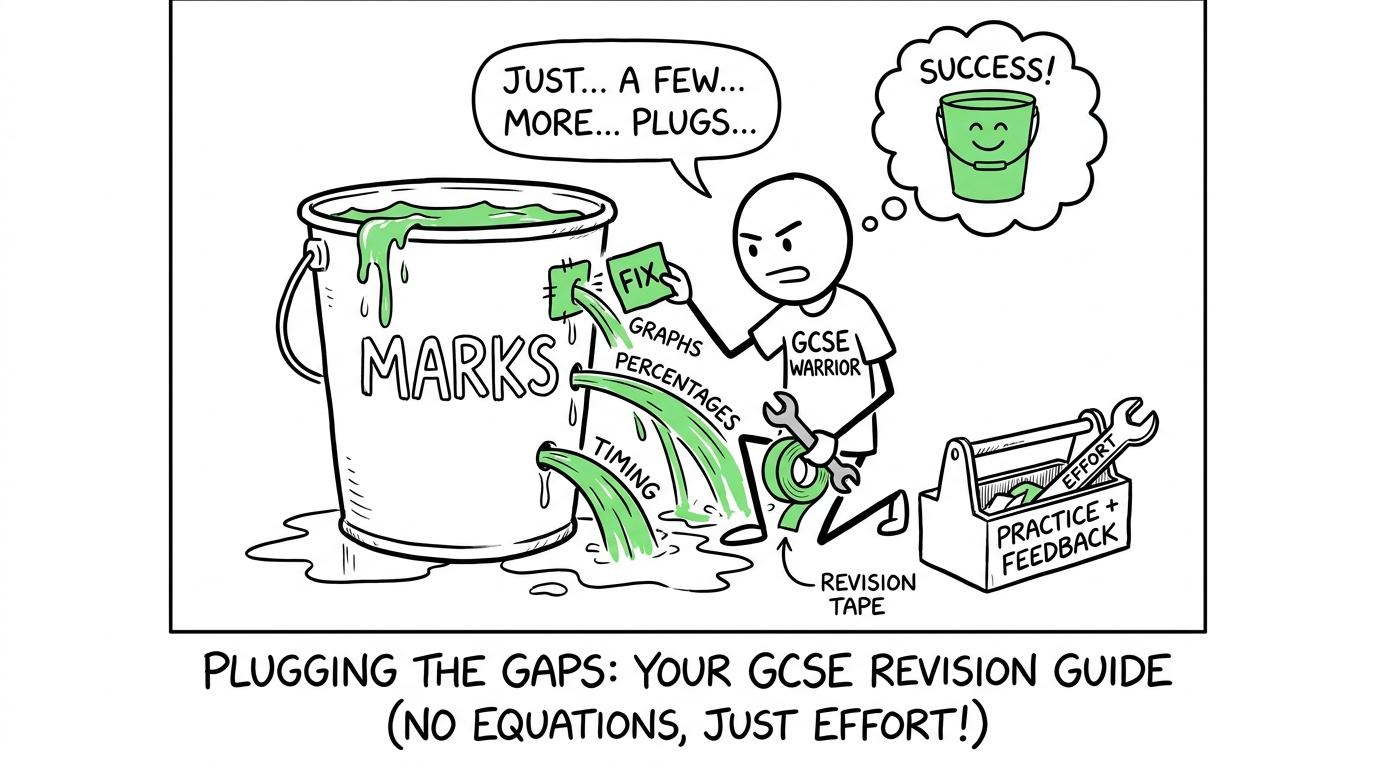 A student repairs the small leaks that are costing marks
Common mistakes when interpreting the results
Treating grades as a direct measure of learning
A higher national grade distribution does not automatically mean a cohort knew more. The assessment and grading arrangements changed substantially in 2020, 2021 and 2022.
Saying an increase is a percentage increase
If the share at grade 777 or above moves from 31.8%31.8\%31.8% to 46.8%46.8\%46.8%, the direct difference is 15.015.015.0 percentage points. That is not the same as saying it rose by 15%15\%15%.
Assuming correlation proves causation
Remote learning happened before unusual results, but other factors changed simultaneously: examinations were cancelled, grading methods changed and entry cohorts differed. The grade data alone cannot establish cause.
Generalising from all GCSEs to Economics
Whole-cohort research provides important context, but Economics has its own entry profile and assessment demands. Evidence about overall GCSE attainment should not be presented as an exact subject-specific effect.
Revising from grade boundaries alone
Boundaries tell you how raw marks were converted into grades for a particular paper and year. They do not teach the underlying skills. Use current revision lessons, practice questions and mark schemes instead.
The result that matters now
The pandemic data tell a cautious story. School closures disrupted learning and widened existing inequalities, but unusually high GCSE grades in 2020 and 2021 largely reflected exceptional assessment arrangements rather than a measurable improvement caused by remote education. As examinations and normal grading returned, GCSE Economics outcomes moved back towards their earlier range.
Your own result is not fixed by that history. It will be shaped by what you can do on the paper in front of you: calculate accurately, interpret data, explain economic relationships and use evidence to reach a judgement.
Start with MathsGenie’s free GCSE Maths revision resources. Use revision lessons and practice questions to repair quantitative gaps, mini tests to check recall, and past papers to build timing. Nearer the exams, add Edexcel GCSE Maths predicted papers, then learn from every mark scheme and video solution.
National results explain the past. Deliberate practice changes what happens next.