Regret Picking GCSE Statistics? What to Check
Regret picking GCSE Statistics? Understand the workload, exam demands and common surprises, then use this clear checklist before committing to it.
Choosing a GCSE option can feel strangely permanent. A subject may receive twenty minutes at an options evening, then occupy lessons, homework and revision time for the next two years. Statistics can look like the safe choice: familiar graphs, averages and probability, with no essays to write.
That first impression is incomplete. Students who regret picking GCSE Statistics often underestimated its breadth, the amount of precise written interpretation involved, or the pressure of revising it alongside GCSE Maths. It is not automatically a bad option. But it is a separate, exam-assessed qualification, and you should inspect the course rather than choose it because it sounds like “more of the easy part of maths”.
This guide explains the common sources of regret and what to check before committing.
The quick GCSE Statistics checklist
Before selecting the option, ask:
- Which exam board and specification does your school teach?
- Will you take Foundation or Higher tier, and when is that decision made?
- How many lessons and homework tasks will you have each week?
- Do you enjoy interpreting data as well as calculating answers?
- Can you explain limitations, bias and conclusions in full sentences?
- What support is available if you fall behind?
- Which other options will compete for your revision time?
- Can you look through a real paper before deciding?
The GCSE Statistics revision hub is a useful starting point. Choose the relevant board and inspect the topics, worksheets and papers. A qualification becomes less mysterious once you have seen what its questions actually demand.
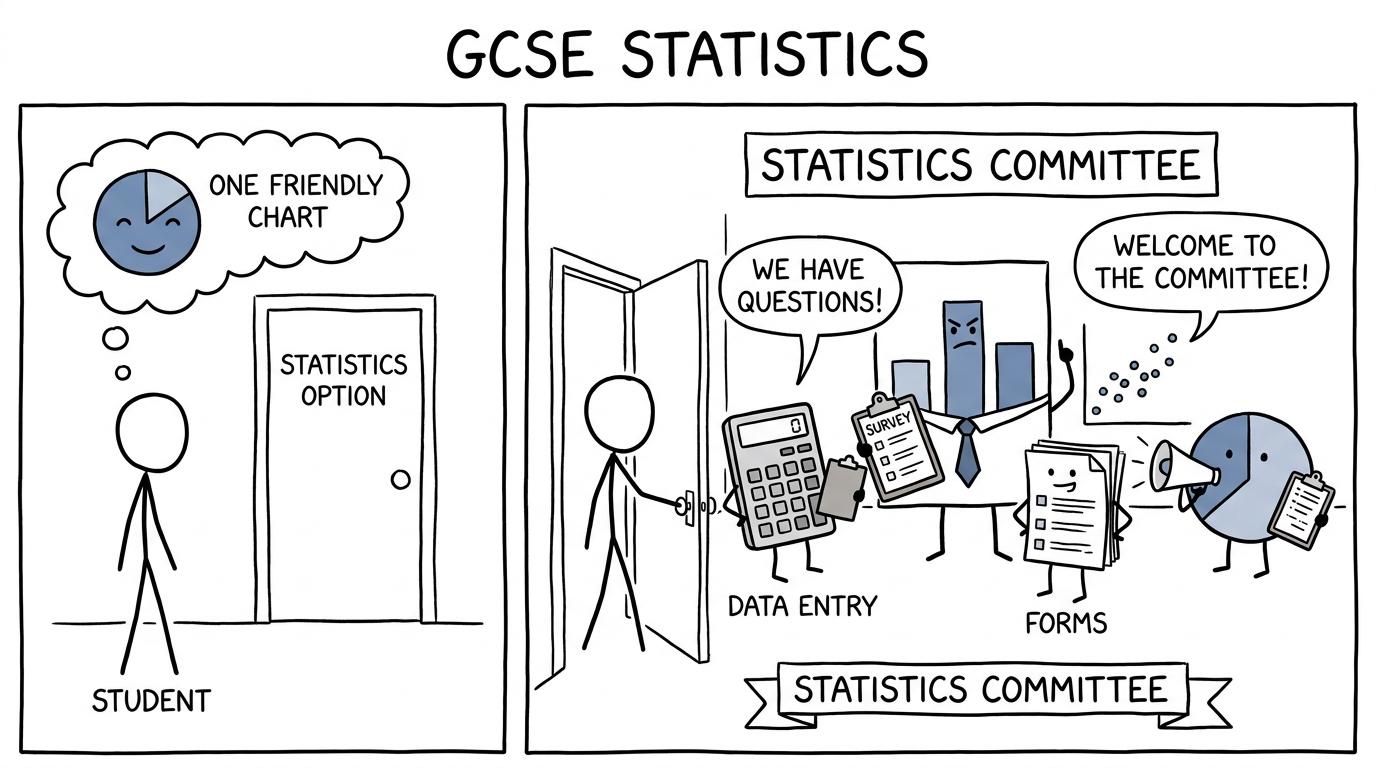 A student discovers that the Statistics option contains rather more than one friendly pie chart
Why students may regret picking GCSE Statistics
There is rarely one dramatic reason. Regret usually grows from a collection of smaller surprises: more content than expected, unfamiliar terminology, another set of examinations and too little practice until late in the course.
They expected an easier version of GCSE Maths
GCSE Statistics overlaps with the statistics and probability found in GCSE Maths, but the dedicated qualification goes further. Official subject content covers the statistical enquiry cycle: planning an investigation, collecting data, processing and presenting it, analysing results, drawing conclusions and evaluating the method.
Depending on the tier and specification, students may meet sampling methods, questionnaires, misleading data presentation, averages and measures of spread, time series, index numbers, correlation, probability and more advanced statistical measures.
Familiar topics can also become more demanding. Knowing that the mean is
mean=total of the valuesnumber of values\text{mean}=\frac{\text{total of the values}}{\text{number of values}}mean=number of valuestotal of the valuesis only the beginning. You may need to decide whether the mean is appropriate, compare it with another measure, identify the effect of an outlier and interpret the result in context. If your foundations need attention, the averages revision guide helps you review the core ideas before judging the wider course.
They liked calculations but not interpretation
Some students enjoy questions with a clear numerical destination. Statistics often asks a different question: what does the result mean?
A calculation can be correct while the conclusion is too strong. A sample may be biased. A graph may create a misleading visual impression. Correlation does not establish causation. An estimate from grouped data should not be presented as exact.
This is where students who describe themselves as “good at maths” can be surprised. Statistical reasoning requires careful reading and precise language. You must connect evidence to context rather than write a memorised sentence about a graph.
They underestimated the size of the course
Graphs and averages are visible parts of statistics, but they are not the whole landscape. Consider the difference between recognising a histogram and understanding why its bar area represents frequency. The relationship is
frequency density=frequencyclass width.\text{frequency density}=\frac{\text{frequency}}{\text{class width}}.frequency density=class widthfrequency.That distinction matters when class intervals have unequal widths. The histograms revision resources show the level of detail involved in just one topic.
The same pattern appears elsewhere. Cumulative frequency involves running totals, graph construction, quartile estimates and comparisons. Box plots compress a distribution into a small diagram, but good answers must interpret centre and spread. Explore the cumulative frequency guide and box plots guide before assuming the course contains only simple charts.
They treated overlap as a reason not to revise
Overlap with GCSE Maths can help. Averages, probability, scatter graphs and data displays will not all be new. But familiarity can create false confidence.
A student may recognise a topic in class and therefore skip independent practice. Later, an examination question combines the calculation with evaluation, sampling or contextual interpretation. Recognition is not the same as recall, and recall is not the same as being able to answer under time pressure.
Overlap should reduce the cost of learning the basics. It should not remove the need to practise the dedicated specification.
Another GCSE created more pressure than expected
GCSE Statistics is a full qualification, not a revision club for GCSE Maths. Current GCSE Statistics qualifications are tiered and assessed by examination. Precise arrangements depend on the board, so check your school’s specification rather than assuming its papers resemble your GCSE Maths papers.
For example, Pearson Edexcel’s current specification uses two equally weighted written papers, each lasting 111 hour 303030 minutes and carrying 808080 marks. Calculators are permitted on both. Other board arrangements must be checked separately.
The important question is not simply, “Can I do statistics?” It is, “Can I give this subject enough time while also revising English, science, maths and my other options?”
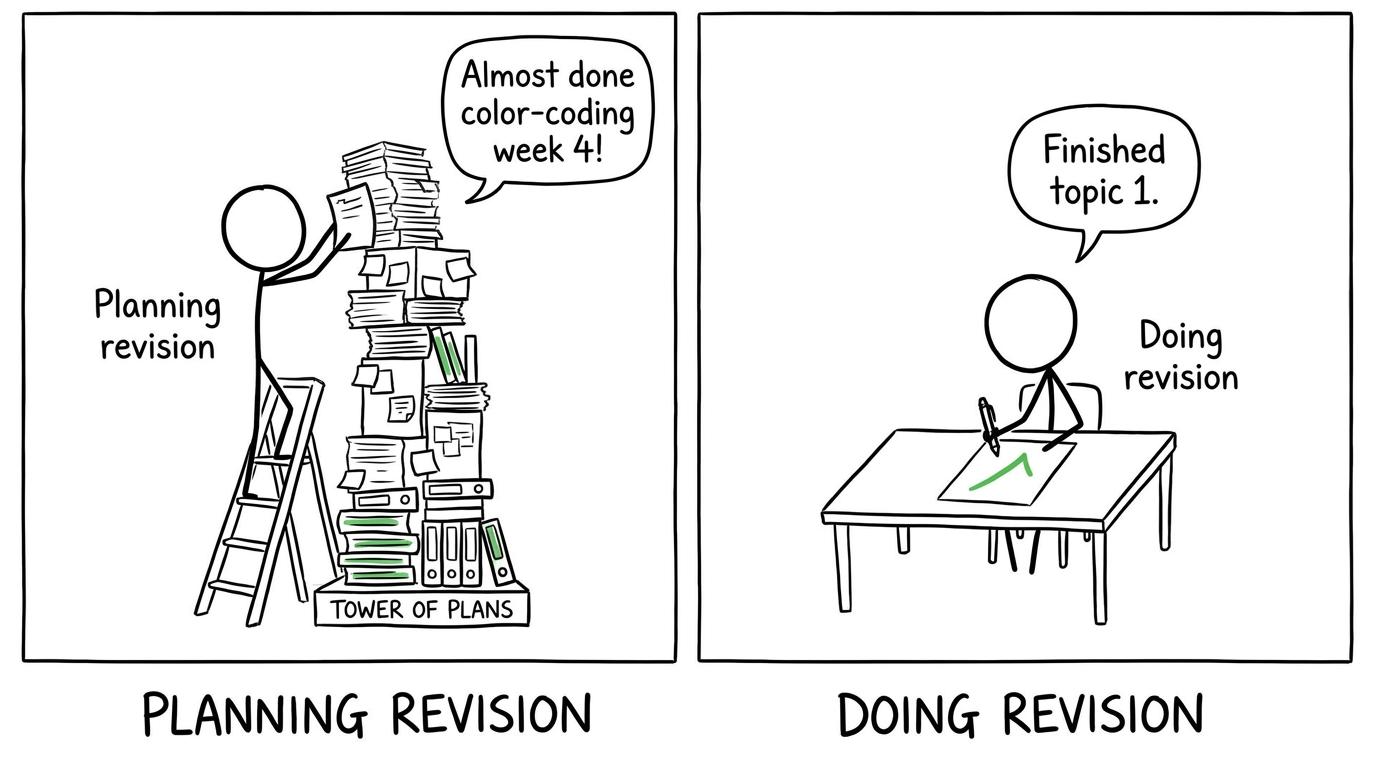 One student plans revision while another quietly gets on with it
They chose it for the wrong reason
A friend choosing the subject does not make its content suitable for you. Nor does a preferred teacher guarantee that the staffing will remain unchanged. “It sounds easy” is particularly unreliable because option names reveal little about assessment demand.
A stronger reason might be that you enjoy analysing evidence, asking whether claims are justified and explaining patterns in data. Statistics may also complement interests involving research, experiments, economics, geography, psychology, biology, business or later mathematical study. That does not make it compulsory for those routes, but it may make the course more meaningful.
Choose the work, not the label.
What GCSE Statistics actually rewards
Success is built from several connected habits:
- Accurate methods: selecting and applying appropriate calculations.
- Data literacy: understanding tables, diagrams, distributions and summaries.
- Contextual interpretation: explaining what an answer means for the situation given.
- Evaluation: recognising bias, limitations and inappropriate conclusions.
- Communication: using correct terminology and showing enough working.
- Exam judgement: knowing when an answer is exact, estimated or uncertain.
This mix explains why the subject can feel rewarding. It also explains why passive revision is weak. Reading notes may make a method look familiar, but only questions reveal whether you can choose and communicate it independently.
What to check before you commit
Inspect your board and tier
Do not rely on a generic list from social media. Ask your teacher for the exact exam board, specification code and likely teaching sequence. Dedicated GCSE Statistics is available through particular awarding organisations; OCR and Eduqas references you see online may instead relate to the statistics content within GCSE Maths. Your school can confirm the qualification it is offering.
If your school uses Pearson Edexcel, browse the Edexcel GCSE Statistics revision area. Look at both the topic resources and complete papers. Foundation and Higher tier have different available grade ranges and levels of demand, so ask how entry decisions are made.
Look beyond the first page of a paper
Opening questions can create a misleading sense of the whole course. Scan a complete paper and notice how often you must justify, compare, interpret or evaluate. Check whether you understand the command words even when you cannot yet complete the mathematics.
Do not use your raw mark on an unseen paper to predict a future grade. You have not been taught the course. The purpose is to understand its shape.
Audit your available time honestly
Write down your option subjects and identify which ones involve substantial coursework-like preparation, practical work, memorisation or extended writing, even where the final qualification is examined. Then consider your commitments outside school.
A realistic plan has space for short, repeated practice. A hopeful plan assumes that your future self will discover several spare evenings in April.
MathsGenie’s guide to finding your weakest GCSE topics offers a useful diagnostic principle: mark work carefully, record why marks were lost, practise the smallest weak skill and re-test it.
Ask what support really exists
Useful questions for your school include:
- Is the course taught throughout Years 101010 and 111111, or compressed?
- How frequently are lessons scheduled?
- Are there topic tests and mock examinations?
- Which revision materials will be provided?
- What happens if the option clashes with another subject?
- Can you speak to current students about the workload without treating one opinion as universal?
The answer is not automatically “do not choose it” if teaching time is limited. It simply changes the amount of independent work you should expect.
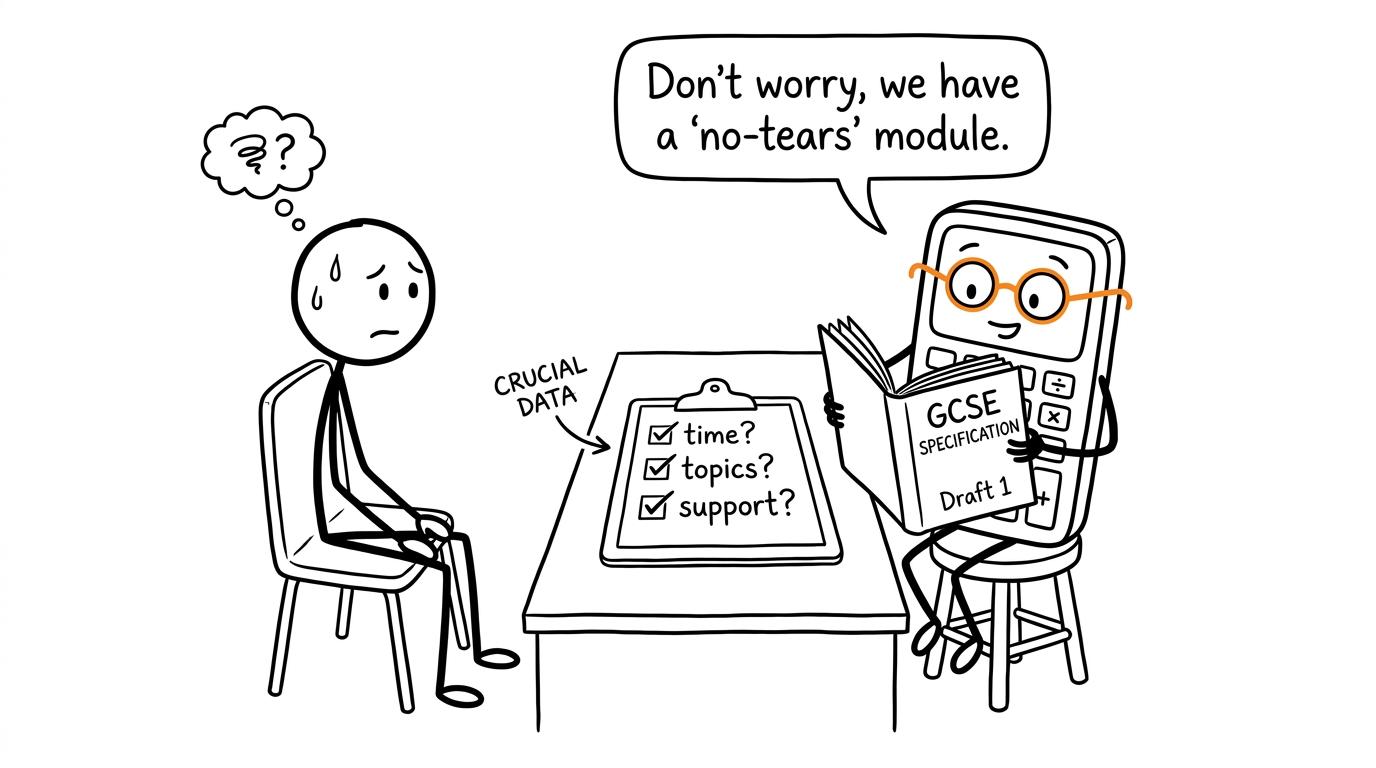 A student interviews the Statistics option before making a commitment
If you have already chosen it and feel regret
Regret can be useful information, but it is not always a verdict. First identify what you actually dislike.
If the problem is one topic, target that topic. If it is timing, begin with short sections rather than full papers. If interpretation costs marks, compare your answers closely with the mark scheme and note the missing contextual detail. If the overall workload is unmanageable, speak to your teacher or options lead early; only your school can explain whether changing courses is possible.
Use the GCSE Statistics revision hub to separate the course into manageable skills. Revision lessons and worksheets can rebuild knowledge, while practice questions reveal whether it transfers to unfamiliar contexts. Later, papers and mark schemes develop timing and judgement.
Common mistakes when judging or revising the option
- Assuming it is easy because topics look familiar. Check the depth of interpretation and evaluation.
- Choosing solely because friends are taking it. Their strengths, workload and plans may differ from yours.
- Ignoring the specification. Your board and tier determine what can be assessed.
- Memorising phrases without using context. Conclusions must respond to the actual data and question.
- Confusing correlation with causation. An association alone does not prove that one variable causes another.
- Treating grouped-data estimates as exact values. State or recognise when midpoint assumptions and graph readings produce estimates.
- Comparing distributions with only one statistic. Strong comparisons usually address an appropriate measure of centre and an appropriate measure of spread.
- Saving papers until the final week. Begin with selected sections, then build towards complete timed attempts. The guide to when to start GCSE past papers explains how to phase that practice.
Make the decision with evidence, not nerves
GCSE Statistics suits students who are curious about data and willing to explain what evidence can, and cannot, support. It can be a poor fit when chosen as an assumed easy grade, when the workload has not been checked, or when a student strongly dislikes interpretation and evaluation.
Before committing, confirm the board, inspect the specification, read a whole paper and ask how the course fits your timetable. If you have already chosen it, turn vague regret into a precise list of weak topics and revision problems. Precise problems are easier to solve.
Start with MathsGenie’s free GCSE Statistics resources. Use revision lessons to understand each idea, practice questions and mini tests to expose gaps, then past papers and mark schemes to strengthen exam technique. Nearer the examination, use GCSE predicted papers selectively alongside video solutions and your revision planner. The aim is not to pretend the course is effortless. It is to make the next step clear enough to take.