Regret Picking GCSE English Language? Read This
Regret picking GCSE English Language? Learn why it can feel harder than expected, what is compulsory, and what to check before choosing at school.
There is a particular kind of frustration that arrives when a subject is not what you expected. You thought English Language would mean learning how words work. Instead, you meet unseen extracts, precise assessment objectives, extended writing and a clock that seems unusually fast.
If you regret picking GCSE English Language, the first thing to know is that, in England, you probably did not pick it in the same way that you chose history, art or computer science. English is a core Key Stage 444 subject, alongside maths and science. Your school decides exactly which qualifications it enters you for, but GCSE English Language is normally part of the compulsory curriculum.
That does not make your frustration imaginary. It means the useful question is not simply, “Can I drop it?” but, “Why does it feel wrong for me, and what can I do before the course becomes harder?”
The short answer
Students can come to regret GCSE English Language because:
- the qualification is based heavily on unseen texts rather than memorised content
- writing quality matters under strict time pressure
- the mark scheme can initially feel subjective
- spelling, punctuation, grammar and sentence control remain important
- the spoken language endorsement can cause anxiety
- English Language and English Literature are easily confused
- the total workload may not have been clear when options were discussed
- some students expected a creative subject but encounter substantial analysis
Before committing to an options package, check:
- whether English Language is compulsory at your school
- whether English Literature is also required
- which exam board you will follow
- the number, length and content of your papers
- how much timed writing the course involves
- how the spoken language endorsement is organised
- what support is available if reading, writing or speaking creates a barrier
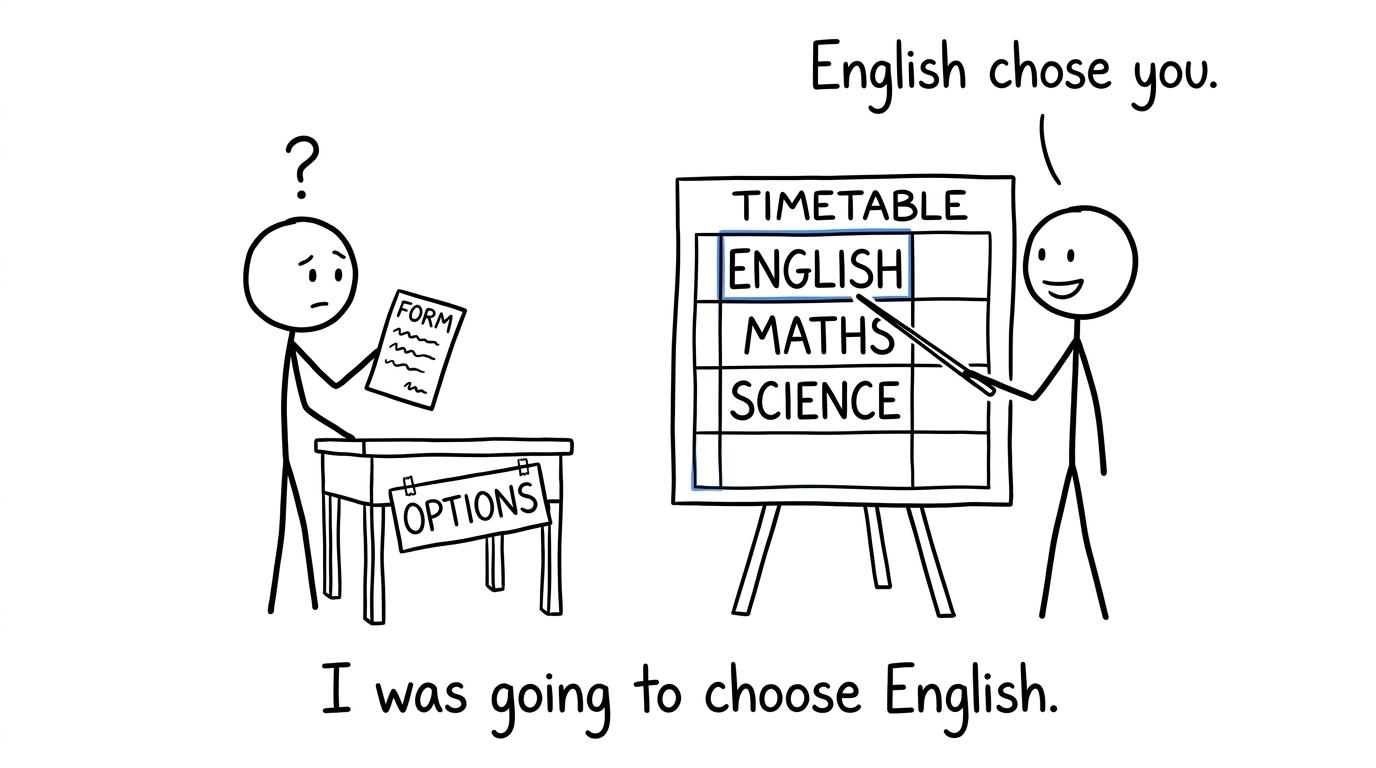 A student discovers that English was already on the timetable
Did you actually choose GCSE English Language?
This is the detail that many options conversations miss.
In England, English, maths and science are core subjects at Key Stage 444. Schools must teach English, although their qualification policies and the precise combination of English Language and English Literature can vary. Academies, independent schools and schools elsewhere in the UK may operate under different curriculum arrangements, so your own options booklet remains the decisive source.
English Language and English Literature are separate GCSEs. Language concentrates on reading unfamiliar material, analysing writers’ choices and producing writing for different audiences and purposes. Literature concentrates on studied plays, novels, poetry and other set texts.
Many schools teach both. However, you should not assume that every school follows the same policy. Ask your English teacher or options lead three direct questions:
- Am I required to take GCSE English Language?
- Am I also required to take GCSE English Literature?
- Which qualification and exam board will appear on my final timetable?
This may reveal that what felt like an optional choice was actually a description of your compulsory English route.
Why some students wish they had not chosen it
There is no authoritative national survey establishing one ranked list of reasons students regret the qualification. Still, the structure of GCSE English Language explains several predictable sources of disappointment.
The texts are unseen
GCSE English Language assesses reading through material that students have not studied before the examination. The extracts may come from the nineteenth, twentieth or twenty-first century and can include literary fiction, journalism, essays and other non-fiction.
That creates a different kind of security from English Literature. You cannot rely on knowing the plot or memorising quotations from a set text. You must transfer familiar reading skills to unfamiliar material.
For a student who likes certainty, this can feel uncomfortable. Yet unseen does not mean unpreparable. You can practise identifying information, making inferences, analysing language and structure, comparing viewpoints and evaluating a text. The passage changes; the underlying decisions do not.
The course is not simply creative writing
Some students imagine English Language as a long sequence of stories and descriptive tasks. Creative writing may feature, depending on the specification, but it is only part of the qualification.
The national subject content divides the written assessment equally between reading and writing, with each worth 50%50\%50%. Students must understand texts critically and produce clear, coherent writing suited to different purposes and audiences.
That can include narrative, descriptive, persuasive or transactional writing. A student who enjoys inventing characters may still dislike comparing viewpoints. Another who enjoys debate may find descriptive writing difficult. The qualification asks for range rather than one preferred style.
Marks can feel less predictable than in maths
In maths, a correct method often leads towards a clearly defined answer. English responses are more open, but that does not mean marks are awarded randomly.
Examiners use assessment objectives covering retrieval, inference, analysis, comparison, evaluation, communication and technical accuracy. Strong responses make a clear point, select precise evidence and explain how that evidence supports the interpretation.
The uncertainty usually shrinks when you stop asking, “Is my interpretation the correct one?” and start asking, “Have I justified this interpretation using the text?”
That is surprisingly close to mathematical reasoning. An unsupported claim is fragile in both subjects. Evidence is working.
Technical accuracy carries real weight
Across GCSE English Language specifications, accurate spelling, punctuation, grammar, vocabulary and sentence structure matter. The national requirements allocate 20%20\%20% of the qualification’s marks to the relevant technical-accuracy assessment objective.
Students sometimes regret the course because they expected ideas alone to carry their writing. Ideas matter, but the examiner must also be able to follow them. Paragraphing, sentence boundaries, vocabulary choices and proofreading all influence how effectively an answer communicates.
This is good news in one respect: technical accuracy is trainable. It is not a mysterious talent. Short editing drills and deliberate proofreading can make it more reliable.
The spoken endorsement feels intimidating
GCSE English Language includes a spoken language assessment. Students prepare a formal presentation, respond to questions and demonstrate appropriate spoken English.
The outcome is reported separately as Pass, Merit, Distinction or Not Classified. It does not contribute to the final numerical GCSE grade, but it remains a compulsory component of the course and is recorded separately.
Knowing that distinction matters. A nervous presentation does not directly reduce the mark on your written papers. If speaking in front of others creates significant anxiety or raises an access need, discuss it early with your teacher or the school’s special educational needs and disabilities team rather than waiting for the assessment date.
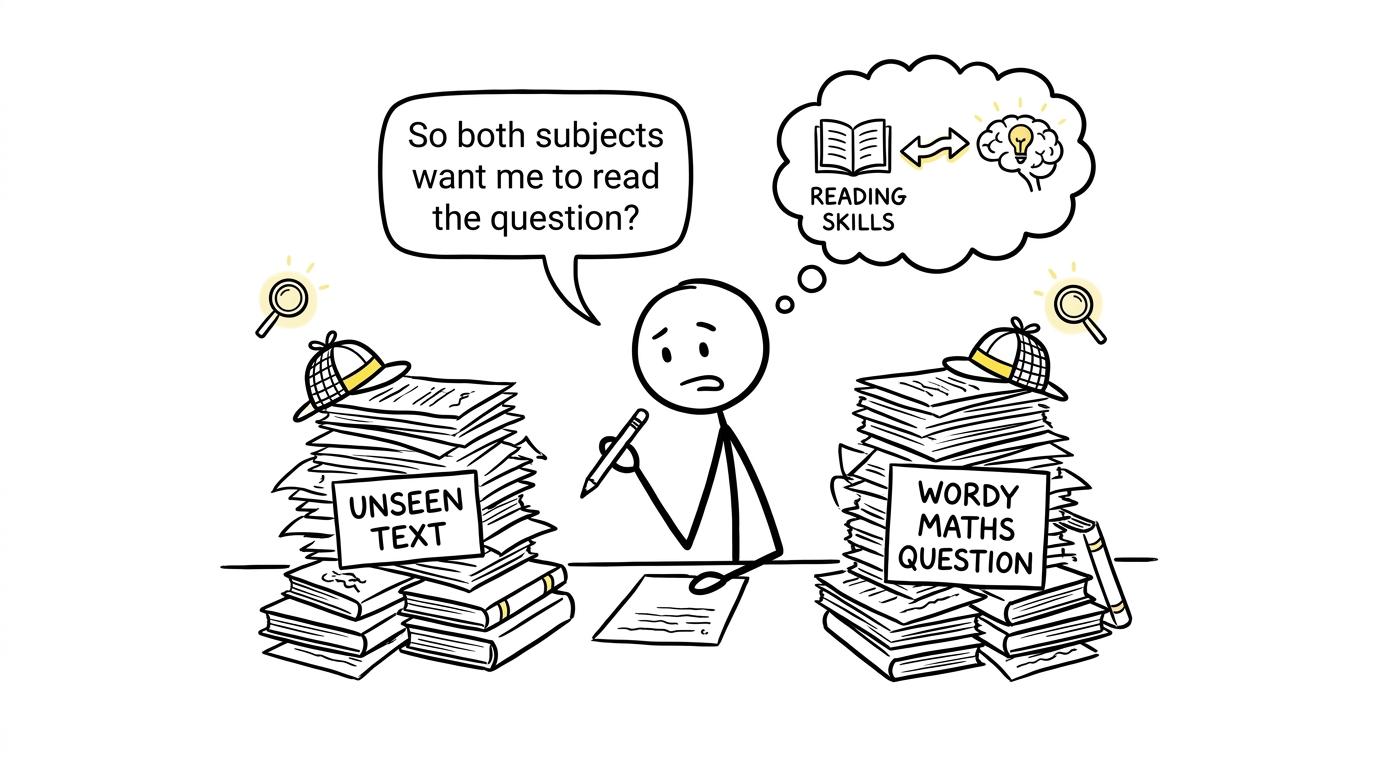 Unseen English texts and wordy maths questions compare detective hats
What to check before you commit
Read the actual specification summary
AQA, Pearson Edexcel, OCR and Eduqas all meet national requirements, but their papers are not arranged identically. The source combinations, question sequence, examination length and balance of tasks can differ.
Do not base your decision on a friend at another school. Ask for your board and specification code, then look at a specimen paper. You do not need to answer it. Simply notice how much reading and writing appears, how questions are worded and how long the papers last.
Ask what the weekly workload looks like
Find out whether Language and Literature are taught together, how often timed writing is set and when mock examinations usually occur. A subject may feel manageable by itself but demanding beside science assessments, coursework deadlines and maths papers.
A realistic timetable prevents this collision. MathsGenie’s GCSE maths revision timetable guide shows how to build short topic sessions around school commitments rather than pretending every evening is empty.
Separate dislike from difficulty
A difficult first paper does not prove that you chose badly. It may only show that the format is unfamiliar.
Before deciding that English Language is not for you, try one cycle:
- attempt one section under a sensible time limit
- mark or review it with your teacher
- identify one reading skill and one writing skill to improve
- practise those skills separately
- attempt another comparable section
This mirrors effective maths revision. The MathsGenie GCSE maths revision hub lets you move from lessons to practice questions and then to exam papers. English improves through the same broad rhythm: learn, practise, receive feedback and retest.
Check your post-161616 plans
English qualifications can matter when applying for sixth form, college, apprenticeships or employment, but entry requirements differ. Check the published requirements of the routes you are genuinely considering rather than relying on a general statement that “everywhere wants the same grade”.
In England, current post-161616 funding rules require many students who have not achieved grade 444 or above in English or an approved equivalent to continue studying an approved English qualification. A grade 444 or above in either GCSE English Language or English Literature can meet the English condition of funding, although individual courses and institutions may set their own entry requirements.
How English Language can support GCSE maths
English and maths look distant on a timetable but often meet inside the question paper.
A multi-step maths problem asks you to identify relevant information, ignore distractions, interpret command words and communicate a logical argument. English Language develops many of those habits.
The overlap is especially useful when you:
- distinguish between “show”, “explain”, “estimate” and “calculate”
- extract values from a long context
- justify a conclusion in probability or statistics
- explain why a result is reasonable
- structure a geometrical proof
- check whether your answer responds to the exact question
Reading is not an extra layer placed on top of maths. In many examination questions, reading is how you gain access to the maths.
Use the active recall guide for GCSE maths to turn instructions and methods into prompts. If time is tight, the twenty-minute maths revision routine can keep mathematical skills active during an English-heavy week.
Common mistakes when deciding or revising
Assuming Language and Literature are the same GCSE
They are separate qualifications with different assessment demands. Confirm which ones your school enters and teaches.
Calling a compulsory subject an option
Your options form may show English alongside your wider programme, but that does not necessarily mean it can be dropped. Ask before making plans around a replacement subject.
Judging the course from one creative task
One enjoyable story, or one disappointing analysis, does not represent the whole specification. Inspect complete specimen papers before forming a conclusion.
Revising by rereading model answers
Reading strong responses can help, but improvement requires producing your own answer, receiving feedback and revising it. Passive recognition often creates confidence that disappears under timed conditions.
Letting English consume all maths revision time
During an English exam week, maths does not need to disappear. The GCSE English Language exam-week checklist includes a practical way to protect a small maths maintenance session.
A focused Edexcel GCSE maths mini test is more useful than an unfocused hour of worrying. Students on other boards should select equivalent resources from the main GCSE hub.
Treating predicted papers as predictions of certainty
Predicted papers are practice resources, not promises about exact questions. Use Edexcel GCSE maths predicted papers after topic revision, and combine them with official past papers and mark schemes. The same principle applies when preparing for unseen English material: practise the skill, not a guessed passage.
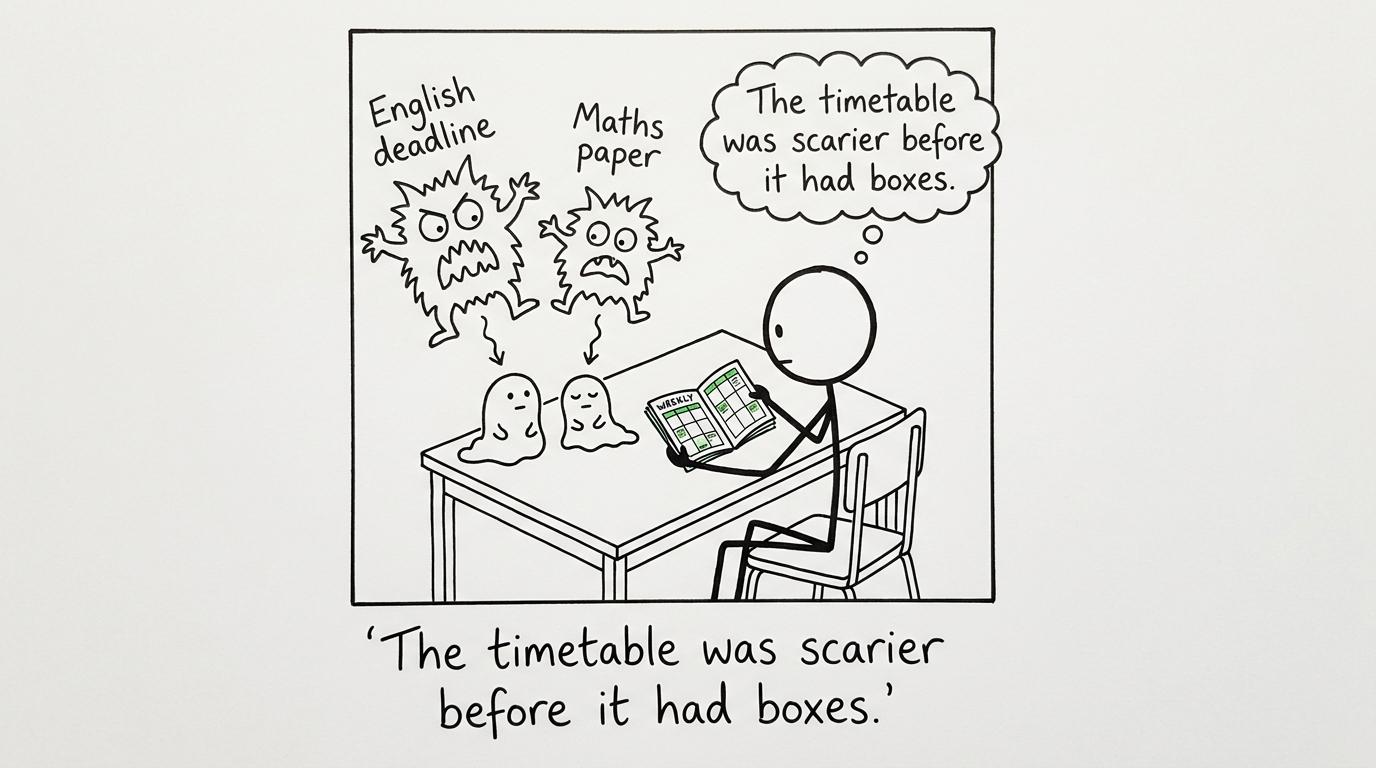 A weekly planner turns two revision monsters into manageable desk pets
A better response than regret
Regret often comes from a gap between expectation and reality. You expected memorisation; the course demanded transfer. You expected creativity; it also demanded analysis. You expected an option; your school treated English as core.
Once the gap is named, it becomes manageable.
Confirm what is compulsory. Check your board. Read the specification summary. Look at a specimen paper. Ask how Language and Literature fit together. Then build a revision plan around the course that actually exists, not the one you imagined.
For maths, begin with the MathsGenie GCSE revision hub. Use free revision lessons and practice questions to repair individual topics, mini tests to maintain recall, and past papers to develop timing. Closer to the examination, add predicted papers, mark schemes and video solutions.
You may not control every subject on your timetable. You can control whether uncertainty remains uncertainty. Open one resource, identify one weakness and make the next session specific.