

Regret Picking GCSE Biology? What to Check First
Regret picking GCSE Biology? Learn the common reasons, what the course demands, and how to check whether separate science suits you before choosing.
Choosing GCSE options can feel strangely permanent. A subject sounds interesting at an options evening, the presentation goes well, and suddenly it occupies several lessons a week for the next two years. Students who regret picking GCSE Biology often dislike not biology itself, but the gap between what they expected and what the course actually demands.
The short answer is this: students are most likely to regret the choice when they underestimate the volume of content, the importance of practical and data-analysis skills, or the amount of precise written explanation required. Before committing, check your school's science pathway, your exam board's specification and several real exam papers. Interest matters, but informed interest is safer.
GCSE Biology decision checklist
Before choosing separate Biology, answer these questions honestly:
- Is your school offering separate sciences, rather than Biology as a completely standalone option?
- Have you looked at the actual specification for AQA, Edexcel, OCR or Eduqas?
- Do you enjoy explaining biological processes, not merely recalling definitions?
- Are you comfortable interpreting unfamiliar graphs, tables and experiments?
- Can you manage another content-heavy GCSE alongside your other options?
- Do you know whether separate Biology is required for your intended next step?
- Have you asked current teachers how the course is organised at your school?
In England, science remains part of the key stage 4 curriculum. Schools decide which approved science pathway they offer. Combined Science normally leads to two GCSE grades, while the separate sciences route leads to individual GCSEs in Biology, Chemistry and Physics. This means the real decision is often combined science or separate sciences, not simply biology or no biology.
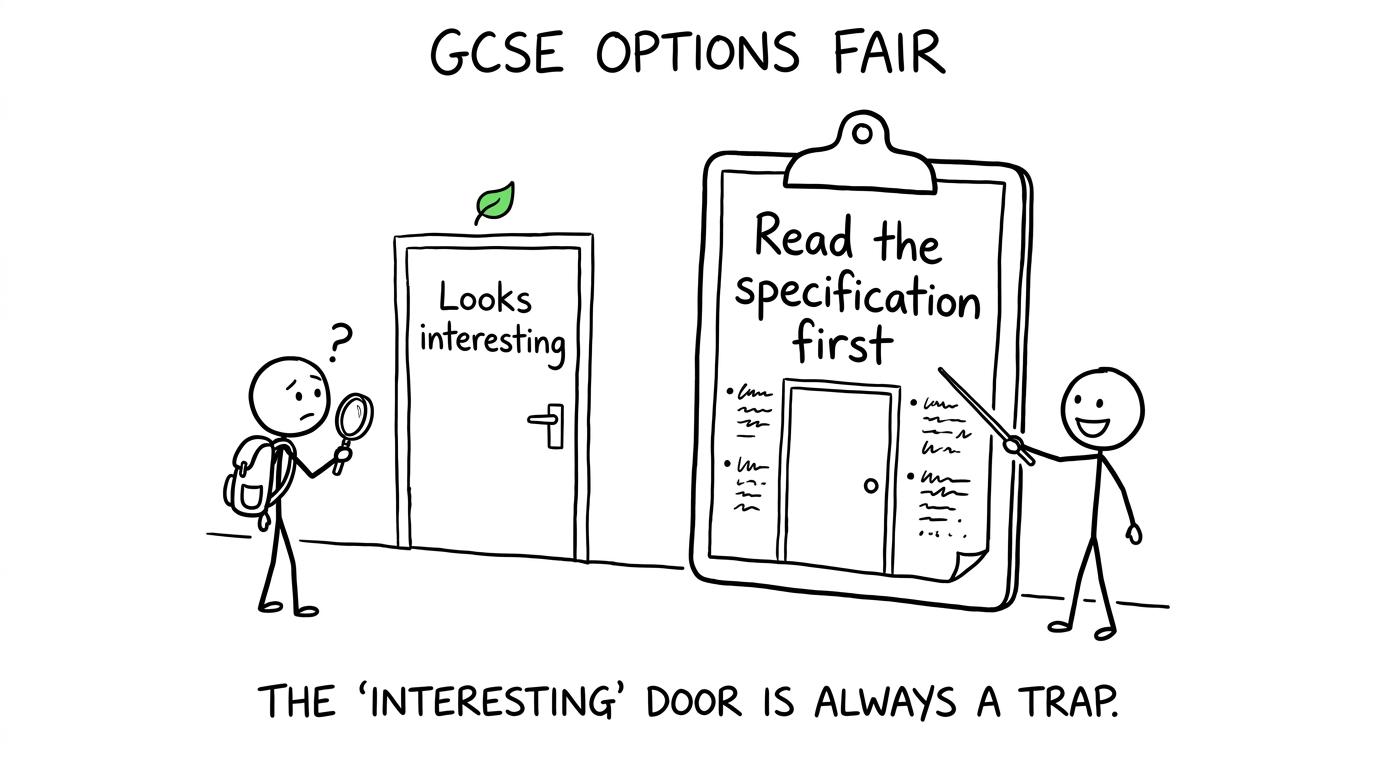 A student discovers that reading the specification is less exciting but more useful than guessing
Why some students regret picking GCSE Biology
There is no reliable national survey proving that one reason dominates. However, several predictable mismatches between expectation and course design can create regret.
The content is broader than expected
GCSE Biology is not only cells, organs and human health. Depending on the specification, students also encounter topics such as infection, bioenergetics, homeostasis, inheritance, variation, evolution, ecology and biotechnology.
Each topic brings specialist vocabulary and linked processes. Knowing that an enzyme is a biological catalyst is only the beginning. An examination may ask you to connect enzyme activity to temperature, explain an experimental pattern or evaluate the limitations of a method.
This is where some students feel caught out. They expected interesting facts about living things. They received a subject that also requires careful chains of reasoning.
Remembering facts is not enough
Modern GCSE Biology papers assess knowledge, application and analysis. A familiar topic may appear inside an unfamiliar experiment, medical context or ecological investigation.
That changes the revision task. Rereading a textbook can create recognition: everything looks familiar while the page is open. The exam requires retrieval and application when the prompts are new.
Before choosing the subject, inspect a recent paper from your likely exam board. Look beyond whether you know the content. Ask whether you would enjoy interpreting the situation and building an answer from evidence.
Practical work still appears in written examinations
For reformed GCSE Biology qualifications in England, practical understanding is assessed through written papers. Regulatory requirements allocate at least 15%15\%15% of marks to knowledge, skills and understanding connected with practical work. Students following separate Biology must also be given opportunities to complete at least eight specified practical activities.
You may need to identify variables, evaluate a method, interpret results, discuss uncertainty or suggest improvements. Enjoying practical lessons helps, but being able to explain the investigation afterwards matters just as much.
A student who chooses Biology mainly because experiments look enjoyable may therefore be disappointed by how much written precision surrounds them.
Biology includes more maths than its reputation suggests
Separate GCSE Biology assessments in England must allocate at least 10%10\%10% of their marks to mathematical skills. The required skills can include decimals, standard form, ratios, percentages, means, probability, sampling, scatter diagrams, equations, gradients, areas and volumes.
Common relationships include:
mean=sum of valuesnumber of values\text{mean}=\frac{\text{sum of values}}{\text{number of values}}mean=number of valuessum of valuesand
percentage change=changeoriginal value×100\text{percentage change}=\frac{\text{change}}{\text{original value}}\times 100percentage change=original valuechange×100Students may also need to move between numerical and graphical information or solve a simple equation. The maths should not go beyond the relevant GCSE Maths tier, but it still has to be used accurately inside a biological context.
If percentages feel fragile, revisit MathsGenie's fractions, decimals and percentages revision guide. The broader GCSE Maths revision hub also provides free lessons, questions and resources across the major exam boards.
The subject may not match the reason it was chosen
Some choices are made for weak reasons: friends are taking the subject, a particular teacher is popular, or Biology appears to be the least mathematical science. None tells you whether you will enjoy the qualification.
Teachers and class groups can change. Biology contains assessed maths. Friends develop different revision habits. A resilient decision rests on the work itself.
Interest is still important. It simply needs a more precise definition: do you enjoy learning detailed systems, applying knowledge to unfamiliar situations, analysing evidence and writing logically structured explanations?
Workload has an opportunity cost
Separate science usually means learning more content across Biology, Chemistry and Physics than on a combined route. Whether that feels manageable depends on your timetable, school and other subjects.
Every option consumes time that cannot be used elsewhere. That does not make Biology a poor choice. It means its cost should be visible before you agree to it.
If maths is already competing for revision time, use a structured plan rather than waiting for pressure to build. MathsGenie's GCSE maths revision timetable explains how to combine focused topic work with timed exam practice.
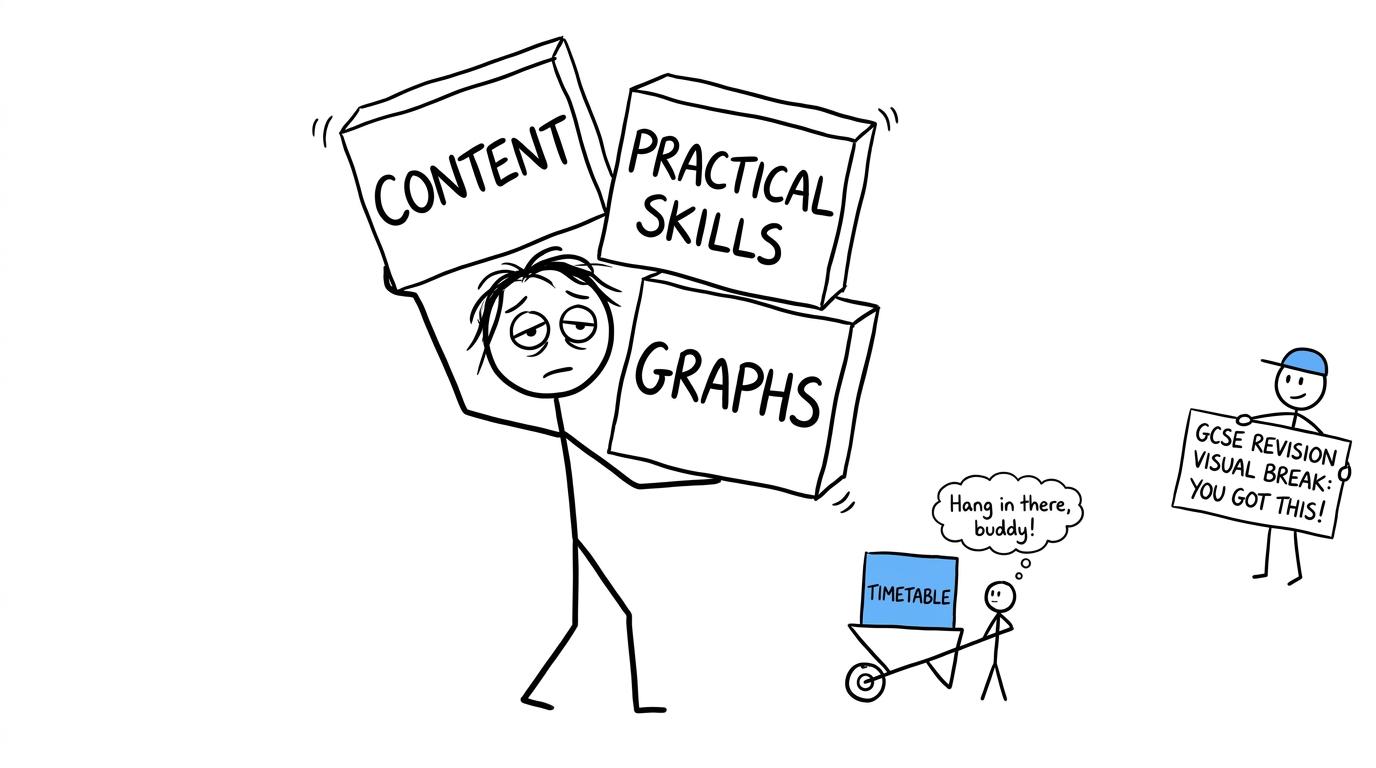 A student balances content, practical skills and graphs while a revision timetable waits nearby
What to check before you commit
Confirm what your school is actually offering
The words used at options evenings can be confusing. Ask whether you would take:
- Combined Science, worth two GCSEs
- Separate Biology, Chemistry and Physics, worth three GCSEs
- another pathway determined by your school or national curriculum
Also confirm the exam board and whether the qualification is tiered. English GCSE Biology specifications commonly offer foundation and higher tiers, but arrangements are not identical across every nation or qualification. Your school can explain the route that applies to you.
Read the specification, not just the brochure
A subject brochure sells the destination. The specification shows the road.
Scan every content heading and highlight each one as:
| Reaction | What it suggests |
|---|---|
| Genuinely curious | The subject may fit your interests |
| Neutral but manageable | Normal for any broad GCSE |
| Strongly unappealing | Ask whether this is one topic or a wider pattern |
| Completely unexpected | Investigate before deciding |
Do not expect to love every chapter. Instead, look for enough sustained curiosity to carry you through the less appealing sections.
Inspect papers and mark schemes
Compare papers from the correct exam board and tier. AQA, Pearson Edexcel, OCR and Eduqas organise and assess content differently, even though English specifications must meet common subject requirements.
Notice the balance of short responses, calculations, practical questions, data interpretation and extended explanations. Then read a mark scheme. It reveals how specific an answer must be and whether your preferred way of thinking suits the subject.
This same habit is valuable in maths. MathsGenie's guide to using GCSE mark schemes effectively shows how marking can expose the reason marks were lost rather than merely producing a score.
Check future entry requirements directly
Do not choose separate Biology solely because someone says it is essential for A Level Biology, medicine or another career. Entry requirements are set by individual sixth forms, colleges, universities and courses, and they can vary.
Check the published requirements of places you might realistically attend, then ask an adviser if anything is unclear. Combined Science can support progression to A Level science, but a particular provider may set specific grade requirements. Verify rather than assume.
How maths preparation can make Biology feel lighter
Biology becomes less intimidating when its numerical skills are automatic. If calculating a percentage or reading a graph takes all your attention, less attention remains for the biological meaning.
Prioritise these transferable areas:
- fractions, decimals, ratios and percentages
- arithmetic means and appropriate rounding
- standard form and orders of magnitude
- rearranging simple formulae
- interpreting tables, scatter graphs and lines of best fit
- calculating and interpreting gradients
- area, volume and unit conversions
Use the GCSE Maths self-assessment sheet to identify gaps, then consult the full GCSE topic list by board and tier. You do not need to revise all of maths to support Biology. Fix the small group of skills that repeatedly slow you down.
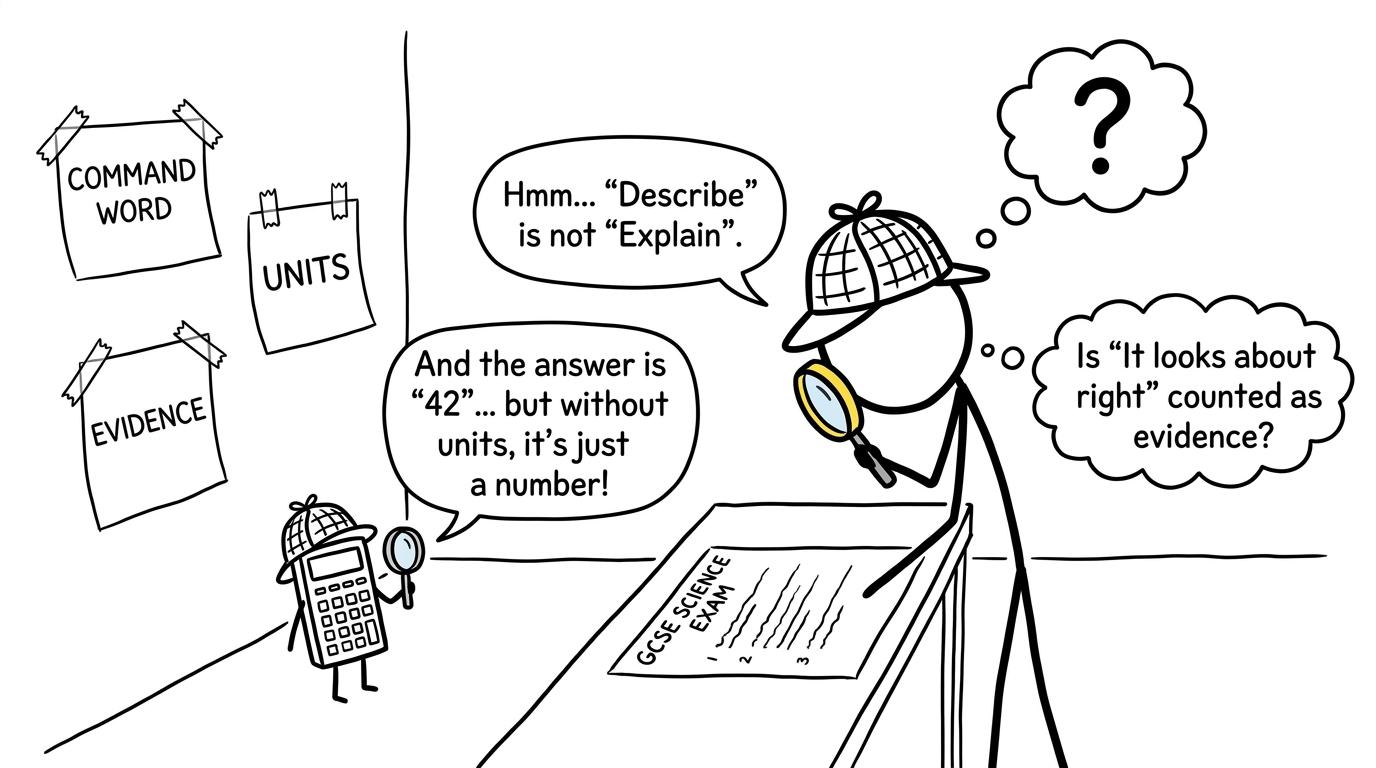 A student detective investigates command words, units and evidence with a calculator assistant
Common mistakes when choosing GCSE Biology
Treating it as an easy memory subject
Recall matters, but application, analysis, practical understanding and mathematical skills are also assessed. Judge the course from examination questions, not from a list of keywords.
Choosing because friends chose it
Friends can make lessons enjoyable, but they cannot complete your revision. Choose work you can tolerate independently on an ordinary Tuesday evening.
Assuming Biology avoids maths
At least 10%10\%10% of marks in separate GCSE Biology assessments in England must assess mathematical skills. Build confidence early rather than treating every calculation as an unwelcome surprise.
Ignoring the other separate sciences
If your school packages Biology with separate Chemistry and Physics, assess the complete route. The decision may add content across all three subjects.
Confusing temporary difficulty with a bad choice
One hard topic does not prove that the subject is wrong for you. Equally, one enjoyable lesson does not prove that it is right. Look for patterns across topics, questions and practical work.
Making the decision without asking your school
Timetables, teaching hours, entry policies and option combinations are local. General online advice cannot replace accurate information about your own school.
Make a decision based on the work
The aim is not to avoid every demanding subject. All worthwhile GCSEs contain sections that feel difficult. The aim is to choose difficulty that seems meaningful enough to sustain.
If you are worried you may regret picking GCSE Biology, take one calm afternoon to inspect the specification, sample several exam questions, ask what pathway your school offers and verify future entry requirements. That small amount of investigation is worth far more than choosing from reputation.
Meanwhile, strengthen the maths that travels into science. Begin with the free GCSE Maths revision hub, use MathsGenie's revision resources and mini tests, and move from revision lessons to practice questions, mark schemes and video solutions. When exams approach, use GCSE Maths predicted papers alongside real past papers. A subject choice feels less risky when the skills underneath it are secure.










