Redo GCSE Statistics Mock Timed: Is It Worth It?
Redo GCSE statistics mock timed and decide if a full resit beats review. Use a mark, repair and retest plan to improve technique before your exams.
The timer stops. You put down your pen, look back through the booklet and immediately remember three things you should have written. It is tempting to start again the next day and prove that you can do better.
But should you redo GCSE Statistics mock timed, or would careful review be a better use of your revision time?
For most students, the best answer is: review the first attempt before redoing the full paper. A timed reattempt becomes valuable after you have identified your mistakes, repaired the weakest topics and allowed enough time for the original answers to become less familiar. If timing, stamina or question selection caused substantial problems, a complete timed redo can then be an excellent test.
The paper itself is not the lesson. What you do between the first attempt and the second is where most improvement happens.
The short decision checklist
Redo the entire mock under timed conditions if:
- you ran out of time or rushed the final questions;
- you struggled to stay focused for a complete paper;
- poor question selection left accessible marks untouched;
- you have reviewed and repaired the topics that caused mistakes;
- enough time has passed that you are solving rather than recalling answers;
- you do not have a suitable unseen paper available.
Review or reattempt selected questions instead if:
- most lost marks came from one or two weak topics;
- you have not yet used the mark scheme properly;
- your first attempt was recent enough to remember the answers;
- you completed the paper comfortably within the official time;
- an unseen mock or past paper would provide a more honest assessment.
You can find board-specific papers and topic resources in the GCSE Statistics revision hub. Check the front of your mock and confirm the exam board, tier, permitted equipment and official time before beginning.
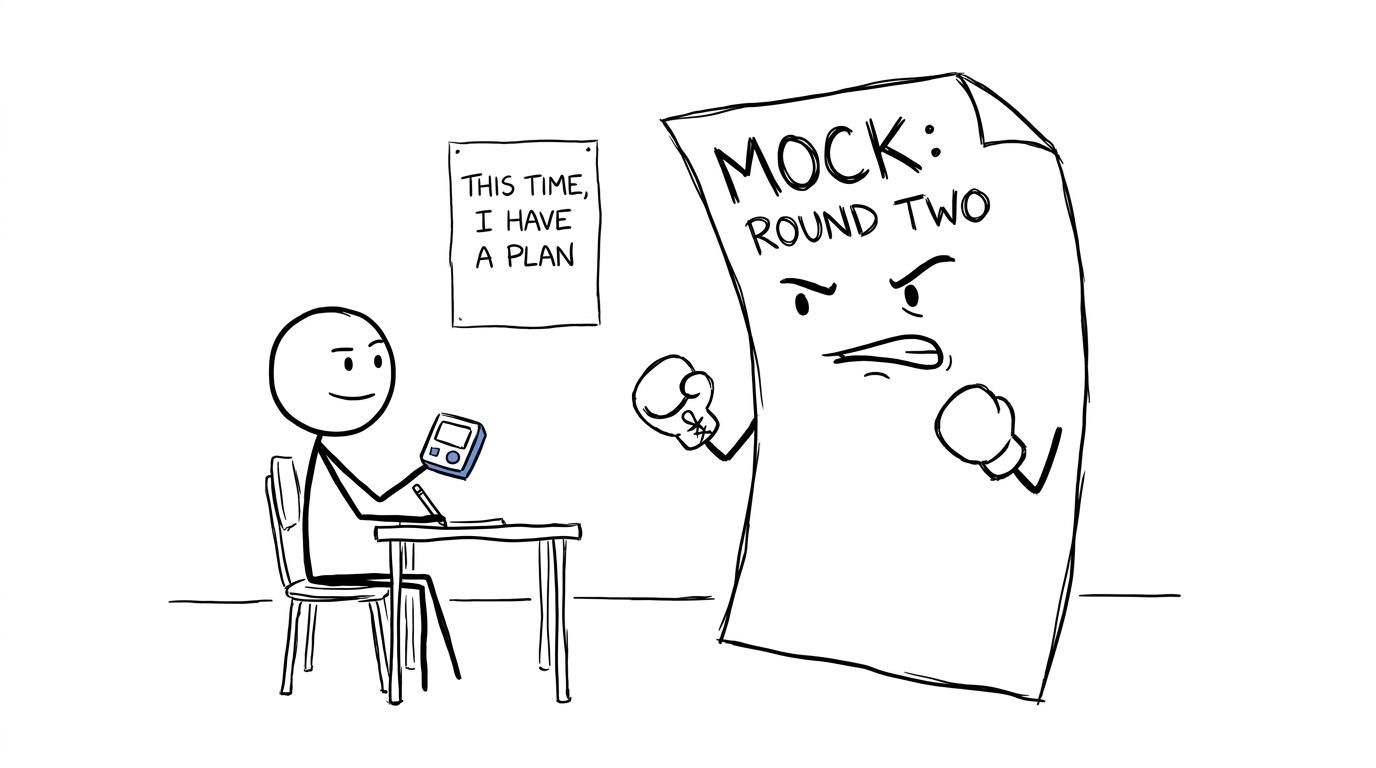 A student prepares calmly to face a GCSE Statistics mock for a second round
Why reviewing the first attempt usually comes first
A mock gives you information. A total mark gives you only a small part of it.
GCSE Statistics is not assessed entirely through calculations. Ofqual's common assessment objectives allocate approximately 55%55\%55% to knowledge and use of statistical techniques, 25%25\%25% to interpretation and statistical reasoning, and 20%20\%20% to evaluating methods and conclusions through the statistical enquiry cycle. Exact paper weightings can vary within the permitted limits.
That matters because two blank or incorrect answers may reveal completely different problems. One might show that you could not calculate a statistical measure. Another might show that you calculated correctly but did not interpret the result in context.
Before considering a full redo, mark every question and classify every lost mark:
| Error type | What it may mean | Best next action |
|---|---|---|
| Knowledge | You did not know a fact, definition or method | Revisit the revision lesson and notes |
| Method | You knew the topic but chose an unsuitable approach | Compare your method with the mark scheme |
| Interpretation | You did not explain the result in context | Practise conclusion and comparison questions |
| Accuracy | Your approach was sound but execution failed | Reattempt similar questions carefully |
| Communication | Units, notation, working or conclusions were incomplete | Study how marks are awarded |
| Timing | You rushed, stalled or left questions untouched | Use timed sections, then a complete paper |
Do not merely copy correct answers beside the originals. Explain why each answer lost marks and what you will do differently. Evidence on retrieval and feedback supports the value of active recall followed by specific correction; simply seeing the answer does not ensure that you can produce it independently later.
MathsGenie's guide to redoing past papers follows the same useful sequence: mark, diagnose, repair and retest.
When a complete timed redo is worth it
Timing was a genuine weakness
A full paper tests decisions that isolated questions cannot fully reproduce. You must decide when to persist, when to move on and how much detail a response needs.
Use your first mock to create a time audit. For each section, record approximately how long you spent, which questions delayed you and where rushing began. The aim is not to divide time rigidly by marks. It is to notice whether a small number of questions consumed a disproportionate share of the paper.
On the redo, practise a simple routine:
- start with the official time shown for your board and paper;
- keep your phone away and use only permitted equipment;
- mark questions you intend to revisit;
- leave space when moving on;
- reserve time to check units, scales, conclusions and unanswered parts.
A timed redo is particularly useful when the first paper showed that you understood much of the content but could not demonstrate it efficiently.
You need to build concentration and stamina
Statistics papers move between calculations, diagrams, data sets and written evaluation. That switching can feel more tiring than practising one topic repeatedly.
A complete mock lets you rehearse sustained concentration. It also reveals whether your accuracy declines later in the paper. If it does, shorter timed sections can be a sensible bridge before another full attempt.
The guide to starting GCSE past papers explains how to move from mini tests and partial papers towards complete timed practice rather than treating every revision session like an exam.
You have repaired the underlying gaps
Redoing immediately may produce a higher score because the questions are familiar. That can feel reassuring without showing durable improvement.
A stronger cycle is:
- mark the first attempt;
- select the two or three largest sources of lost marks;
- revisit the relevant lesson or revision guide;
- complete fresh practice questions without notes;
- check the solutions and correct misconceptions;
- return to the mock after a delay.
If data representation caused difficulty, for example, use targeted resources such as histograms revision, cumulative frequency revision or the box plots revision guide. Check that each resource matches the content and level you need.
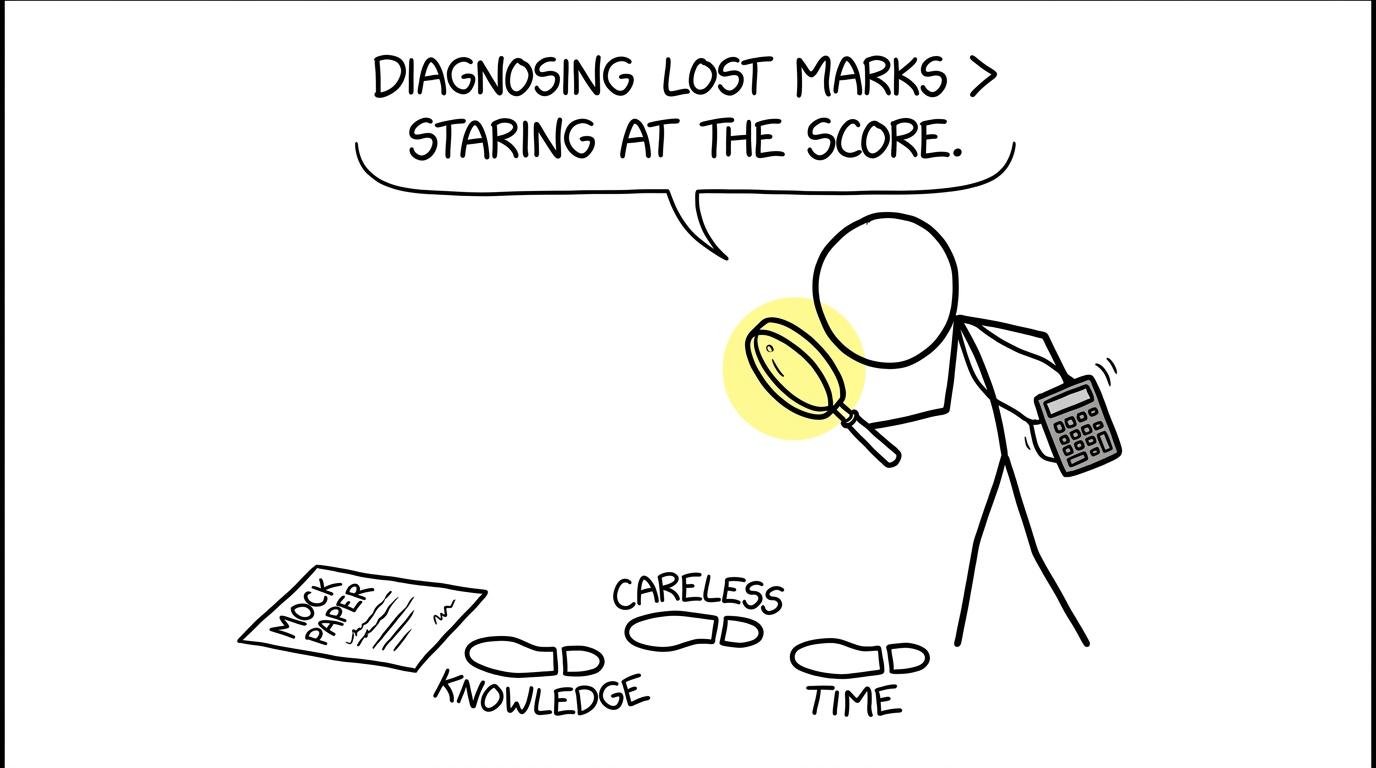 A student detective investigates where marks disappeared
When reviewing is better than redoing the whole mock
A complete paper has an opportunity cost. Time spent repeating questions you already understand cannot be spent repairing fragile knowledge.
Suppose your analysis shows that most lost marks came from sampling, interpreting correlation and evaluating a statistical investigation. Redoing every straightforward calculation on the paper is unlikely to be the most efficient next step. Focused practice gives those weaknesses more attention.
Review is usually better when your difficulties are concentrated. For every weak area:
- state the exact issue rather than writing “statistics” or “graphs”;
- revisit the method or concept;
- answer fresh questions;
- mark them immediately;
- reattempt the original questions without looking at your correction.
Choose the relevant AQA GCSE Statistics resources or Edexcel GCSE Statistics resources so that your practice reflects your specification and tier.
A fresh paper is also better when you want an honest score. Your second mark on the same mock is partly influenced by familiarity, so it should not be treated as directly comparable with an unseen assessment. Track improvement in the types of errors you make as well as the total.
A practical paper, repair and retest plan
First session: extract the evidence
Mark the mock strictly using the mark scheme. Add the marks once, but spend more attention on the pattern underneath the total.
Create a short repair list containing the most important weaknesses. Record whether each one concerns knowledge, interpretation, evaluation, accuracy or timing. If you want context for historical results, use the GCSE Statistics grade boundaries guide, but remember that boundaries vary by series and are not revision targets.
Middle sessions: repair specific weaknesses
Use revision lessons, worksheets, practice questions and mini tests. Begin without notes so that you must retrieve the method. Then use feedback from the mark scheme or video solution to correct the process.
Return to the weak skill on another day. One successful answer completed immediately after watching a solution is not yet secure evidence of independent understanding.
Final session: choose the right retest
Select one of three options:
- redo only the questions that originally caused difficulty;
- complete a timed section to test pace and decision-making;
- redo the whole mock under official conditions.
For a clearer measure of your current level, use an unseen past paper or predicted paper where available. The familiar mock is best for testing whether particular lessons have been applied; the unseen paper is better for testing transfer.
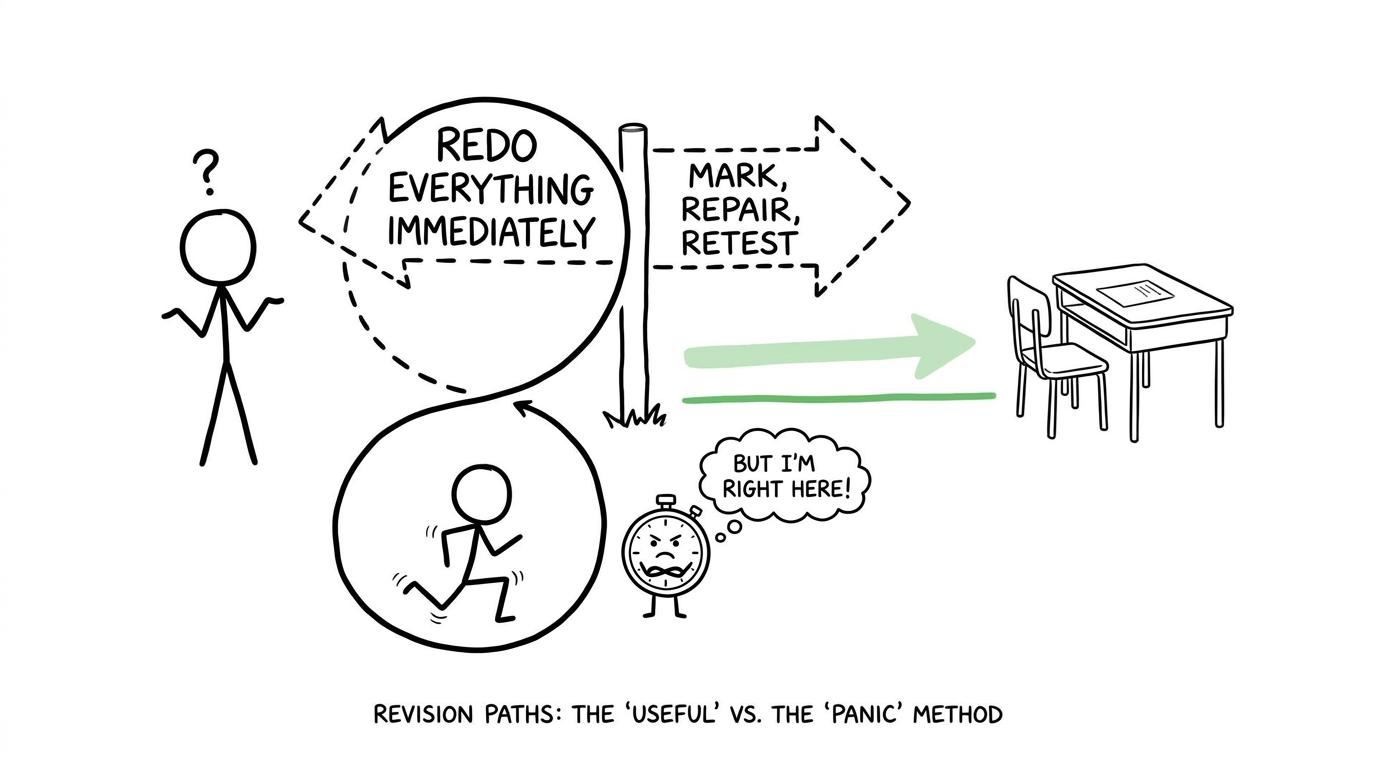 A student chooses the mark, repair and retest path
Common mistakes when redoing a Statistics mock
Repeating the paper without repairing anything
A second attempt is not automatically revision. Without analysis and focused practice, you may repeat the same misconception more quickly.
Memorising the mark scheme's wording
Mark schemes show what earns credit, but statistical conclusions must respond to the context in the question. Learn the reasoning structure rather than a sentence that only fits one data set.
Treating a familiar score as a new predicted grade
Recognition makes a repeated paper easier. Use the new mark as evidence that corrections have been remembered, not as a guaranteed exam outcome.
Ignoring written statistical reasoning
Students often concentrate on numerical errors because they are easy to identify. Yet interpretation and evaluation form a substantial part of GCSE Statistics. Review whether conclusions refer to context, evidence, limitations and the suitability of methods.
Using the wrong conditions
Check your board, tier, official time and permitted equipment. GCSE Statistics arrangements should not be assumed from a different GCSE maths paper. AQA and Edexcel specifications, for example, should be checked separately.
Spending every revision session on full papers
Papers diagnose weaknesses; focused practice repairs them. You need both. A balanced plan alternates revision lessons and topic questions with mini tests, timed sections and complete papers.
Turn the mock into your next revision decision
Redoing an entire GCSE Statistics mock under timed conditions is worthwhile when it answers a real question: Can you now manage the paper, sustain concentration and apply your repaired knowledge independently?
If you have not reviewed the first attempt, do that first. If the errors are concentrated, use targeted practice. If timing and stamina were major problems, repair the content and then complete the timed redo. When you need an unbiased measure, choose a fresh paper.
Start at the MathsGenie GCSE Statistics revision centre. Use the revision planner to schedule your repair topics, then combine free revision lessons, practice questions, mark schemes, video solutions and mini tests. When those weaknesses feel less fragile, move to past papers and predicted papers under timed conditions.
The goal is not to complete the same paper twice. It is to become a student who makes fewer of the same mistakes the second time.