Redo GCSE Business Mock Timed: Is It Worth It?
Redo GCSE Business mock timed? Learn when a full resit beats reviewing mistakes and how to turn feedback into stronger GCSE exam performance.

A mock can leave you with an uncomfortable choice. Do you spend another long session sitting the same paper, or use that time to investigate what went wrong? If you are wondering whether to redo GCSE Business mock timed, the short answer is: usually not immediately. Review the first attempt, repair the main weaknesses and retest selected questions first. Redo the whole paper later only if you need to measure pacing, stamina or progress under realistic conditions.
That distinction matters. Repeating a paper can feel productive because it is difficult. But difficulty and improvement are not always the same thing. The best revision session is the one that changes what you can do next time.
The quick decision checklist
Redo the complete mock under timed conditions if most of these statements are true:
- You lost a significant number of marks because you ran out of time.
- Your knowledge is reasonably secure, but your pacing is unreliable.
- You have reviewed the mark scheme and corrected the original mistakes.
- Enough time has passed for the paper to test performance rather than short-term memory.
- You can reproduce the correct exam conditions for your board.
- Sitting the paper will not replace more urgent topic revision.
Choose targeted review instead if:
- Several answers show missing Business knowledge.
- You misunderstood command words such as analyse, justify or evaluate.
- Your calculations, application or chains of reasoning were weak.
- You remember many answers from the marking process.
- The exam is close and the full resit would consume most of your available revision time.
The default sequence should be review, repair, retest, then resit if needed.
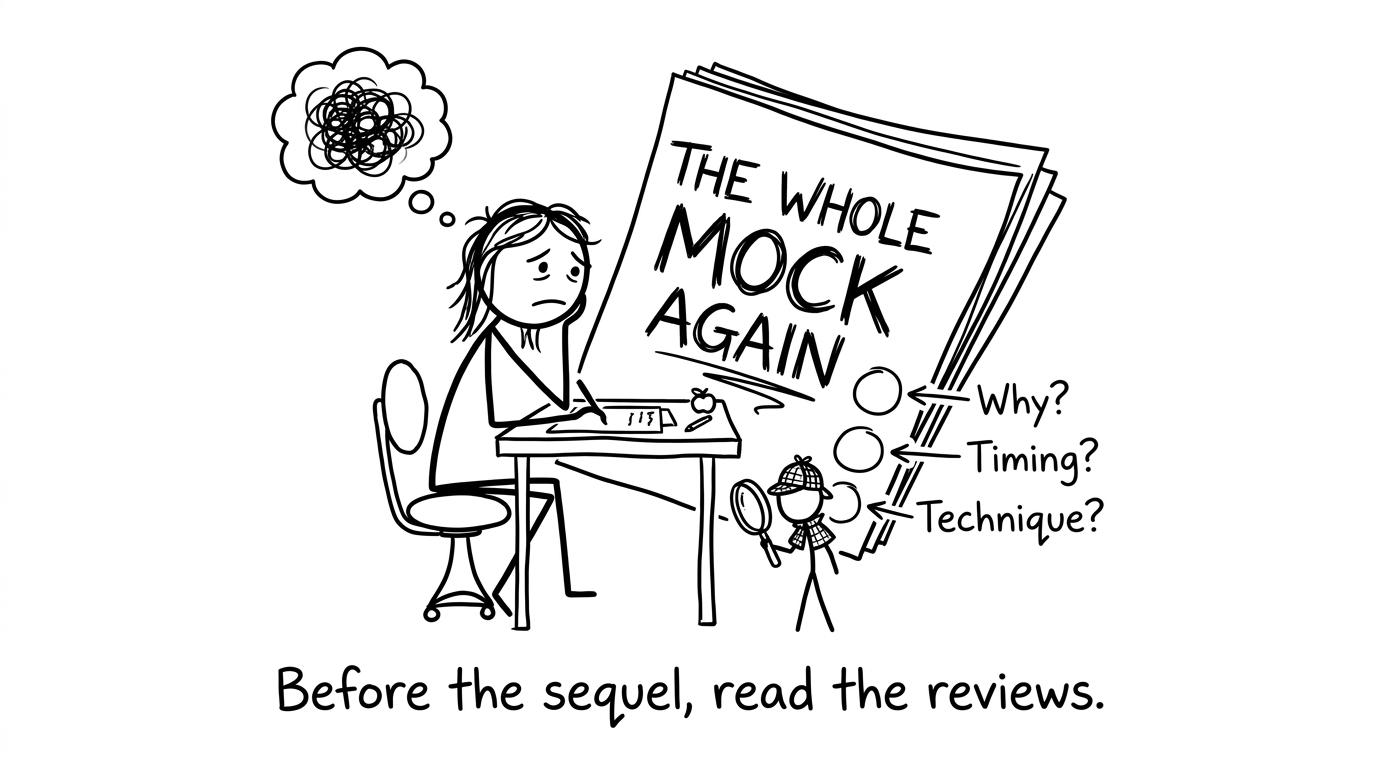 A student considers the sequel to an enormous mock paper while a detective identifies weak spots
Why reviewing the first attempt usually comes first
A mock is not merely a score. It is a collection of clues.
Your lost marks may come from different causes: incomplete subject knowledge, weak application to the business context, an unsupported judgement, a calculation error, poor question selection or slow writing. Resitting the entire paper before identifying those causes risks reproducing them.
Research on metacognition and self-regulated learning supports a cycle of planning, monitoring and evaluating learning. Retrieval practice is valuable too, but feedback matters because repeatedly retrieving an incorrect idea can reinforce a misconception. In practical terms, you should not simply do the same task again. You should understand the first performance and adapt the next one.
Begin by sorting every lost mark into four categories:
| Category | What it might reveal | Best next action |
|---|---|---|
| Knowledge | A definition, formula or concept was missing | Relearn the precise content, then self-test |
| Application | The answer was generic rather than connected to the case | Practise using details from unfamiliar business contexts |
| Analysis or evaluation | The reasoning stopped early or the judgement lacked support | Plan and improve selected extended responses |
| Timing or exam technique | Questions were unfinished, rushed or misread | Use a timed section, then consider a full resit |
This audit turns a disappointing result into a revision plan. The same principle applies to maths: a paper becomes useful when it identifies the skills that need attention. MathsGenie's guide to using Edexcel GCSE Maths past papers properly explains how marking, diagnosis and targeted practice should form one continuous loop.
When a full timed Business mock is worth repeating
Timing was the main problem
Official AQA and Pearson Edexcel GCSE Business papers currently last 111 hour 454545 minutes and carry 909090 marks each. Both qualifications use two written papers, although their content and section structures differ. Always follow the current specification and the instructions on your own AQA, Edexcel, OCR or Eduqas paper rather than assuming every board is identical.
For a 909090-mark paper completed in 105105105 minutes, the broad average is:
10590≈1.17 minutes per mark\frac{105}{90} \approx 1.17 \text{ minutes per mark}90105≈1.17 minutes per markThat is a planning guide, not a command to leave every question after exactly that time. Reading source material, checking calculations and planning extended responses affect the distribution. Still, if you spent too long on low-mark questions and left a major response unfinished, another full timed sitting can reveal whether your new pacing strategy works.
You need to practise stamina and decision-making
Knowing Business content at your desk is not identical to retrieving it after more than an hour of concentrated reading and writing. A complete mock tests whether you can maintain focus, move on from a difficult question and return later without panicking.
These are performance skills. They cannot be measured fully through isolated questions. Full papers therefore become more valuable as the real exams approach, once most knowledge gaps have already been addressed.
You have changed something specific
A resit should test an intervention. Perhaps you now underline command words, plan extended answers briefly, use source details more deliberately or set checkpoints for completing sections.
If nothing has changed between attempts, the second score tells you little. If you have revised and adopted a clear strategy, it becomes evidence of whether that strategy survives time pressure.
When targeted review is the better use of time
Suppose the first mock exposed weak knowledge across marketing, finance and operations. A complete repeat may spend another 105105105 minutes confirming something you already know: the foundations need work.
A more efficient session would include:
- checking each answer against the official mark scheme;
- writing the exact reason each mark was lost;
- revising the weakest specification areas;
- answering fresh questions on those areas;
- reattempting selected mock questions without notes;
- completing one timed section to check pacing.
This preserves the useful pressure of testing without paying the time cost of a whole paper.
MathsGenie uses the same progression for maths revision. GCSE Maths revision resources let students move from lessons and topic questions to shorter tests and complete papers. If a full paper is currently too blunt an instrument, Edexcel GCSE Maths mini tests offer focused timed practice. The subject changes, but the revision principle survives: isolate a weakness before testing the whole system again.
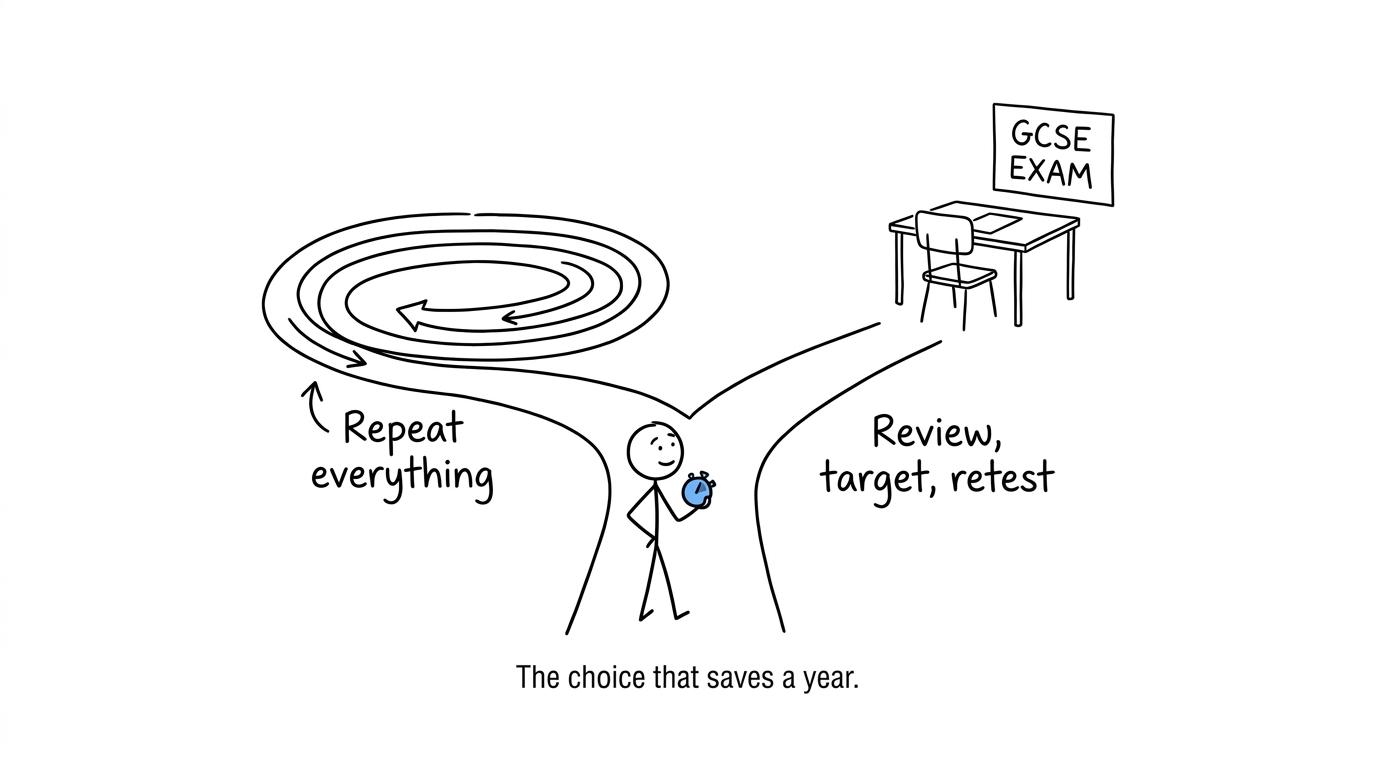 A student chooses between repeating everything and reviewing, targeting and retesting
How to review the first mock properly
Mark against your board's expectations
Use the official mark scheme supplied by your teacher or exam board. Do not award a mark merely because your answer sounds reasonable. Check whether it contains the required knowledge, applies that knowledge to the context and develops the analysis or evaluation expected by the command word.
For longer answers, ask what kept the response in its level. Was the reasoning generic? Was an alternative considered? Did the conclusion answer the precise question? Levels-based mark schemes reward the quality of the response as a whole, so adding isolated terminology is not automatically enough.
Build a short marks-leak list
Do not create an enormous catalogue that you will never revisit. Select the few recurring problems costing you the most marks. Each entry should describe an action, not a personality trait.
“Bad at evaluation” is vague. “My conclusion does not compare the most important factors in this business context” is fixable.
Retest after a delay
Once you have revised, answer selected questions without looking at your previous response. Where possible, use fresh questions to check whether the learning transfers beyond a familiar case study. Then return to the original questions after a delay.
If you recognise the wording and remember the mark scheme, interpret a higher score cautiously. Familiarity can inflate performance without proving that you could handle a new paper.
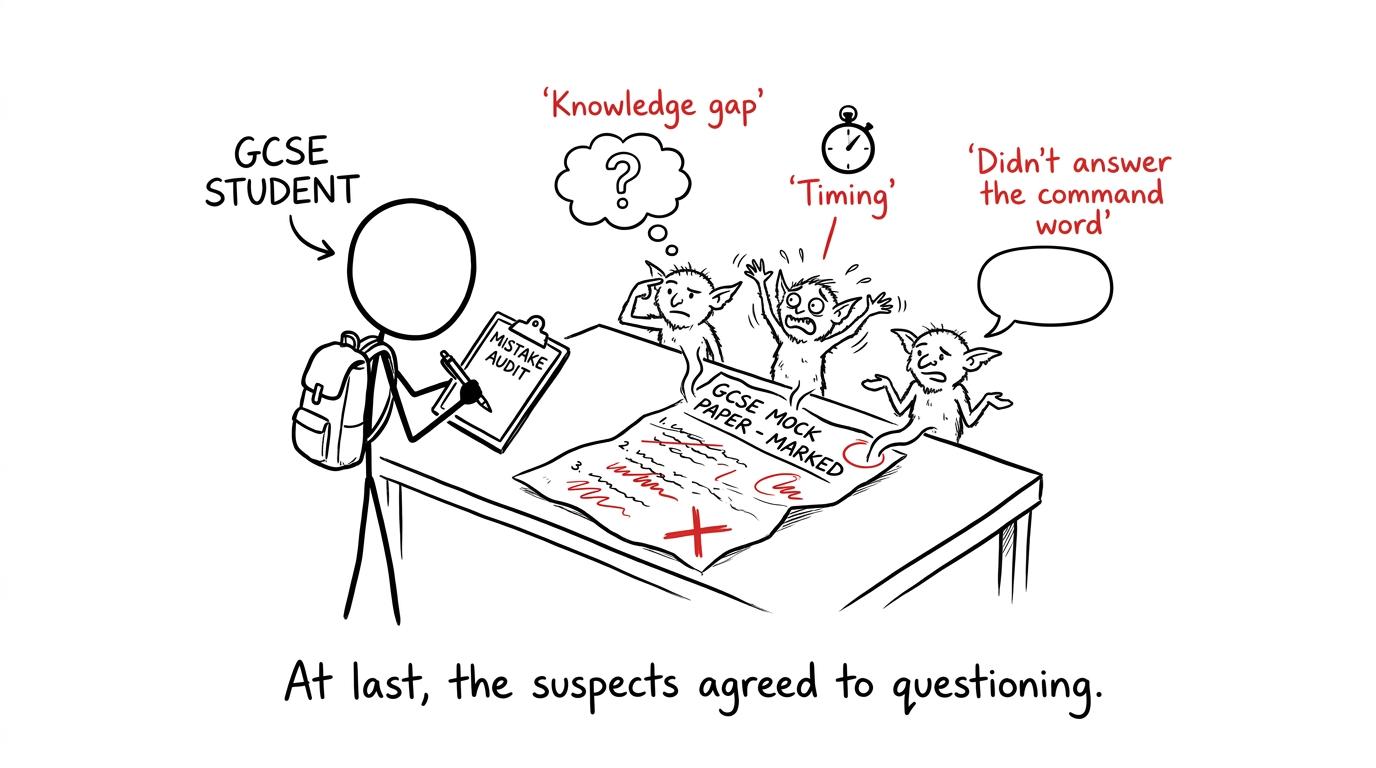 A student questions three mistake gremlins emerging from a marked mock
How to resit the mock under useful conditions
If a full resit is justified, make it realistic:
- Use the exact time printed on the paper.
- Work in silence with your phone out of reach.
- Use only the equipment allowed by your exam board.
- Do not pause the clock or consult notes.
- Record section-completion times discreetly.
- Finish every question you can, then mark the paper strictly.
Compare more than the total. Look at marks by section, unfinished responses, calculation accuracy and the quality of extended answers. A modest score increase accompanied by better completion and fewer rushed judgements may be more meaningful than a dramatic rise caused by remembering answers.
For maths, the equivalent progression is explained in when to start GCSE past papers: begin with diagnosis and shorter practice, then build towards full timed papers. Students preparing for Edexcel Maths can use GCSE Maths predicted papers for fresh exam-style material after addressing topic weaknesses.
Balance Business revision with GCSE Maths preparation
Your revision time has an opportunity cost. A full Business mock plus detailed marking can occupy a substantial session. If it replaces the maths topic currently costing you repeated marks, it may not be the best decision that day.
Plan by need rather than by subject anxiety. MathsGenie's GCSE maths revision timetable guide shows how to combine foundation work, targeted practice and exam sessions. Its one-month GCSE maths revision plan also demonstrates why full-paper practice should sit alongside focused correction rather than replace it.
This is especially important for foundation and higher tier maths students. Choose resources matching your tier and exam board, then use mark schemes and video solutions to identify the method behind each lost mark. Business and maths demand different answers, but both reward honest diagnosis.
Common mistakes when repeating a mock
Resitting it immediately
An immediate second attempt often measures memory of the discussion or mark scheme. Leave enough time to revise and forget superficial details before treating the result as evidence of improvement.
Focusing only on the total mark
A higher total does not automatically mean stronger exam readiness. Compare why marks changed and whether improvements would transfer to an unfamiliar paper.
Practising timing before fixing knowledge
Speed cannot rescue concepts you do not understand. Build accuracy and reasoning first, then add time pressure progressively.
Using the wrong paper conditions
Paper duration, structure and permitted equipment depend on the qualification. Confirm your board and specification. For maths, also check foundation or higher tier and whether the paper is calculator or non-calculator.
Skipping the second review
The resit must be marked and analysed too. Otherwise, you have spent a long time producing another score without extracting the lesson.
Make the next attempt earn its place
Redoing an entire GCSE Business mock under timed conditions is worthwhile when it answers a real question: can you now manage the paper, sustain your reasoning and complete it within the limit? It is less worthwhile when the first attempt has already shown clear knowledge or technique gaps that remain unfixed.
Review first. Repair what cost you marks. Retest the weak areas. Then use a full resit to measure whether the whole performance has changed.
Apply that same disciplined cycle to maths with MathsGenie. Start with free revision lessons and practice questions, check your work using mark schemes and video solutions, build speed through mini tests, and finish with past papers and predicted papers under timed conditions. Do not repeat work merely to feel busy. Make every paper tell you what to do next.