Ready for GCSE English Language Early Sitting?
Ready for GCSE English Language early sitting? Use mock evidence, timing and teacher feedback to judge readiness while protecting wider GCSE revision.
Finishing early can sound like the cleanest possible win: secure the qualification, remove a subject from your timetable and create more room for everything else. But to decide whether you are ready for GCSE English Language early sitting, enthusiasm is not enough. You need repeated evidence from complete, timed papers, reliable teacher assessment and confidence across the whole specification.
The short answer is this: sit early only if your performance is already stable at or above your target grade, including on unfamiliar texts and under proper exam conditions. One strong mock is encouraging. Several consistent performances tell you much more.
This decision should be made with your English teacher, examinations officer and parent or carer. Entry arrangements, available series and school policies matter alongside academic readiness.
Your early-entry readiness checklist
You are more likely to be genuinely ready if you can say yes to all of these:
- You have completed the full specification for your exam board.
- You have sat several complete papers under timed, closed-book conditions.
- Your marks remain consistent when the texts and writing prompts are unfamiliar.
- Your teacher has marked your work using current exam-board mark schemes.
- You can perform across reading, comparison, evaluation and extended writing tasks.
- Your spelling, punctuation, grammar and vocabulary remain accurate under pressure.
- You understand the exact paper structure for AQA, Pearson Edexcel, OCR or Eduqas.
- You have completed, or have a confirmed plan for, the Spoken Language endorsement.
- Early entry will not weaken your preparation for GCSE maths and other subjects.
- Your school supports the entry and has explained the consequences of a later resit.
If several answers are “not yet”, that is not failure. It is useful information. Readiness is not a personality trait. It is evidence that can be built.
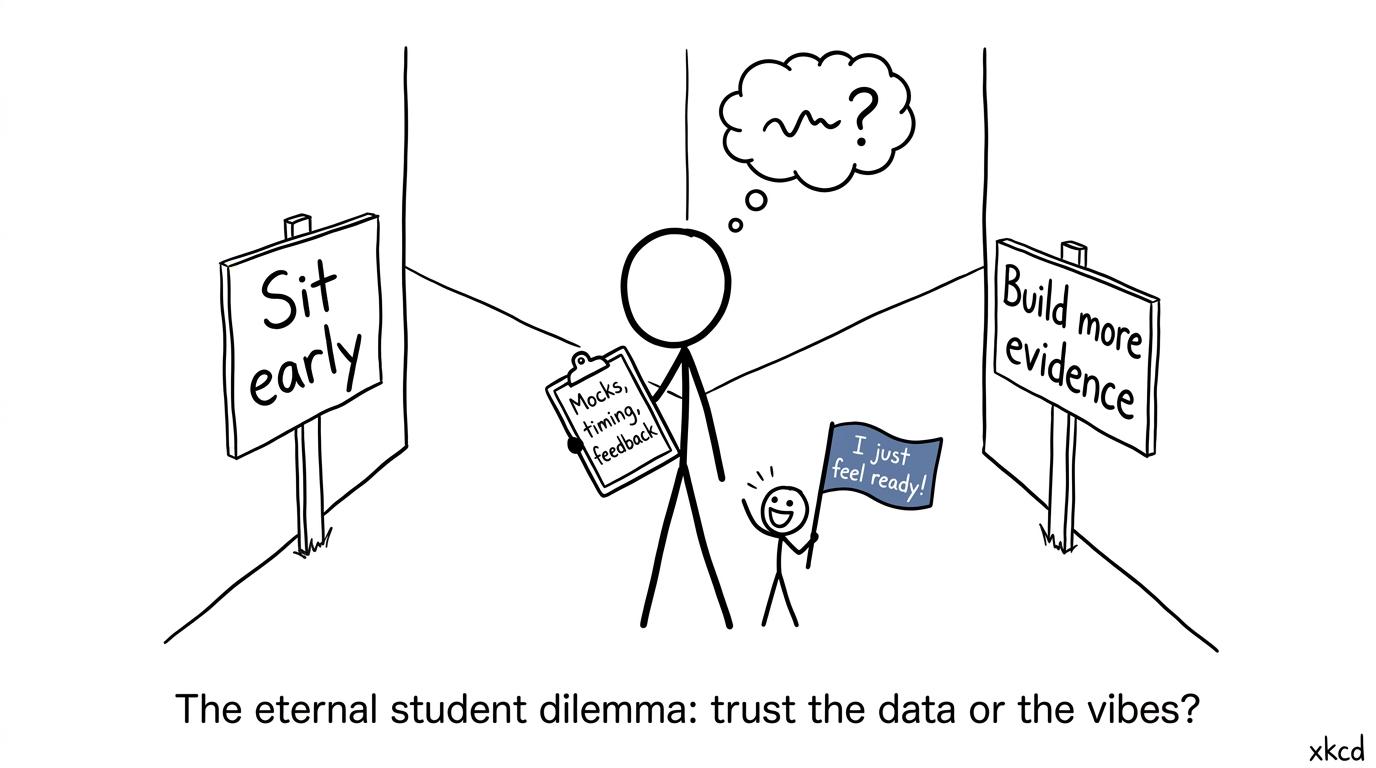 A student choosing between sitting early and building more evidence
Genuinely ready versus simply keen
A keen student often enjoys English, writes quickly or has recently achieved a high mark. A ready student can reproduce that performance when the paper is less comfortable.
That difference matters because GCSE English Language assesses transferable skills rather than a short list of facts. You cannot predict the unseen extracts or depend on receiving a favourite writing prompt. You must interpret information, analyse language and structure, compare perspectives, evaluate a text and produce controlled writing for a stated purpose and audience.
A ready student has consistent evidence
Look for a pattern across multiple assessments rather than a personal best. Those assessments should include both papers from your actual specification and a range of unseen material.
The useful questions are:
- Is the result stable across different paper types?
- Was the work completed independently?
- Did timing remain controlled from beginning to end?
- Were the marks confirmed by a teacher familiar with the specification?
- Are weaker assessment objectives improving rather than being hidden by stronger ones?
This is the same principle that makes finding your weakest GCSE topics valuable in maths. A total mark tells you what happened. A breakdown tells you what to do next.
A keen student depends on favourable conditions
You may be keen rather than ready if your best work was untimed, heavily planned with a teacher or based on familiar material. Other warning signs include avoiding one paper, repeatedly running out of time or relying on memorised paragraphs that do not quite answer the task.
None of these problems is permanent. They simply mean the qualification is still teaching you something useful.
Know the qualification you are entering
GCSE English Language is untiered, unlike GCSE maths, where foundation and higher tier decisions affect the questions and grades available. English Language candidates take the assessment required by their chosen specification.
The precise paper names, timings and question structures vary across AQA, Pearson Edexcel, OCR and Eduqas. However, regulated GCSE English Language qualifications assess reading and writing, while Spoken Language is reported separately and does not contribute to the final grade from the written examinations.
Your preparation must therefore use the current specification and mark schemes for the exact qualification your school enters. Completing papers from another board may provide extra reading practice, but it is not a reliable final readiness test.
For a linear qualification, the required written papers are taken in the same examination series. You cannot usually bank one written paper early and complete the other whenever you choose.
Summer and November are not interchangeable
An early summer entry may be possible if your centre agrees and completes the appropriate administration. The November series has an important restriction in England: GCSE English Language and GCSE maths entries are generally available only to students who were at least sixteen on the preceding final day of August. Limited exceptions can apply as a reasonable adjustment for some disabled students.
That means a younger student cannot assume that November offers a convenient early attempt. Ask your school which series is legally and practically available before creating a revision plan around it.
Government accountability rules can also mean that a pupil's first entry counts in the school's performance measures. That is principally an accountability issue for the school, but it helps explain why centres may be cautious. A later resit may still be possible, yet it should not be treated as a consequence-free backup plan.
Test whether your performance travels
Real readiness travels from one paper to another. It survives an unfamiliar source, an awkward question and the pressure of the clock.
Use several secure or teacher-approved papers that you have not previously seen. Complete them with the permitted materials, correct timing and no feedback between sections. Then ask your teacher to review the pattern using the official mark scheme.
Do not concentrate only on the grade. Record:
- marks by question and assessment objective;
- unfinished or rushed sections;
- repeated reading errors;
- weaknesses in paragraph control or textual evidence;
- accuracy problems in extended writing;
- whether performance falls late in the paper.
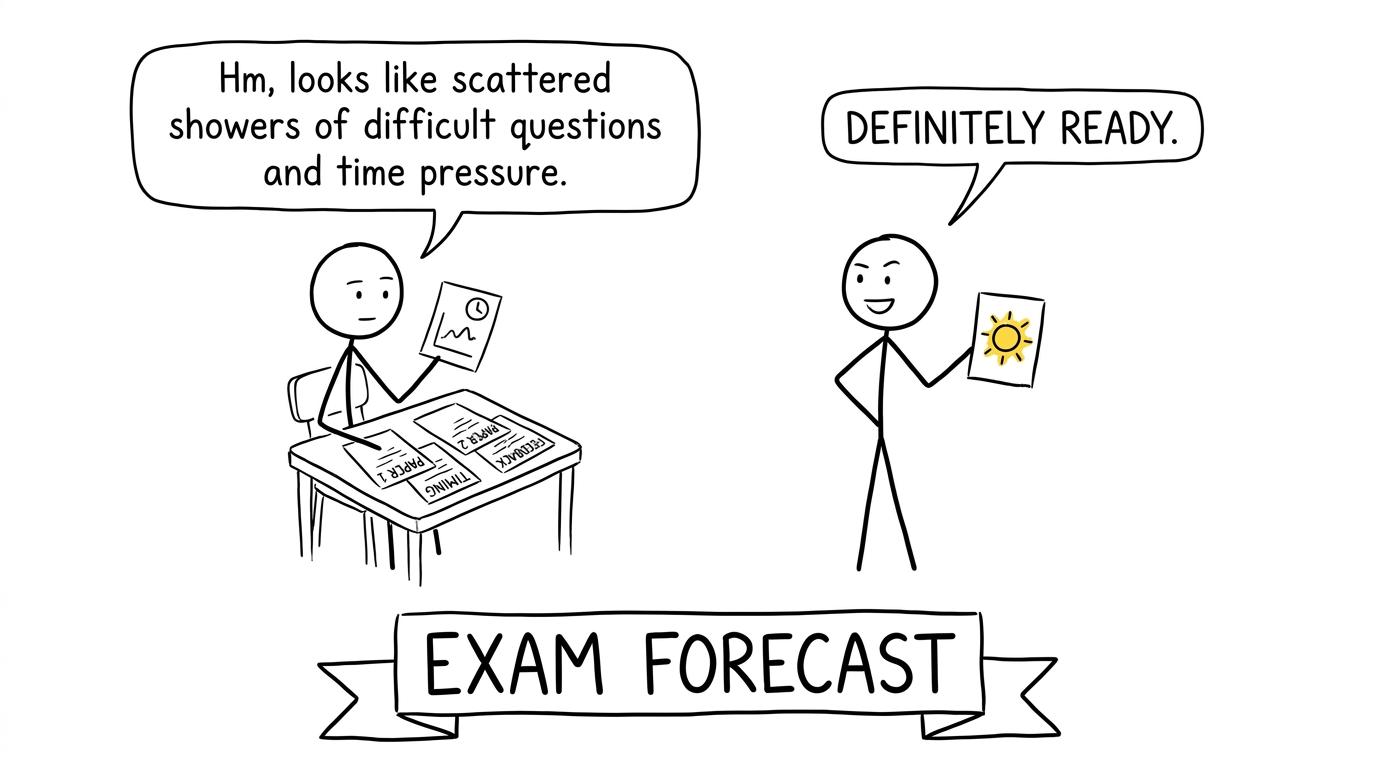 One student checks several forecasts while another trusts one sunny result
A sensible readiness judgement includes a margin for variation. If your target is only reached when the source feels familiar or the writing task suits you perfectly, the result is fragile. If you remain around or above the target across different papers, the evidence is stronger.
Maths students can use the same diagnostic habit with GCSE maths past papers, where mark schemes and focused revision expose whether a result is repeatable rather than lucky.
Check the skills behind the total mark
A high overall score can conceal a serious gap. Strong creative writing might compensate for weak comparison in one mock, but the balance may shift on another paper.
Ask your teacher for an assessment-objective breakdown. You should be able to:
- retrieve and infer information accurately;
- select concise, relevant evidence;
- analyse how language and structure shape meaning;
- compare ideas or perspectives where required;
- evaluate a text with supported judgement;
- adapt form, tone and register to audience and purpose;
- organise extended writing coherently;
- maintain accurate spelling, punctuation and grammar.
The Spoken Language endorsement requires a prepared formal presentation, appropriate responses to questions and effective spoken Standard English. It is separately reported as Pass, Merit or Distinction rather than contributing marks to the written GCSE grade. Confirm with your school when and how it will be completed.
Protect the rest of your GCSE timetable
An early sitting is valuable only if its opportunity cost makes sense. English preparation may arrive during an important period for maths, science, English Literature and option subjects. The question is not merely, “Can I pass English early?” It is, “Can I prepare properly without reducing my wider outcomes?”
Create a realistic weekly timetable that includes lessons, homework, timed English papers, correction time and recovery. If fitting English into that plan means abandoning regular maths practice, the apparent shortcut may become expensive.
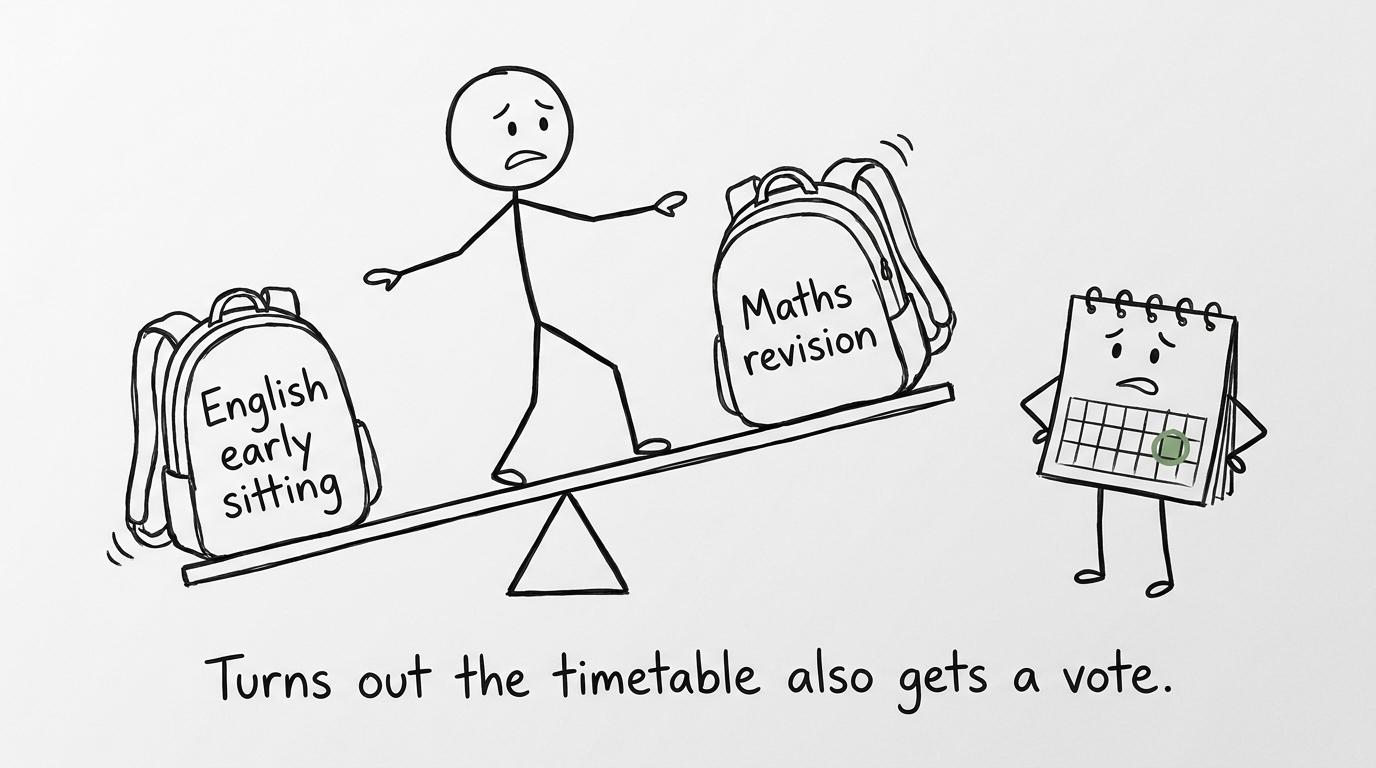 A student balances English early entry against maths revision
MathsGenie's twenty-minute maths revision routine can help preserve consistency on busy school days. For longer planning, use the GCSE one-week revision plan as a model for balancing diagnosis, practice and review.
Watch for tiredness too. If additional papers are damaging sleep, concentration or attendance, the timetable is giving you an answer. Sitting early is optional. Sustainable preparation is not.
A practical decision process
Gather independent evidence
Complete multiple unseen assessments covering the full qualification. Treat them as examinations, not assisted classroom tasks.
Review the pattern with your teacher
Ask for specific feedback on your likely grade range, weakest assessment objectives, timing and technical accuracy. “You are doing well” is supportive, but it is not enough for an entry decision.
Confirm the administration
Your examinations officer should verify the specification, available series, entry deadline, Spoken Language arrangements and the school's resit policy. Private candidates must enter through an approved examination centre rather than directly with an exam board.
Consider what happens afterwards
Decide how you would maintain literacy and writing skills after an early pass. Also ask what lesson or curriculum arrangements would follow. Passing early is less useful if it creates an unstructured gap in your timetable.
Make the decision collectively
The strongest decision combines student confidence, teacher evidence, centre approval and a workable whole-GCSE plan. If one of those pieces is missing, waiting is often the wiser choice.
Common mistakes when judging early-entry readiness
Treating one mock as proof: one result may reflect a favourable text, prompt or mark. Look for consistency across complete papers.
Confusing fast writing with effective writing: speed helps only when the response remains relevant, controlled and accurate.
Ignoring the weaker paper: confidence must cover every assessed component, not just creative writing or a preferred reading section.
Using the wrong exam board's format: broad skills transfer, but timings, wording and mark allocation differ. Final rehearsals must match your specification.
Assuming November is open to every student: age restrictions normally apply to GCSE English Language and maths in the November series in England.
Planning around a resit: a resit may be possible, but it requires more preparation and can affect the school's first-entry position. The first sitting should be a serious entry, not a trial run.
Sacrificing other subjects: an early English grade is not a gain if rushed preparation causes avoidable losses elsewhere.
Readiness is calm evidence, not urgency
The best sign that you are ready is not impatience to finish. It is quiet consistency: you know the specification, complete both papers on time, respond well to unfamiliar material and receive the same message from several properly marked assessments.
If that evidence is not present yet, keep building it. Waiting for the normal examination series is not falling behind. It may give your reading, judgement and writing greater depth.
Meanwhile, protect your maths progress with the free GCSE Maths revision hub. Use revision lessons and practice questions to repair individual gaps, Edexcel GCSE maths past papers to test performance under pressure, and Edexcel predicted papers for fresh exam-style rehearsal. Mark carefully, use the worked solutions and video solutions, then return to mini tests until the improvement is repeatable.
That is what readiness looks like in any subject: not simply feeling prepared, but having evidence that holds up when the paper begins.