Ready for GCSE Statistics Early Sitting? Key Signs
Ready for GCSE Statistics early sitting? Use paper evidence, topic mastery and teacher checks to decide whether early entry is sensible, not merely exciting.
There is a revealing difference between wanting to finish a GCSE early and being prepared to do it. Enthusiasm says, "I understand most of this." Readiness asks, "Can I still perform when the questions are unfamiliar, the clock is running and nobody gives me a hint?"
Being ready for GCSE Statistics early sitting means you have reliable evidence across the whole specification, not simply confidence after a good lesson or one strong mock. You should be consistently reaching an appropriate mark on unseen papers, working independently under timed conditions and recovering sensibly when a question feels unfamiliar. Your teacher should also agree that early entry supports your wider GCSE programme.
The decision is less about age than stability. A result produced once may be promising. A result repeated under different conditions is evidence.
The early-sitting readiness checklist
Before discussing an entry with your school, ask whether you can honestly tick these boxes:
- You know your exam board, specification and tier.
- You have covered the entire course, including less familiar topics.
- You can complete full papers within the official time.
- Your marks are consistent across several unseen assessments.
- You understand why you lose marks and can correct recurring errors.
- You can interpret data and evaluate statistical claims, not just perform calculations.
- Your calculator skills, written explanations and graph work are dependable.
- Preparing early is not damaging revision for GCSE Maths, English or other subjects.
- Your statistics teacher supports the entry.
- You understand the consequences of early entry and any later re-entry.
If several answers are "not yet", that is useful information rather than failure. It tells you what must become secure before the exam.
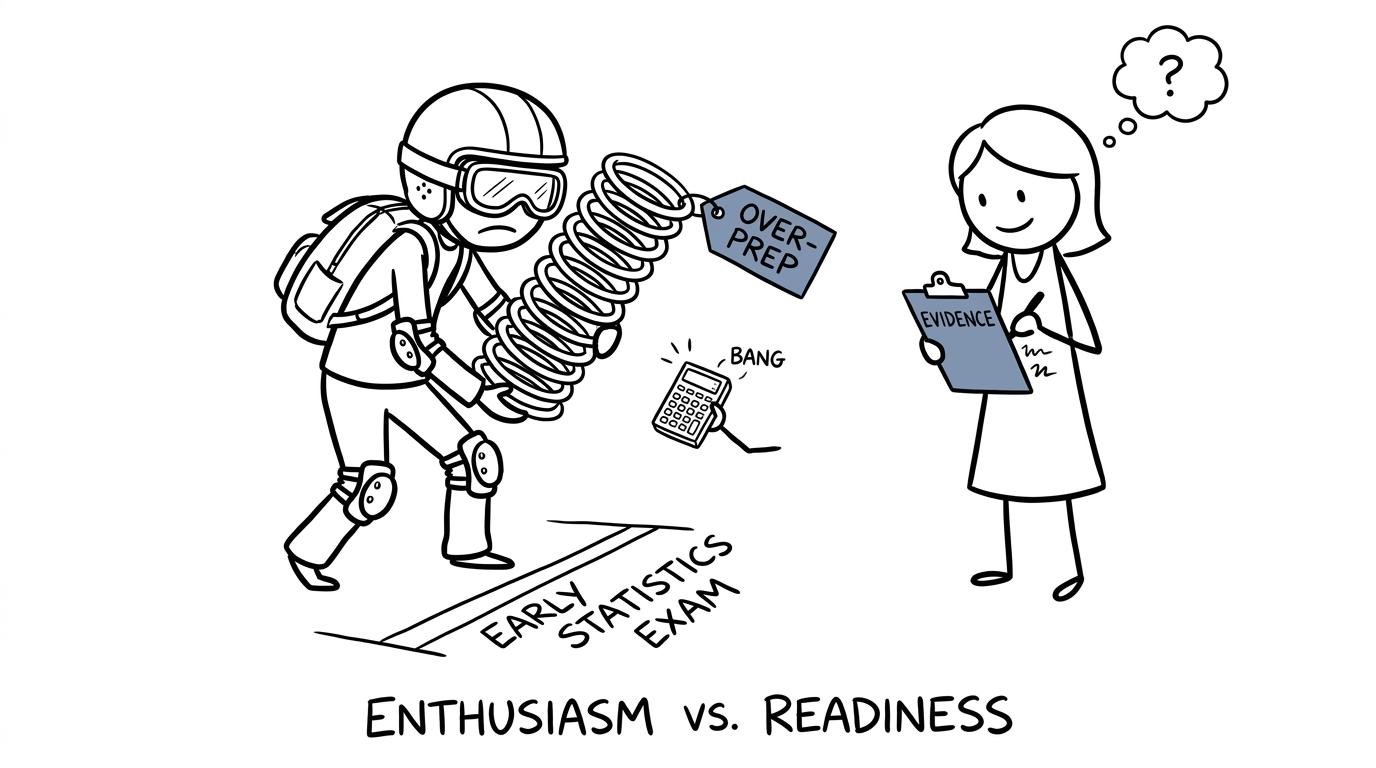 A keen student waits at the early Statistics exam starting line while a teacher checks the evidence
Keen versus genuinely ready
A keen student often enjoys the subject, completes classwork quickly and recognises familiar methods. Those are good signs, but an examination asks for more. It mixes topics, changes the wording and requires decisions without telling you which technique to use.
A genuinely ready student can:
- select a representative sampling method and discuss possible bias;
- choose suitable averages and measures of spread;
- read, construct and criticise statistical diagrams;
- interpret correlation without claiming that it proves causation;
- use probability models appropriately;
- compare distributions using context;
- explain limitations in data collection and conclusions;
- sustain accurate work across a complete paper.
The distinction is independence. If you can solve a question only after someone says "use cumulative frequency" or "think about stratified sampling", the topic is understood but not yet examination-ready.
Use the free GCSE Statistics revision hub to check the resources for your board rather than assuming that strong GCSE Maths data skills cover the separate Statistics specification.
You have mastered the whole specification
Statistics can feel deceptively comfortable because many early topics use familiar ideas: averages, charts, percentages and probability. The harder demand is reasoning about how evidence was obtained and what it can legitimately show.
Readiness therefore requires breadth. Make a specification checklist and classify every area as secure, developing or untested. "Secure" should mean that you can answer mixed exam questions without notes, not that you remember watching the lesson.
Students following Pearson Edexcel can use the Edexcel GCSE Statistics revision page to move between topic questions, worksheets and papers. If averages from grouped or frequency data remain fragile, revisit the averages from frequency tables revision guide before attempting another mixed assessment.
Your board matters. Current Pearson Edexcel GCSE Statistics assessment consists of two calculator papers, each lasting 111 hour 303030 minutes and carrying 808080 marks. AQA also uses two calculator papers worth 808080 marks each, but each lasts 111 hour 454545 minutes and includes Statistical Enquiry Cycle questions. Both qualifications are tiered. Confirm the exact board, tier and current arrangements with your school rather than practising under the wrong conditions.
Your past-paper results are consistent
One high mark can be caused by familiar questions, generous self-marking or a paper completed without strict timing. Readiness is better judged as a pattern.
Complete several unseen papers or securely controlled school mocks under the correct conditions. Record the raw mark, topics lost, unfinished questions and avoidable errors. You can calculate the percentage score using:
percentage score=raw marktotal marks×100\text{percentage score}=\frac{\text{raw mark}}{\text{total marks}}\times 100percentage score=total marksraw mark×100Do not choose a universal percentage from social media and treat it as a guarantee. Grade boundaries vary by exam series because papers vary in difficulty. Ask your teacher what level of performance provides a sensible margin for your target grade, using relevant official boundaries and your school’s assessment evidence.
Consistency matters more than your best result. If your scores swing sharply whenever a paper contains unfamiliar contexts, your knowledge may not yet be robust. If several properly timed attempts cluster around or above the agreed target, that is stronger evidence.
Past papers should remain diagnostic. The GCSE Statistics resit revision plan explains a useful process: mark carefully, identify the exact reason for each lost mark, repair the topic and retest it later. The same process works when preparing for early entry.
You can perform without support
Revision success and exam success are not identical. At home, it is easy to pause the timer, check a note or ask whether your diagram looks right. In the examination, your judgement has to stand on its own.
Run a realistic test:
- use an unseen paper matching your board and tier;
- follow the official time limit;
- use only permitted equipment;
- do not pause, search for help or check answers online;
- mark it afterwards with the correct mark scheme;
- have a teacher review answers involving interpretation or evaluation.
A student ready to sit early does not need every question to feel easy. They need a sensible response when it does not. That may mean annotating the information, identifying the stage of the statistical enquiry cycle, showing a valid method and returning later rather than becoming stuck.
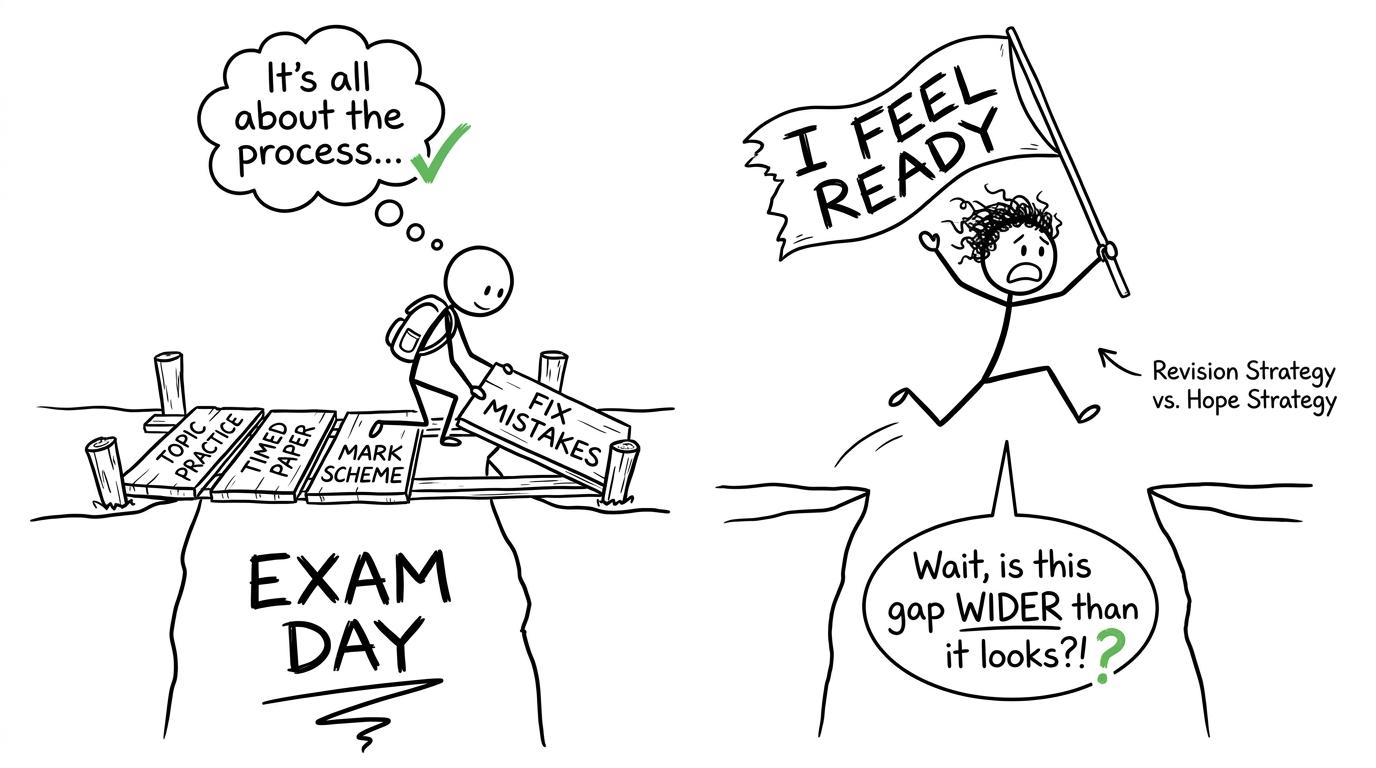 A student builds a bridge to exam day from topic practice, timed papers, mark schemes and corrections
Your statistical reasoning is stronger than memorised methods
GCSE Statistics rewards judgement. You may need to decide whether a sample is representative, explain why a conclusion is unreliable or compare two distributions using both average and spread.
A complete comparison usually needs appropriate statistics and contextual interpretation. Knowing that the interquartile range is
IQR=Q3−Q1\text{IQR}=Q_3-Q_1IQR=Q3−Q1is useful, but readiness means understanding what a larger or smaller value suggests about the variation in the data. Similarly, recognising correlation is not enough. You must avoid treating association as proof that one variable causes another.
Ask your teacher to inspect extended responses rather than relying entirely on self-marking. A numerical answer is often straightforward to check; the quality of an evaluation can be harder to judge objectively.
You have enough time without weakening other subjects
An early GCSE is not automatically an advantage. It is worthwhile only if the preparation fits alongside the rest of your education.
Consider the opportunity cost. Extra Statistics papers may take time from GCSE Maths topics that still need attention, English coursework or another subject with a heavier content gap. Being capable of passing early is not the same as early entry being the best decision.
Use the free MathsGenie revision planner to map the remaining Statistics topics, timed papers and correction sessions beside your other commitments. A sustainable plan contains rest and catch-up space. If the plan works only when every week goes perfectly, it is too fragile.
The one-month GCSE revision plan also offers a practical structure for diagnosis, targeted practice and timed assessment. Adapt the cycle to Statistics rather than simply adding more hours.
Your teacher agrees that the evidence is strong
Your school or examination centre manages the entry and decides the tier. Speak to your teacher or examinations officer early enough for them to review the evidence and explain deadlines, fees where relevant, access arrangements and school policy.
Bring useful information to that conversation:
- marks from several controlled papers;
- an error log showing improvement;
- a completed specification checklist;
- evidence that you can manage the official timing;
- your target grade and reason for taking the qualification early.
In England, early entry can also affect school performance measures because first-entry rules may determine which result counts for accountability purposes. That is not the same as saying that a later result disappears from your personal record, but it is another reason for the school to consider entry carefully. Ask how the current rules apply to your particular cohort rather than making assumptions.
Common mistakes when judging early-entry readiness
Using one mock as proof
A single result is a snapshot. Use several unseen, timed assessments covering different parts of the specification.
Revising only comfortable topics
Repeatedly answering averages or basic probability questions can create confidence without revealing gaps. Mixed papers expose whether you can select methods independently.
Treating predicted content as a replacement for the course
Predicted papers can provide valuable extra practice, but no prediction removes the need to revise the full specification. Read how to use predicted topics without guessing and treat every prediction as practice, not a promise.
Marking interpretation too generously
Statistics answers often need a comparison, a contextual statement or a limitation. Ask a teacher to check longer written responses against the mark scheme.
Ignoring timing and calculator fluency
Knowing a method slowly is not enough. Practise entering calculations accurately, checking graphs and moving on when a question is consuming too much time.
Assuming enthusiasm guarantees resilience
You can enjoy Statistics and still need more preparation. Readiness includes responding calmly to an awkward paper and continuing after a difficult question.
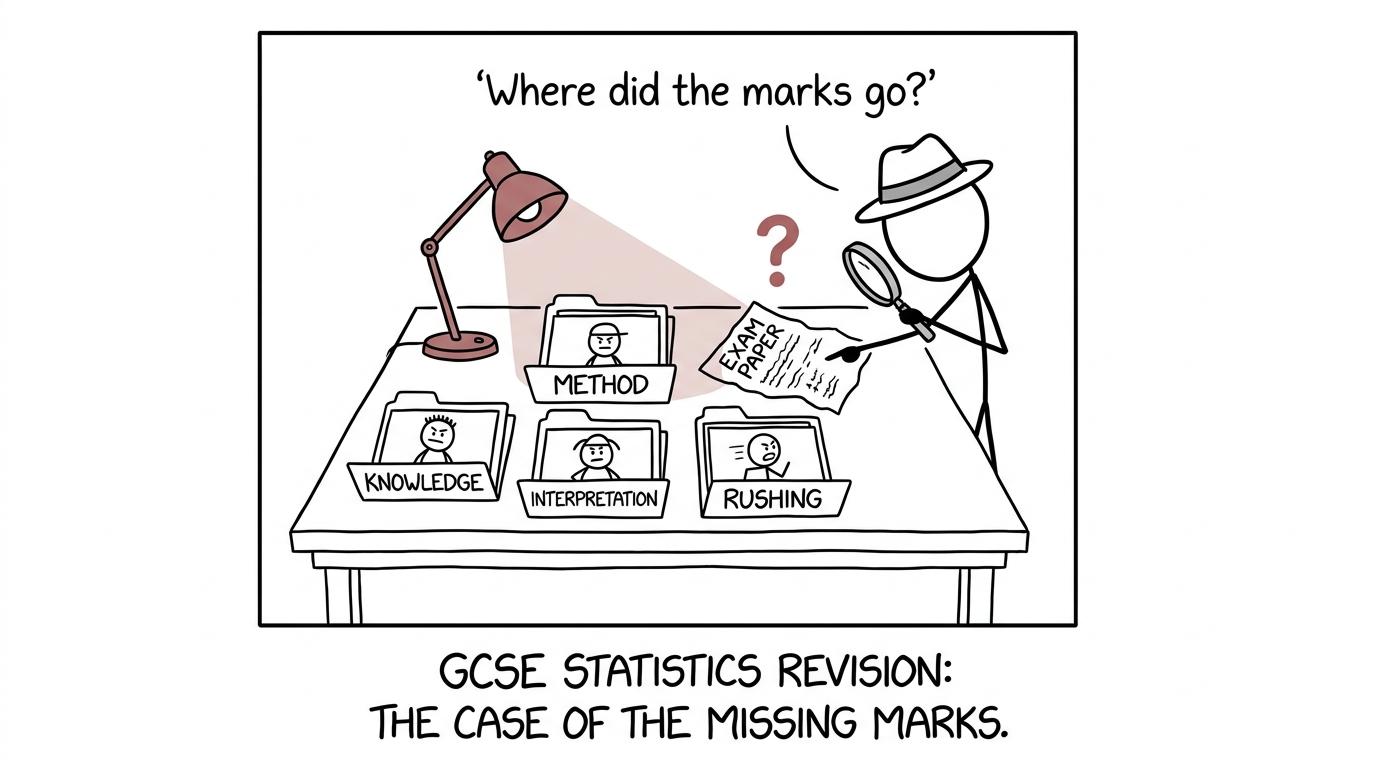 A student detective investigates where the marks disappeared
Make the decision from evidence, not impatience
The best sign that you are ready is not that you want the exam over with. It is that your performance has become repeatable: full coverage, stable timed marks, independent reasoning, careful interpretation and teacher agreement.
If the evidence says "not yet", you have gained something valuable: a precise revision plan. Start with the MathsGenie GCSE Statistics resources, repair weak topics through revision lessons and practice questions, then test the improvement using mini tests, past papers, mark schemes and video solutions. Use predicted papers only after the specification is secure.
If the evidence remains strong across several assessments, take it to your teacher and discuss the entry. Early sitting should be the result of readiness, not the test of whether readiness exists.