Ready for GCSE History Early Sitting? Key Signs
Ready for GCSE history early sitting? Use this evidence-led checklist to test knowledge, exam technique, timing and whether early entry is sensible.

There is a large difference between wanting to finish a GCSE early and being ready to do it. Enthusiasm matters, but the exam cannot see enthusiasm. It sees knowledge, analysis, judgement and performance under time pressure.
If you are wondering whether you are ready for GCSE History early sitting, the short answer is this: you need consistent evidence from complete, timed assessments covering your exact specification. One promising mock, a strong memory or a love of history is not enough. You should also understand the practical consequences of early entry and have the support of your teacher, school and parent or carer.
This guide will help you distinguish genuine readiness from understandable eagerness. Although the subject is History, the evidence-led approach will feel familiar to students who use MathsGenie's GCSE maths revision hub: attempt, mark, diagnose, improve and retest.
The early-sitting readiness checklist
Before agreeing to an early entry, you should be able to answer yes to most of these statements:
- I know my exam board, specification, topics, paper structure and question types.
- I have completed all the content that will be assessed.
- I can recall accurate evidence without relying heavily on prompts.
- I can explain causes, consequences, change, continuity and significance.
- I can evaluate sources and interpretations rather than merely describe them.
- I have completed several full assessments under timed conditions.
- My results are consistent, not dependent on a familiar topic or generous marking.
- A qualified teacher has reviewed my scripts and agrees that early entry is sensible.
- Preparing early will not damage my progress in maths, English, science or other GCSEs.
- I understand the entry arrangements and what would happen if I later resat the subject.
The final decision should be based on the whole pattern. Readiness is not a mood. It is a record of repeatable performance.
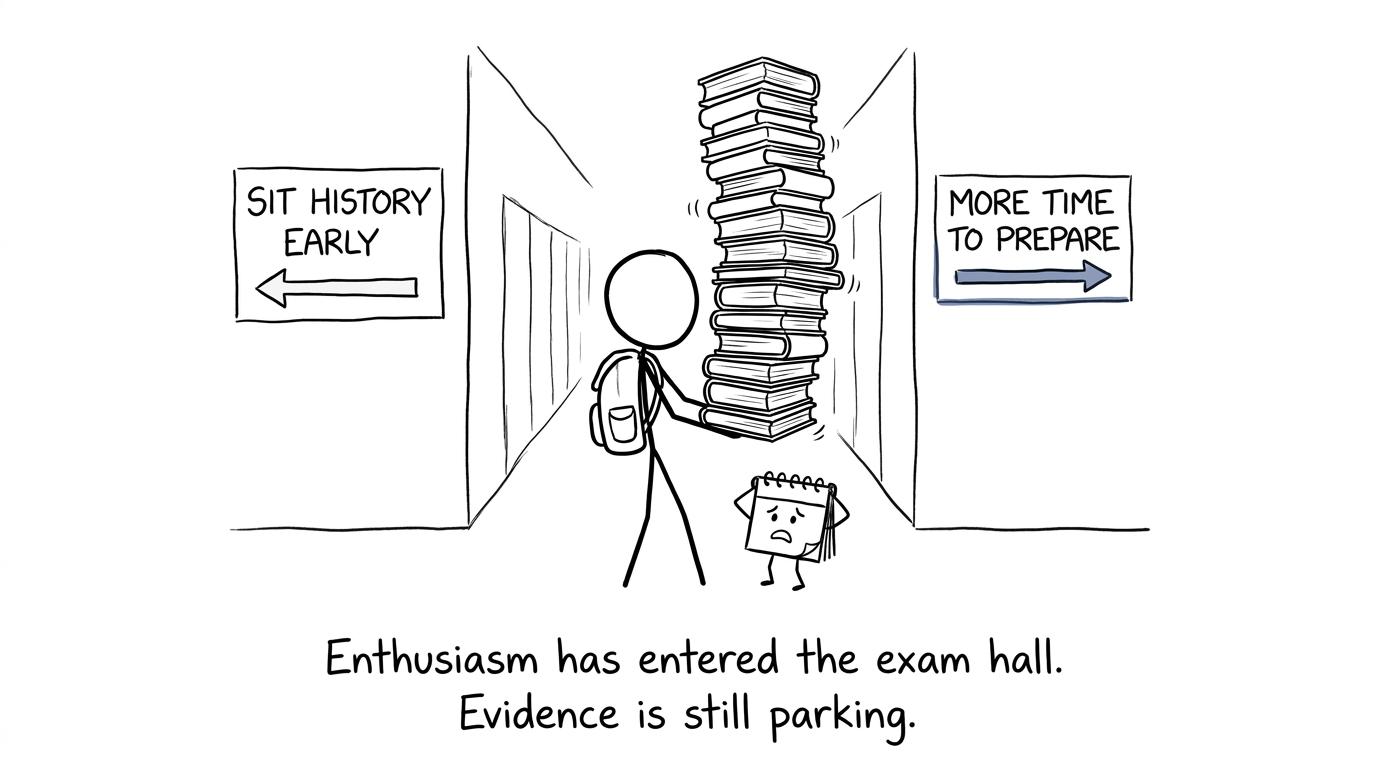 A student choosing between sitting History early and taking more preparation time
Know exactly which GCSE History you are taking
GCSE History is not one universal collection of topics. Edexcel, AQA, OCR and Eduqas offer different specifications and option combinations. Even two students following the same exam board may study different depth, period or thematic studies.
You therefore need to confirm:
- the awarding organisation and specification code;
- every option selected by your school or centre;
- the number, duration and order of the papers;
- the command words and mark tariffs used;
- whether revised specification content applies to your examination year;
- the permitted examination series.
This matters particularly when using old papers. Pearson introduced content changes affecting parts of Edexcel GCSE History for first assessment in summer 2026, for example. Specifications in Wales are also undergoing reform, so students following WJEC or Eduqas routes must check the qualification and assessment year carefully. Your teacher and current exam-board specification should settle any uncertainty.
Unlike GCSE maths, GCSE History in England is not divided into foundation and higher tier. The same qualification must distinguish performance across grades 999 to 111. Being comfortable with straightforward recall questions does not therefore prove that you are ready for the demands of the complete paper.
You have finished the course, not merely raced through it
Coverage is the first test. You should have been taught, revised and assessed on every required unit, including content that feels less memorable.
But coverage is not the same as mastery. Reading a chapter once may create recognition: the material looks familiar when you see it. An exam requires retrieval: you must produce relevant knowledge without the page in front of you and select what answers the precise question.
A useful audit has three columns:
| Area | Evidence of readiness | Warning sign |
|---|---|---|
| Knowledge | Accurate recall across every unit | Large gaps outside favourite topics |
| Chronology | Events placed in a coherent sequence | Dates remembered as isolated facts |
| Concepts | Confident use of cause, consequence, change and significance | Narrative without explanation |
| Sources | Evaluation using content, provenance and context | Generic claims about bias |
| Interpretations | Supported comparison and judgement | Description of what each view says |
If one paper or unit is substantially weaker, the qualification is not yet secure. Early entry compresses the time available to repair that weakness.
Your skills match the assessment objectives
For GCSE History qualifications regulated in England, Ofqual sets four assessment objectives. Broadly, AO1 tests knowledge and understanding, AO2 tests explanation through second-order historical concepts, AO3 concerns sources, and AO4 concerns interpretations.
The subject marks are weighted approximately as follows:
- AO1: 35%35\%35%
- AO2: 35%35\%35%
- AO3: 15%15\%15%
- AO4: 15%15\%15%
Accuracy in spelling, punctuation and grammar, alongside appropriate specialist terminology, is also credited under the regulatory requirements. Individual exam boards distribute questions and marks differently, so use the mark scheme for your own specification.
The important lesson is that factual knowledge alone cannot carry the whole GCSE. A student who remembers many dates but cannot construct a supported explanation may feel prepared while still dropping substantial marks.
Ask your teacher to classify lost marks by assessment objective. You can calculate the proportion lost in each area using:
Loss rate=marks lost in an assessment objectivemarks available for that objective×100\text{Loss rate} = \frac{\text{marks lost in an assessment objective}}{\text{marks available for that objective}} \times 100Loss rate=marks available for that objectivemarks lost in an assessment objective×100This is a diagnostic measure, not a universal readiness boundary. Your teacher should decide what level of consistency is appropriate for your target grade.
Your timed results are stable
One excellent paper can be luck. Perhaps the questions matched your strongest unit. Perhaps you had recently revised the exact issue assessed. Genuine readiness survives changes in topic, question wording and energy level.
Collect evidence from several assessments completed:
- without notes or advance knowledge of the questions;
- within the official time limit;
- using complete papers or realistic combinations of sections;
- under quiet, uninterrupted conditions;
- with strict marking and written feedback.
Record your total, marks by question type and unfinished sections. You are looking for a stable range rather than a single personal best. If one result is dramatically higher than the others, investigate why before treating it as evidence.
This is the same principle behind using GCSE past papers properly. A paper is most valuable when it reveals what to fix. Maths students can build the habit with GCSE 45-minute tests, then transfer the discipline of timed practice and honest marking to History.
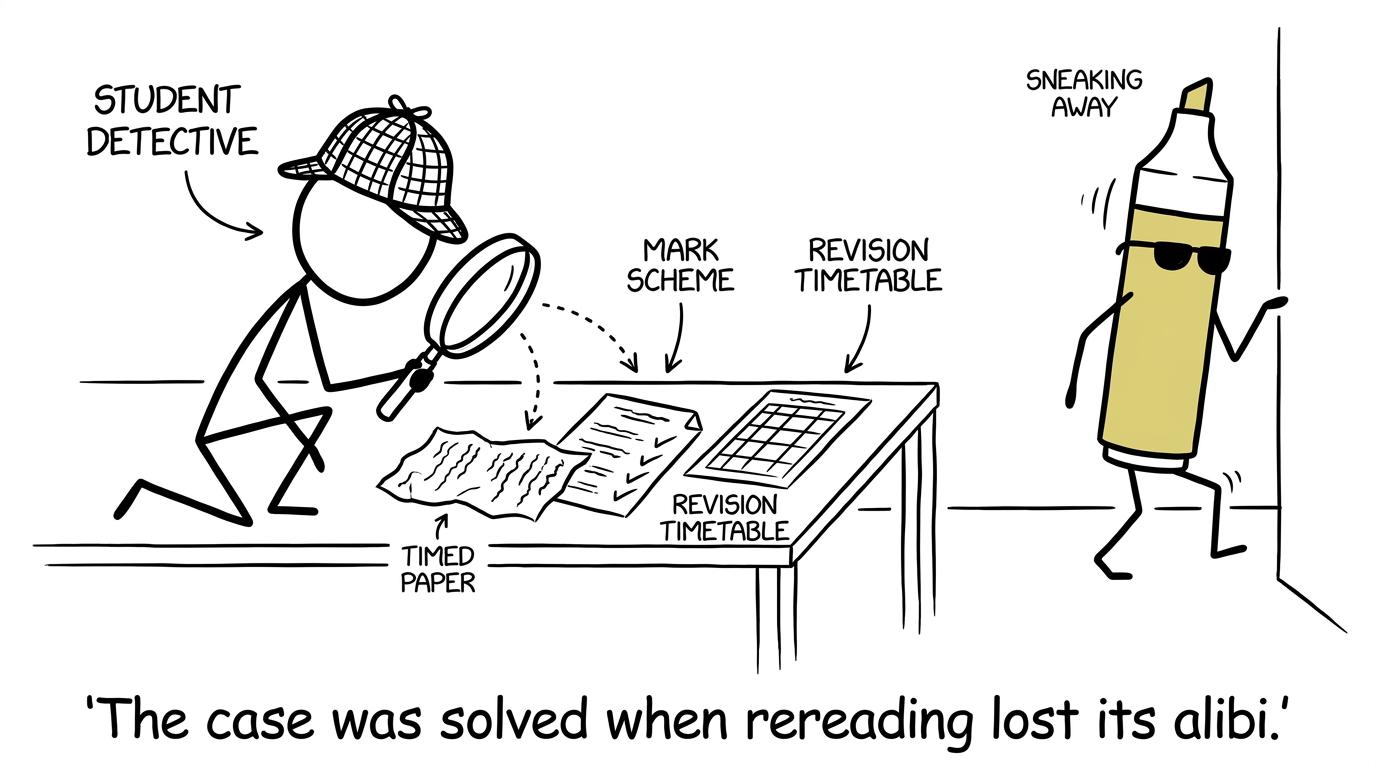 A revision detective investigating timed papers and mark schemes
You can manage the entire examination experience
Knowing the content at home is only one part of readiness. You must also make decisions while the clock is moving.
A ready student can usually:
- identify the demand of a question quickly;
- select relevant evidence rather than writing everything remembered;
- allocate time according to the marks available;
- sustain analytical writing across the full paper;
- reach supported judgements where required;
- move on when a response is taking too long;
- proofread without sacrificing an unfinished high-tariff answer.
Pay attention to stamina. A strong first response followed by rushed or incomplete later answers suggests that knowledge has developed faster than examination control.
MathsGenie's guide to finding your weakest GCSE topics offers a useful cross-subject method: log each lost mark, identify the reason and retest the weakness. In History, your labels might include missing knowledge, weak contextualisation, unsupported judgement, source evaluation or timing.
Early entry must fit your wider GCSE plan
An early History sitting does not happen in isolation. The revision hours have to come from somewhere. If accelerating History causes neglected algebra, incomplete science content or exhaustion before English assessments, the apparent head start may create a larger cost elsewhere.
Map the preparation alongside your complete timetable. MathsGenie's one-month revision plan demonstrates how to combine retrieval, focused practice and timed papers without treating every evening as an emergency. The same planning principle applies across subjects.
Consider what finishing History early would genuinely achieve. It may reduce the number of Year 111111 examinations or suit a student who has completed the course independently. But sitting early simply to remove the subject from a timetable is weak reasoning if another year could produce deeper understanding and a stronger grade.
The question is not, “Could I pass now?” It is, “Is sitting now better than using the available time to improve?”
Confirm the administrative consequences
Your school or approved examination centre makes the entry. If you are studying independently, JCQ defines you as a private candidate when you sit examinations at an approved centre without being enrolled there. Private candidates must arrange entry through a centre, pay its fees and organise any access arrangements with it. Centres can set internal deadlines earlier than awarding organisations' deadlines.
Students in England should also discuss the Department for Education's early-entry and discounting rules with their school. Where qualifications overlap in the same subject, the first entry can affect which result counts in school performance measures. This does not make early entry impossible, but it is another reason not to treat it as a casual trial run.
Before committing, ask:
- Who will enter me, and for which exact specification and options?
- What are the centre's deadlines and charges?
- Have any required access arrangements been confirmed?
- Which examination series is available?
- What are the academic and administrative consequences of a resit?
Do not assume that you can book the qualification directly with an exam board or take it whenever you choose.
Signs you are keen but not yet ready
Enthusiasm can imitate readiness. Warning signs include:
- revising favourite periods while avoiding weaker units;
- measuring preparation by hours rather than marked work;
- knowing facts but struggling to answer the precise question;
- completing essays with unlimited time and calling them exam practice;
- depending on essay templates that do not adapt to unfamiliar wording;
- refusing to attempt full papers because a low mark might feel discouraging;
- assuming that a later resit removes all risk;
- making the decision without teacher feedback.
None of these means you cannot become ready. They simply show where evidence is missing.
Common mistakes when deciding on early entry
Using predicted grades as proof
A predicted grade is professional guidance, not a completed examination. Pair it with timed scripts, mark-scheme analysis and performance across the whole specification.
Treating content completion as exam readiness
Finishing the final topic means the course has been covered. It does not prove that earlier material can still be retrieved or applied.
Ignoring the weakest paper
Your strongest unit is comforting but not decisive. The weakest compulsory component often gives the clearest picture of whether more preparation time is needed.
Comparing yourself with another student
A classmate's early entry says nothing about your specification coverage, target grade or wider workload. Use your own marked evidence.
Revising History at the expense of maths
Early entry should reduce pressure, not relocate it. Keep maths active with short, regular practice through the Edexcel GCSE maths revision area or the AQA GCSE maths revision area, depending on your board.
Make the decision from evidence
A genuinely ready student has completed the correct specification, performs consistently under timed conditions, demonstrates all the assessment objectives and has teacher support. A merely keen student usually has motivation without enough full-paper evidence.
If the evidence says “not yet”, that is useful information rather than failure. More time allows knowledge to settle, writing to sharpen and weak units to catch up. If the evidence says “ready”, confirm the practical arrangements before entering.
Meanwhile, protect the rest of your GCSE programme. Use MathsGenie's free revision lessons and practice questions to repair individual maths topics, mini tests to check retention, and past papers, predicted papers, mark schemes and video solutions to build reliable examination performance. Start with the GCSE maths revision resources, make a realistic plan and let marked work, not impatience, tell you when you are ready.