

Pomodoro Technique GCSE Arabic: Does It Work?
Pomodoro technique GCSE Arabic advice: learn when short revision bursts improve vocabulary, writing and listening, and when longer sessions work best.
A revision timer can make a difficult evening feel manageable. Instead of promising yourself that you will revise Arabic for hours, you agree to concentrate for just 252525 minutes. The question is whether the Pomodoro technique for GCSE Arabic genuinely improves learning or merely makes revision look organised.
The short answer is: it can work, but the timer is not the part that creates learning. Short, protected blocks can help you begin, reduce distraction and practise vocabulary regularly. However, speaking tasks, extended writing and full listening papers often need longer, more flexible sessions. The strongest approach is to adapt the timer to the task rather than interrupting useful concentration simply because a bell rings.
For students balancing Arabic with GCSE maths, English and science, that flexibility matters. Your revision system should protect attention while still preparing you for the length and demands of the real examination.
The quick Pomodoro checklist for GCSE Arabic
Use this as your starting point:
- Choose one precise outcome before starting.
- Work without notifications for 252525 minutes.
- Take a genuine 555-minute break away from the task.
- Use active recall rather than simply rereading vocabulary.
- Join two blocks together for extended writing or listening.
- Mark or check your work before the session ends.
- Revisit the same material on another day.
- Practise full papers separately under examination conditions.
A timer gives revision a boundary. It does not decide what belongs inside that boundary.
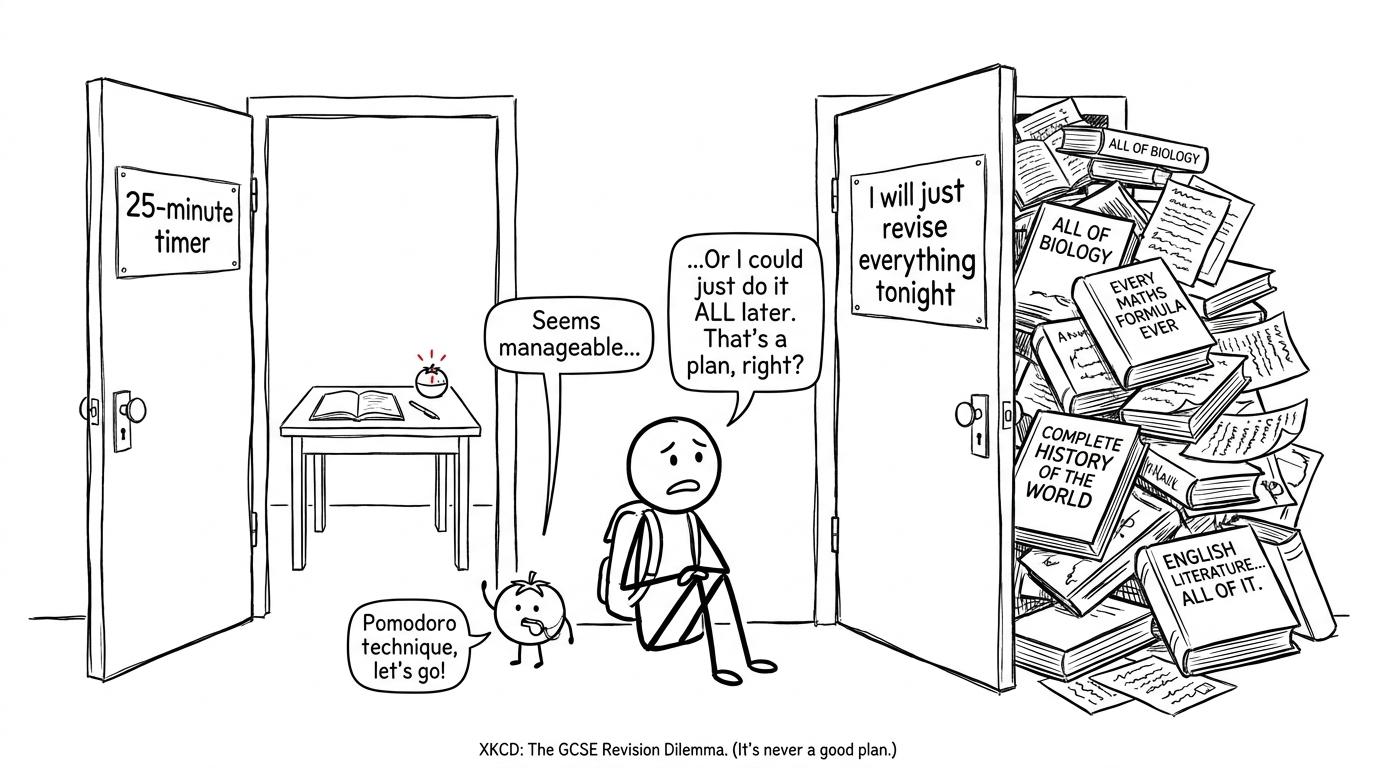 A student chooses between a small timed revision session and an enormous mountain of books
Does the Pomodoro Technique actually improve learning?
The traditional routine uses 252525 minutes of focused work followed by a 555-minute break. After several cycles, you take a longer break. This structure can lower the emotional cost of starting: 252525 minutes feels possible even when “revise Arabic” feels enormous.
Research into predetermined revision breaks presents a measured picture. Some studies with university students have found lower distraction and fatigue during structured sessions. Other recent comparisons have found no meaningful advantage in task completion or learning performance over self-regulated breaks. The evidence is not specific to school-age students learning GCSE Arabic, so it would be misleading to claim that one timer pattern guarantees better marks.
What the technique does reliably provide is structure. It asks you to define a task, remove distractions and return after a break. Those behaviours can support effective revision, but they still need to be combined with retrieval, feedback and spaced practice.
This distinction is important. Completing four timed blocks is not the same as learning for four blocks. A student who retrieves vocabulary from memory, checks errors and revisits it later is doing more useful work than someone who spends the same time highlighting a list.
Why short revision bursts suit parts of GCSE Arabic
Pearson Edexcel GCSE Arabic assesses listening, speaking, reading and writing, with each skill contributing equally to the qualification. Those skills overlap, but they do not respond equally well to the same session length.
Vocabulary retrieval
A short block is well suited to vocabulary because the task can be narrow and measurable. You might retrieve words from one theme, check them, separate secure words from uncertain ones and test the uncertain set again.
The crucial word is retrieve. Looking repeatedly at an Arabic word and its English meaning can create familiarity without reliable recall. Covering the answer and producing it from memory is harder, but that difficulty gives you useful evidence about what you know.
Spread these blocks across several days. Spacing matters more than squeezing every repetition into one evening. The same principle supports maths revision: MathsGenie's guide to stopping forgotten GCSE content explains how retrieval and later re-testing can be built into a practical routine.
Grammar and sentence construction
Focused bursts can also help with one defined grammar feature or sentence pattern. The scope must remain small. “Revise Arabic grammar” is too vague; “produce accurate sentences using one tense and check verb agreement” gives the block a finish line.
Correction belongs inside the session. If you write for 252525 minutes but never inspect accuracy, you may rehearse the same mistake repeatedly. Reserve the final few minutes for checking forms, spelling, agreement and whether your sentences actually answer the intended question.
Short reading extracts
A Pomodoro can hold one short text, a set of comprehension questions and a review of unfamiliar language. It works particularly well when you attempt questions before reaching for notes or a dictionary during ordinary revision.
Keep the examination rules separate from your home routine. Your final preparation should reflect the resources and conditions permitted by your specification, not the conveniences available at your desk.
When GCSE Arabic needs longer sessions
A timer becomes unhelpful when it breaks a task at the moment productive concentration begins. The purpose is to protect attention, not to obey 252525 minutes at all costs.
Extended writing
Longer writing tasks require planning, sustained composition and checking. Stopping midway through an argument can make your writing less coherent and prevent you from discovering whether you can manage the task as a whole.
Use two linked blocks instead. Plan and begin in the first, take a short break if you reach a natural stopping point, then complete and check in the second. As examinations approach, practise complete tasks within the appropriate time rather than pausing automatically.
Listening practice
Short clips fit neatly into timed bursts. A complete listening paper does not. Repeatedly stopping audio outside the permitted format can create a false sense of control, while the examination requires you to follow its fixed sequence and timing.
Use short sessions to improve individual weaknesses such as numbers, opinions or changes of tense. Use uninterrupted sessions to rehearse full-paper concentration.
Speaking preparation
Brief sessions are useful for retrieving phrases, improving pronunciation and answering quick questions aloud. A complete speaking rehearsal needs continuity because interaction, recovery and spontaneous responses cannot be recreated through isolated flashcards alone.
A sensible pattern is to use short weekday blocks for language building, followed by a longer weekly rehearsal with a teacher, partner or suitable recording routine. The short work builds the pieces; the longer rehearsal tests whether they connect.
A flexible Pomodoro plan for Arabic and maths
Many GCSE students are not choosing between Arabic revision methods in isolation. They are deciding how to fit Arabic beside algebra, geometry and several other subjects. A good plan reduces that competition.
Try this flexible evening structure:
- First block: Arabic vocabulary retrieval for 252525 minutes.
- Break: move, drink water and leave your phone alone for 555 minutes.
- Second block: one focused GCSE maths topic for 252525 minutes.
- Break: another 555 minutes.
- Third and fourth blocks: join them for Arabic writing, maths paper practice or another task requiring continuity.
- Final review: record errors and choose what needs revisiting.
For a shorter day, MathsGenie's 20-minute GCSE maths revision routine shows how to combine recall, questions and marking without pretending that every evening offers unlimited time.
The resource should match the block. Start from the GCSE maths revision hub when you need board-specific lessons and practice for Edexcel, AQA, OCR or Eduqas. If you take AQA, use the AQA GCSE maths revision area rather than practising material chosen for a different board.
Short blocks work especially well with Edexcel GCSE maths mini tests. Full Edexcel GCSE maths past papers, by contrast, should usually be completed in continuous exam conditions. The same distinction applies to Arabic: isolate skills when learning, then combine them when rehearsing performance.
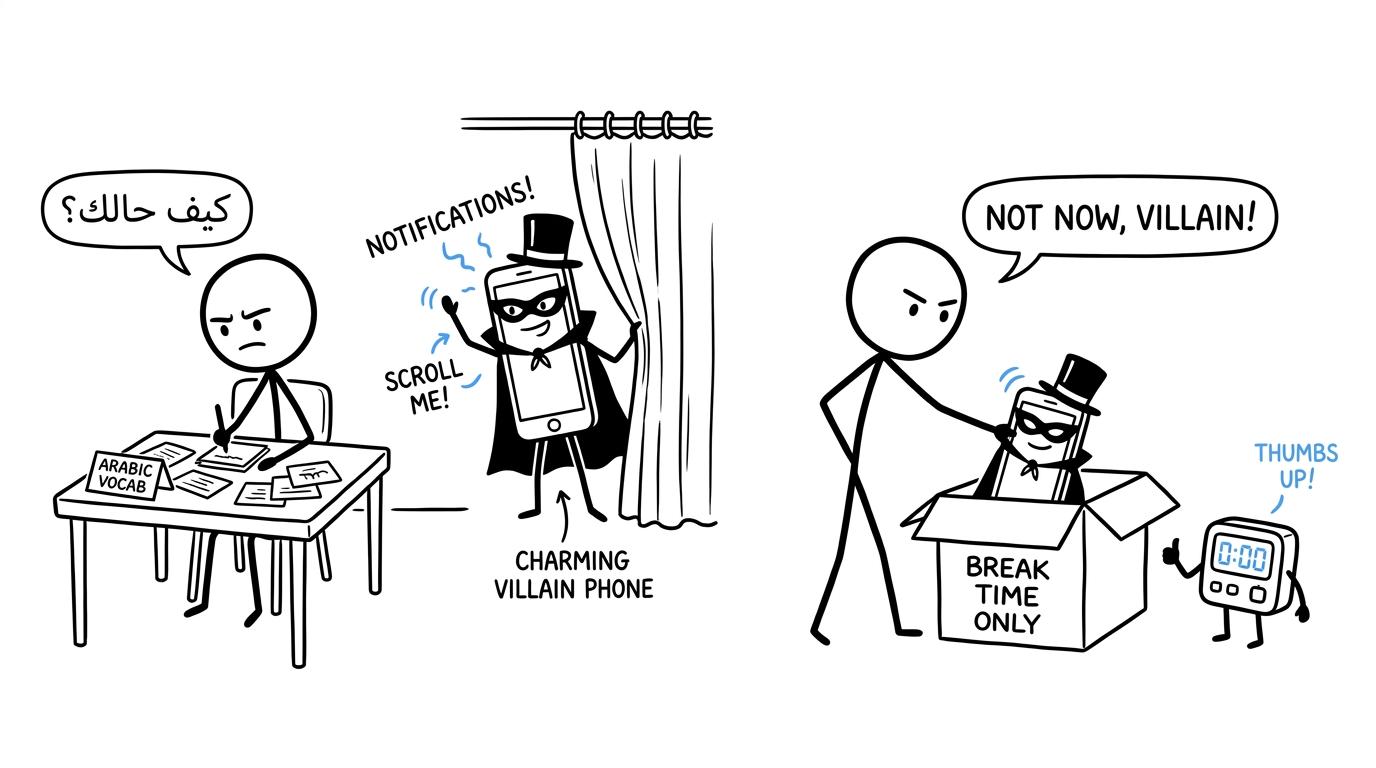 A distracting phone is placed in a break-time-only box while a student revises
How to make each timed block count
Before starting, write an output rather than a subject name. “Arabic” is not a task. “Retrieve vocabulary from the school theme, check it and record errors” is.
During the block, keep only the required materials open. A phone used as a timer can also be a doorway to messages, videos and several missing minutes. Use focus mode, place it out of reach or use a separate timer.
At the end, evaluate the result:
- What could you produce without support?
- Which errors repeated?
- What should be revisited tomorrow or later in the week?
- Does the next task need a short block or uninterrupted practice?
This plan-monitor-review cycle is a form of self-regulated learning. It turns the timer from a productivity decoration into a feedback system.
For maths, the same habit can begin with a diagnostic paper and an error log. MathsGenie's guide to finding your weakest GCSE topics helps you choose revision from evidence rather than comfort. Nearer the examination, Edexcel GCSE maths predicted papers can provide fresh timed practice after topic gaps have been addressed.
Common Pomodoro mistakes in GCSE Arabic revision
Treating time completed as proof of learning
A row of finished timers measures attendance, not recall. End each block with a check: a vocabulary test, an answer produced aloud, corrected sentences or a short set of questions.
Taking breaks on social media
A 555-minute break can become much longer when notifications take control. Choose a low-friction break such as stretching, walking or getting water.
Interrupting concentration mechanically
If you are near the end of a writing response or listening task, finish at a sensible boundary. A timer should serve the task. The task should not serve the timer.
Using only short sessions
GCSE exams demand sustained attention. Short sessions can build knowledge, but they cannot replace complete speaking rehearsals, writing tasks, listening assessments or past papers.
Revising only comfortable material
Vocabulary you already know feels productive because it moves quickly. Use errors from classwork, tests and teacher feedback to select the next block. Improvement usually begins where fluency ends.
Ignoring marking and correction
Practice without feedback leaves you uncertain about accuracy. Build checking into every session, just as you would use maths mark schemes and video solutions after completing exam questions.
The verdict: use the timer, but adapt it
The Pomodoro technique can be effective for GCSE Arabic when the main problem is beginning, maintaining attention or returning to vocabulary regularly. It is less suitable when a task requires uninterrupted listening, spontaneous speaking, extended writing or realistic examination stamina.
So keep the structure, but loosen the rule. Use short blocks for retrieval and targeted repair. Combine blocks for demanding language work. Protect full-length sessions for exam practice. Most importantly, judge revision by what you can recall, produce and correct, not by how many tomatoes appear on an app.
The same system can keep maths moving while you prepare for Arabic. Begin with MathsGenie's free GCSE maths revision resources, choose a revision lesson or focused set of practice questions, and use mini tests for short blocks. Then build towards past papers and predicted papers, checking every attempt with mark schemes and video solutions. If you continue with maths after GCSE, the A Level maths revision hub provides the same clear route from learning to independent exam practice.
Set one precise task, start the timer and make the block earn its place.











