Podcasts & Audiobooks for GCSE Spanish Revision
Podcasts audiobooks GCSE Spanish: discover when listening helps, why passive audio falls short, and how to combine it with active exam practice for success.
Revision often begins with an optimistic idea: perhaps you can put on some headphones, press play and learn while doing almost anything else. If your search history says “podcasts audiobooks GCSE Spanish”, the short answer is yes, listening can genuinely help, but it works best as a supplement, not as your entire revision method.
Podcasts and audiobooks can improve your familiarity with spoken Spanish, pronunciation, rhythm and vocabulary in context. What they cannot do alone is prepare you fully for dictation, reading, writing, speaking or the precise demands of an exam paper. For that, listening needs to become active and sit alongside specification vocabulary, exam-style questions and feedback.
This matters especially if Spanish is competing with GCSE maths and several other subjects. Audio can fill moments when written revision is impractical. It should not quietly replace the focused practice that earns marks.
The quick listening revision checklist
Effective GCSE Spanish listening usually includes the following:
- Choose material close to your current level.
- Prioritise GCSE themes and vocabulary.
- Use short sections rather than playing an entire episode passively.
- Listen more than once, with a different purpose each time.
- Retrieve key words without looking at a transcript.
- Write down or repeat selected phrases.
- Complete exam-board listening questions as well.
- Keep maths revision active with questions, marking and corrections.
Think of audio as exposure plus practice. Exposure helps Spanish sound less unfamiliar. Practice checks whether you can actually understand and use what you heard.
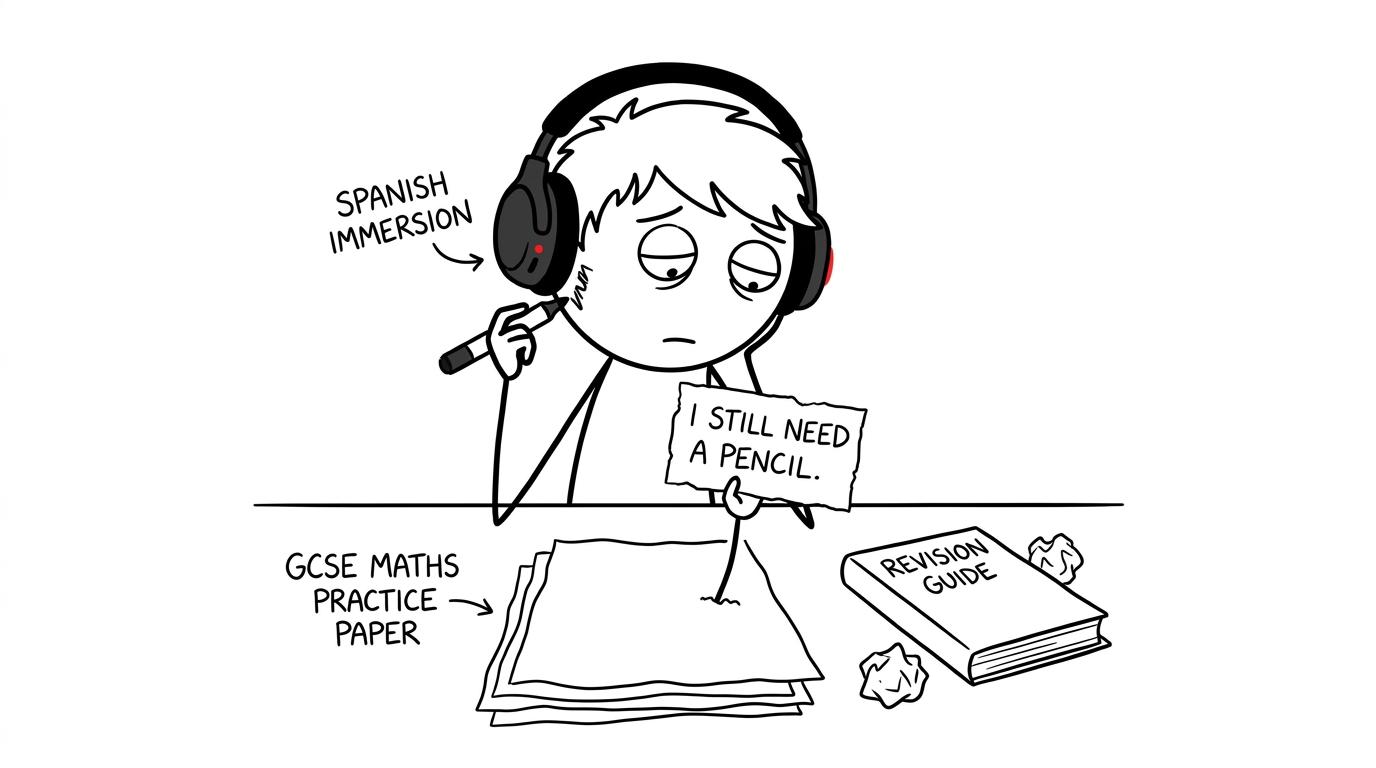 A student discovers that headphones cannot complete a maths practice paper
Do podcasts and audiobooks genuinely help GCSE Spanish?
They can help with several skills that matter in GCSE Spanish.
Becoming comfortable with natural speech
Spoken Spanish can initially feel like one continuous stream because speakers connect sounds and do not pause neatly between every word. Regular listening helps you notice where familiar words begin and end. It also exposes you to pronunciation, intonation and different voices.
This does not mean that any Spanish audio is automatically useful. A fast current-affairs programme created for fluent adults may produce little more than confusion. Material becomes more productive when you can understand the general subject and identify at least some of the language without relying entirely on English.
Learning vocabulary in context
A vocabulary list tells you what a word means. Audio shows you how it behaves inside a sentence. You hear which words commonly appear together, how verbs change and how speakers express an opinion or move between time frames.
Context can make vocabulary more memorable, but recognition is not the same as recall. Hearing a familiar word and thinking “I know that” is easier than producing it in a speaking or writing assessment. After listening, close the transcript and try to recall the key expressions. That small act turns exposure into revision.
Preparing for listening and dictation
Current AQA and Pearson Edexcel GCSE Spanish specifications include a distinct listening assessment worth 25%25\%25% of the qualification. Their reformed qualifications also assess transcription or dictation within listening. Exact paper lengths, marks and task formats differ, so students should always check the current specification and sample assessment materials for their board.
Podcasts and audiobooks build general listening confidence, but exam audio has its own demands: instructions, distractors, short-answer questions and precise transcription. Only exam-board materials reproduce those demands closely enough. Use general listening to strengthen the underlying skill, then test it with official-style questions.
Podcasts or audiobooks: which is better?
Neither format is universally better. They solve different revision problems.
Why podcasts are usually easier to target
Podcasts tend to be shorter and more focused. You can choose an episode connected with family, school, technology, holidays, the environment or another specification theme. Learner-focused programmes may also provide transcripts, controlled speed and explanations.
Their shorter structure makes repeated listening realistic. Replaying a three-minute section is manageable; restarting a long chapter can feel less inviting.
When audiobooks become useful
Audiobooks provide sustained exposure to narration, description and connected language. They can be valuable for confident Higher tier students who already know substantial vocabulary and want to develop listening stamina.
However, an unabridged novel written for native speakers may contain literary vocabulary far beyond GCSE requirements. A familiar story, graded reader or audiobook with a matching text is usually more accessible. Audiobooks should broaden your contact with Spanish, not consume the time needed for examinable vocabulary and question practice.
For most students, short podcasts are the more efficient starting point. Audiobooks become increasingly helpful once ordinary GCSE-level listening no longer feels overwhelming.
How to turn listening into active revision
The difference between useful listening and background noise is what you do before, during and after pressing play.
Before listening
Choose a short extract and identify its likely topic. Recall relevant vocabulary before the audio begins. If the subject is holidays, for instance, retrieve words connected with transport, accommodation, weather and opinions.
This activates what you already know and gives your attention somewhere to go. Avoid reading the full transcript first unless the material is currently too difficult to access without support.
During listening
Use separate listens for separate purposes:
- First listen: identify the topic, speakers and overall message.
- Second listen: note key details, opinions, negatives and time references.
- Third listen: pause selectively to check uncertain phrases or attempt a short transcription.
Do not pause after every unfamiliar word. GCSE listening rewards understanding of meaning, not perfect translation. One unknown word may be irrelevant; a missed negative such as no or nunca can reverse the answer.
After listening
Write a brief summary in English or simple Spanish, then retrieve several useful expressions from memory. Check the transcript afterwards and correct what you misheard. Finally, say selected sentences aloud so that listening feeds into pronunciation and speaking.
A good session can be short. Focus matters more than letting an hour of audio pass while your attention wanders.
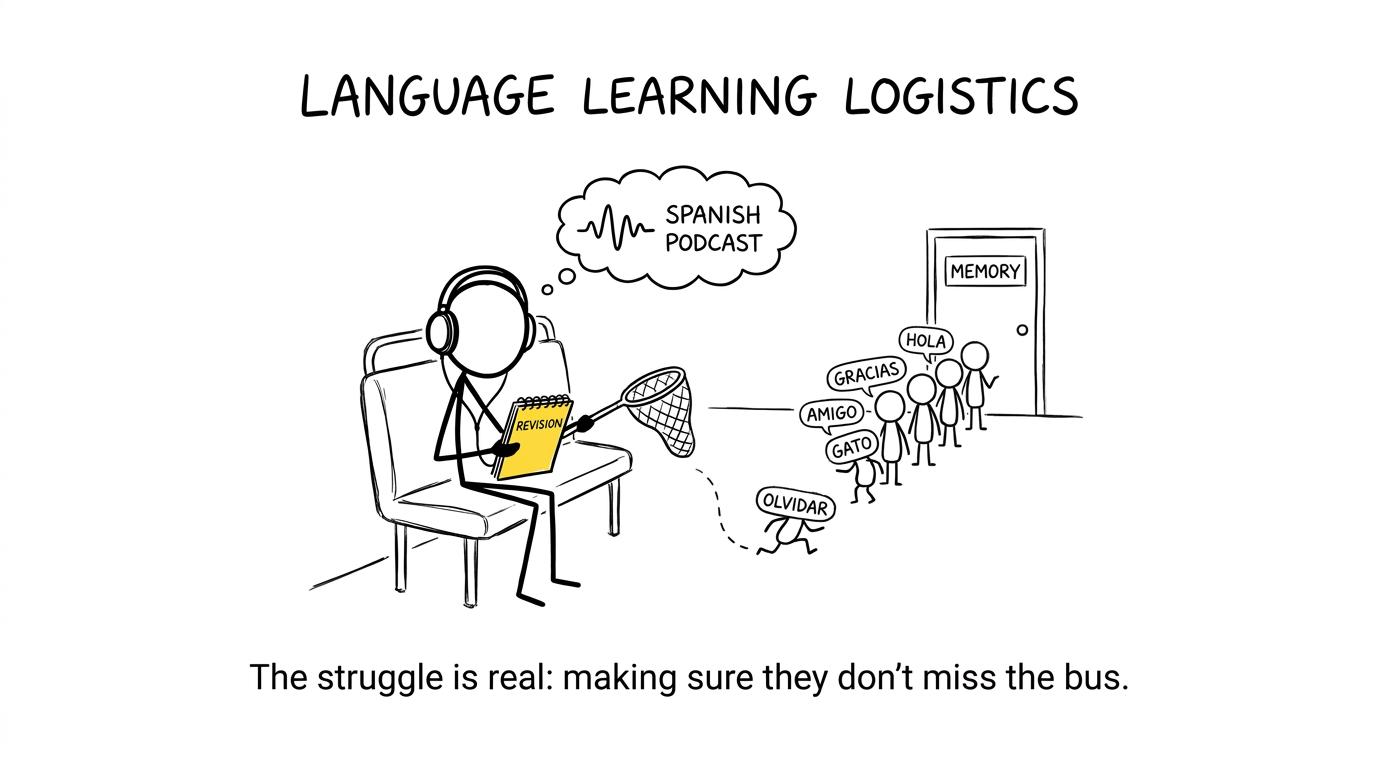 Vocabulary tries to escape while a student catches it in a notebook
Why listening should remain a supplement
Listening alone creates an uneven revision plan. GCSE Spanish assesses receptive and productive skills: you must understand language, but you must also produce accurate language yourself.
Passive audio does not reliably reveal whether you can spell a dictated word, manipulate a verb, construct an extended written response or answer an unfamiliar exam question. It can also produce an illusion of fluency: the episode feels familiar, so the content feels learned.
A balanced Spanish plan should therefore include:
- specification vocabulary and grammar;
- active retrieval;
- speaking aloud;
- reading and writing tasks;
- dictation;
- timed listening questions;
- feedback from mark schemes, transcripts or a teacher.
The same principle applies to maths. Watching or listening to an explanation can make a method feel clear, but only solving questions shows whether you can use it independently. The MathsGenie GCSE maths revision hub connects revision lessons with exam-style practice across foundation and higher tier.
Fitting Spanish audio around maths revision
If maths is one of your priority exams, use Spanish audio in low-friction parts of the day: a safe walk, a bus journey, tidying your room or the opening minutes of a revision session. Keep desk-based concentration for activities that require writing and checking.
A sensible division is:
- use audio for extra Spanish exposure;
- use focused sessions for Spanish exam questions and written recall;
- use focused sessions for maths problem-solving, marking and corrections.
Do not listen to Spanish while attempting difficult algebra or geometry. Both tasks compete for attention. What looks like efficient multitasking often becomes shallow practice in two subjects.
To organise the wider week, adapt the structure in the GCSE maths revision timetable guide. If exams are approaching, the one-month GCSE maths revision plan can help you protect enough time for active maths while using Spanish listening around it.
Match every resource to the exam
AQA, Edexcel, Eduqas and other boards do not necessarily use identical wording, timings or question structures. Check which specification your school follows, whether you are entered for foundation or higher tier, and which assessment materials apply to your exam series.
For Spanish, prioritise your board's current vocabulary, sample papers, audio and mark schemes. Treat entertainment podcasts as additional exposure rather than a prediction of what will appear.
For maths, the same board-specific discipline matters. MathsGenie provides past papers with mark schemes, while students following Pearson can go directly to the Edexcel GCSE maths past papers. The guide to using GCSE past papers properly explains how to turn each attempt into targeted revision rather than simply recording a mark.
Common mistakes with listening-based revision
Letting audio run in the background
Background exposure may build familiarity, but it is weak evidence of learning. Include moments of retrieval, transcription or summary so that you must respond to the language.
Choosing material that is far too difficult
If almost everything is unknown, you cannot connect new language to secure knowledge. Move to slower, shorter or learner-focused content and use a transcript after an initial attempt.
Reading every word while listening
A transcript is valuable for checking, but following it from the beginning can turn listening practice into reading practice. Listen without it first whenever the material is accessible enough.
Replacing exam questions with enjoyable content
An interesting podcast may keep you engaged, but it cannot reproduce every exam skill. Complete current, board-relevant listening and dictation tasks alongside it.
Multitasking during demanding revision
Spanish audio and a hard maths paper do not make a productive partnership. Give the maths paper your full attention, then use audio during a break or routine activity.
Never correcting misunderstandings
Repetition without feedback can reinforce the same mistake. Check transcripts, answers and unfamiliar phrases, then listen again.
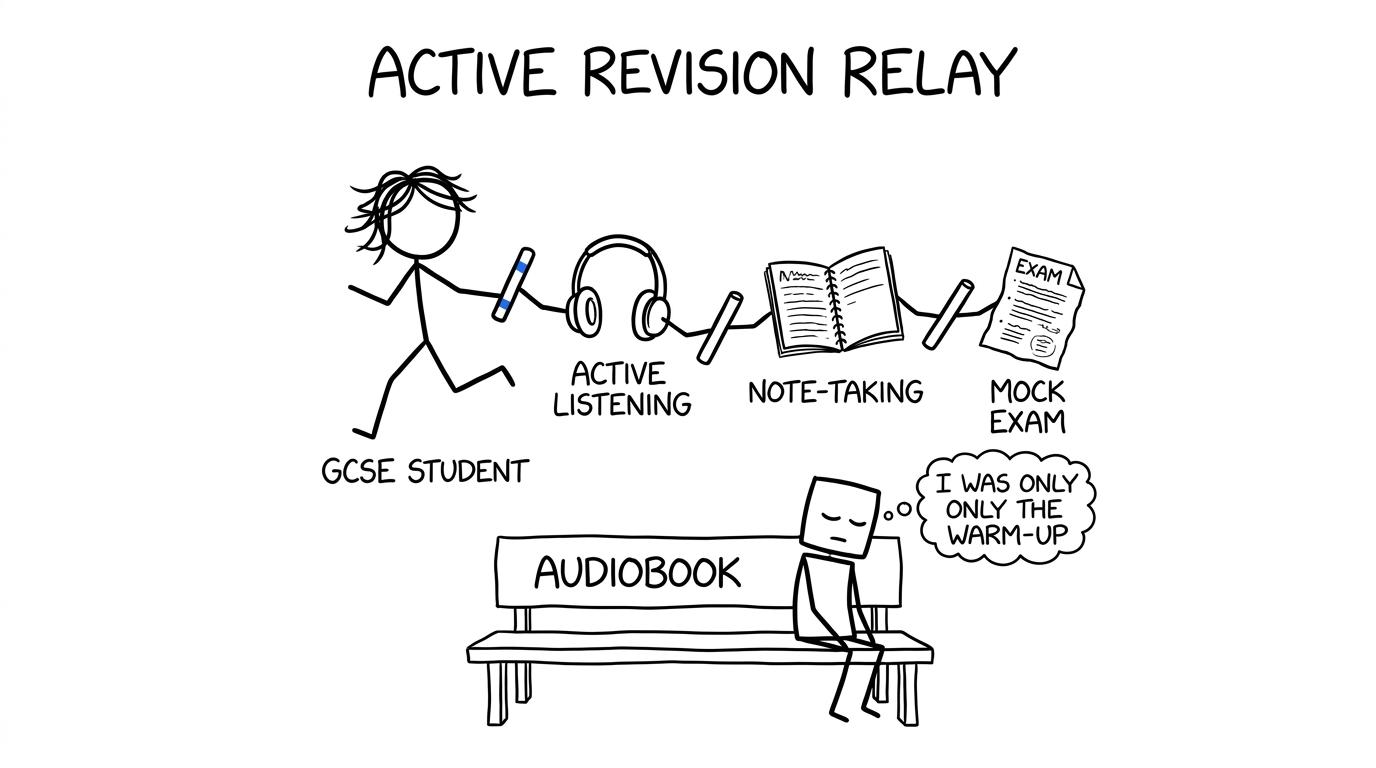 Headphones pass the revision baton to a notebook and an exam paper
A listening habit that supports the whole revision week
A useful habit is small enough to repeat: choose one short Spanish extract, listen actively, retrieve what you heard and check it. Then stop. The goal is not to collect hours. It is to make spoken Spanish incrementally easier to understand.
Bring the same logic to maths. Diagnose a weakness, learn the method, practise questions, mark them and revisit the error. The article on when to start GCSE past papers can help you place full papers sensibly within that cycle.
Podcasts and audiobooks are therefore worthwhile for GCSE Spanish, particularly for listening confidence, pronunciation and vocabulary in context. They are not a complete revision system. Their real value appears when enjoyable exposure leads to active recall, accurate correction and exam-specific practice.
For your maths preparation, make MathsGenie your free revision base. Start with a revision lesson, move into practice questions and mini tests, then use past papers and predicted papers under timed conditions. Check every attempt with mark schemes and video solutions. Headphones can make spare moments useful; focused practice is what turns those moments into marks.