Podcasts Audiobooks GCSE French: Do They Help?
Podcasts audiobooks GCSE French advice: discover when listening improves comprehension, why it is only a supplement, and how to balance it with maths.
Revision can create a strange kind of optimism. Put on a French podcast, open a maths worksheet and perhaps two subjects will improve at once. Unfortunately, attention does not work quite that neatly.
The short answer to the podcasts audiobooks GCSE French question is yes: suitable audio can improve your familiarity with spoken French, pronunciation, vocabulary and listening confidence. But it works best as a supplement. Podcasts and audiobooks cannot replace GCSE listening questions, dictation, vocabulary recall, speaking practice or written exam tasks. And they should not play while you are solving maths problems that need your full attention.
The useful distinction is simple. Audio creates exposure. Active exam practice turns that exposure into marks.
A quick listening-revision checklist
Before pressing play, check that:
- the French is reasonably close to your current level;
- the subject connects to vocabulary on your specification;
- an accurate transcript is available where possible;
- you can slow down, pause and replay the recording;
- you have decided on one active task, such as noting key words;
- the session will not replace question practice;
- you are not trying to complete demanding maths work simultaneously.
If most of those conditions are met, listening can be worthwhile. If the audio is incomprehensible background noise, its revision value is much smaller.
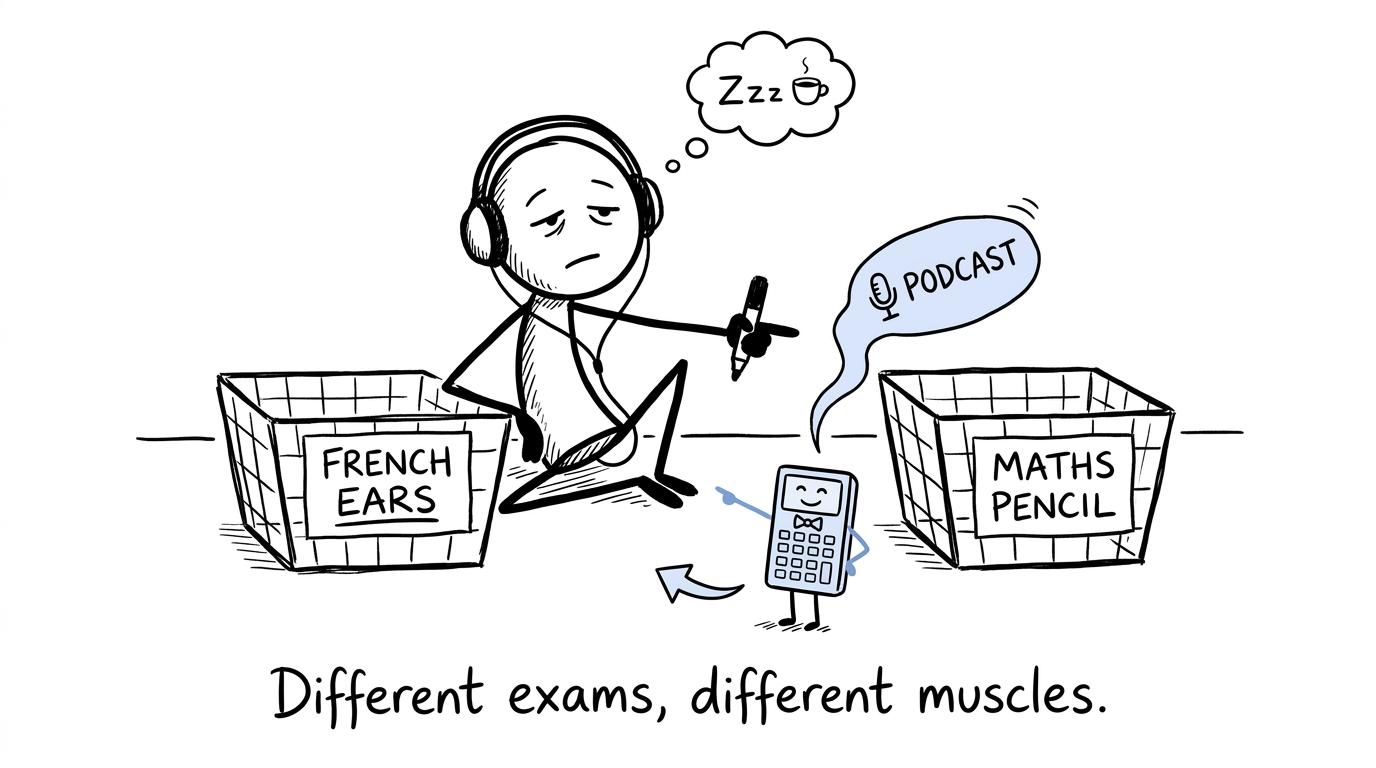 A student sorting headphone revision and maths practice into the right baskets
Why listening can help with GCSE French
GCSE French does not test whether you can recognise words only when they are printed neatly on a vocabulary list. You must also process spoken language in real time.
Current AQA and Pearson Edexcel specifications for qualifications first assessed from 2026 include a dedicated listening assessment worth a quarter of the qualification. Their listening papers assess understanding of spoken French and include dictation. Exact paper structures differ, so always check the specification and sample assessment materials for your own board and exam year.
Podcasts and audiobooks can support several parts of that challenge.
They connect familiar words to real sounds
A word may feel secure on a flashcard but disappear when spoken quickly inside a sentence. French also contains silent letters, linked sounds and pronunciation patterns that are not obvious from English spelling.
Regular listening helps you notice where words begin and end. It also makes common phrases, verb forms and sound patterns less surprising. That matters in dictation, where recognising meaning is not enough: you must connect what you hear to accurate written French.
They build tolerance for partial understanding
Many students panic when they miss one word and then lose the next sentence while mentally chasing it. Authentic listening teaches a calmer lesson: you do not need to understand everything to identify the speaker, setting, opinion, time frame or main message.
That is useful, but exam questions still require precision. A general sense of the topic cannot replace identifying whether an event happened yesterday, happens regularly or will happen next week.
Repetition can strengthen vocabulary
Language-learning research supports the value of repeated encounters with spoken vocabulary. Research also consistently connects stronger vocabulary knowledge with better listening comprehension.
The important word is repeated. Hearing an unfamiliar expression once while thinking about something else is unlikely to secure it. Hearing it, checking it, saying it and meeting it again gives it a much better chance of becoming usable knowledge.
Podcasts or audiobooks: which is better?
Neither format wins in every situation. The best choice depends on what you need to practise.
| Format | Most useful for | Main limitation |
|---|---|---|
| Short learner podcast | Manageable listening, topic vocabulary and repeated practice | May sound slower or more controlled than unfamiliar exam material |
| Native-speaker podcast | Natural rhythm, different voices and authentic phrasing | Can contain too much unknown language |
| Graded audiobook | Sustained listening with vocabulary matched to learners | May not resemble short GCSE exam extracts |
| Familiar story in French | Using known context to infer meaning | Following the plot can create an illusion of understanding every phrase |
| Audiobook with transcript | Connecting sound, spelling and sentence structure | Reading can dominate unless you sometimes listen without it |
For most GCSE students, a short podcast or graded audiobook is a better starting point than a fast programme made for fluent adults. Difficulty should stretch you without making the whole recording opaque.
An audiobook has one particular advantage: continuity. Characters, setting and repeated language reduce the amount of new context you must process each time. A podcast has a different advantage: short episodes fit more easily into revision and often expose you to varied speakers and topics.
Why passive listening is not enough
Listening while walking, tidying or travelling can increase contact with French. That is useful bonus time. It is not the same as revising actively.
Passive listening gives you few reliable checks. You can finish an episode feeling that it made sense without proving that you could retrieve its vocabulary, transcribe a sentence or answer a precise question.
A stronger session has three phases:
Listen for the overall message
Listen once without stopping. Identify the setting, people, broad topic, opinions and likely time frame. Do not reach for a dictionary after every unknown word.
Listen for evidence
Replay a short section. Note key words, negatives, connectives, numbers, tense clues and changes of opinion. If there is a transcript, check it only after making an honest attempt.
Produce something
Finish by doing one small output task. Summarise the extract, say a response aloud, write down a short phrase from dictation or test yourself on selected vocabulary later.
That final stage changes the activity from consumption into retrieval.
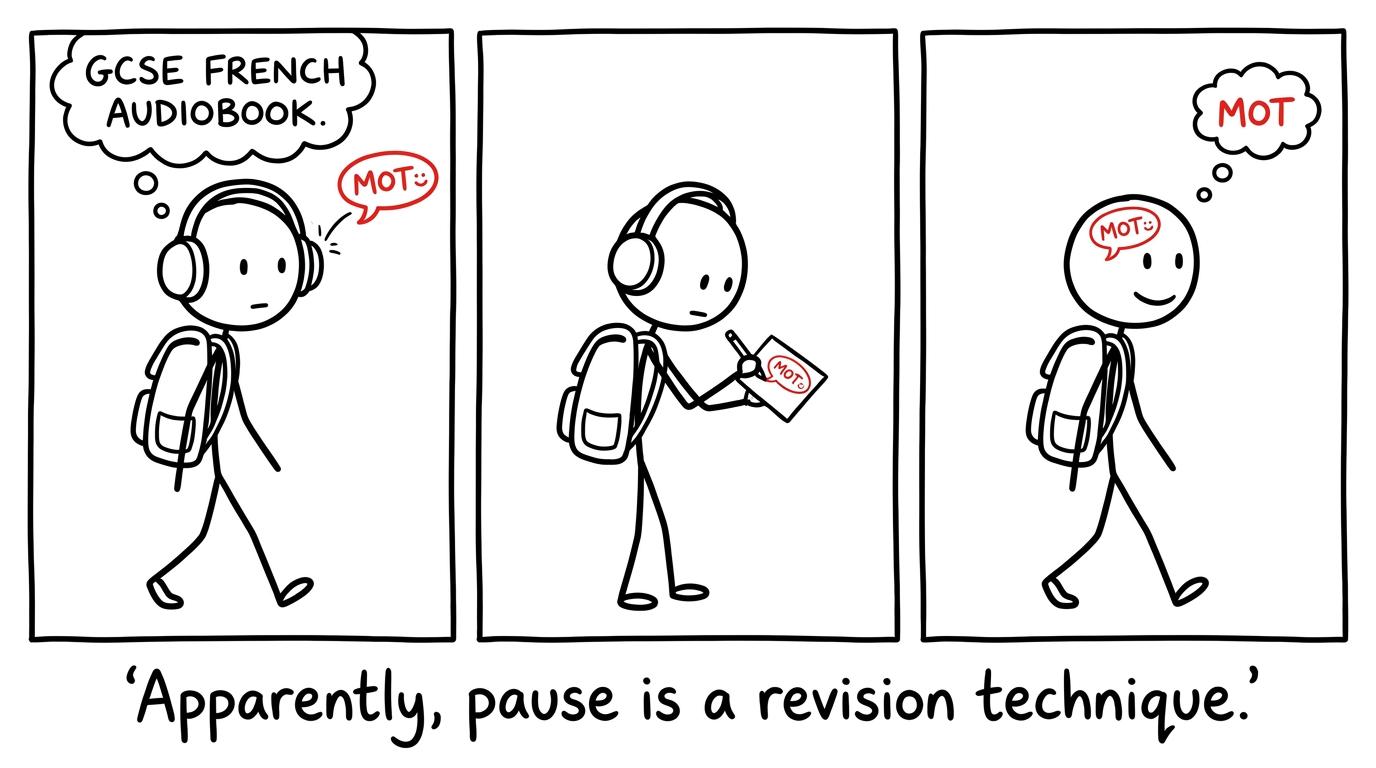 A vocabulary word finally enters a student's memory after they pause the audio and write it down
The best way to use audio alongside exam practice
Think of a podcast as a training partner, not a mock paper. It develops familiarity with spoken language, but it does not reproduce the full demands of your assessment.
A balanced French routine should include:
- short listening extracts and exam-style questions;
- dictation and sound-to-spelling practice;
- active vocabulary recall;
- reading, writing and translation where required;
- speaking aloud and responding without a script;
- occasional podcasts or audiobooks for broader exposure.
Use official or teacher-approved specimen materials and past papers to understand your board's question style. AQA and Edexcel both assess listening and dictation in their reformed GCSE French qualifications, but the timing and structure are not identical. Students following OCR, Eduqas or another qualification should use the materials specified by their school rather than assuming every board follows the same arrangement.
Audio is most helpful when it follows a deliberate purpose. You might focus on recognising negatives one day and opinions another. Random listening is pleasant; targeted listening is easier to evaluate.
Can you listen while revising GCSE maths?
Usually, no. Spoken audio competes for the same attention you need to interpret a maths question, hold steps in mind and check your reasoning. A French podcast may make a routine task feel productive, but it can quietly reduce the quality of both activities.
When working through GCSE maths revision lessons and questions, give the problem your full attention. Put the audio on during a walk or simple household task instead. Separate sessions are not less efficient. They make it possible to notice whether you are actually learning.
A sensible weekly plan might place French listening beside, rather than inside, maths revision. Use the structure in the GCSE maths revision timetable guide to protect focused maths blocks, then add short audio sessions at natural breaks.
For maths, active practice remains essential. Use GCSE mini tests to diagnose gaps and choose resources that match your board and tier. The GCSE maths topics by exam board and tier guide can help you organise Foundation or Higher work across Edexcel, AQA, OCR and Eduqas.
How much listening should you do?
There is no universal number of minutes that guarantees improvement. Your starting level, consistency, choice of material and concentration matter more than an impressive total on a timer.
Short, repeatable sessions are often more useful than occasionally enduring a long recording that you barely understand. Stop while you can still listen carefully. Return to the same extract later and check whether more of it has become accessible.
Measure quality with questions such as:
- Can I state the main message?
- Which details did I miss on the first listen?
- Can I recognise the key phrases without the transcript?
- Can I spell a selected phrase accurately?
- Can I use any of the new language myself?
Progress is not merely finishing more episodes. It is needing less support to understand useful French.
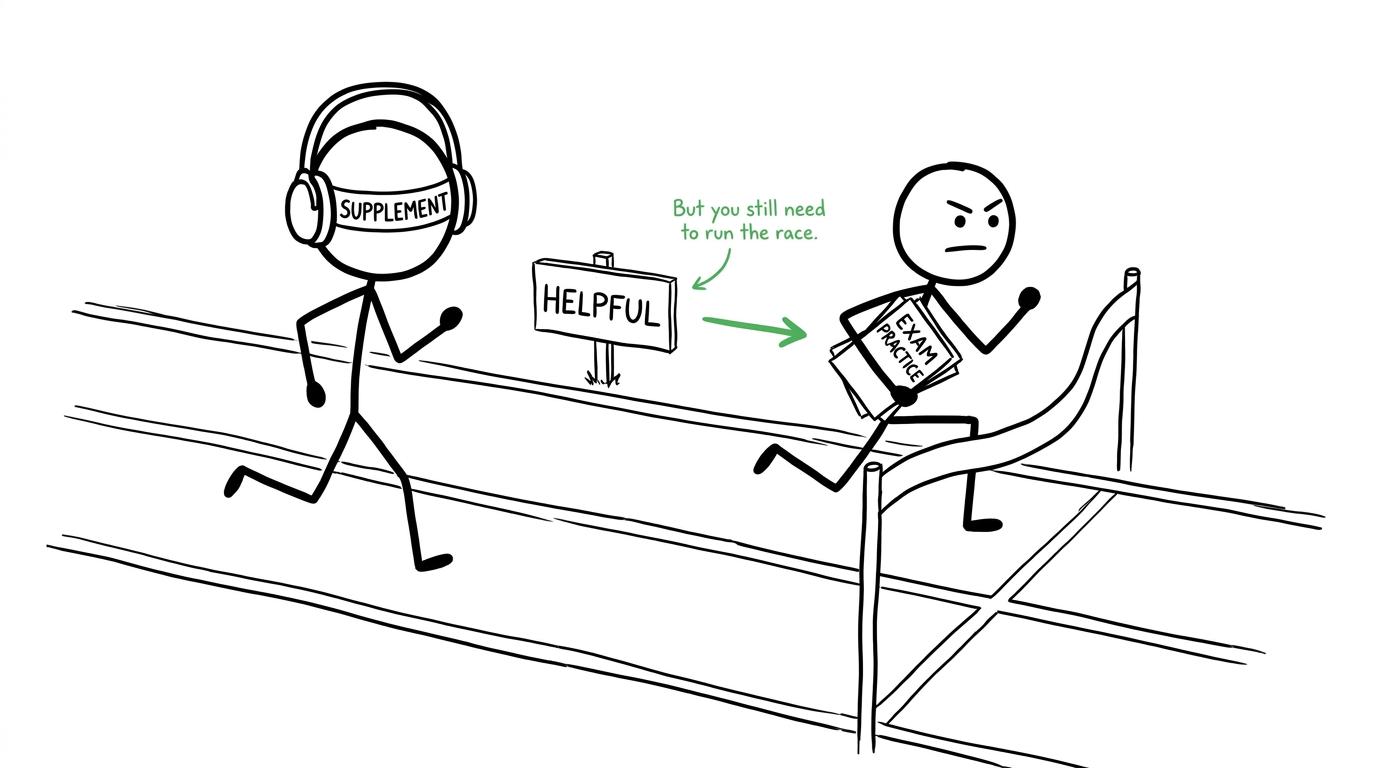 Revision headphones and past-paper practice running in separate but complementary lanes
Common mistakes with podcasts and audiobooks
Choosing material that is far too difficult
If almost every sentence is unknown, there is too little secure language to support inference. Move to graded content, a familiar story or a shorter extract with a transcript.
Treating background noise as active revision
Exposure has value, but an hour of distracted listening is not automatically an hour of effective practice. Include pauses, recall and checking.
Reading the transcript immediately
A transcript is a support, not a substitute for listening. Try the audio first, consult the text, then listen again without reading.
Ignoring spelling and dictation
Recognising a spoken word does not guarantee that you can transcribe it. Current reformed GCSE French listening assessments include dictation, so practise connecting sounds to accurate written forms.
Replacing exam questions with entertaining audio
Enjoyment can help you continue, but podcasts do not teach every assessment skill. Keep exam-style listening, timed tasks and teacher feedback at the centre of your preparation.
Playing French during demanding maths practice
Multitasking can feel industrious while producing shallow work. When completing a GCSE maths past paper, work in realistic conditions, then mark and review it properly. Nearer the exams, Edexcel GCSE maths predicted papers can add fresh practice, but they should supplement past papers rather than replace them.
Make every revision method earn its place
Podcasts and audiobooks genuinely can help with GCSE French. They make spoken language more familiar, connect vocabulary to pronunciation and give you opportunities for repeated listening. Their limit is equally important: listening alone does not rehearse the complete examination.
Use audio for exposure, exam questions for precision and active recall for memory. Keep French listening separate from focused maths work, where every line of reasoning deserves your attention.
Then let MathsGenie make the maths side of your timetable simpler. Start from the free GCSE maths revision hub, use revision lessons and practice questions to repair weak topics, and test progress with mini tests, past papers, predicted papers, mark schemes and video solutions. If you are already looking beyond GCSE, the A Level maths revision hub provides the same clear route into more advanced work.
Good revision is rarely about finding one magical resource. It is about giving each resource the right job.