

Podcasts Audiobooks GCSE Arabic: Do They Help?
Podcasts audiobooks GCSE Arabic revision can improve listening and vocabulary, but only with active practice. Learn when audio helps and what it cannot replace.
Revision can look productive without producing much learning. Headphones go on, an Arabic podcast plays, and half an hour later the episode is finished. Yet when you try to recall its vocabulary, very little appears.
So, do podcasts audiobooks GCSE Arabic resources genuinely help? Yes, particularly with listening comprehension, pronunciation, vocabulary recognition and familiarity with spoken Arabic. But they work best as a supplement. Listening alone cannot prepare you fully for the speaking, reading and writing parts of GCSE Arabic, and passive background audio is much less useful than focused listening followed by recall.
The important question is not simply whether you listen. It is what your brain has to do while listening.
The quick answer: when listening-based revision works
Podcasts and audiobooks are useful when you:
- choose material in standard Arabic at an appropriate level
- listen with a clear purpose or question
- pause and retrieve key meanings from memory
- use a transcript when available
- repeat short, difficult sections
- say or write a summary afterwards
- connect the material to your GCSE specification themes
They are less effective when the audio runs in the background while you scroll, complete demanding maths questions or drift into another task.
That distinction matters. Exposure helps you become familiar with the sound of a language, but an examination requires you to understand, retrieve and respond under pressure.
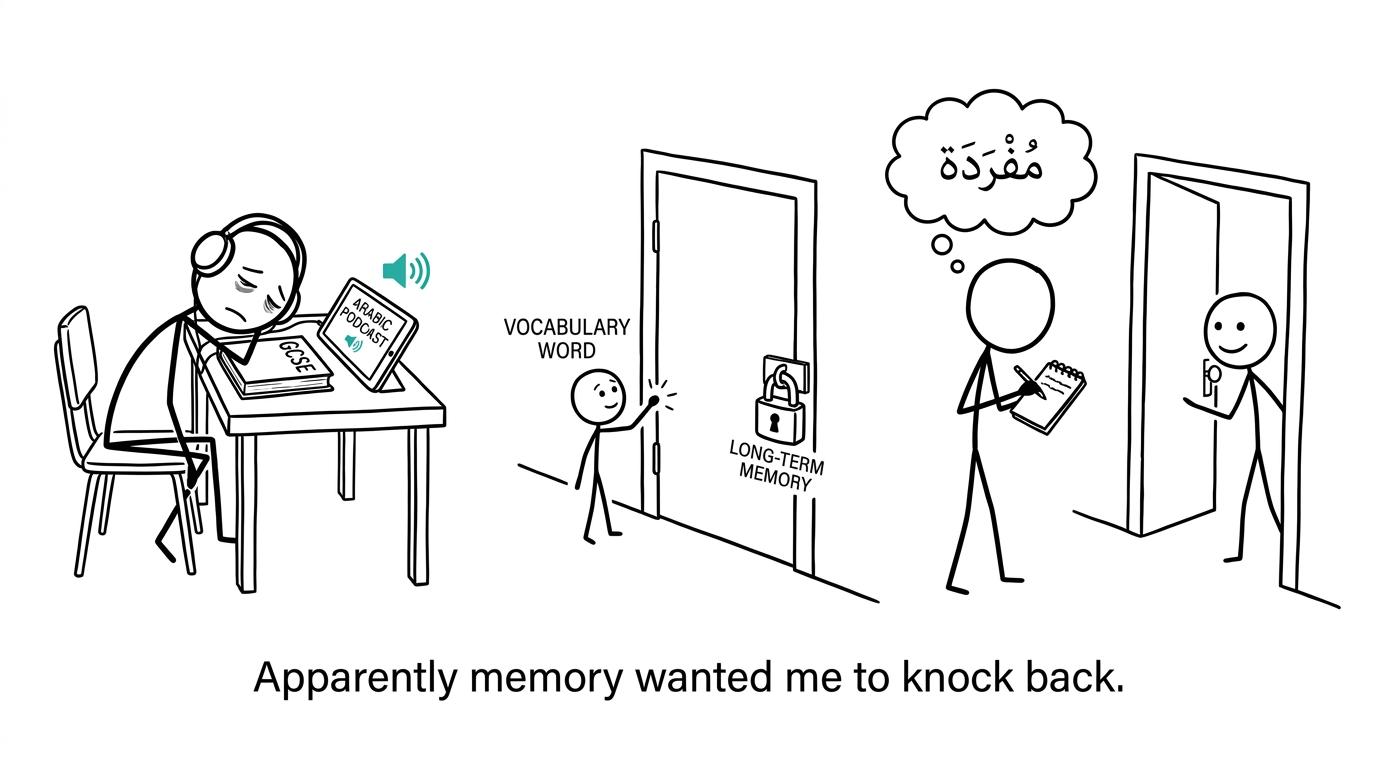 A vocabulary word knocks on the door of long-term memory
Why podcasts can help with GCSE Arabic
The current Pearson Edexcel GCSE Arabic qualification assesses listening, speaking, reading and writing. Each skill represents 25%25\%25% of the qualification. The listening paper assesses understanding of standard spoken Arabic across public and social situations, with recordings featuring different speakers.
Podcasts can support that listening skill in several distinct ways.
They build familiarity with connected speech
Vocabulary often feels secure when it appears alone on a flashcard. It can become much harder to recognise when a speaker places it inside a complete sentence at natural speed.
Regular listening helps you notice where words begin and end, how familiar structures sound in context and which details signal a change of time, opinion or topic. This is valuable because listening questions rarely present vocabulary as a neat list. You must process a stream of language and select the relevant information.
Research into second-language learning generally supports purposeful, repeated listening. However, much of that evidence comes from learners of languages other than Arabic, often in university or adult settings. It is therefore sensible to treat the findings as useful guidance rather than direct proof that any podcast will raise a GCSE Arabic grade.
They expose you to different voices
Understanding one teacher is not the same as understanding every speaker. A carefully chosen range of podcasts can introduce differences in pitch, pace and delivery.
For GCSE preparation, the material should still be reasonably close to standard spoken Arabic. A programme dominated by a regional dialect, specialist political vocabulary or very rapid informal conversation may be interesting, but it may not align closely with what you need to recognise in the examination.
They make repetition easier
A live conversation moves on. Recorded audio does not.
You can replay one sentence, reduce the speed temporarily, compare it with a transcript and then listen again without support. Research on repeated second-language listening suggests that this process can improve comprehension, particularly when learners actively investigate what they missed.
The replay button is not a sign that you are bad at listening. It is the listening equivalent of returning to a difficult exam question and identifying the exact step where your method failed.
Are audiobooks useful for GCSE Arabic revision?
Audiobooks can help, but their usefulness depends heavily on difficulty and structure.
A long literary audiobook written for fluent adult listeners may contain unfamiliar vocabulary, complex sentences and cultural references well beyond the GCSE course. Spending an hour understanding almost nothing is not efficient revision.
Shorter or graded audio stories are usually more practical. They offer a continuous context, which can make new vocabulary easier to interpret, while still developing concentration beyond the brief extracts found in many revision activities.
An audiobook is most useful when:
- the language is predominantly standard Arabic
- you can understand the broad meaning without translating every word
- chapters or sections are short enough to replay
- a written version is available
- the subject overlaps with familiar GCSE themes
A transcript or matching text can be valuable, but use it in the right order. Listen first, check the text second, then listen again without reading. If you begin by reading throughout, you may practise reading more than listening.
Why audio should remain a supplement
Listening feels convenient. You can do it on a journey or while tidying your room. That convenience is its strength, but it can also disguise the limits of the method.
GCSE Arabic does not assess listening alone. In the Pearson Edexcel specification, speaking, reading and writing are separately assessed and equally weighted. Podcasts cannot check the accuracy of your written Arabic, make you construct a translation into Arabic or recreate the pressure of responding during a speaking assessment.
Audio also tends to train recognition more than production. You may recognise a phrase immediately but still struggle to produce it without prompting. This gap is normal. It is also why effective revision must include retrieval.
After listening, close the transcript and do something observable:
- retell the main message aloud
- record a brief spoken response
- list key vocabulary from memory
- write a short summary in Arabic
- answer listening questions without replaying the audio
Retrieval practice is well supported across educational research. Recalling information rather than merely reviewing it helps strengthen long-term memory, especially when you receive feedback afterwards.
The same principle should shape your maths revision. A video can clarify a method, but improvement comes from attempting questions yourself. MathsGenie’s GCSE maths revision hub follows that movement from explanation to independent practice.
A practical active-listening routine
A useful listening session does not need to consume an evening. One focused extract can be more productive than several passive episodes.
Before listening
Choose a short section related to a specification theme such as identity and culture, school, travel, future aspirations or global issues. Write down what you expect to hear and prepare two or three questions.
This gives your attention somewhere to go.
During the first listen
Listen without a transcript. Aim for the central message rather than every individual word. Note the speaker, setting, opinion and any important change of time.
Do not pause after every unfamiliar expression. Constant interruption can prevent you from understanding the overall meaning.
During the second listen
Now listen for detail. Pause only where necessary and note important words or phrases. If a transcript is available, use it to locate the reason you missed something: unknown vocabulary, an unfamiliar sound or a sentence that moved too quickly.
After listening
Remove the transcript and retrieve. Summarise the extract aloud or in writing, answer your original questions and record vocabulary you could not recall.
Return to the same material on another day. Spaced review is more useful than replaying it repeatedly in one sitting and never revisiting it.
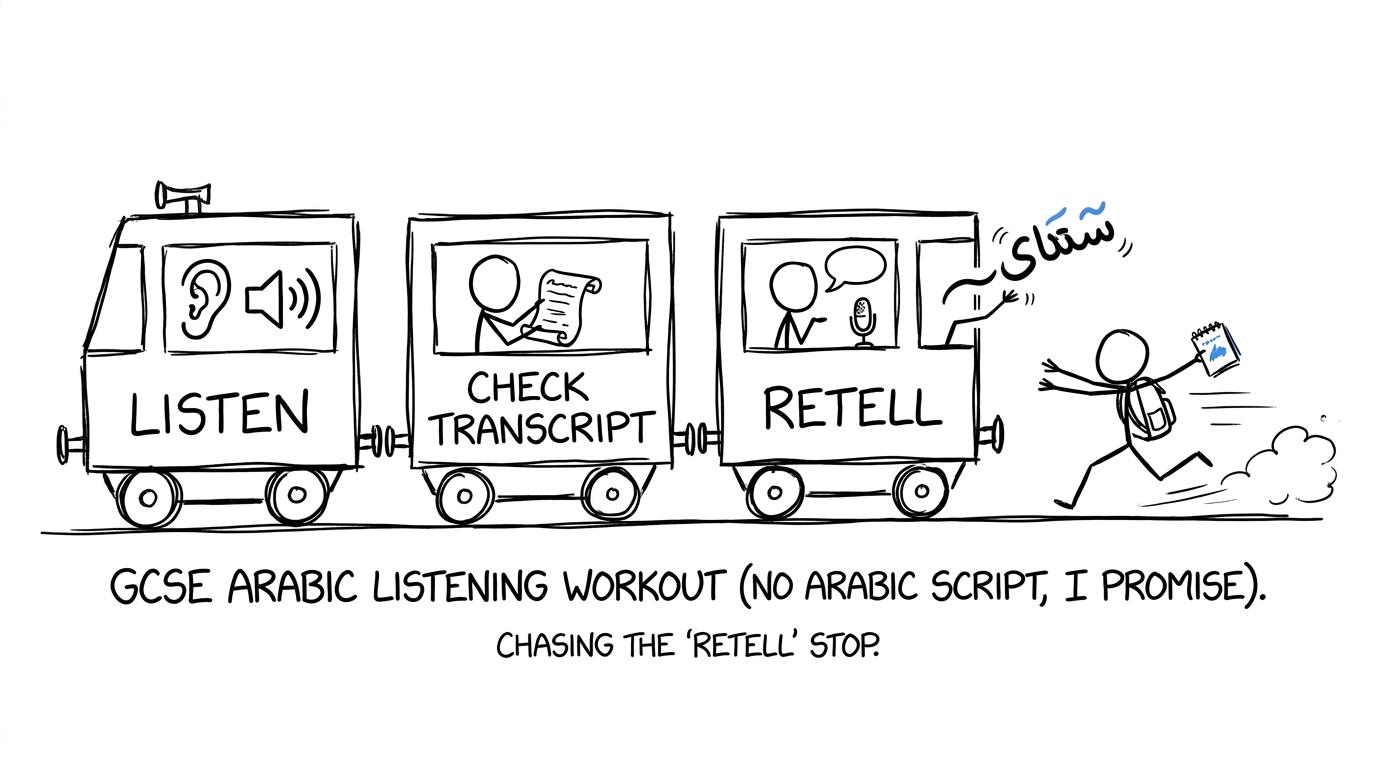 The listen, transcript and retell revision train
How to choose the right Arabic audio
An impressive title or large audience does not make a podcast suitable for GCSE revision. Judge the resource by what it asks you to understand.
Match the language to the examination
Pearson Edexcel assesses standard spoken Arabic. Some exposure to regional varieties can broaden your understanding, but heavily dialectal content should not dominate exam-focused revision unless your teacher recommends it.
Match the topic to the specification
Audio about family life, education, technology, travel, work or environmental concerns is more likely to reinforce useful GCSE language than specialist material about economics or advanced literature.
Match the difficulty to your current level
A useful recording stretches you without becoming noise. If you can identify the broad subject and recover additional details after another listen, the level is probably productive. If you understand virtually nothing even with a transcript, choose something shorter or simpler.
Prefer resources with useful controls
Clear audio, short sections, playback controls and accurate transcripts make deliberate practice easier. Automatically generated captions can contain mistakes, particularly with names, endings and similar-sounding words, so check doubtful language with a teacher or reliable course material.
Fitting Arabic listening around GCSE maths revision
Many students preparing for GCSE Arabic are also managing maths and several other subjects. Audio can recover otherwise unused time, but it should not compete with work that needs full concentration.
Listening to Arabic while walking or doing a routine household task can provide extra exposure. Listening while solving algebra, interpreting graphs or completing a timed paper is different. Both tasks require attention, and switching between them can reduce the quality of each.
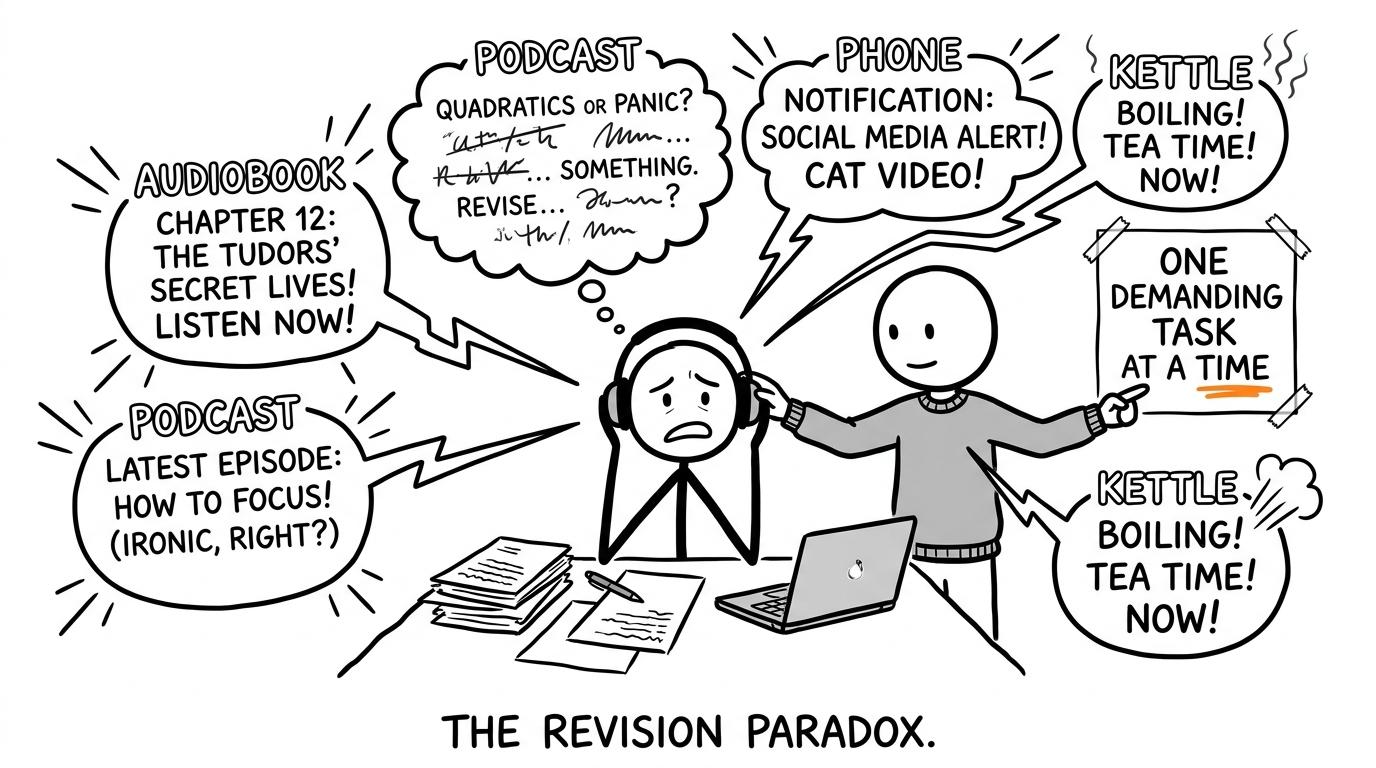 A student discovers that four revision tasks cannot all be the main task
Keep demanding sessions separate. A realistic GCSE maths revision timetable can give maths its own focused blocks while leaving journeys or short breaks for Arabic listening. If examinations are close, the one-month GCSE revision plan offers a practical structure for prioritising weak areas.
For maths, use audio only for light review if it genuinely helps. Independent questions, marking and correction should remain central. MathsGenie’s guide to using GCSE past papers properly explains why the learning often happens after the paper, when mistakes are identified and repaired.
Common mistakes with podcasts and audiobooks
Treating background noise as revision
Finishing an episode is not evidence that you learnt from it. Add a recall task so that the session has a measurable result.
Choosing content that is far too difficult
Authentic does not automatically mean appropriate. Material should be challenging enough to stretch your listening, not so difficult that you cannot identify its main idea.
Using only one speaker or programme
Familiarity with one voice can create false confidence. Gradually introduce other speakers and recording styles while keeping the language suitable for the specification.
Reading the transcript from the beginning
A transcript is support, not a substitute for listening. Try the recording first, investigate gaps with the text and then listen again without it.
Ignoring speaking, reading and writing
Audio cannot replace complete GCSE Arabic preparation. Balance it with conversation practice, reading tasks, translation and timed writing.
Playing audio during difficult maths
Trying to understand Arabic while completing a higher-tier maths question divides attention. Give each demanding task its own space. If motivation is the real barrier, the GCSE revision guide for reluctant students provides a smaller attempt-mark-fix routine.
The verdict on listening-based GCSE Arabic revision
Podcasts and audiobooks can genuinely improve familiarity with spoken Arabic, vocabulary recognition and listening confidence. Their value comes from suitable material, repetition, transcripts, retrieval and regular use, not from the number of hours that happen to play through your headphones.
Use audio to supplement a balanced GCSE Arabic plan, never to replace speaking, reading, writing or exam-style listening questions. Confirm your exact board, tier and assessment arrangements with your school, then align every resource with that specification.
And when it is time to switch back to maths, make the switch fully. Start with MathsGenie’s free GCSE revision resources, build understanding through revision lessons and practice questions, and test it with GCSE predicted papers, past papers, mini tests, mark schemes and video solutions. Listen when listening is the task. Practise when practice is the task. That simple boundary makes both forms of revision stronger.











