Perfectionism GCSE Engineering Revision: Break the Cycle
Perfectionism GCSE engineering revision can turn care into delay. Build a practical routine for maths practice, mistakes, past papers and calmer progress.
A tidy revision timetable can feel productive. So can colour-coded notes, carefully rewritten formulae and a folder organised to the millimetre. But none of those activities necessarily tests whether you can answer a question.
That is how perfectionism GCSE engineering revision can quietly become a problem. It disguises avoidance as preparation. You appear busy, yet postpone the uncomfortable work that produces useful feedback: attempting calculations, checking mark schemes and discovering what you cannot do yet.
The answer is not to lower every standard. Engineering depends on accuracy. The better approach is to apply precision where it earns marks and accept roughness where it helps you learn.
A quick anti-perfectionism checklist
Before each revision session, ask:
- Is my task small enough to begin immediately?
- Will I answer questions rather than only read notes?
- Have I chosen a topic because it is weak, not because it feels safe?
- Am I willing to mark an imperfect first attempt?
- Will I record one clear action for each important mistake?
- Do I have a stopping time?
If the answer to most of these is yes, your session is likely to produce evidence rather than merely the feeling of being organised.
How perfectionism appears in GCSE Engineering revision
Perfectionism is not simply wanting to do well. High standards can be useful when they remain flexible. The trouble begins when your standards make starting, finishing or receiving feedback feel unsafe.
Research on students distinguishes between productive striving and more harmful perfectionistic concerns. Findings about perfectionism and procrastination are mixed, and much of the published research involves university students rather than GCSE pupils. It would therefore be too strong to say that perfectionism always causes procrastination. However, fear of mistakes, unrealistic expectations and anxiety can clearly contribute to delay.
In revision, this often appears in ordinary-looking habits.
Waiting for the ideal plan
You may feel unable to begin until every Engineering topic has a place in a flawless timetable. Then one missed evening makes the whole plan seem ruined.
A useful plan should survive real life. Start with the GCSE maths revision hub, identify one relevant weakness and schedule the next action. You do not need to design the entire journey before taking the first step.
Rewriting instead of retrieving
Beautiful notes provide a sense of control because the answer is already visible. Retrieval is less comfortable: close the book, recall the principle, attempt a question and check what remains.
Engineering-related maths may involve ratio, units, standard form, graphs, area, volume, tolerances, percentages, speed or density. These skills improve through use. The AQA GCSE Maths revision collection gives you lessons and questions that can turn passive review into active practice.
Avoiding questions that expose weaknesses
A perfectionist may practise ten familiar questions rather than attempt one uncertain question. The familiar work protects confidence, but it does not repair the gap.
Difficulty is not proof that revision has failed. It is information about what to revise next. A wrong answer found several weeks before an exam is cheaper than the same error found in the examination hall.
Spending too long on one detail
Engineering encourages care, but revision has limited time. You might spend an entire session making one diagram immaculate, memorising a minor definition word for word or checking an easy calculation repeatedly.
Ask a more useful question: what is the next mark-producing action? It may be checking units, practising a rearrangement or answering an extended-response question under a time limit.
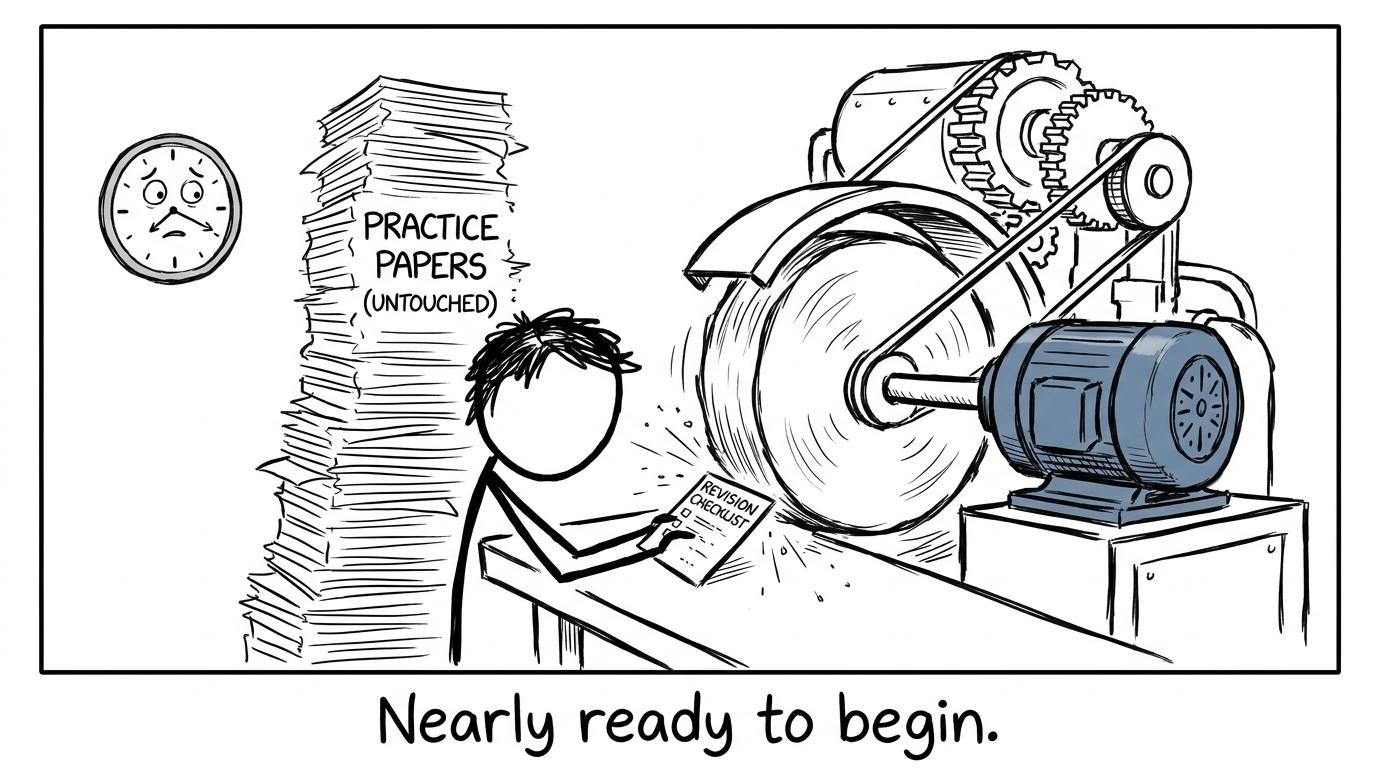 A student polishing a revision checklist while practice papers pile up
Why perfectionism can do more harm than ordinary procrastination
Ordinary procrastination is often visible. You know that you have not started. Perfectionistic procrastination is harder to notice because it can look like committed revision.
The hidden cost is opportunity. Suppose a student has 606060 minutes. Spending 505050 minutes redesigning notes leaves only 101010 minutes for retrieval and questions. The notes may improve, but the student receives little evidence about exam performance.
Perfectionism can also create an all-or-nothing rule:
If I cannot complete the full session properly, there is no point beginning.
That rule turns a disrupted hour into no revision at all. A more resilient rule is:
If the full session is unavailable, I will complete the smallest useful version.
That might mean one mini test, five retrieval prompts or fifteen minutes correcting previous errors. Small sessions are not automatically better, but completed, focused practice is more valuable than an ideal session that never starts.
There is also an emotional cost. If every error is treated as a verdict on ability, marking becomes threatening. Students then delay papers, look at solutions too early or award themselves marks generously. This protects them from discomfort today while preserving the same weakness for tomorrow.
Accuracy matters, but perfection is not the same as precision
GCSE Engineering does reward careful work. Under the current AQA specification, students apply knowledge and skills in practical and theoretical contexts, analyse engineering evidence and use mathematical concepts in engineering situations. The qualification includes a written paper and non-exam assessment, so both exam performance and a managed design-and-make process matter.
None of this means every revision artefact must be perfect.
Precision means using the right units, showing a valid method, reading scales carefully and presenting an answer clearly. Perfectionism means believing that a mistake makes the attempt unacceptable.
Precision improves through feedback. Perfectionism often avoids feedback.
For example, relationships such as speed and density should be recalled and applied confidently:
speed=distancetime,density=massvolume.\text{speed}=\frac{\text{distance}}{\text{time}}, \qquad \text{density}=\frac{\text{mass}}{\text{volume}}.speed=timedistance,density=volumemass.The goal is not to copy these formulae beautifully. It is to recognise when they apply, rearrange them accurately and use consistent units. MathsGenie's speed and density revision guide can help you practise those skills directly.
Build a revision system that expects mistakes
A good system does not depend on feeling confident. It gives you a sequence to follow when confidence is low.
Define an observable finish line
Avoid tasks such as “revise engineering maths”. They have no visible endpoint and invite endless preparation.
Use actions such as:
- complete one question set on units;
- mark one timed section;
- identify three lost-mark patterns;
- practise one weak formula rearrangement;
- revisit yesterday's incorrect questions.
The best order for learning GCSE maths topics can help when several weaknesses compete for attention.
Use a minimum viable session
Choose a short version you can complete even on a difficult day:
- 555 minutes recalling key facts;
- 202020 minutes answering questions;
- 101010 minutes marking and recording corrections.
This is not a universal prescription. Adjust it around schoolwork and your teacher's guidance. Its purpose is to remove the need for a perfect mood, desk or uninterrupted evening.
The NHS-supported Oxford Health guidance on procrastination recommends beginning with a very small commitment, such as five minutes, to reduce the barrier to starting. The useful principle is simple: action can come before motivation.
For a broader structure, adapt MathsGenie's one-month GCSE revision plan rather than spending days constructing a new system from scratch.
Separate attempting from judging
During the attempt, concentrate on the question. During marking, become the examiner.
Do not interrupt every difficult step to check the answer. That prevents you from finding out whether you can sustain a method independently. When the time ends, use the mark scheme and label the reason for each significant lost mark:
- knowledge;
- mathematical method;
- units or accuracy;
- misreading;
- time management.
Then choose the next action. “Be more careful” is too vague. “Write the units beside every substituted value” is usable.
Keep a marks-leak list, not a book of shame
Your error log should be short. Record the topic, what happened and what you will do next. Once the error no longer repeats, remove it.
This changes mistakes from personal failures into engineering data. A prototype test is useful because it reveals what needs changing. A revision attempt works the same way.
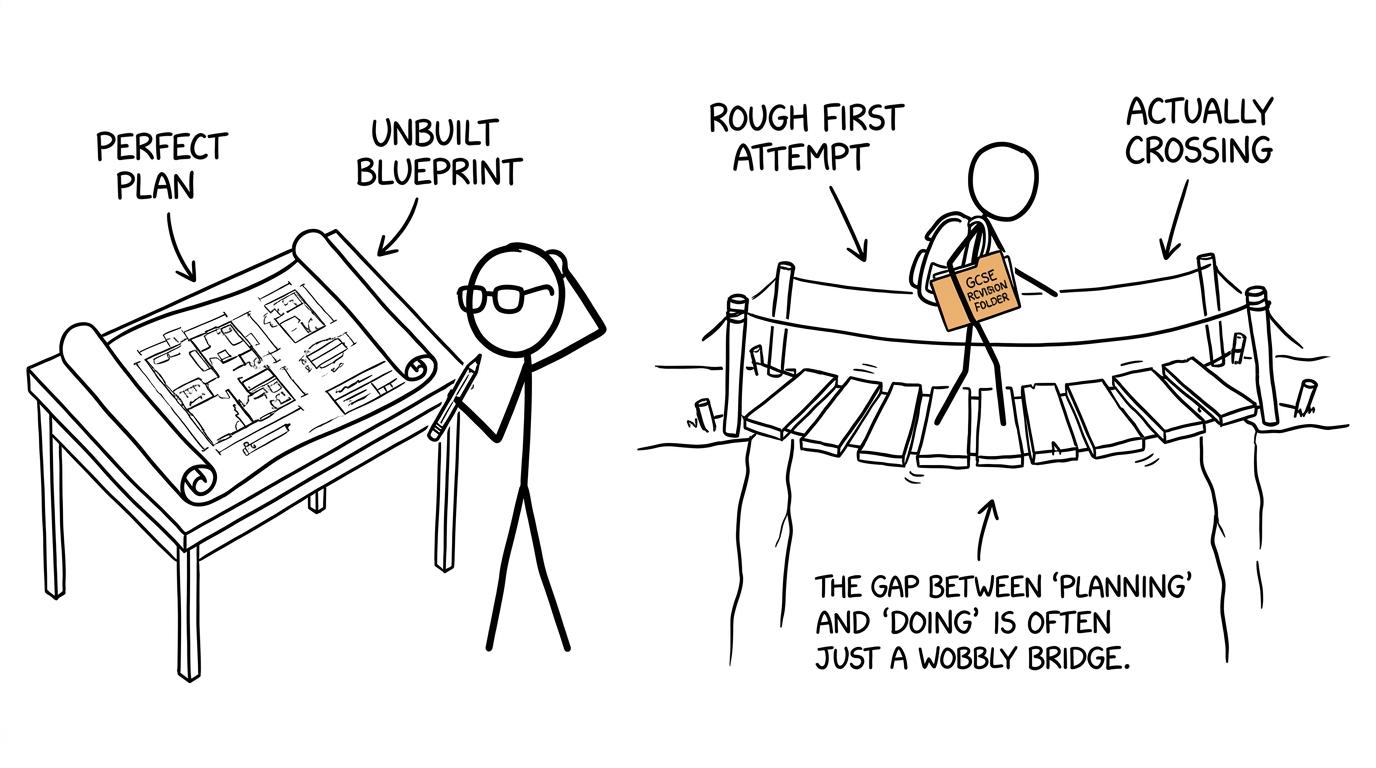 A rough bridge succeeds while the perfect bridge remains a blueprint
Use papers before you feel completely ready
Waiting until you “know everything” before attempting papers is one of the most expensive perfectionist habits. A paper is not merely a final test. Used early enough, it is a diagnostic tool.
Start with a manageable section or mini test. Later, move towards timed papers under realistic conditions. The guide to when you should start GCSE past papers explains how to increase the challenge gradually.
Your GCSE Maths board may be Edexcel, AQA, OCR or Eduqas even if Engineering is taught through a different specification. Always select the correct maths board and foundation or higher tier. Near the examination period, Edexcel GCSE Maths predicted papers can provide fresh practice for Edexcel students, but they should supplement rather than replace official past papers and specification coverage.
Use this loop:
- attempt;
- mark;
- diagnose;
- practise the weakest skill;
- reattempt after a gap.
A paper covered in corrections may teach you more than a high-scoring paper made entirely from comfortable topics.
Common mistakes when trying to beat perfectionism
Replacing one rigid system with another
An anti-perfectionism routine can itself become perfectionistic. Missing one planned session does not require a redesigned timetable. Resume with the next useful task. MathsGenie's GCSE maths revision timetable guide is best treated as a flexible framework, not a contract you can fail.
Lowering standards in the wrong places
“Good enough” does not mean ignoring safety, units, tolerances or clear working. Lower standards for decorative notes and elaborate planning, not for mathematical accuracy or practical safety.
Looking at solutions too soon
A quick glance removes uncertainty, but it also removes the retrieval challenge. Make a genuine attempt first. Then use mark schemes and video solutions to understand the gap.
Trying to repair every weakness at once
A long list creates paralysis. Select the two or three errors costing the most marks. Fix those, then review the list again.
Treating stress as a discipline problem
Persistent anxiety, sleep disruption or distress is not solved by a better checklist alone. Speak to a parent, carer, teacher, school pastoral lead or GP if pressure is affecting daily life. Asking for support is a practical response, not a failure of effort.
Progress is built from usable attempts
Engineering rarely advances because someone waits for certainty. Designs are tested, weaknesses are found and decisions improve. Revision follows the same pattern.
Begin before the session feels perfect. Let questions reveal the gaps. Use mark schemes without turning them into judgements, and direct your precision towards calculations, units, diagrams and explanations that earn marks.
MathsGenie gives you a free place to run that cycle: start with revision lessons, move into practice questions and mini tests, then use past papers, predicted papers, mark schemes and video solutions to test what has changed. Open one relevant topic today and complete an imperfect first attempt. That is not a compromise. It is how improvement begins.