Peaking Too Early GCSE Psychology Revision: Is It Normal?
Peaking too early GCSE Psychology revision can feel worrying. Learn why confidence fades, use spaced retrieval, and keep it fresh until May without stress.
Is it normal to feel ready too early?
You finish a Psychology mock in January feeling strangely calm. Memory studies make sense, research methods feel manageable, and your evaluation paragraphs arrive without much effort. Then a worrying thought appears: what if this confidence disappears before May?
Yes, peaking too early GCSE Psychology revision is a normal concern. More importantly, feeling confident early does not mean you have used up a limited supply of knowledge. It usually means the material is accessible now. Your task is not to keep revising at maximum intensity for months. It is to revisit the course at sensible intervals, test what you can retrieve and gradually shift towards exam-style application.
A peak is only dangerous when revision stops completely or becomes so exhausting that you cannot sustain it. Early confidence, handled well, is an advantage.
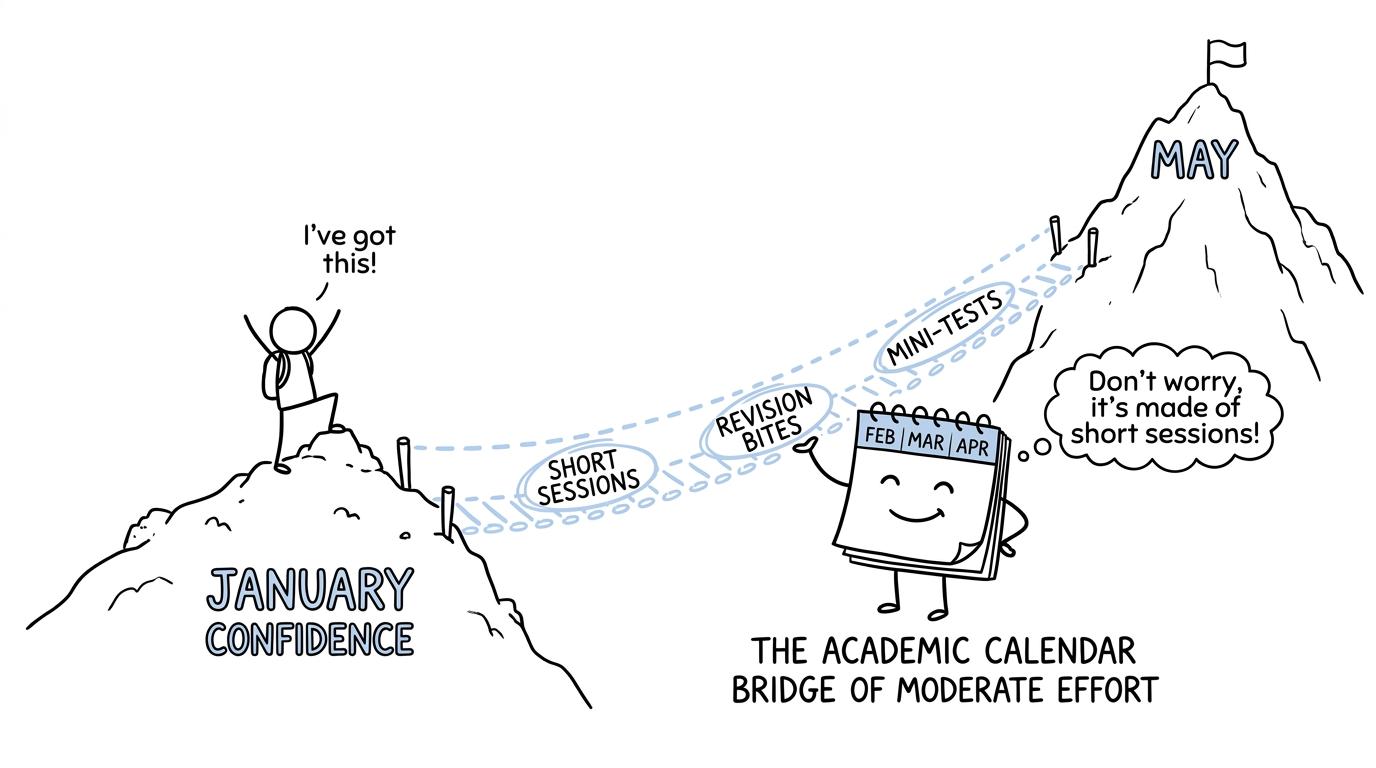 A student discovers that January confidence and the May exam are connected by a bridge of short revision sessions
The short checklist
If you already feel confident months before the exam, use this maintenance plan:
- test yourself without notes rather than repeatedly reading them;
- revisit topics after increasingly long gaps;
- mix knowledge, application and evaluation questions;
- mark answers and record the precise reason for lost marks;
- keep Psychology sessions short enough to leave room for maths and other GCSEs;
- increase timed paper practice gradually as May approaches;
- protect sleep, breaks and ordinary life instead of trying to remain at peak intensity.
For the maths part of your timetable, the free MathsGenie revision planner can help you distribute topics across the remaining weeks.
Why early confidence can fade
Confidence often rises immediately after a topic has been taught or revised. The terminology is familiar, the examples are recent and your notes provide helpful cues. That feeling is real, but it is not the same as being able to retrieve and apply the material months later under exam conditions.
Familiarity can look like mastery
Reading a model answer can make every sentence seem obvious. Looking at a flashcard before attempting an answer can create the same effect. Psychologists would recognise the problem: recognising information is easier than recalling it independently.
Close the book and the experience changes. Can you outline a study accurately? Can you apply a theory to an unfamiliar scenario? Can you select an appropriate strength or weakness without being prompted?
The gap between “I recognise this” and “I can produce this” explains many apparent early peaks. It does not mean your original revision failed. It means your next phase should involve retrieval.
Recent success is supported by recent cues
A strong mock result may follow several lessons on the same unit. You have heard the vocabulary repeatedly, completed similar questions and discussed likely evaluation arguments. Months later, those cues will be less available.
This is why a January mark should be treated as evidence, not a lifetime guarantee. It tells you what worked. A later low-stakes test tells you what remains accessible.
Blocked revision can create temporary fluency
Spending an entire evening on memory may make memory questions feel easy by the end of the session. You know which theory is relevant because every question belongs to the same topic.
The real paper is less accommodating. You must identify what a question requires, choose suitable knowledge and move between different demands. Mixing topics feels harder, but that difficulty can reveal whether your understanding is flexible.
What the GCSE Psychology exam actually requires
For the current AQA GCSE Psychology specification, the qualification is linear and assessed through two written papers. Each paper lasts 111 hour 454545 minutes, carries 100100100 marks and contributes 50%50\%50% of the qualification. Students answer multiple-choice, short-answer and extended-writing questions.
The assessment is not simply a memory contest. AQA assesses three broad objectives:
- AO1: knowledge and understanding;
- AO2: applying knowledge and understanding;
- AO3: analysing and evaluating psychological material to reach judgements and conclusions.
That distinction matters. You might remember every key term in February but still need months of practice applying theories to unfamiliar scenarios and constructing balanced evaluations. Check your own specification and teacher guidance before planning, particularly if your school follows a different qualification.
Research methods also includes mathematical and data-handling skills such as ratios, fractions, percentages, averages, significant figures and the interpretation of charts or scatter diagrams. If those skills need attention, the GCSE maths revision hub provides free revision lessons and practice organised by exam board and tier.
How to keep Psychology knowledge fresh until May
Use spaced retrieval, not permanent intensity
The Education Endowment Foundation’s evidence reviews describe retrieval practice as an active attempt to bring previously learnt material back from long-term memory. They also stress that retrieval should be appropriately challenging, repeated after delays and followed by feedback.
A practical pattern might revisit a topic after 111, 333, 777 and 141414 days, then at longer intervals if recall remains secure. These intervals are not universal rules. Difficult topics may need shorter gaps, while stable topics can wait longer.
At each revisit, begin without notes. Try a short brain dump, several flashcards, an essay plan or a few exam questions. Check your answer afterwards and correct omissions. The attempt matters because it shows what your memory can currently do.
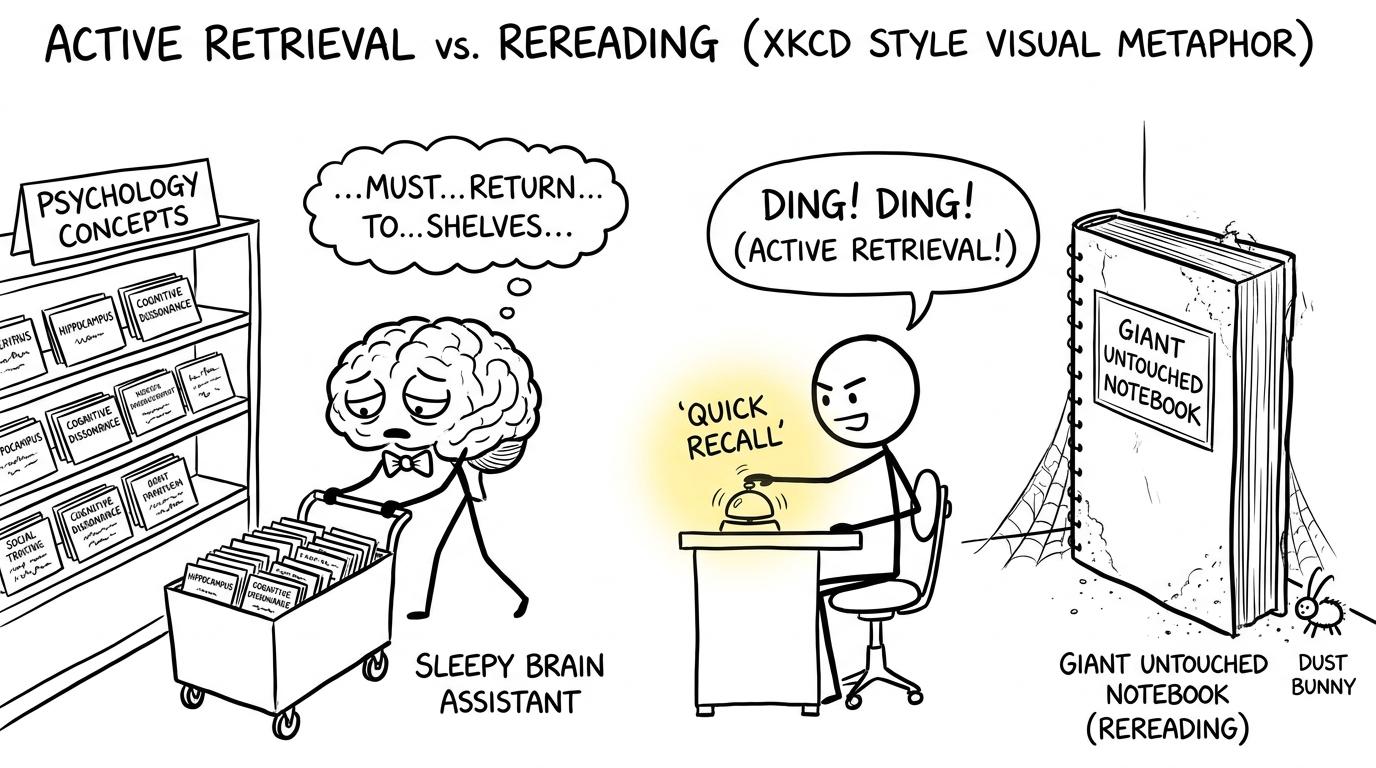 A brain librarian responds to quick recall while an untouched notebook gathers dust
Rotate the kind of thinking
A useful revision cycle has three layers:
- Recall: definitions, theories, studies and procedures.
- Application: using knowledge in a new person, experiment or situation.
- Evaluation: explaining strengths, limitations and justified conclusions.
If recall is already strong, do not keep polishing the same flashcards. Move more of your time towards application and evaluation. Early revision builds the library; later revision practises finding the right book quickly.
Keep an error log
After a test, do not record only the total mark. Label each lost mark by cause:
- missing knowledge;
- inaccurate terminology;
- weak application to the scenario;
- undeveloped evaluation;
- misreading the command word;
- timing;
- mathematical or data interpretation error.
This turns a vague fear of decline into a list of fixable problems. The same method works in maths. MathsGenie’s guide to finding your weakest GCSE topics explains how to use marks as diagnostic evidence rather than as a judgement.
Move gradually towards timed papers
You do not need to complete full papers every week from the beginning of revision. Early on, use short question sets and individual sections. Later, introduce timed sections, followed by complete papers when you need to develop concentration, question selection and pacing.
Always review the result. A paper completed but never analysed is mainly a test; a paper that changes your next revision session becomes a learning tool.
This progression is also valuable for maths. The guide to when to start GCSE past papers shows how to move from smaller diagnostic tasks towards timed exam practice. Edexcel students can then use Edexcel GCSE maths past papers with mark schemes and available solutions.
Balance Psychology with GCSE maths revision
The danger of feeling excellent at one subject is that it quietly takes revision time from another. Psychology may feel rewarding because a complete topic can be recalled in one sitting. Maths often improves through repeated practice across many small skills.
Give each subject a different job:
- maintain strong Psychology topics with brief retrieval sessions;
- repair weak Psychology skills with application and evaluation questions;
- use maths sessions for active problem-solving rather than reading methods;
- reserve longer weekend blocks for timed papers and careful marking.
The GCSE maths revision timetable guide offers a sustainable structure for Foundation and Higher tier students. You can also use MathsGenie’s self-assessment sheets and formula resources to decide which maths topics deserve the next available slot.
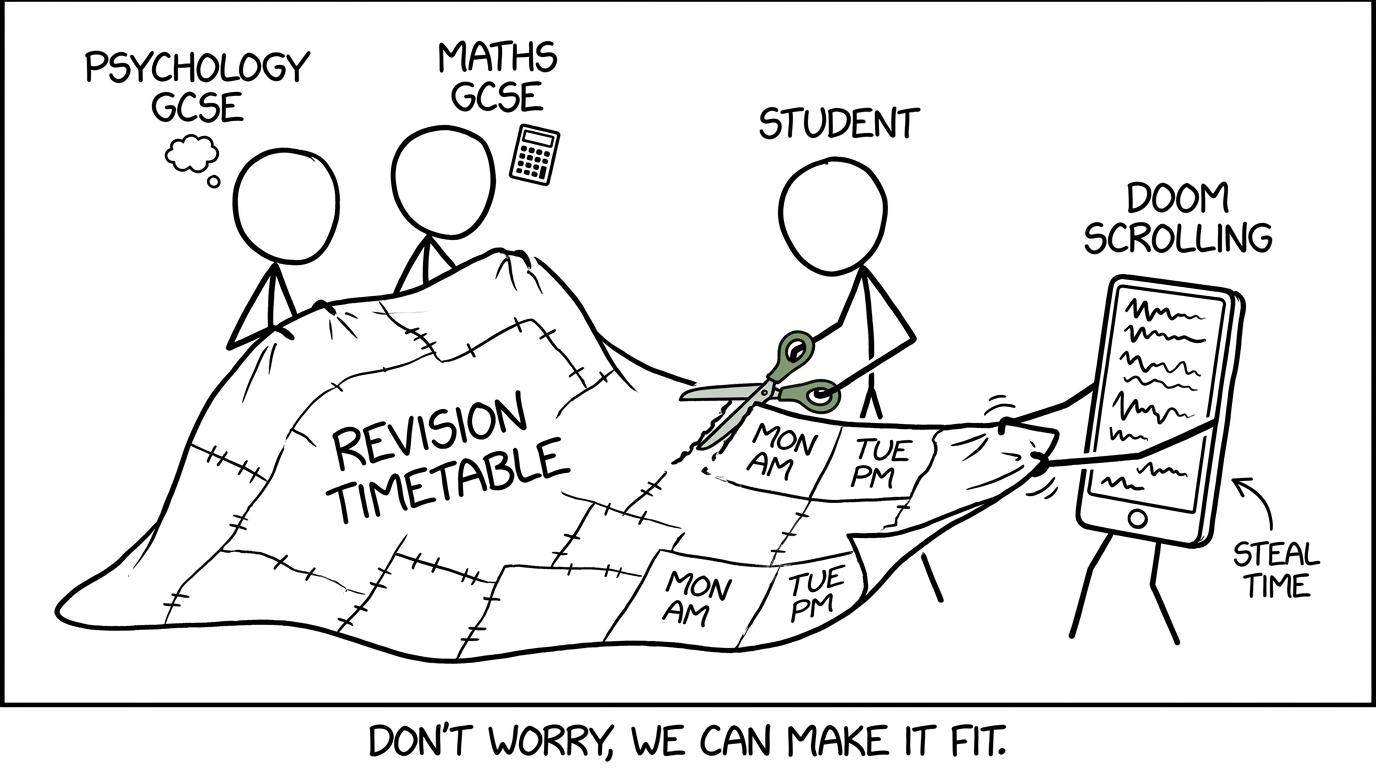 Psychology and maths share a revision timetable while a phone tries to steal it
Signs that you are maintaining knowledge well
You are probably on track if you can:
- retrieve key content after a delay without opening your notes first;
- explain rather than merely name a strength or limitation;
- apply knowledge to an unfamiliar scenario;
- interpret research data accurately;
- identify your mistakes from a mark scheme;
- return to a weak area without abandoning the rest of your timetable;
- finish revision with enough energy to repeat the routine next week.
Notice that none of these signs requires feeling perfectly confident every day. Effective retrieval often feels effortful. A temporarily difficult session can be evidence that you are testing memory honestly, not that your knowledge has vanished.
Common mistakes when trying not to peak early
Repeating comfortable material
Students often protect confidence by revising what already feels secure. Keep strong topics alive, but spend more time on questions that expose uncertainty.
Turning every session into a full mock
Constant full papers can create fatigue and leave little time to repair individual weaknesses. Alternate papers with short, targeted practice.
Checking notes too quickly
Allow yourself a genuine attempt before looking. Then use feedback promptly so that errors do not become established.
Treating one lower mark as proof of decline
Paper difficulty, topic balance, timing and marking can all affect a result. Look for a pattern across several tasks and investigate which skills caused the lost marks.
Ignoring maths inside Psychology
Research methods may require accurate work with averages, percentages, graphs and data. MathsGenie’s guide to stopping GCSE maths content from fading uses the same spaced, active approach that supports Psychology revision.
Revising at maximum effort for months
An exam plan must be repeatable. If every evening is treated like the final night before the paper, fatigue is likely to arrive before exam season. Maintenance is deliberately quieter than cramming.
Keep the knowledge moving
You do not need to preserve the exact feeling you had after a successful mock. Confidence will rise and fall. What matters is whether knowledge continues to be retrieved, corrected and applied.
Use short spaced reviews to maintain GCSE Psychology, then let delayed tests show you where to return. For maths, make MathsGenie’s free GCSE revision resources your base: learn with revision lessons, practise with exam questions and mini tests, then build towards past papers and predicted papers. Mark each attempt carefully and use mark schemes or video solutions to repair the step that cost you marks.
The goal is not to feel permanently at your peak. It is to arrive in May with knowledge that still answers when called.