Should Parents Be Involved in GCSE Statistics Revision?
Parents involved in GCSE statistics revision can support routines and confidence. Learn what helps, what causes friction and when parents should step back.
A student sits down to revise sampling, histograms or probability. A parent wants to help. Within ten minutes, the student feels watched, the parent feels ignored, and the statistics textbook has somehow become the least complicated thing in the room.
Should parents get involved in GCSE Statistics revision? Yes, but usually as organisers, encouragers and calm questioners rather than substitute teachers. The best approach to parents involved GCSE Statistics revision is support without control: help the student establish a routine, find suitable resources, reflect on mistakes and ask for help when necessary. The student should still choose methods, answer questions and make corrections independently.
That balance matters. Evidence reviewed by the Education Endowment Foundation suggests that parental engagement can support attainment overall, but the evidence for direct involvement in secondary homework is less convincing. For older students, help with planning, habits and self-regulation is often more valuable than taking over the academic task.
The short answer: what helpful involvement looks like
Parents do not need to remember every statistical formula. They can help by:
- agreeing a realistic revision routine with the student;
- protecting a quiet time and place for focused work;
- helping the student identify the correct exam board and tier;
- asking the student to explain a statistical idea aloud;
- providing questions without supplying the method;
- encouraging honest use of mark schemes;
- noticing when confusion should be taken to a teacher;
- keeping exam conversations calm and proportionate.
Students can begin at the GCSE Statistics revision hub, where resources are organised by exam board. If the course is Edexcel, the Edexcel GCSE Statistics revision page brings together lessons, worksheets, exam-style questions and papers.
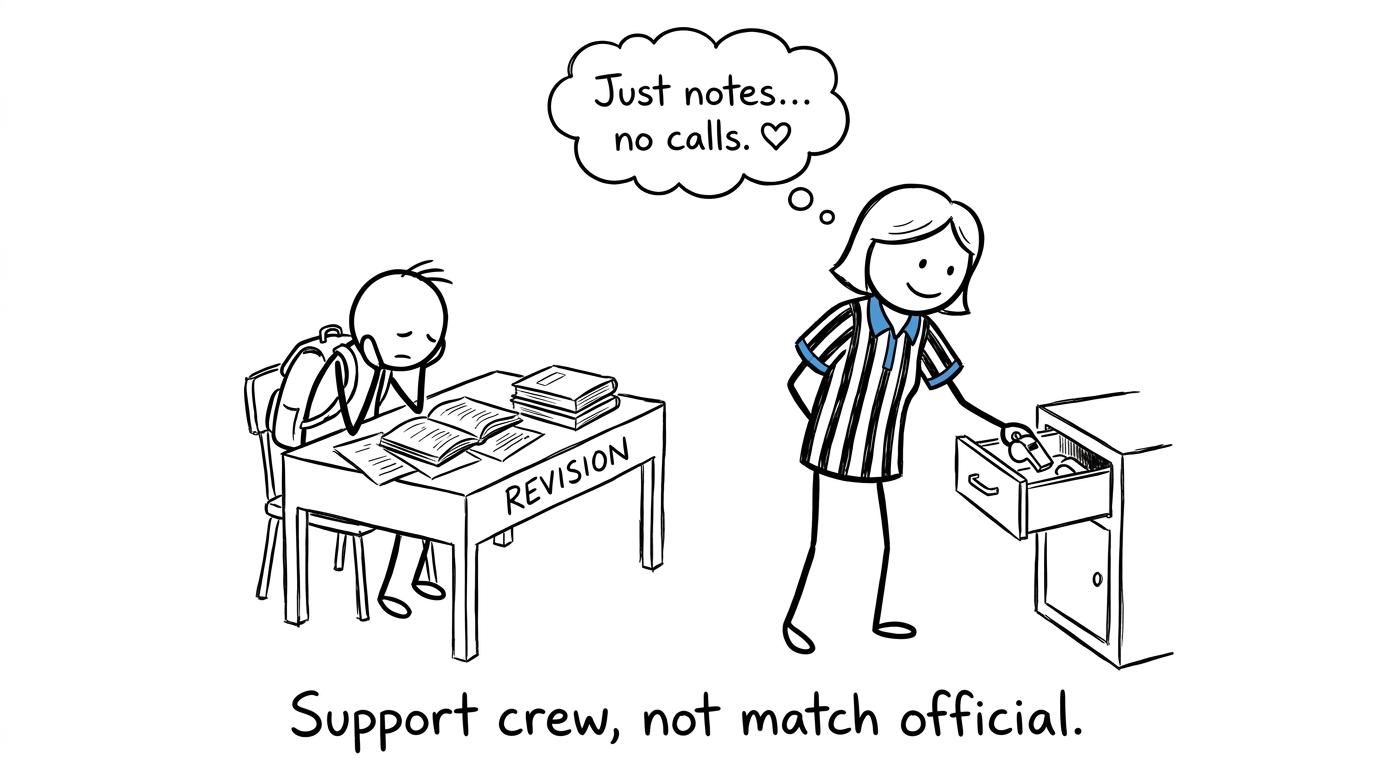 A parent acts as support crew rather than a revision referee
First, be clear about which statistics course you mean
“GCSE Statistics” can mean the separate GCSE qualification, but students also meet statistics within GCSE Maths. These are related, not interchangeable.
The separate qualification covers statistical techniques alongside interpretation, reasoning and evaluation. For example, students may need to judge sampling methods, question the reliability of conclusions and work through stages of a statistical enquiry. GCSE Maths includes topics such as averages, scatter graphs, cumulative frequency and histograms, with the exact content depending on tier and specification.
Exam structures differ between qualifications and boards. AQA GCSE Statistics, for example, is a linear qualification with Foundation and Higher tiers, and its assessment objectives include knowledge of techniques, interpretation in context and evaluation of statistical methods. Students should use the specification, tier and paper information provided by their school rather than assuming that every online statistics question belongs to their course.
This is one place where a parent can be genuinely useful. Check the qualification name and exam board together, then use matching resources. Do not turn that administrative check into a debate about which tier the student “ought” to be taking; tier decisions belong in a conversation with the school.
Where parental involvement genuinely helps
Creating structure without controlling every minute
A revision plan removes a surprisingly expensive decision: “What should I do now?” A parent can help the student choose two or three specific sessions for the week, each with a clear task.
A useful session might follow this pattern:
- review one topic using a revision lesson;
- answer questions independently;
- mark the work carefully;
- record why marks were lost;
- return to the same skill several days later.
The task should be precise. “Revise statistics” is vague. “Complete a set of cumulative frequency questions and correct every error” gives the session a finish line.
Quality matters more than simply extending the time spent at a desk. Research on homework indicates that work connected to classroom learning, with useful feedback, tends to be more effective. Parents can support the conditions for that process without sitting beside the student throughout it.
Asking questions that reveal understanding
Statistics contains procedures, but it is not only procedural. A student might remember that the interquartile range is
IQR=Q3−Q1\mathrm{IQR}=Q_3-Q_1IQR=Q3−Q1without being able to explain what it says about the spread of the middle 50%50\%50% of the data. Similarly, knowing that
frequency density=frequencyclass width\text{frequency density}=\frac{\text{frequency}}{\text{class width}}frequency density=class widthfrequencyis not the same as recognising when a histogram is appropriate.
A parent can ask:
- “Why did you choose that average?”
- “What does your answer mean in this context?”
- “Is that value exact or estimated?”
- “Does the sample represent the population?”
- “What evidence supports that conclusion?”
- “What would make this prediction unreliable?”
These questions do not require the parent to know the answer. Their purpose is to make the student articulate a reason. For topic support, students can revisit the averages revision guide, scatter graphs revision guide or probability revision guide.
Making marking useful rather than emotional
A raw mark is information, not a verdict. Parents can help students look beyond the total and classify lost marks:
| Type of error | Useful next action |
|---|---|
| Missing knowledge | Revisit the relevant lesson or revision guide |
| Incorrect method | Compare the method with the mark scheme or solution |
| Weak interpretation | Practise conclusions written in context |
| Calculator or arithmetic slip | Repeat the calculation and check input carefully |
| Misread question | Underline the command word and required units |
The parent’s role is not to announce whether a score is “good enough”. It is to ask what the paper has revealed. MathsGenie’s guide to finding weak GCSE topics explains how to turn lost marks into a focused revision list.
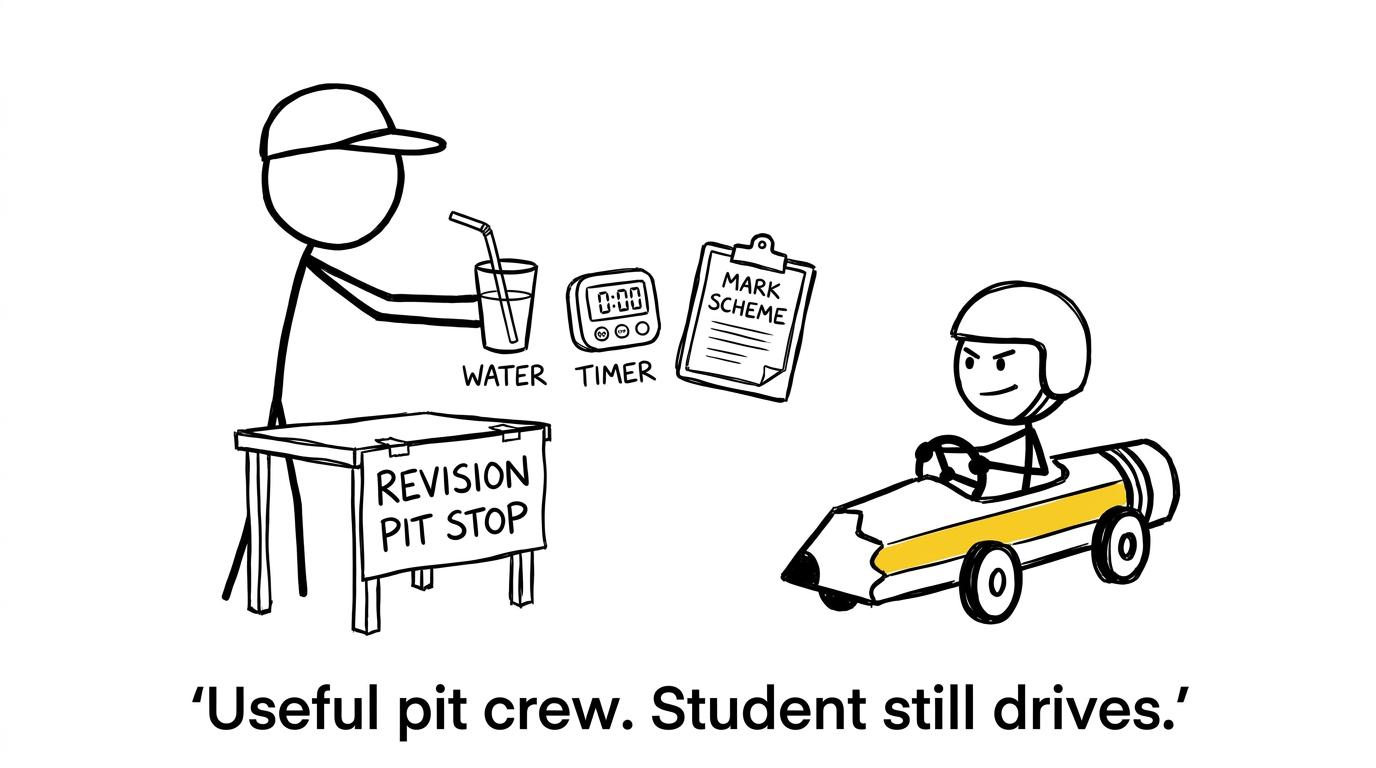 A parent provides revision pit-stop support while the student remains in control
Where involvement creates more friction than progress
Teaching a different method
A parent may remember being taught statistics differently or may know a more advanced approach from work. That knowledge can be useful, but introducing another method immediately can increase confusion.
If the student’s method is valid and matches the specification, let them use it. If neither person is certain, consult the revision lesson, mark scheme or teacher. A disagreement at the kitchen table is not a reliable mathematical authority.
Correcting the student while they are still thinking
Silence can look like confusion when it is actually concentration. Frequent hints interrupt the student’s opportunity to retrieve knowledge and choose a method independently. Those decisions are exactly what an examination requires.
Agree on a rule: the student attempts the question first and marks where help is wanted. The parent can discuss it afterwards, but should not narrate every step.
Turning revision into surveillance
Repeatedly asking, “Have you revised?” may produce compliance without useful learning. It can also make every family conversation feel like an assessment.
A better arrangement is one short weekly check-in. The student reports what they completed, what remains difficult and what the next task will be. Between check-ins, responsibility returns to the student.
Comparing marks with other students
Statistics revision should produce better decisions, not more comparison. Another student may be taking a different tier, following another board or revising from a different starting point. Compare the student’s current work with their previous work instead: fewer repeated errors, clearer interpretation and better management of time.
A practical parent-student revision agreement
A simple agreement prevents help from changing shape halfway through a session.
The student might agree to:
- choose the week’s topics;
- attempt questions without immediate assistance;
- mark work honestly;
- record recurring mistakes;
- ask a teacher when a difficulty remains unresolved.
The parent might agree to:
- help protect agreed revision time;
- ask before quizzing;
- avoid giving answers or unrequested hints;
- discuss errors calmly;
- praise useful habits rather than demanding a particular grade.
Not every student wants the same support. One may appreciate verbal questions; another may prefer help printing a paper and then working alone. Ask directly: “Would you like me to quiz you, organise resources or leave you to complete this independently?”
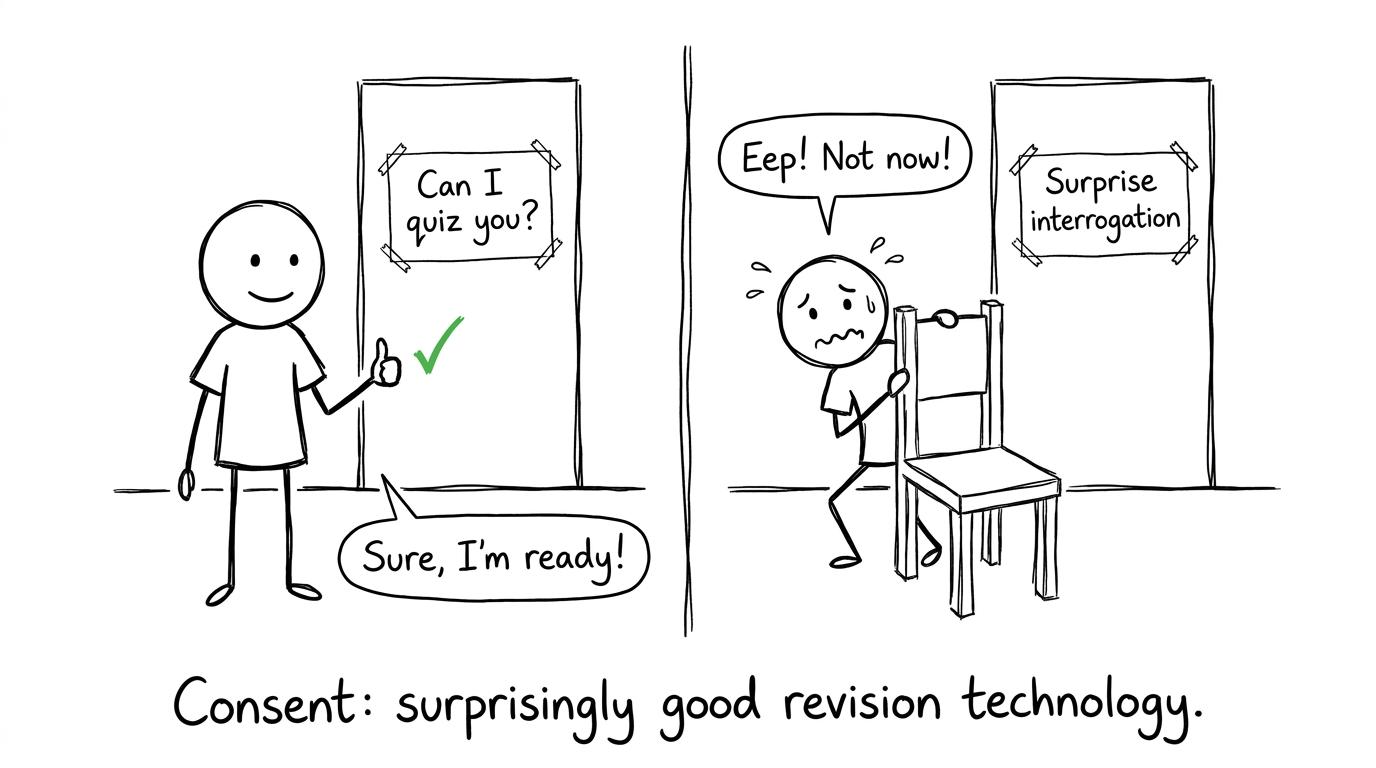 A student demonstrates why permission works better than surprise revision questions
How to use papers without a parent taking over
Past papers are most valuable when they diagnose weaknesses. Start with topic practice, then mixed questions, timed sections and finally complete papers. The student should work under realistic conditions; the parent can help with timing and remove interruptions.
Afterwards, the student should use the mark scheme and explain each lost mark. For graphical topics, the cumulative frequency revision guide and histograms revision guide can help repair specific gaps.
Predicted papers can provide additional practice near the examination, but they are not forecasts that make other topics safe to ignore. The specification remains the reliable guide to examinable content. The MathsGenie article on using predicted topics without guessing explains this distinction.
Common mistakes families should avoid
- Starting with a full paper too early: topic questions are often better when knowledge is still incomplete.
- Measuring revision only in hours: completed questions, corrected errors and successful re-tests provide better evidence.
- Giving hints too quickly: productive struggle is part of learning.
- Treating the mark scheme as an answer sheet: it should reveal the wording, reasoning and working that earn marks.
- Ignoring interpretation: GCSE Statistics assesses what results mean, not only whether calculations are correct.
- Using mismatched resources: check the qualification, board and tier before beginning.
- Revising only comfortable topics: let errors determine what comes next.
- Allowing every discussion to become about grades: focus on the next controllable action.
Support should make independence easier
The most useful parent is not the one who can complete every statistics question. It is the one who helps create the conditions in which the student can eventually complete those questions alone.
Begin with the free MathsGenie GCSE Statistics resources. Choose the correct exam board, revisit weak areas through revision lessons and practice questions, then build towards mini tests, past papers and predicted papers where available. Use mark schemes and video solutions to understand lost marks, not merely to check final answers.
Parents can provide the routine, calm and occasional question. Students must do the thinking. When those roles remain clear, involvement becomes support rather than pressure, and revision becomes something the student gradually learns to own.