Parents Involved in GCSE Spanish Revision: Should They Be?
Parents involved GCSE Spanish revision: learn where support improves speaking, routines and confidence, and where it creates friction for busy GCSE students.
Revision can turn an ordinary kitchen-table question, “Have you done any Spanish?”, into an argument remarkably quickly. The student hears pressure. The parent believes they are offering support. Both usually want the same outcome.
So, should parents get involved in GCSE Spanish revision? Yes, but mainly as organisers, audiences and encouragers rather than replacement teachers. The best approach to parents involved GCSE Spanish revision is light-touch and student-led: help establish a routine, test material the student has chosen, listen to speaking practice and remove practical distractions. Step back when help becomes correction, surveillance or control.
This matters particularly for students balancing Spanish with GCSE maths. Revision time is limited. Support should make the week easier to manage, not create another demand competing with algebra, geometry and past papers.
The short answer: support the process, not every answer
A useful parental role can be summarised in one checklist:
- Ask the student what kind of help they want.
- Help protect short, regular revision sessions.
- Quiz vocabulary from an agreed list or set of cards.
- listen to speaking answers without interrupting.
- Help with timing, equipment and a quiet workspace.
- Encourage the student to check uncertain language with their teacher or official resources.
- Leave the student responsible for choosing, attempting and correcting the academic work.
The distinction is subtle but important. A parent can hold the flashcards without deciding which vocabulary matters. They can operate the timer without controlling the revision timetable. They can listen to a role-play without pretending to be a Spanish teacher.
This reflects wider evidence about parental engagement at secondary school: routines, encouragement, planning and communication can be helpful, while direct involvement in the content of homework requires caution. Older students also need to develop the independence they will rely on in sixth form, college and A Level courses.
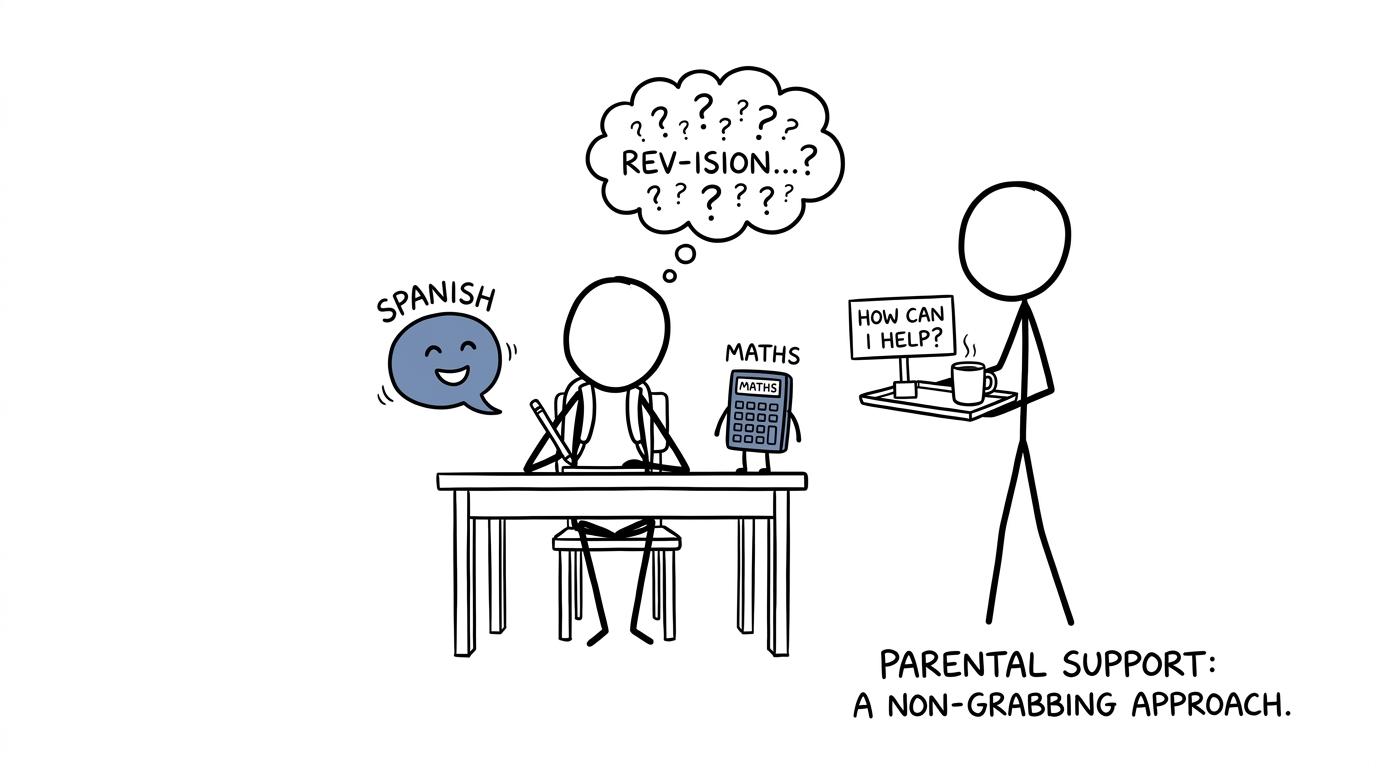 A parent offers calm practical help while Spanish and maths wait on the student's desk
Why GCSE Spanish needs a particular kind of help
GCSE Spanish is not one skill. Current specifications assess listening, speaking, reading and writing, although exact tasks and arrangements depend on the exam board. Students should confirm whether they take AQA, Pearson Edexcel or Eduqas, as well as their foundation or higher tier entry.
For the reformed specifications first assessed from summer 202620262026, features include prescribed vocabulary and grammar, dictation within listening, and reading aloud within speaking. The precise format, timings and mark allocation must always be checked against the student’s own specification.
That variety creates several useful roles for a parent who does not speak Spanish. A parent can play an audio clip, hold a picture prompt, listen while the student reads aloud or check whether every writing bullet point has been addressed. None of those jobs requires the parent to judge complex grammar.
The same principle works in maths. A student may use the GCSE Maths revision hub to choose a lesson and questions, while a parent simply asks what topic will be completed and when. The resource supplies the mathematics; the parent helps protect the routine.
Where parental involvement genuinely helps
Creating a revision routine that survives busy weeks
A revision plan succeeds when it is realistic enough to repeat. Parents can help students look across the whole week, including Spanish, maths, science, English, schoolwork and rest.
The goal is not to fill every evening. It is to prevent revision from being postponed until panic takes over. A student might choose a short Spanish retrieval session followed by a separate maths session, with the parent helping to keep that time free from avoidable interruptions.
Students who need a workable structure can adapt the principles in the GCSE maths revision timetable or use the one-month GCSE revision plan. Although those resources focus on maths, the planning ideas, diagnosis, short focused blocks, retrieval and regular review, transfer sensibly to Spanish.
The student should still own the plan. A timetable imposed from above often feels like another piece of homework. One built together is more likely to survive the first difficult week.
Making speaking practice less awkward
Speaking is one area where another person is genuinely useful. Silent revision cannot reproduce the feeling of answering aloud while someone listens.
A parent can:
- read an English prompt from a teacher-provided role-play;
- hold up a picture or topic card;
- ask pre-agreed questions;
- time an uninterrupted response;
- note where the student paused or stopped;
- ask the student to repeat the task after reviewing it.
The parent does not need to supply the correct pronunciation. In fact, guessing can embed errors. Their job is to create a small amount of realistic pressure and let the student hear their own fluency.
Feedback should remain observational: “You paused for a long time after the second question” is useful. “That sounded wrong” is rarely useful unless the parent knows exactly why and can point to an authoritative correction.
Testing vocabulary without taking control
Vocabulary testing works best when the student supplies the material. They might give a parent a list, flashcards or a school-approved vocabulary set and specify the direction of testing: English to Spanish, Spanish to English, spelling or recognition.
This prevents a common problem: the parent selecting impressive but irrelevant words that do not match the student’s specification or current topic.
A simple routine is enough:
- The student chooses a small set.
- The parent tests in a random order.
- Uncertain items go into a separate pile.
- The student checks the answers.
- The difficult words return on another day.
Parents should resist turning one mistake into a lecture. Retrieval is meant to reveal forgetting. Finding a weak word is the purpose of the exercise, not evidence that the session has failed.
Protecting confidence and reducing decisions
Revision consumes attention before a question has even been attempted. Students must decide what to revise, find resources, avoid distractions and judge whether their work was useful.
Parents can reduce that background load by helping with practical details: a clear workspace, headphones for listening, a charged device, a drink, transport to school sessions or a calm reminder about an upcoming assessment.
For maths, reducing decisions might mean bookmarking the appropriate Edexcel GCSE Maths revision area, AQA GCSE Maths revision area or OCR GCSE Maths revision area. Spanish and maths do not necessarily share an exam board, so each subject should be checked separately.
This is modest help. That is why it can work. The parent removes friction without removing ownership.
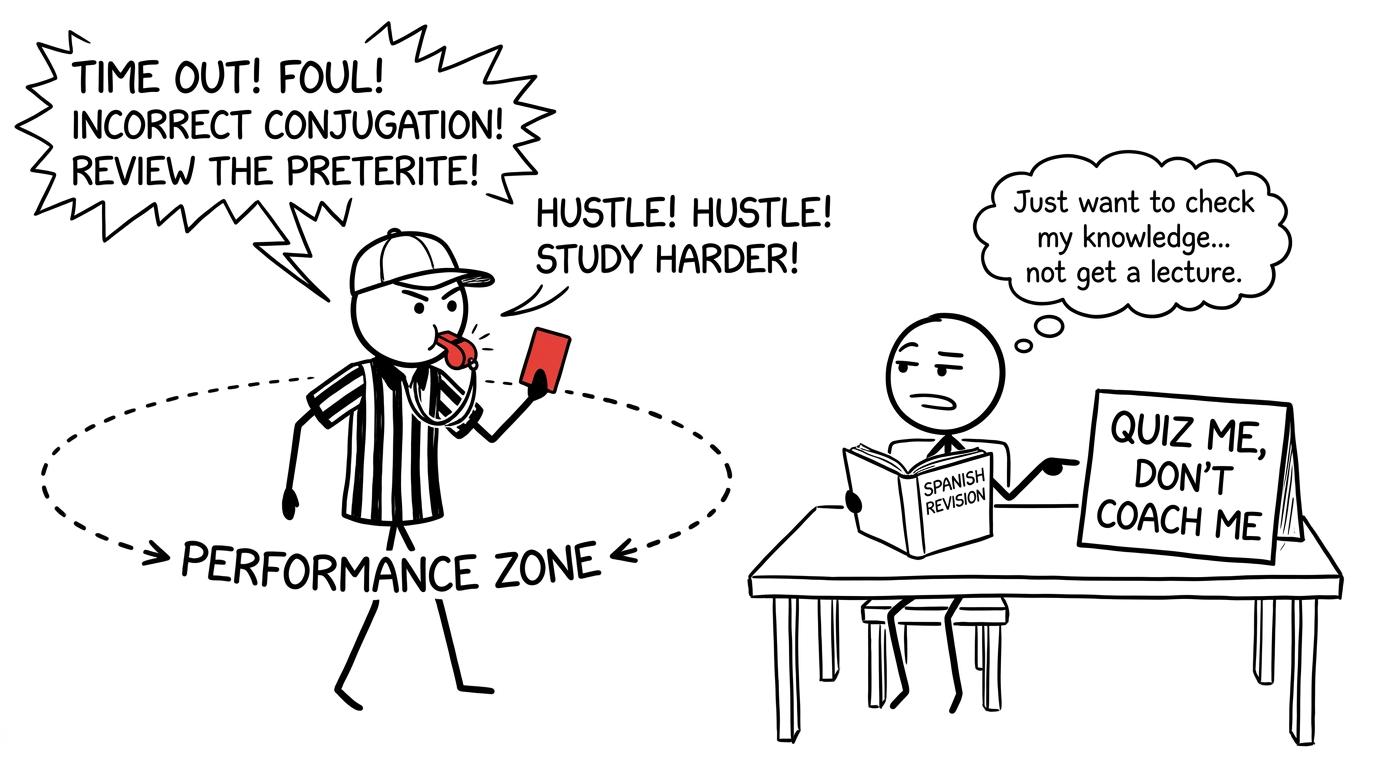 An overenthusiastic parent referee learns to quiz rather than coach
Where involvement creates more friction than progress
Correcting language the parent is unsure about
A confident correction is not automatically a correct correction. Spanish contains distinctions in verb forms, agreement, accents and register that may not be obvious to a non-specialist.
If parent and student disagree, the argument should not decide the grammar. Mark the phrase for checking and take it to the teacher, class materials or the relevant specification. The same rule applies in maths: use an authoritative solution or mark scheme rather than allowing confidence to replace evidence.
Interrupting every spoken mistake
Constant interruption damages fluency practice. A student who is stopped after every hesitation begins concentrating on avoiding embarrassment rather than communicating.
Agree on the purpose before starting. If the aim is fluency, listen until the end and note only major pauses. If the aim is accurate pronunciation, use a short extract and an approved model. Trying to correct fluency, grammar, accent and vocabulary simultaneously makes feedback noisy and discouraging.
Turning support into surveillance
Daily interrogation about marks, revision time and unfinished tasks can make students hide problems rather than discuss them. Monitoring every minute may produce visible activity, but visible activity is not the same as learning.
A weekly conversation is often more useful:
- What went well?
- Which Spanish skill needs attention?
- Which maths topic is currently losing marks?
- What help would make next week easier?
Students can identify maths weaknesses using the find your weakest GCSE topics routine. Parents can ask about the resulting plan without hovering over each question.
Comparing siblings, friends or predicted grades
Comparison changes revision from a practical problem into a judgement about identity. One student may speak confidently but struggle with dictation. Another may write accurately but freeze in conversation. Those differences require different practice, not a family league table.
Predicted grades are information, not destiny. Use them to open a conversation with the teacher about priorities, tier and support. Do not use them as a threat.
A student-led agreement that prevents arguments
Before revision intensifies, parent and student can agree on four boundaries:
The student chooses the academic target
The target should be specific: a vocabulary set, a speaking theme, a listening task or a maths topic. “Revise Spanish” is too broad to guide a session.
The parent chooses only from agreed support roles
Useful roles include quiz partner, listener, timer, planner and provider of practical help. “Teacher” should be reserved for someone with the necessary subject knowledge.
Corrections come from reliable evidence
For Spanish, use teacher feedback and board-matched materials. For maths, use mark schemes and video solutions. Edexcel GCSE Maths past papers, for example, allow students to check how marks are awarded instead of debating an answer at the table.
Either person can pause an unproductive session
If frustration rises, stopping briefly is not surrender. It protects the relationship and prevents a small revision problem becoming an evening-long conflict.
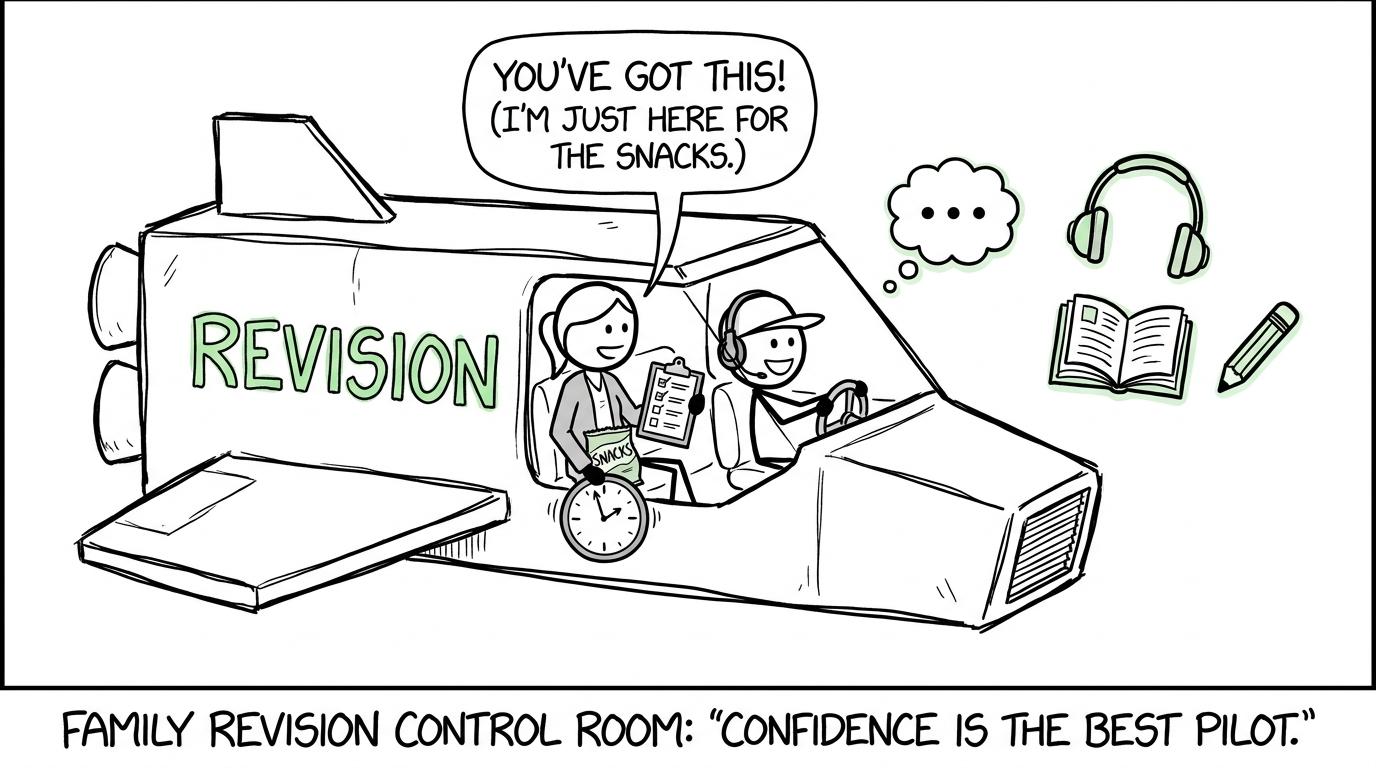 The student pilots revision while the parent supports from the passenger seat
Common mistakes parents and students should avoid
- Starting without asking what help is wanted. A student seeking a listener may not want grammar corrections.
- Using resources from the wrong specification. Check the exam board, qualification and tier before practising.
- Testing only comfortable vocabulary. Revision should revisit uncertain material, not repeatedly confirm what is already known.
- Making sessions too long. Short, repeatable practice is usually easier to sustain alongside maths and other subjects.
- Doing the task for the student. Supplying a polished translation or speaking answer removes the retrieval and decision-making the exam requires.
- Treating every mistake as a crisis. Mistakes are diagnostic information. They show what should be revisited.
- Neglecting other GCSE subjects. Spanish support should fit within the student’s full revision plan rather than quietly displacing maths, English or science.
When time is tight, a compact routine can restore balance. The 20-minute GCSE revision routine offers a useful model for focused maths sessions, leaving room for regular Spanish retrieval without turning the evening into a marathon.
The best involvement leaves the student more independent
Good parental involvement is almost invisible. The student begins promptly, speaks aloud without feeling judged, checks uncertain answers properly and knows what to do next. Over time, the parent needs to do less.
That is the real test. If support makes the student increasingly dependent on reminders, corrections and approval, it needs adjusting. If it builds planning, confidence and honest self-assessment, it is serving its purpose.
For maths revision, let MathsGenie provide the subject guidance. Start with free revision lessons, move into practice questions, check work with mark schemes and video solutions, then build exam confidence through mini tests, past papers and predicted papers. Parents can help protect the routine. Students should remain in the driving seat.