

Should Parents Get Involved in GCSE Economics Revision?
Parents involved GCSE Economics revision: learn when support improves planning and confidence, and when it creates stress or friction at home.
Revision can turn an ordinary question into a small argument. A parent asks, “Have you revised Economics?” The student hears, “You are already behind.” Both people want the same result, yet the conversation pushes them further apart.
So, should parents get involved in GCSE Economics revision? Usually, yes, but as supportive coaches rather than substitute teachers. The most useful parental involvement protects revision time, encourages planning and helps a student reflect on mistakes. It does not mean taking control of the timetable, correcting every answer or repeatedly checking whether work has been done.
That distinction matters. Evidence on parental engagement is broadly positive, but research is less conclusive about precisely which approaches improve attainment at secondary level. Guidance from the Education Endowment Foundation advises caution around direct parental help with older students’ homework. Support for routines, goals, time management and independent learning is often more valuable.
The short answer for students and parents
A productive arrangement normally looks like this:
- the student keeps ownership of what and how they revise;
- the parent helps create regular, realistic revision time;
- support is agreed rather than imposed;
- questions focus on thinking, not interrogation;
- mistakes are treated as information;
- subject teachers and the correct specification remain the authority;
- maths weaknesses are repaired with targeted practice;
- rest, meals and sleep are protected.
The principle is simple: parents can manage some of the conditions around revision, but the student must do the learning.
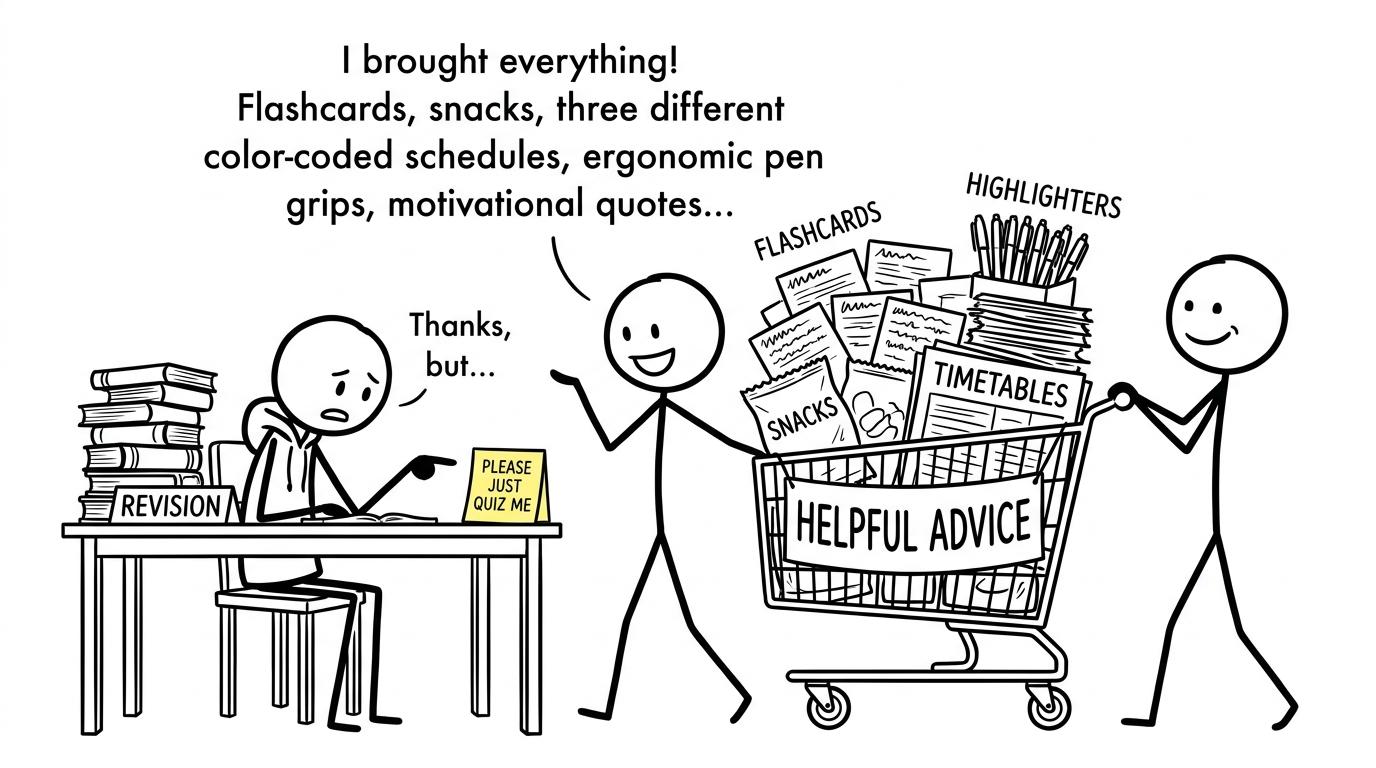 A parent brings an overflowing trolley of revision help while the student asks to be quizzed
Where parental involvement genuinely helps
Creating structure without taking control
Starting is often harder than revising. A parent can help a student choose a repeatable routine, perhaps agreeing which evenings are available and when revision will stop. This reduces daily negotiation without turning home into another classroom.
The plan should remain flexible. Economics must compete for time with maths, English, science and other GCSE subjects. A useful weekly conversation might establish:
- the next assessment or paper;
- two Economics priorities;
- one quantitative skill to practise;
- when the student wants to be tested;
- what support would make the week easier.
Students who need a broader structure can adapt the approach in the GCSE maths revision timetable guide. The important feature is not a perfect colour-coded calendar. It is a plan that can still be followed on an ordinary, tiring Wednesday.
Helping with retrieval practice
A parent does not need an Economics qualification to read questions from flashcards or a student-created list. They can ask for a definition, then follow it with prompts such as:
- “Can you explain that in your own words?”
- “What might cause it to change?”
- “Who could gain or lose?”
- “What evidence would support that judgement?”
- “Is there another possible outcome?”
These prompts reflect the demands of GCSE Economics more closely than simply memorising a glossary. Across regulated GCSE Economics qualifications, assessment objectives reward knowledge and understanding, application, and analysis and evaluation. The national weightings are 35%35\%35%, 35%35\%35% and 30%30\%30% respectively.
That means knowing a definition is only one part of the task. Students must also apply ideas to a context, explain chains of reasoning and reach supported conclusions.
Making revision measurable
Parents can help students notice progress without turning every score into a verdict. After a practice task, the useful questions are:
- Which marks were lost through missing knowledge?
- Which answer did not use the context?
- Where did the reasoning stop too early?
- Was the calculation wrong, or was it interpreted poorly?
- What should be practised next?
The guide to finding weak GCSE topics explains how to turn lost marks into specific revision targets. This is much more actionable than saying, “I am bad at Economics” or “I need to improve maths.”
Supporting the quantitative side of Economics
GCSE Economics is not only an essay subject. Official subject requirements state that at least 10%10\%10% of the total qualification marks must reward quantitative skills at a level no lower than Key Stage 3. Students may need to calculate percentages, percentage changes, averages, revenue, costs, profit and income. They must also construct or interpret graphs and use data to support economic decisions.
Useful relationships to recognise include:
Percentage change=new value−original valueoriginal value×100\text{Percentage change}=\frac{\text{new value}-\text{original value}}{\text{original value}}\times 100Percentage change=original valuenew value−original value×100 Profit=total revenue−total cost\text{Profit}=\text{total revenue}-\text{total cost}Profit=total revenue−total cost Average cost=total costquantity produced\text{Average cost}=\frac{\text{total cost}}{\text{quantity produced}}Average cost=quantity producedtotal costA parent can help by encouraging a student to identify which mathematical skill caused difficulty. They do not need to reteach it themselves. MathsGenie’s free GCSE maths revision hub provides revision lessons, questions and solutions organised by exam board, while the percentage practice questions can strengthen a skill that regularly appears in economic data.
The mathematical method is only half the answer. In Economics, students must often explain what a result means in its stated context.
Where involvement creates more friction than progress
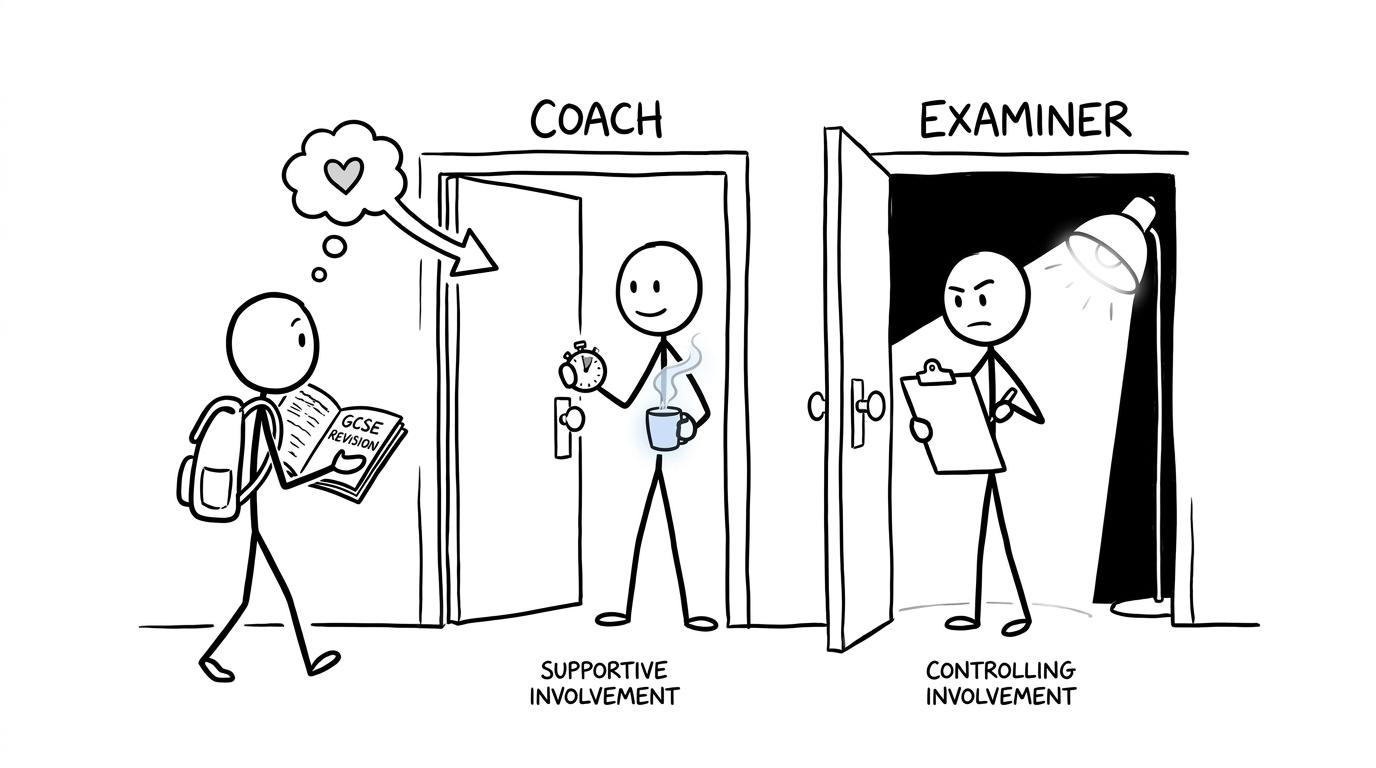 A student chooses a calm revision coach instead of a parent acting like an examiner
When support becomes surveillance
Frequent questions about revision can make a student feel watched rather than supported. Repeated checking may also move responsibility away from the student: revision becomes something done to stop a parent asking, not preparation chosen for a personal goal.
Agreeing a brief check-in is usually calmer. Outside that time, the parent steps back unless the student asks for help. Trust is not the absence of standards. It is giving someone room to meet them.
When parents try to become the subject expert
Economic ideas can invite debate because they concern prices, taxation, employment, trade and government policy. Real-world discussion can be valuable, but an opinion is not automatically a specification-ready answer.
AQA and OCR GCSE Economics have their own paper structures, command words and support materials. Pearson Edexcel International GCSE Economics is a separate qualification with its own specification. Students should check their exact course rather than assume every resource or answering method transfers perfectly.
If a parent’s explanation conflicts with class teaching, the student should use their teacher, specification and official mark schemes as the reference point. A parent can ask, “What does your course require?” instead of insisting, “This is how Economics works.”
When correction arrives too quickly
A student needs time to retrieve, think and struggle productively. Supplying an answer after a few seconds removes that opportunity. Even a correct explanation can become unhelpful if it arrives before the learner has identified the gap.
A better sequence is:
- allow thinking time;
- ask the student to locate the uncertain step;
- offer a small prompt;
- let the student check an approved resource;
- ask them to explain the corrected idea afterwards.
The same principle applies to maths. A revision lesson or video solution is most useful after a genuine attempt, not as something copied line by line.
When targets become comparisons
Comparing grades with siblings, friends or a parent’s own results rarely identifies the next useful action. It turns revision into a judgement about identity.
Evidence is more useful than comparison. A marked paper can reveal whether the next step is terminology, application, evaluation, calculations or timing. The GCSE one-month revision plan offers a practical diagnose-practise-mark-retest rhythm that can be adapted across subjects.
A low-friction agreement for home revision
Parents and students can agree three boundaries before the busiest revision period begins.
Decide what the student owns
The student should normally choose the topic, complete the questions, mark honestly and maintain an error list. This preserves independence and shows what they can actually do without assistance.
Decide what the parent owns
The parent may help protect a quiet space, reduce interruptions, provide materials, hold a timer or test previously learned content. Practical support matters, particularly when revision has to fit around family responsibilities or limited access to devices.
Decide when to step back
Support should decrease when the student is working independently. It should also pause if a discussion becomes heated. Ten calm minutes later will usually achieve more than another thirty minutes of argument.
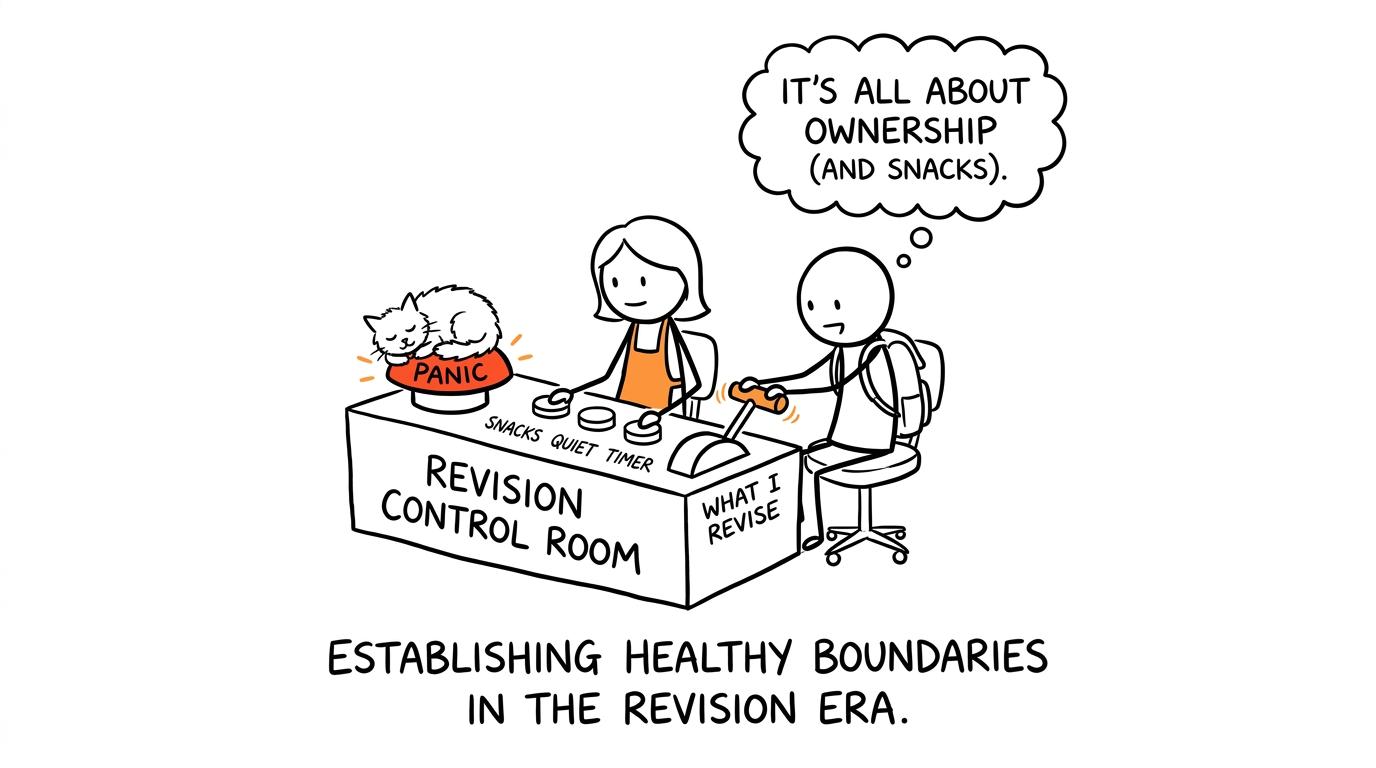 A student controls what to revise while a parent manages snacks, quiet and the timer
Common mistakes to avoid
Building the entire timetable for the student
A parent-designed plan may look efficient but create little commitment. Build the timetable together, then let the student update it. Maths students can use the recommended order for learning GCSE maths topics when deciding which numerical gaps need attention.
Treating time spent as proof of learning
Two hours of highlighting may produce less progress than twenty focused minutes of retrieval and feedback. Ask what was learned, tested or corrected rather than how long someone sat at a desk.
Giving hints throughout timed practice
Help changes the result. During a timed paper or mini test, parents should preserve exam conditions. Discussion belongs after the attempt, when the student can use the mark scheme to identify genuine gaps. The Edexcel GCSE maths past-paper collection demonstrates this attempt-mark-review process for mathematical practice.
Focusing only on calculations
Correct arithmetic does not guarantee full marks in Economics. A numerical result may need a unit, interpretation or link to the case study. Equally, confident writing cannot compensate for inaccurate data handling. Both sides need practice.
Using pressure as motivation
Urgency may produce a short burst of work, but it can also encourage avoidance and secrecy. Calm expectations, specific next actions and consistent routines are more useful than repeated warnings about exam day.
The best role is supportive, limited and agreed
Parents involved in GCSE Economics revision can make a meaningful difference when they create the conditions for independent work. They can help a student begin, keep routines realistic, practise retrieval and respond thoughtfully to mistakes. They are less helpful when they become the timetable owner, subject authority or permanent examiner.
For students, the goal is not to refuse support. It is to ask for the right kind: “Test me on these terms”, “Please keep this half-hour quiet”, or “Can we review my plan on Sunday?” Specific requests turn concern into something useful.
MathsGenie can support the quantitative part of that plan for free. Start with the GCSE maths revision hub, choose the relevant exam board and use revision lessons and practice questions to repair weak skills. Then use mini tests, past papers, predicted papers, mark schemes and video solutions to check whether those skills remain reliable under exam conditions.
Good parental support does not remove difficulty. It gives the student enough space, structure and confidence to work through it.










