Is an Online GCSE History Revision Course Worth It?
Online GCSE history revision course guide: decide if paid tuition beats free resources using a practical checklist for feedback, cost, content and time.
The difficult part of GCSE revision is rarely finding something to watch. It is deciding what deserves your limited time. If you are considering an online GCSE history revision course while also preparing for maths exams, the short answer is this: a paid course can be worth it when it provides precise specification coverage, regular feedback and accountability that free resources do not. It is probably unnecessary if you already know what to revise, can mark your work effectively and follow a consistent plan.
The price alone tells you very little. A free resource used deliberately can outperform an expensive course watched passively. What matters is whether the course changes what you do each week, and whether that change produces better exam answers.
The quick decision checklist
Before paying, ask:
- Does it match your exact exam board and History options?
- Does it teach the question types used in your papers?
- Will a qualified teacher mark your written answers?
- Is feedback specific enough to act on?
- Does the timetable fit around maths and your other GCSE subjects?
- Can you sample a lesson or inspect the course materials first?
- Are the price, access period and cancellation terms clear?
- Could free resources provide the same content if you built your own plan?
If the main benefit is simply access to recorded explanations, free resources may be enough. If the course gives you expert marking, a sensible sequence and deadlines you will genuinely follow, paying may be reasonable.
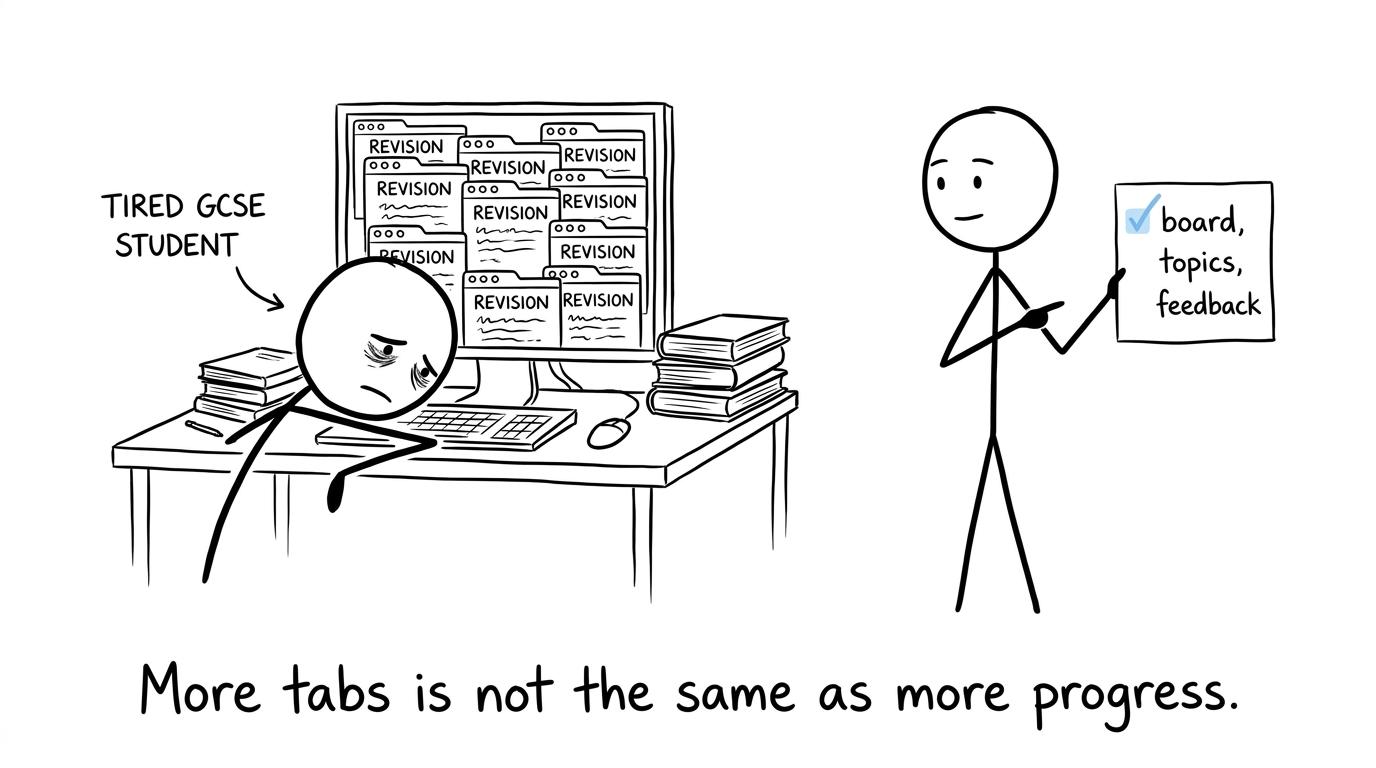 A student discovers that more revision tabs do not necessarily mean more progress
What a GCSE History course actually needs to teach
History revision is not only about remembering dates, people and events. Across GCSE specifications, students are assessed through four broad objectives:
- knowledge and understanding of the periods studied;
- explanation and analysis using ideas such as cause, consequence, change, continuity, similarity, difference and significance;
- analysis and evaluation of contemporary sources;
- analysis and evaluation of historical interpretations.
Official GCSE History specifications allocate approximately 35%35\%35% to knowledge and understanding, 35%35\%35% to explanation and analysis, 15%15\%15% to sources and 15%15\%15% to interpretations. The precise paper structure and question wording vary between AQA, Pearson Edexcel, OCR and Eduqas.
That distinction matters. A course can contain accurate historical information yet still offer weak exam preparation. Useful teaching must connect knowledge to the demands of particular questions: selecting relevant evidence, explaining links, evaluating provenance where required and reaching supported judgements.
It must also cover the options taught by your school. A broad label such as “GCSE History” is not enough. One school may teach Medicine in Britain and Weimar and Nazi Germany, while another follows different thematic, period and depth studies. Check the specification code, topics and historic-environment component before enrolling.
When a paid online course may be worth it
You need reliable marking and feedback
Written feedback is the strongest reason to consider paying. You can learn facts independently, but it is harder to judge whether an explanation is developed, whether evidence supports the argument or why an answer remains in a particular level of the mark scheme.
Good feedback identifies a specific next action. It might tell you that your knowledge is accurate but insufficiently connected to the question, or that your judgement needs explicit comparison between factors. “Add more detail” is not enough.
Before joining, find out:
- how often work is marked;
- who marks it;
- whether feedback is individual or automated;
- how quickly it is returned;
- whether you can submit an improved response.
A video library with one generic model answer is not equivalent to personal feedback.
You struggle to turn intentions into a routine
Some students do not need more material. They need a timetable that removes daily negotiation. A live lesson, submission deadline or weekly test can provide useful structure, especially when revision keeps being postponed.
But accountability only works if the timetable is realistic. A History course that consumes every evening may quietly damage your maths preparation. Your revision plan must leave room for active practice across subjects, including time to use the free GCSE Maths revision hub for board-specific lessons, questions and papers.
If short sessions fit your week better, the 20-minute GCSE maths revision routine shows how a compact learn-practise-mark cycle can protect consistency during busy school days. The same principle applies to History: smaller sessions that require retrieval and writing are usually more useful than a long session spent merely watching.
Your school coverage has left identifiable gaps
A course may be valuable if absence, a school move or disrupted teaching has left clear sections of your specification uncovered. The key word is identifiable. Diagnose the gap before buying the solution.
List your History units and rate your confidence in factual recall, explanation, sources, interpretations and timed writing. Then compare that list with the proposed course. Paying for a complete course to repair one narrow weakness may be poor value; targeted tuition or focused free materials could be more efficient.
Maths revision should follow the same evidence-led approach. MathsGenie’s guide to finding your weakest GCSE topics explains how lost marks can become a focused practice plan rather than a vague feeling that everything needs work.
When free History resources are probably enough
Free resources are likely to be sufficient when you have supportive teaching, access to official specifications and past papers, and the discipline to write and mark answers regularly.
A strong free revision system needs four parts:
- A map: your exam-board specification and the exact options taught by your school.
- Accurate content: school notes, textbooks and trustworthy lessons that cover those options.
- Active practice: recall, timelines, essay plans, source analysis and complete timed answers.
- Feedback: teacher comments, official mark schemes and careful comparison with exemplars.
The weakness of free revision is rarely the price. It is fragmentation. Students collect videos, flashcards and notes from different places without checking whether they fit the same specification. A paid course can solve that organisational problem, but so can a well-built checklist.
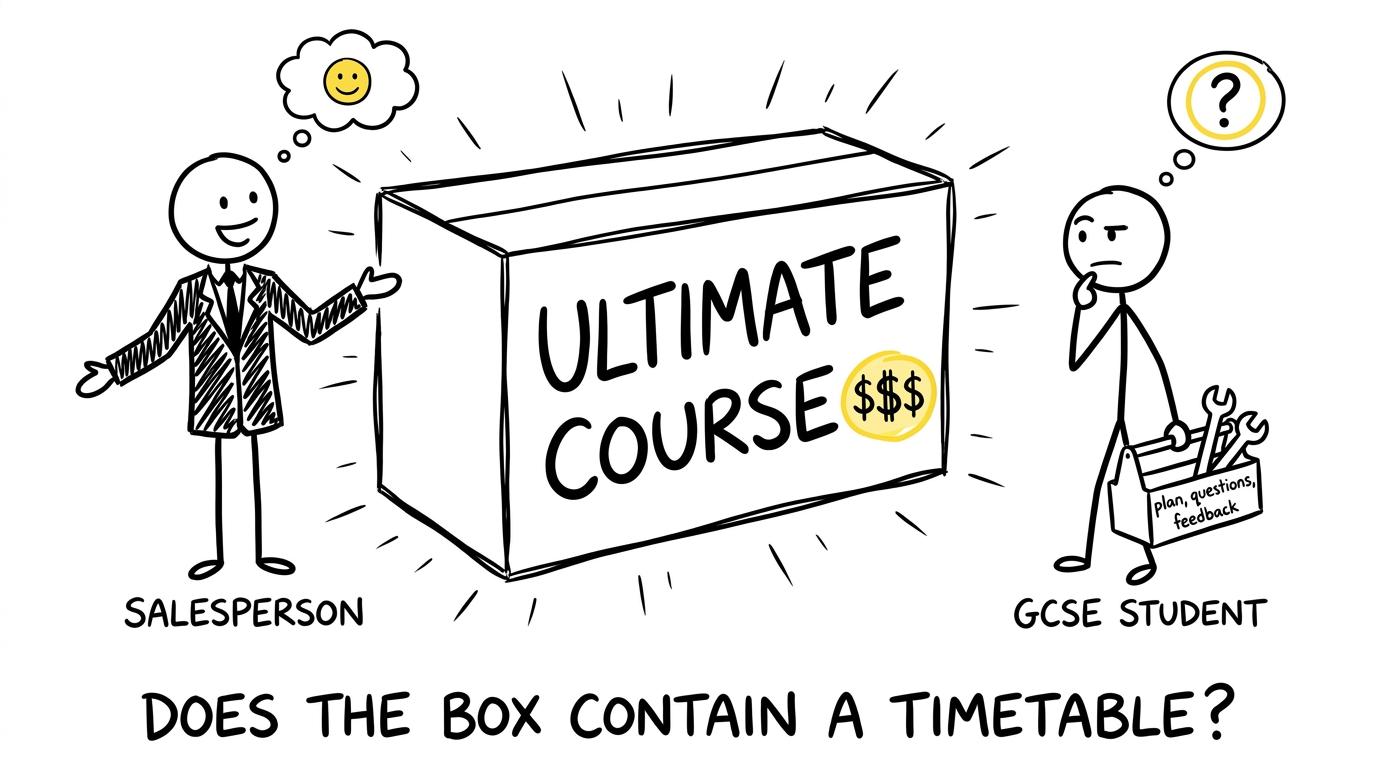 A huge course box competes with a small but useful revision toolkit
Compare the real value, not the marketing
| Feature | When it adds genuine value |
|---|---|
| Recorded lessons | They cover your precise board, topics and question types |
| Live teaching | You can ask questions and the group size allows useful interaction |
| Marked answers | Feedback is individual, prompt and linked to the mark scheme |
| Model responses | The reasoning and structure are explained, not merely displayed |
| Quizzes | They require retrieval and reveal specific knowledge gaps |
| Course timetable | It is manageable alongside maths, English and science |
| Community access | It is moderated, purposeful and safe |
| “Predicted” content | It supplements full specification coverage rather than encouraging guessing |
Be cautious with promises of guaranteed grades or secret predictions. No legitimate course controls the paper or your final result. Revision should cover the specification rather than gambling on a narrow list of anticipated questions.
Also calculate the opportunity cost. Money spent on a course cannot be spent elsewhere, and every scheduled hour displaces another activity. The right question is not, “Is this course good?” It is, “Is this the best use of my next hour and my revision budget?”
How to test a course before committing
First, ask for a syllabus or topic list. Compare it line by line with your school’s specification. Then inspect a sample lesson and sample feedback. A polished video is easy to demonstrate; the quality of marking is more revealing.
Next, complete one week using free resources. Follow a simple cycle:
- retrieve knowledge without notes;
- check and correct it;
- answer one exam-style question;
- compare the response with the mark scheme;
- record one precise improvement;
- revisit the skill later.
If you can sustain that routine and obtain teacher feedback, the course may add little. If you repeatedly stall because you cannot choose material, understand the mark scheme or judge your answers, structured support becomes easier to justify.
Apply the same test to maths. Rather than buying help because maths feels difficult, use an appropriate paper to locate the difficulty. Edexcel GCSE Maths past papers and AQA GCSE Maths past papers include papers and mark schemes, with worked solutions where available. The evidence from your mistakes should determine your next revision step.
Protecting your maths revision time
For a student preparing for maths exams, History support is only worthwhile if it improves one subject without destabilising the rest. Create a weekly plan based on tasks, not hopeful blocks labelled “revision”.
A useful task is specific: complete a timed History interpretation question, review simultaneous equations, or mark a calculator paper. A vague task such as “revise History for two hours” makes passive activity too easy.
If exams are approaching, MathsGenie’s one-month GCSE maths revision plan offers a framework built around diagnosis, topic repair and timed papers. The guide to when to start GCSE past papers can also help you balance topic learning with exam practice.
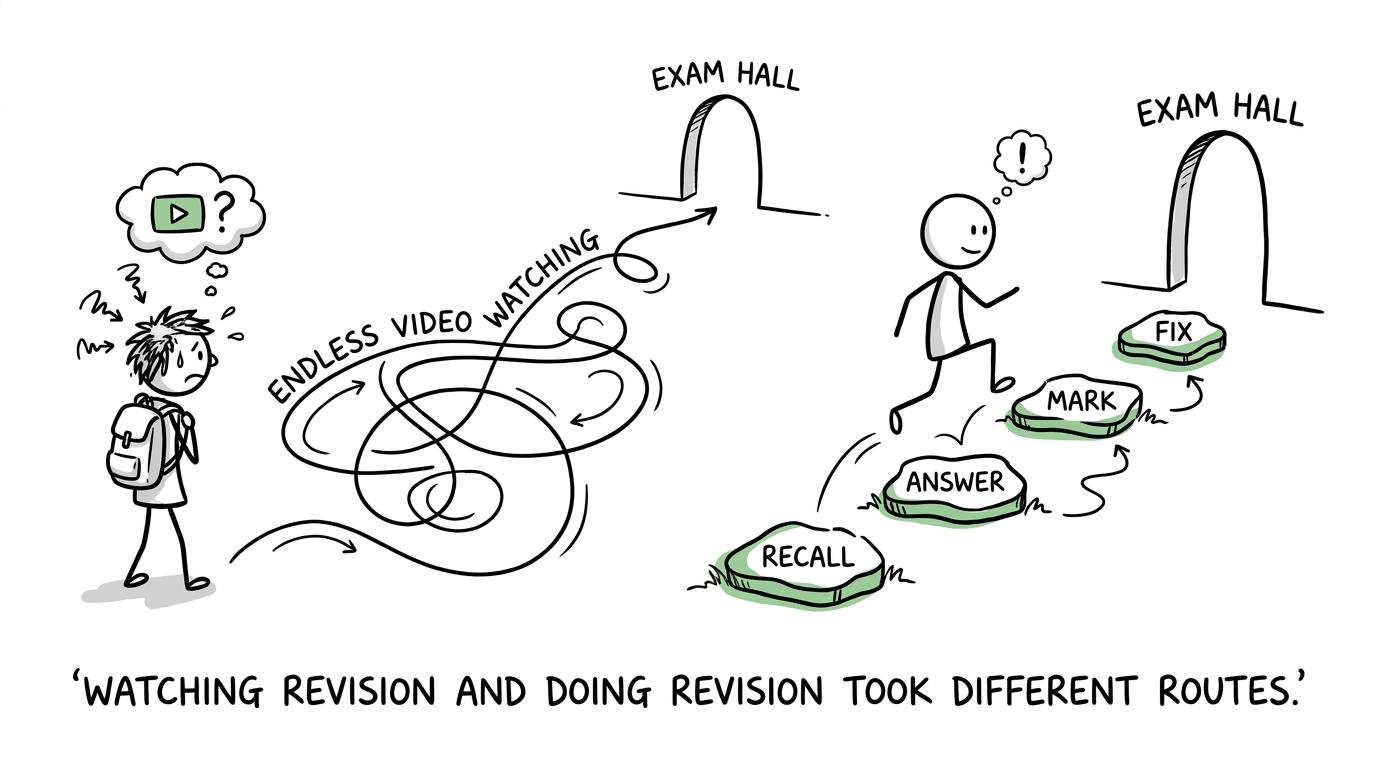 Watching revision and doing revision take very different routes
Common mistakes when choosing a revision course
Buying before checking the exam board
A course may be excellent and still be wrong for your specification or chosen options. Confirm the board, qualification and topics with your teacher first.
Paying mainly for motivation
A purchase can create a short burst of optimism. That feeling is not the same as a workable routine. Look for deadlines, marked work and measurable tasks rather than inspirational promises.
Counting videos watched as revision completed
Recognition feels comfortable: the explanation makes sense while it is on screen. The exam demands recall and application without the presenter beside you. Every lesson should lead to an unaided task.
Ignoring feedback quality
The number of lessons is easy to advertise. The quality of feedback is harder to see and often more important. Ask to view an anonymised example of marked work if one is available.
Letting one subject absorb the timetable
History requires substantial reading and writing, but it should not crowd out repeated maths practice. Plan both subjects visibly and revise the weaknesses shown by evidence.
The final verdict
An online GCSE History revision course is worth considering when it matches your exact specification, provides expert feedback and supplies structure you would not otherwise maintain. It is less likely to be worth paying for when it mainly repackages information already available free, offers generic videos or encourages passive watching.
Start free. Diagnose what is missing. Pay only when the course fills that specific gap better than the alternatives.
Meanwhile, keep maths revision grounded in action. Open the MathsGenie GCSE Maths revision area, choose your board and tier, and combine free revision lessons with practice questions, mini tests, past papers, predicted papers, mark schemes and video solutions. The goal is not to possess more resources. It is to build a revision system that repeatedly turns mistakes into marks.