Is an Online GCSE German Revision Course Worth It?
Online GCSE German revision course guide: compare paid teaching with free resources, assess feedback and structure, and protect time for GCSE maths.
The difficult part of GCSE revision is rarely finding another resource. It is deciding which resource deserves your limited time.
An online GCSE German revision course can be worth paying for if it gives you regular speaking practice, expert feedback and a structure you will genuinely follow. It is less likely to be worth it if it mainly repackages vocabulary lists, recorded explanations and worksheets that you could access free elsewhere.
For a student also preparing for maths exams, there is another cost to consider: attention. A German course that consumes every evening may improve one subject while quietly weakening another. The right decision is not simply whether a course is good. It is whether it solves your most important problem without unbalancing the rest of your GCSE revision.
The short answer: when is a paid German course worth it?
A paid course is most likely to offer value when:
- you need live speaking practice and individual correction;
- you struggle to revise consistently without scheduled sessions;
- your teacher has identified specific gaps in listening, pronunciation, grammar or writing;
- the course matches your exam board, specification and tier;
- feedback is detailed enough to change what you do next;
- the timetable leaves enough space for maths and your other subjects.
Free resources are often enough when:
- you already receive useful feedback from your school;
- you can organise vocabulary, listening and grammar practice independently;
- you need more practice rather than more explanation;
- the paid course consists mostly of recordings and downloadable notes;
- you have not yet used the materials provided by your teacher and exam board.
The sensible default is to identify the gap first. Pay only when the course fills that gap better than the free alternatives.
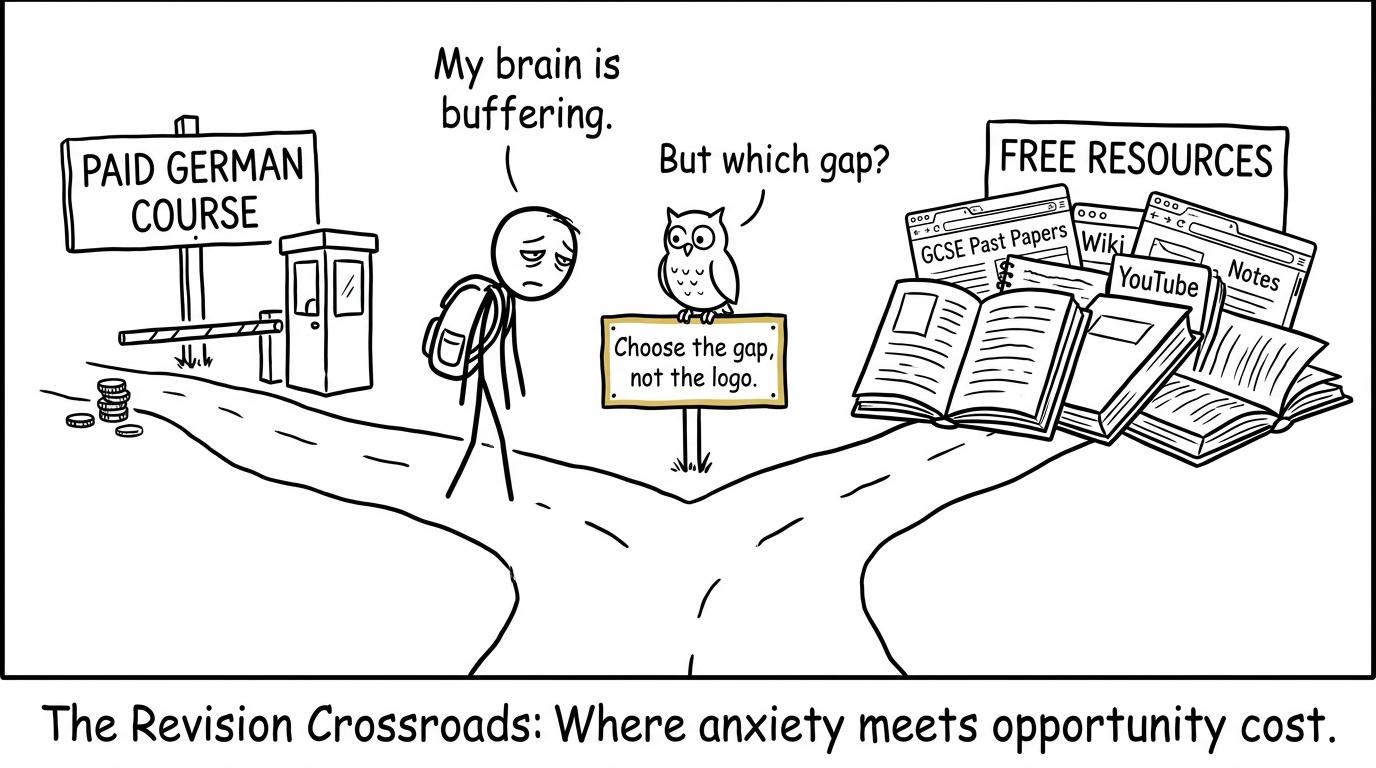 A student choosing between paid courses and free revision resources
What GCSE German revision needs to cover
Current GCSE German qualifications from AQA, Pearson Edexcel and Eduqas assess four language skills: listening, speaking, reading and writing. For specifications first assessed in summer 2026, each skill contributes a substantial part of the qualification, with the major boards allocating each component one quarter of the overall assessment.
Students take either foundation or higher tier across the qualification, according to their board's entry rules. The exact task formats and timings differ, so a course should not offer vague "GCSE German" preparation without identifying the specification it follows.
A balanced revision plan should include:
- Listening: understanding spoken German and completing dictation-style tasks where required;
- Speaking: role-play, reading aloud, visual prompts and conversation tasks, depending on the board;
- Reading: comprehension, inference and translation into English;
- Writing: communicating accurately in German and translating from English;
- Vocabulary and grammar: recalling language accurately enough to use it under exam conditions.
This matters when comparing paid and free options. A beautifully produced course can still be incomplete. If it offers hours of grammar videos but little speaking feedback, it may improve the skill that is easiest to deliver online while neglecting the one you actually need.
What a paid online GCSE German course can add
Live feedback that free resources cannot easily provide
Speaking is where paid support can make the clearest difference. A teacher can notice pronunciation problems, ask unplanned follow-up questions and explain why an answer sounds unnatural. They can also identify whether hesitation comes from missing vocabulary, uncertain grammar or a lack of practice retrieving language aloud.
Writing feedback can also be valuable. A useful tutor does more than correct a sentence. They show you the recurring pattern behind the error and give you a focused next action.
Before joining, ask how often work is marked, who marks it and whether feedback is individual. "Tutor support included" can mean anything from detailed corrections to access to a general message board.
Structure and accountability
A course creates appointments. That can help if independent revision repeatedly gets postponed.
But structure only has value when it produces action. Weekly attendance without retrieval practice, written work or speaking between sessions can create familiarity without dependable recall. Look for a cycle of learning, practising, receiving feedback and returning to the same weakness later.
This is the same principle that makes effective maths revision work. MathsGenie's guide to building a GCSE maths revision timetable prioritises repeatable sessions, targeted practice and review rather than heroic bursts of activity.
Smaller decisions
Good courses reduce decision fatigue. Instead of wondering what to revise, you open the lesson and begin. That convenience can be meaningful during a busy GCSE year.
However, convenience is not the same as quality. A clear weekly sequence should still be linked to the correct specification, tier and assessment format.
When free GCSE German resources are enough
Free does not mean incomplete. Your school may already provide specification-aligned teaching, vocabulary lists, speaking questions, model answers and access to past or sample assessment materials. Exam boards publish specifications and assessment resources, while libraries and educational platforms may provide additional listening and grammar practice.
Independent revision is most effective when you turn those materials into a routine:
- retrieve vocabulary without looking;
- listen and write down what you hear;
- answer speaking prompts aloud rather than silently planning them;
- complete timed reading and writing tasks;
- check work against reliable guidance;
- record errors and revisit them.
The weakness of free resources is usually not scarcity. It is fragmentation. Students collect tabs, videos and worksheets but lack a system for deciding what comes next.
You can solve much of that problem without buying a course. Choose one main source for each skill, follow your school's specification order and keep a short error log. If that system works, paying for another library of content may add very little.
How to compare an online GCSE German revision course
Do not judge a course by the length of its sales page. Use this checklist.
| Question | What a strong answer looks like |
|---|---|
| Does it name the exam board? | The course clearly identifies AQA, Pearson Edexcel or Eduqas and the relevant specification. |
| Does it cover all four skills? | Listening, speaking, reading and writing appear in the timetable and practice materials. |
| Is teaching live or recorded? | The format, class size and opportunity to ask questions are stated clearly. |
| Is feedback individual? | The provider explains what is marked, by whom and how often. |
| Is speaking genuinely interactive? | Students speak regularly and receive correction, rather than only watching demonstrations. |
| Are tasks exam-shaped? | Practice reflects the current tier and assessment format. |
| Can you try it first? | A sample lesson, short trial or clear preview lets you assess the teaching style. |
| Are the terms clear? | Price, renewal, cancellation and access periods are easy to understand. |
Be cautious if a provider guarantees a particular grade, relies on testimonials instead of showing the teaching process, or describes materials as suitable for every board without explaining the differences.
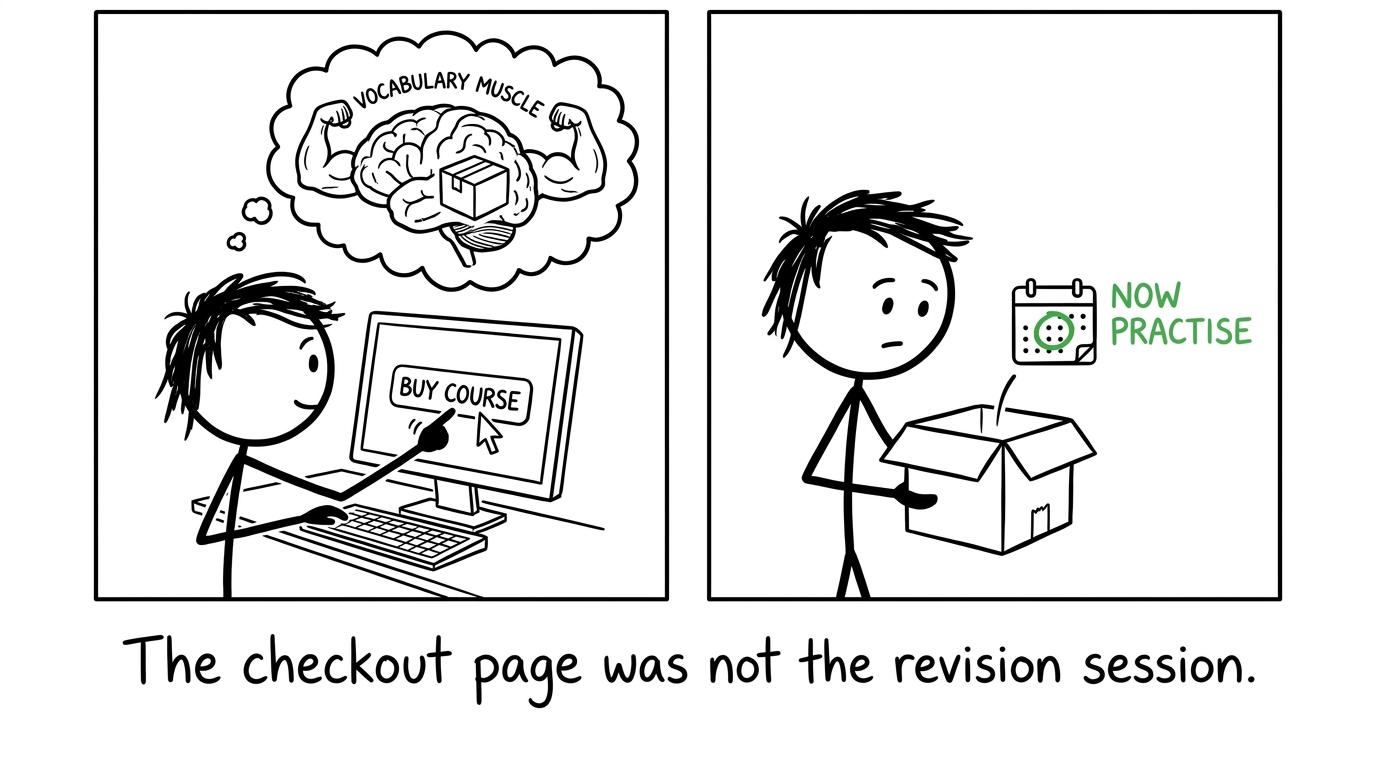 A student discovering that buying a course is not the same as practising
Protecting your GCSE maths revision time
The target audience for a German course may be revising eight or more subjects, but the timetable is still finite. Every fixed lesson creates a trade-off.
Before enrolling, map your week. Include school, homework, rest and existing commitments. Then reserve realistic blocks for German and maths. Maths needs repeated contact because methods become reliable through questions, marking and correction.
If your maths preparation feels unstructured, begin with the free GCSE Maths revision hub. You can choose your exam board and work through revision lessons, worksheets and exam-style questions at the appropriate level.
For Edexcel students, the Edexcel GCSE Maths revision area organises foundation and higher content in one place. After topic practice, use Edexcel GCSE Maths past papers to develop timing and learn how marks are awarded.
Students following AQA, OCR or Eduqas should use resources aligned to their own board and tier. The MathsGenie resources collection also brings together shorter tests, practice papers and predicted papers for focused exam preparation.
The goal is not to divide every evening equally. It is to stop one subject expanding until it consumes the time needed by all the others.
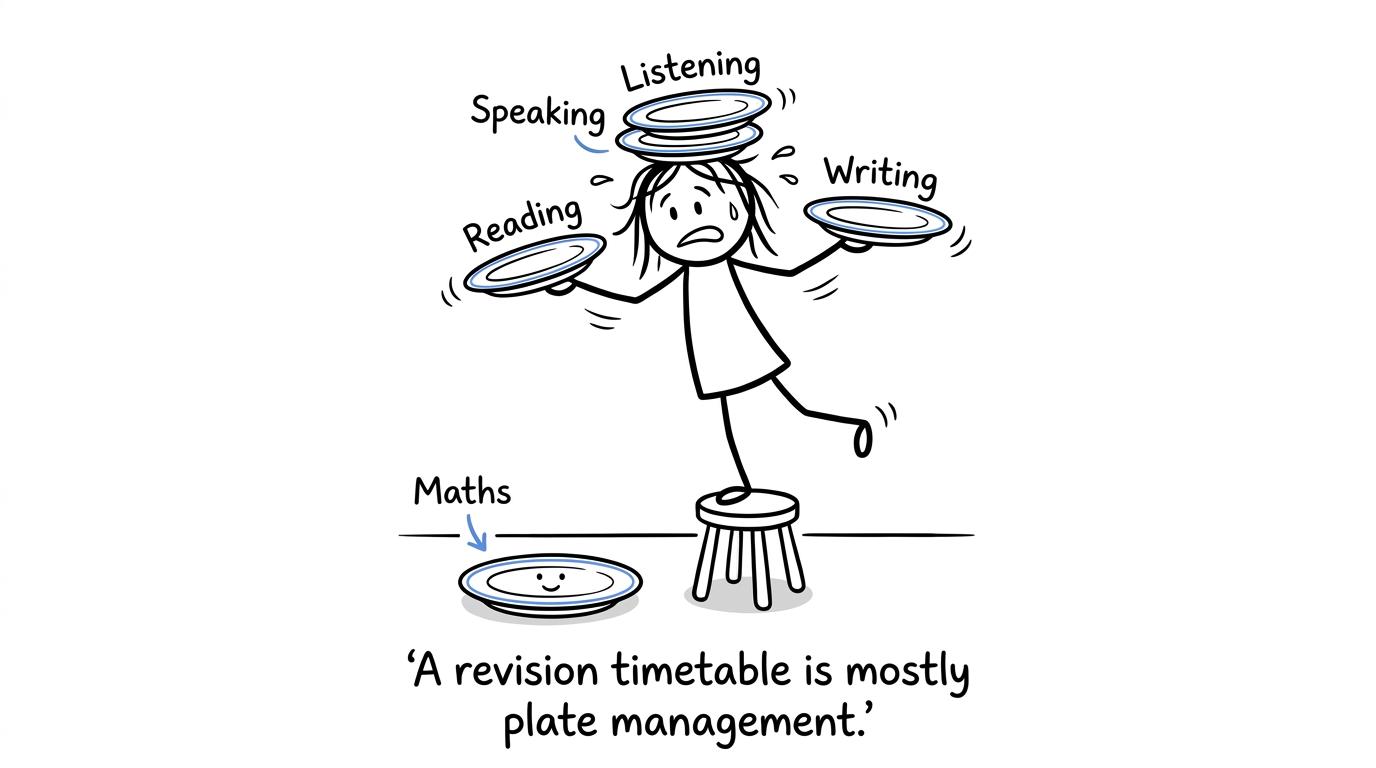 A student balancing German skills while maths waits for its revision slot
A low-risk way to decide before paying
Start with a short diagnostic period rather than purchasing from a feeling of panic.
For one or two weeks, track what happens when you revise German independently. Note which tasks you complete, where you become stuck and what feedback you cannot obtain. Use school materials and the official resources recommended by your teacher.
At the end, classify the main problem:
- Knowledge: vocabulary or grammar is missing.
- Application: you know the content but cannot use it in exam tasks.
- Feedback: you cannot tell why speaking or writing is losing marks.
- Consistency: revision does not happen without an appointment.
- Confidence: you avoid speaking despite knowing useful language.
A paid course is easier to evaluate once the problem is specific. If speaking feedback is the gap, a small live class or individual tutoring may be more useful than a comprehensive recorded course. If consistency is the issue, a structured group programme could provide enough accountability. If vocabulary is the main weakness, disciplined free practice may be the better investment.
Apply the same diagnostic approach to maths. The GCSE one-month revision plan shows how to identify weak topics, combine focused practice with timed work and use mark schemes to plan the next session. For paper practice, the guide to using Edexcel past papers properly explains the attempt, mark, repair and retest cycle.
Common mistakes when choosing a German course
Buying because the exam feels close
Urgency makes structure look more valuable than it may be. Check the syllabus coverage, feedback and timetable before paying. A rushed purchase can leave you with hours of content but no plan for using it.
Confusing access with progress
Owning videos, notes and quizzes does not improve a grade by itself. Progress comes from retrieving language, completing tasks, receiving correction and acting on it.
Ignoring the exam board and tier
Task formats differ. Make sure the provider teaches the current specification for your board and prepares you for the correct tier.
Paying for content when feedback is the real need
If you already understand the grammar but need someone to correct speaking or writing, a large self-paced course may not solve the problem. Buy the missing service, not the largest package.
Letting German displace maths
A course timetable can feel non-negotiable, while independent maths sessions are easy to move. Protect those sessions. Use mini tests and shorter tasks when time is tight, then build towards full papers. MathsGenie's guide to when to start GCSE past papers can help you plan that progression.
Make the decision from evidence, not anxiety
An online GCSE German revision course is worth it when it provides something you need and cannot obtain reliably for free, usually personalised feedback, live speaking practice, expert correction or dependable structure. It is not automatically better because it is paid, long or professionally presented.
Diagnose the weakness. Check the board and tier. Ask exactly how feedback works. Compare the timetable with the rest of your GCSE commitments. Then decide.
And while German develops through listening, speaking, reading and writing, keep your maths moving through its own dependable rhythm: learn, practise, mark, repair and retest. Start with MathsGenie's free GCSE revision lessons and practice questions, then build confidence with mini tests, past papers, predicted papers, mark schemes and video solutions. One useful session in each subject is worth more than another course left unopened.