Online GCSE English Literature Revision Course: Worth It?
Online GCSE English Literature revision course: decide whether paid teaching, feedback and accountability offer better value than free resources today.
There is a particular kind of revision anxiety that appears when your notes are complete but your essays still feel uncertain. You know the plot. You remember several quotations. Yet when a question asks how a writer presents ambition, conflict or responsibility, the blank page seems much larger than it should.
An online GCSE English Literature revision course can be worth paying for if it provides expert feedback, exam-board-specific teaching and a structure you will genuinely follow. It is usually not worth the cost if it merely repackages recorded videos, summaries and generic essay templates that you could access free elsewhere.
The real question is not whether paid revision is automatically better. It is whether the course solves a problem that your current free resources, school support and independent practice do not.
The quick decision checklist
Before paying, ask:
- Does the course match your exact exam board and set texts?
- Will a qualified or experienced teacher mark your writing?
- Is feedback individual and specific rather than automated or generic?
- Are there live lessons, deadlines or check-ins that will improve your consistency?
- Can you see a sample lesson and sample feedback before joining?
- Does the timetable leave enough space for GCSE maths and your other subjects?
- Could your teacher, school materials and free resources provide the same support?
- Are the price, cancellation terms and access period clear?
If the strongest feature is simply “lots of content”, pause. Most students do not suffer from a shortage of content. They struggle to choose what to do next, practise it properly and discover why their answer lost marks.
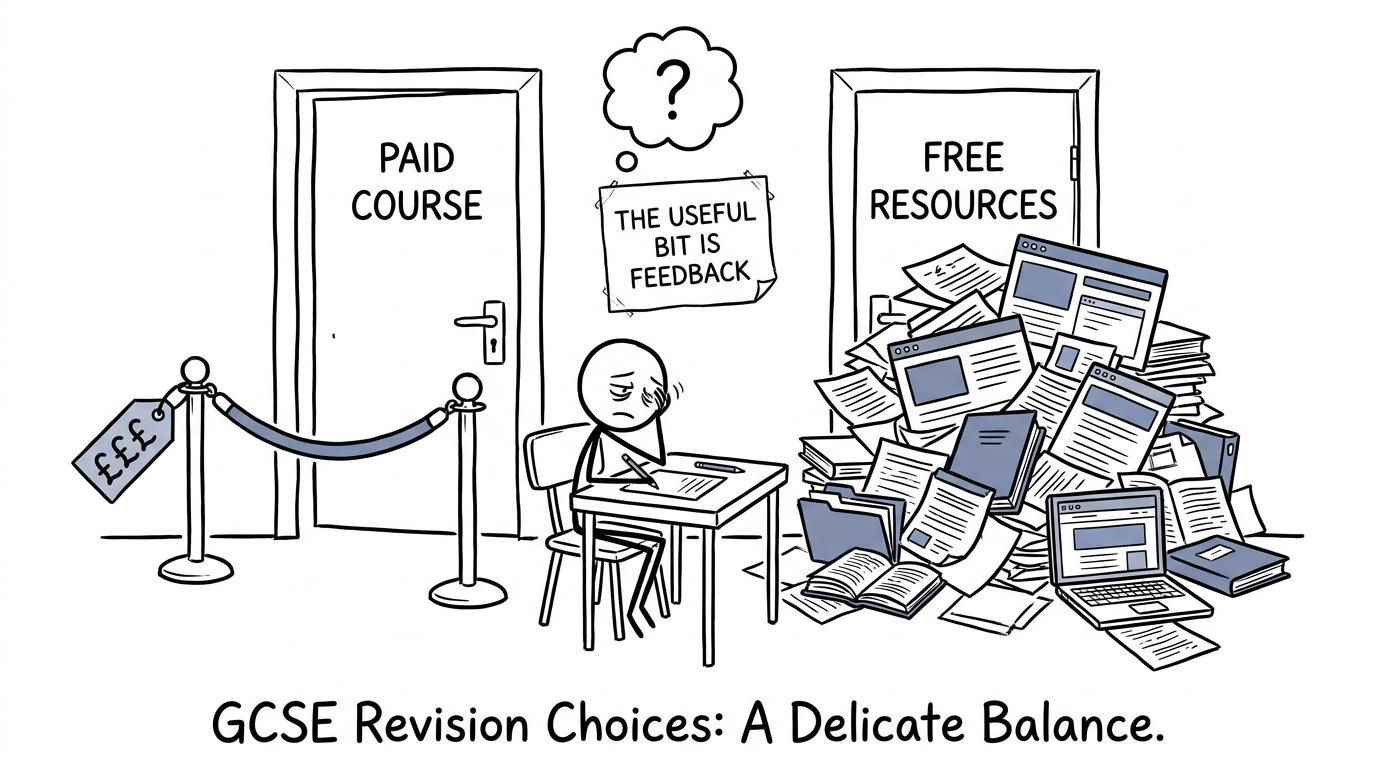 A student choosing between a paid course and free revision resources
What GCSE English Literature revision must achieve
A useful course should be built around the qualification rather than around impressive-looking quantities of video.
GCSE English Literature specifications require students to understand substantial texts, develop informed responses, support interpretations with textual references and analyse writers' use of language, form and structure. Context and accurate written communication also matter, although their precise treatment depends on the specification and question.
The national subject content includes Shakespeare, a nineteenth-century novel, poetry and British fiction or drama from the modern period. Unseen material must also be assessed. However, paper structures, set-text choices and question styles differ across AQA, Pearson Edexcel, OCR and Eduqas.
For example, AQA's current specification uses two compulsory closed-book papers, while OCR describes its examinations as closed text. That does not mean every board should be revised in exactly the same way. A worthwhile provider should know your specification, current set texts and assessment objectives rather than teaching a vague version of “GCSE English”.
Effective revision therefore needs to develop four broad abilities:
- secure knowledge of characters, themes, events and relationships
- selective recall of useful quotations and textual references
- analysis of language, structure and form
- planned, relevant writing under timed conditions
A course that spends most of its time retelling plots is offering comfort, not enough preparation.
When a paid online course may be worth it
You need meaningful feedback on essays
English Literature differs from a subject where you can always compare one final answer with a mark scheme. Mark schemes describe levels and qualities, but students often need help seeing where those qualities appear in their own writing.
Good feedback might identify that your argument answers the question initially but loses focus, that your quotation is relevant but under-analysed, or that context has been added without connecting it to the writer's purpose. It should then give you a manageable next action.
Educational evidence generally supports the value of feedback, but feedback is not valuable merely because it exists. “Add more detail” is rarely enough. Before enrolling, ask how frequently work is marked, who marks it, how quickly it is returned and whether you can submit an improved version.
You understand the texts but lack structure
Some students know plenty but revise unpredictably. They reread Macbeth one evening, watch poetry videos the next and then avoid essay practice because it feels harder.
A course can provide useful external structure through weekly lessons, submission dates and a clear route through the specification. This reflects a broader principle of effective independent learning: students benefit from planning, monitoring and evaluating their work within the subject they are learning.
Structure is especially valuable if it changes your behaviour. A beautiful online dashboard that you rarely open has no academic value.
You have a specific gap that school support cannot currently fill
Perhaps you joined the class late, missed part of a text, need support with unseen poetry or repeatedly receive the same essay feedback without knowing how to act on it. Focused teaching may save time.
The key word is specific. “I want to feel more confident” is understandable but difficult to evaluate. “I need to plan comparative poetry answers and receive feedback on two timed attempts” gives you a standard against which to judge a course.
When free resources are probably enough
A paid course is less likely to represent good value when you already have supportive teaching, accurate materials and regular opportunities to submit work.
Free resources may be enough if you can:
- follow your exam-board specification and school text list
- retrieve key ideas and quotations without constantly rereading
- plan and write answers regularly
- use teacher comments to improve the next response
- compare your work with official assessment materials
- maintain a realistic revision timetable
Free does not mean unstructured. You can create a strong routine by choosing one task, completing it from memory, checking it and recording the next improvement. This is the same feedback loop that makes maths revision effective.
For maths, the free GCSE Maths revision hub organises lessons, questions and papers by board. English resources should meet the same basic standard: correct specification, purposeful practice and a clear way to review mistakes.
Paid courses versus free revision resources
| Feature | Paid course may be better when | Free resources may be enough when |
|---|---|---|
| Teaching | You need a concept explained live and can ask questions | Recorded explanations and school lessons already make sense |
| Feedback | Your essays receive detailed individual marking | Your teacher regularly marks practice and explains improvements |
| Accountability | Deadlines make you complete difficult tasks | You reliably follow your own timetable |
| Coverage | You have missed teaching or have clear gaps | Your school has covered the full specification |
| Flexibility | Sessions fit your existing revision plan | Fixed lesson times would crowd out other subjects |
| Value | The price mainly buys expertise and feedback | The price mainly buys videos, notes and quizzes |
The comparison is not really paid versus free. It is active support versus passive content.
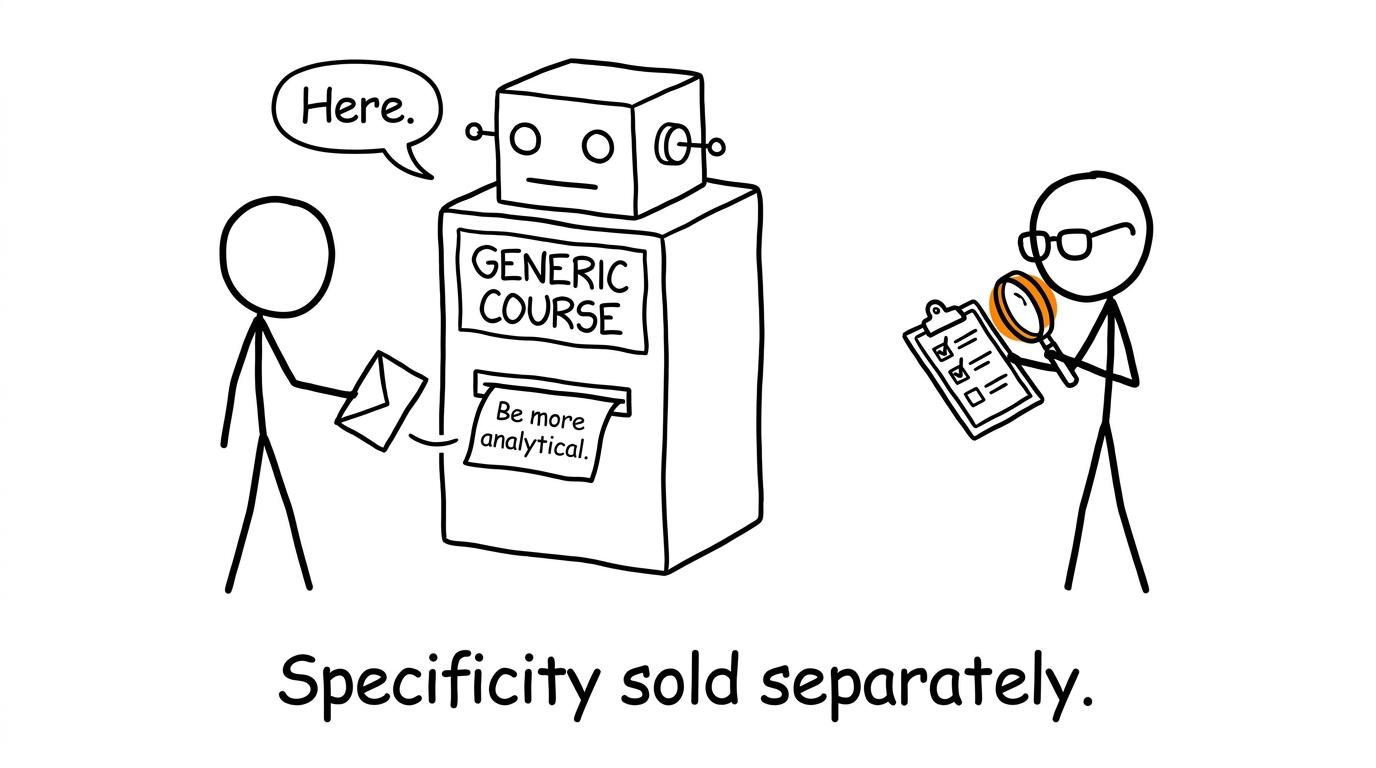 A robot gives generic essay feedback while a tutor offers a specific checklist
How maths students should protect their revision time
The target audience for an English Literature course is often revising maths at the same time. This matters. Every scheduled English session has an opportunity cost: it occupies time that could have been used to repair algebra, practise geometry or complete a timed paper.
Start by mapping all subjects, mocks and course sessions in one place. MathsGenie's GCSE maths revision timetable guide can help you build a weekly plan around diagnosis, topic repair and paper practice.
On busy school days, preserve momentum with a short GCSE maths revision routine. A brief, focused session is more useful than abandoning maths for a week because an English course has become demanding.
Your English course should reduce decision-making, not consume the whole timetable. If it assigns several hours of passive viewing each week, ask whether those hours would be better spent writing one answer, receiving feedback and then revising a weak maths topic.
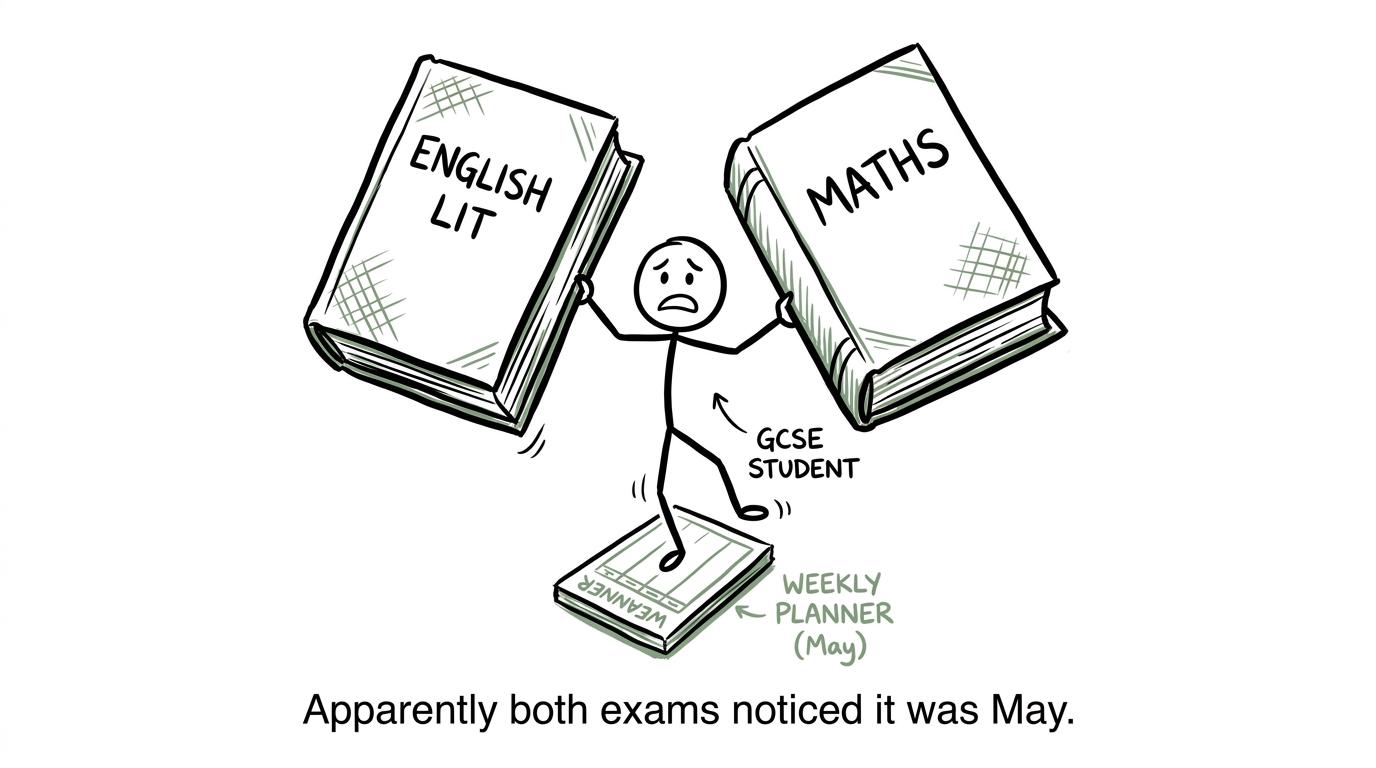 A student balancing English Literature and maths on a tiny planner
How to inspect a course before paying
Check alignment carefully
Confirm the exam board, specification, set texts and poetry anthology. Look for current course information rather than assuming a familiar text list is still correct. Exam boards can update set-text options, so the provider should state which examination series its material supports.
Ask to see the feedback
A sample marked essay reveals more than a promotional page. Look for comments connected to the question, assessment objectives and the student's actual wording. The feedback should distinguish between knowledge, interpretation, analysis and written control.
Examine the teaching model
Find out whether lessons are live, recorded or mixed. Live teaching can provide questions and accountability, while recordings offer flexibility. Neither format is automatically superior. What matters is whether you must think, retrieve, plan and write rather than simply watch.
Test the free alternative first
Run a one-week experiment before buying anything. Follow a planned English routine, ask your teacher for feedback and complete the free maths work already available to you. Use GCSE Maths mini tests to keep mathematical recall moving while you assess your English needs.
If the experiment fails, identify why. A course can fix missing explanation or accountability. It cannot fix an unrealistic timetable by adding more work to it.
Common mistakes when choosing a revision course
Buying because exams feel close
Urgency makes any organised product look reassuring. Buy only when you can name the problem it solves and the work you will complete.
Confusing watching with practising
Video can explain a method, but exam performance requires retrieval and writing. In maths, the equivalent would be watching solutions without attempting questions. MathsGenie's guide to revising GCSE maths efficiently places practice, marking and correction at the centre for this reason.
Ignoring your exam board
A polished lesson on the wrong anthology or question structure can waste valuable time. Verify everything against information from your school and exam board.
Paying for motivation without checking the timetable
A live course may create accountability, but only if you can attend and complete the work. Check clashes with school, maths revision and other commitments first.
Replacing official practice with predictions
Predictions can focus practice but cannot guarantee examination content. This applies in English and maths. Use official past materials for realism, then use supplementary practice to expose further gaps. Maths students can combine Edexcel GCSE Maths past papers with GCSE predicted papers, rather than treating either as a shortcut.
The final verdict
An online GCSE English Literature revision course is worth it when you are paying for something scarce: perceptive feedback, expert explanation, personal guidance or accountability that changes what you actually do.
It is probably not worth it when the package consists mainly of summaries, recorded lectures and generic templates. Free resources, school support and disciplined practice can be just as effective when they are accurate and used actively.
Choose English support with care, then keep the rest of your revision balanced. Make MathsGenie GCSE Maths revision your free maths base: use revision lessons to rebuild weak methods, practice questions and mini tests to check them, and past papers, predicted papers, mark schemes and video solutions to prepare for exam conditions. The best resource is not the one with the largest price or library. It is the one that makes your next useful action obvious.