

Online GCSE Drama Revision Course: Is It Worth It?
Online GCSE drama revision course options can add structure and feedback, but free resources may be enough. Learn what is worth paying for and why.
The difficult part is not finding another revision resource. It is deciding whether that resource deserves your limited time.
An online GCSE drama revision course can be worth joining if it provides specification-specific teaching, expert feedback and a routine you cannot create alone. But paying for a course is not automatically better than using free resources. If you already have strong teacher support, know your set text and can revise consistently, free materials may be enough.
For students also preparing for GCSE Maths, the decision matters twice. Every evening spent on Drama is an evening that cannot be spent repairing algebra, geometry or probability gaps. The goal is not to choose between subjects. It is to give each subject the kind of help it genuinely needs.
The short answer: when is a Drama course worth paying for?
A paid course is most likely to be worthwhile when it gives you something that free revision cannot easily provide:
- individual feedback on analytical writing or portfolio work
- live discussion of your set text
- practical performance or design feedback
- teaching matched to your exam board
- accountability through scheduled sessions
- access to a knowledgeable tutor when you are stuck
Free resources are more likely to be sufficient when you:
- understand the structure of your qualification
- receive useful feedback from your school teacher
- can identify your weaknesses accurately
- revise independently without repeatedly postponing the work
- have suitable notes, past questions and mark schemes
- mainly need retrieval practice rather than fresh teaching
Before paying, ask one question: What exact problem will this course solve? “I feel behind” is a feeling. “I cannot structure my live theatre evaluation” is a problem that a good course may be able to solve.
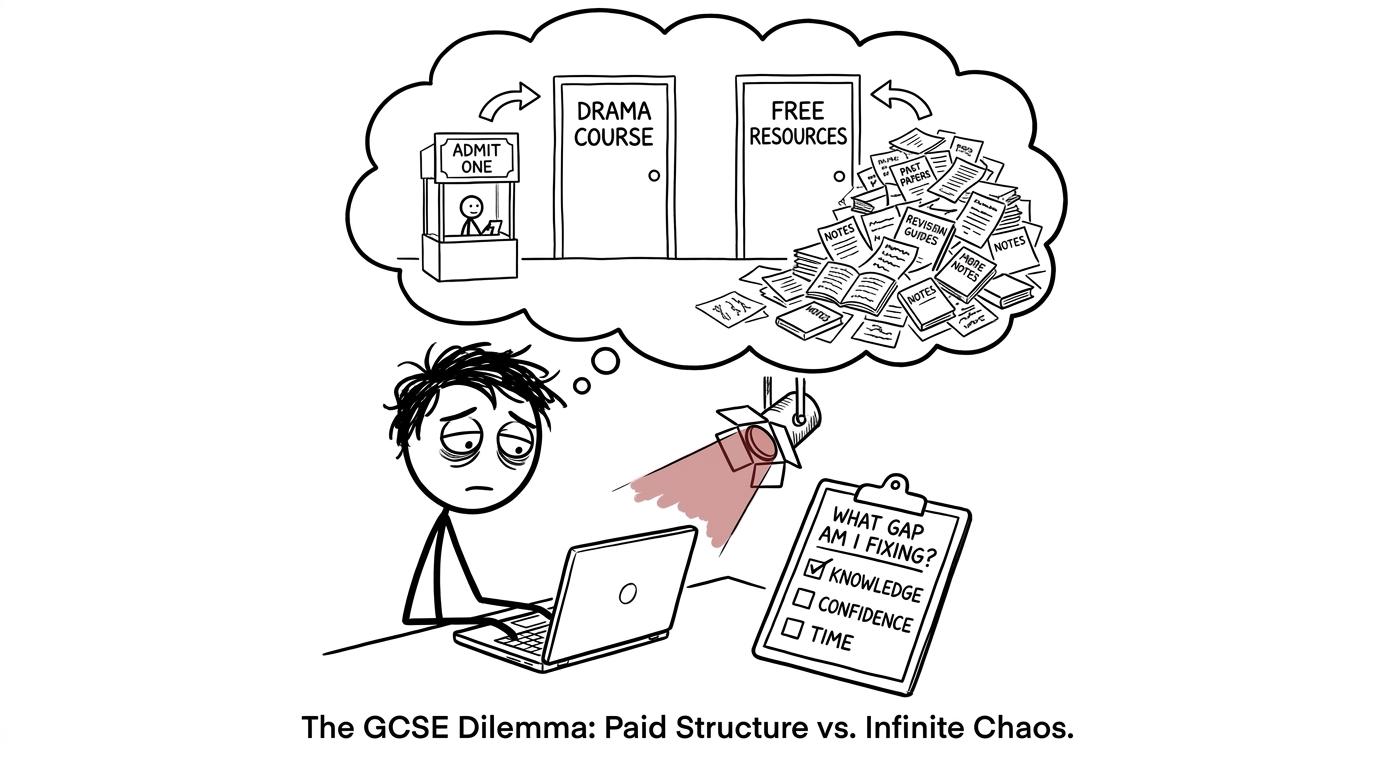 A student choosing between a paid Drama course and free revision resources
Understand what GCSE Drama actually assesses
A course cannot be judged properly until you know what your specification requires. GCSE Drama is not simply a written subject with theatrical vocabulary added around the edges. It combines practical creation, performance or design, and written analysis.
The balance varies between AQA, Pearson Edexcel, OCR and Eduqas, so advice designed for the wrong board may waste time or even prepare you for the wrong question structure.
For example, the current AQA specification divides assessment between Understanding Drama, Devising Drama and Texts in Practice. Its written examination is worth 40%40\%40%, while devising is worth 40%40\%40% and the text-based practical component is worth 20%20\%20%. Pearson Edexcel also currently gives 40%40\%40% to devising, 20%20\%20% to Performance from Text and 40%40\%40% to its written Theatre Makers in Practice component.
Those similarities can hide important differences in permitted materials, set texts, portfolio requirements and question formats. OCR and Eduqas have their own structures too. Always check the current specification and guidance supplied by your exam board and school.
A credible online GCSE drama revision course should therefore state:
- which exam board it covers
- which set texts it supports
- whether it teaches written, practical or portfolio components
- how feedback is delivered
- whether teaching reflects the current specification
If the sales page talks only about “boosting confidence” without identifying components, assessment objectives or texts, look more carefully before buying.
What paid Drama courses can do better than free resources
Provide precise feedback
Free videos can explain what analysis means. They cannot normally tell you whether your paragraph identifies a theatrical choice, analyses its effect and evaluates its success.
That distinction matters. Watching an explanation may create familiarity, but feedback exposes the gap between recognising a strong answer and producing one. A course with marked tasks, specific comments and opportunities to improve the same skill offers more value than a large library of recordings.
The same principle applies in maths. Watching a method is only the beginning; improvement comes from attempting questions, checking the mark scheme and correcting errors. MathsGenie’s guide to using GCSE past papers properly explains this learn, attempt, mark, repair cycle.
Create useful accountability
A scheduled lesson can stop revision being endlessly moved to tomorrow. This is valuable if you work well with deadlines and live interaction.
However, accountability should lead to independent work. A weekly session is not enough if nothing happens between lessons. Look for short tasks, retrieval activities and opportunities to apply feedback rather than passive sessions that simply feel productive.
Support practical interpretation
Drama involves decisions about character, voice, movement, staging, lighting, sound, costume and audience effect. Discussion with an experienced teacher may help you make those decisions more precise.
Yet online teaching has limits. A remote tutor may not see your full rehearsal environment, understand your group’s development or know the instructions given by your centre. Your school teacher remains central to practical and non-examination assessment. A paid course should complement that relationship, not contradict it.
When free GCSE Drama resources are probably enough
Free does not mean inferior. Specifications, sample materials, past papers, mark schemes and examiner guidance can reveal exactly what is assessed. Your class notes, set-text annotations and teacher feedback may already contain the information you need.
A strong free revision routine might include:
- checking the specification for each component
- learning accurate theatre terminology
- retrieving quotations, moments and production details
- planning responses to past questions
- comparing plans with mark schemes and examiner guidance
- revisiting teacher feedback
- rehearsing explanations aloud
- keeping a record of recurring weaknesses
The weakness of free resources is rarely that there are too few. It is that they arrive without a sequence. Students collect tabs, videos and documents but do not turn them into completed tasks.
Structure can be built without buying a course. MathsGenie demonstrates this through its free GCSE Maths revision hub, where lessons, practice questions, papers and solutions are organised around a clear learning journey. For Drama, you can create a similar sequence using your board’s official materials and your teacher’s guidance.
Protect your GCSE Maths revision time
Drama and maths ask for different kinds of thinking, but they compete for the same hours. Drama may require interpretation, evaluation and rehearsal. Maths requires repeated problem-solving and accurate recall under pressure.
Start by listing deadlines and examination dates, then allocate sessions according to need rather than mood. Maths topics are cumulative: weakness in fractions can affect ratio, percentages and algebra, while insecure algebra can spread into graphs and higher-tier problem-solving.
Use the GCSE Maths topics by exam board and tier to check what your paper can assess. If the list feels overwhelming, the best order for learning GCSE Maths topics provides a more manageable route.
A balanced week should contain:
- focused Drama knowledge or writing practice
- practical rehearsal where required
- maths topic revision
- maths exam-question practice
- time to mark, correct and retest
- rest and contingency space
Do not let a paid course consume every available evening merely because money has been spent on it. This is the sunk-cost trap: continuing with something because of its cost rather than its usefulness. If recorded sessions are too long or live classes clash with important maths work, the course may be poorly suited to your timetable.
The GCSE Maths revision timetable guide can help you build a realistic plan. Edexcel students can also use the structured GCSE Maths scheme of learning to place topics in a sensible sequence.
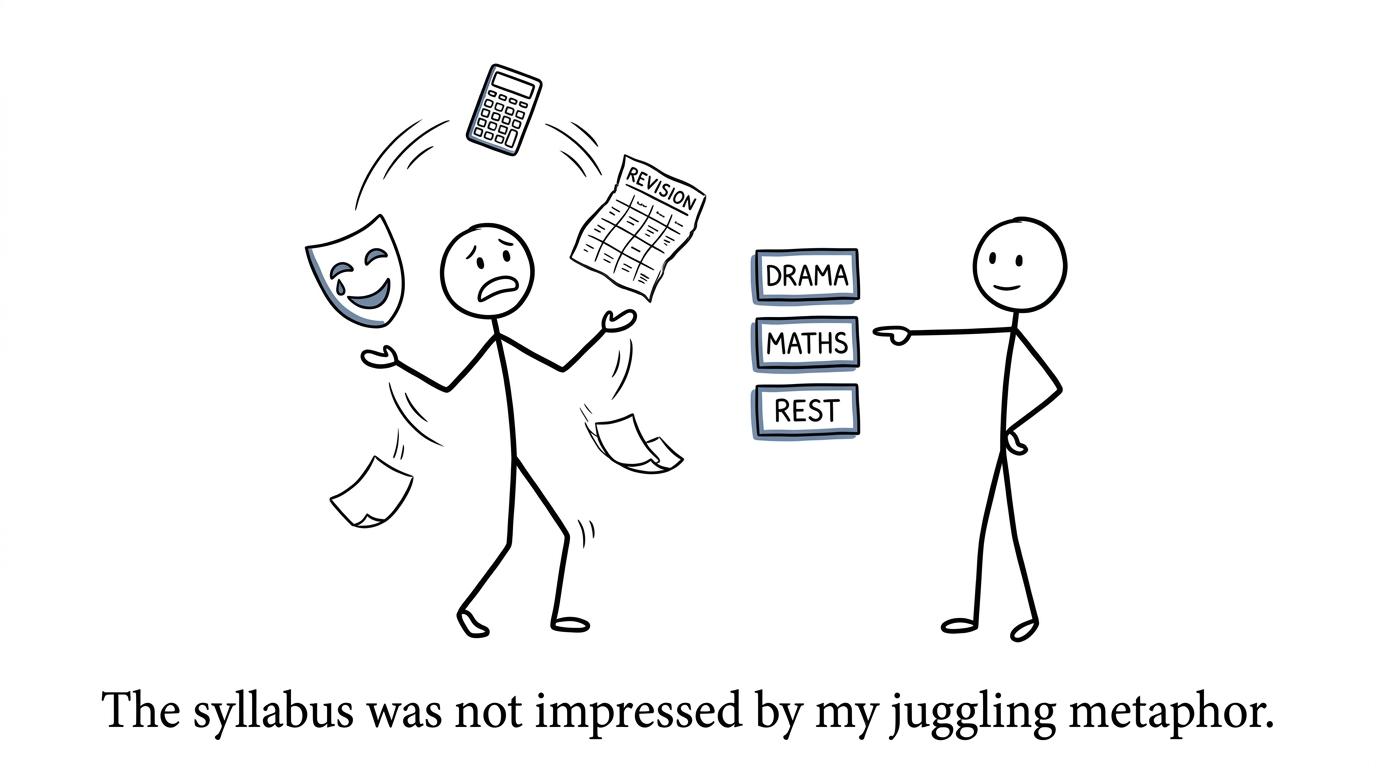 A student juggling Drama, Maths and rest in a revision timetable
How to assess an online GCSE Drama revision course
Check the teaching, not just the quantity
A course with many hours of video is not necessarily good value. Ask whether lessons produce an observable improvement: a better plan, a more precise paragraph, stronger evaluation or clearer performance intention.
Look for sample teaching before enrolling. The tutor should use accurate terminology, connect ideas to assessment objectives and explain how marks are awarded without promising a particular grade.
Examine the feedback offer
Find out whether feedback is individual or generic, written or verbal, live or delayed. Check how many pieces of work can be submitted and whether feedback includes a chance to redraft.
If “feedback” only means displaying a model answer, much of the course may be replaceable with free material.
Read the practical details
Check the current total price, cancellation terms, timetable, lesson length and duration of access. If sessions are recorded, confirm how long recordings remain available. Never assume that “unlimited access” or a refund is included unless the provider states it clearly.
You should also verify safeguarding arrangements and whether communication takes place through appropriate channels. If you are uncertain, discuss the course with a parent, carer or teacher before enrolling.
Compare it with the free alternative
Write down what you would do if you did not buy the course. Be specific. Your alternative might be teacher feedback, official exam-board materials, weekly answer plans and peer rehearsal.
Then compare outcomes rather than appearances. A polished dashboard is not the same as useful teaching.
Common mistakes when choosing a revision course
Buying before identifying the weakness
A general course may not help if your real issue is narrow, such as recalling production moments or evaluating design choices. Diagnose the gap first.
Choosing the wrong exam board or set text
The language of Drama is transferable, but assessment structures are not identical. Confirm the board, specification and text before paying.
Mistaking watching for revising
Recorded lessons can feel reassuring because everything makes sense while the tutor speaks. Close the video and retrieve the ideas without notes. Then plan or write a response. Revision must produce independent recall.
Ignoring school feedback
Your teacher knows the work completed in class and the requirements being followed by your centre. Do not replace specific school guidance with generic online advice.
Sacrificing maths indiscriminately
Drama deadlines may be urgent, but maths needs regular contact. Keep at least some short, focused maths sessions in the week. Use OCR GCSE Maths past papers if OCR is your board, or select the correct board from the main GCSE hub. Close to an exam, the GCSE Maths night-before plan helps you prioritise without attempting an exhausting final cram.
Make the decision that solves the real problem
An online GCSE drama revision course is worth paying for when it offers relevant expertise, personal feedback and a structure you will actually follow. It is not worth paying for merely because revision feels uncertain. Free specifications, school support, past materials and disciplined practice can be enough for many students.
Make the decision calmly. Identify the gap, inspect the course and compare it with a realistic free plan. Then protect the rest of your timetable.
For maths, start with MathsGenie’s free revision lessons and practice questions, then move into past papers, mark schemes, video solutions, mini tests and predicted papers. The aim is not to gather more resources. It is to turn each session into clearer methods, corrected mistakes and marks you are better prepared to earn.










