

Online GCSE Combined Science Revision Course: Worth It?
Online GCSE combined science revision course guide: compare paid teaching with free resources, assess value and choose the right support for your exams.
The hardest part of GCSE revision is not always understanding the content. Sometimes it is deciding whom to trust, what to use and whether paying for more support will genuinely improve your marks.
An online GCSE combined science revision course can be worth joining if it gives you structure, useful feedback and teaching matched to your exam board. But it is not automatically better than free resources. If you already revise consistently, mark exam questions carefully and ask teachers for help when stuck, a paid course may add little. The real question is not simply, “Is this course good?” It is, “Does it solve a problem my current revision cannot solve?”
That distinction can save both money and time.
The short answer: when is a paid science course worth it?
A paid course is most likely to be worthwhile when you:
- struggle to organise biology, chemistry and physics revision;
- need live explanations or personalised feedback;
- repeatedly make the same mistakes without knowing why;
- have significant gaps after absence or disrupted learning;
- work better when lessons happen at fixed times;
- can confirm that the course matches your exam board and tier.
Free resources may be enough when you:
- understand most topics but need more practice;
- can follow a timetable independently;
- receive useful support from your school;
- have access to specification-matched videos, questions and mark schemes;
- are willing to complete and review past papers honestly.
Before paying, identify your actual bottleneck. A course cannot provide value if you do not know what you need it to change.
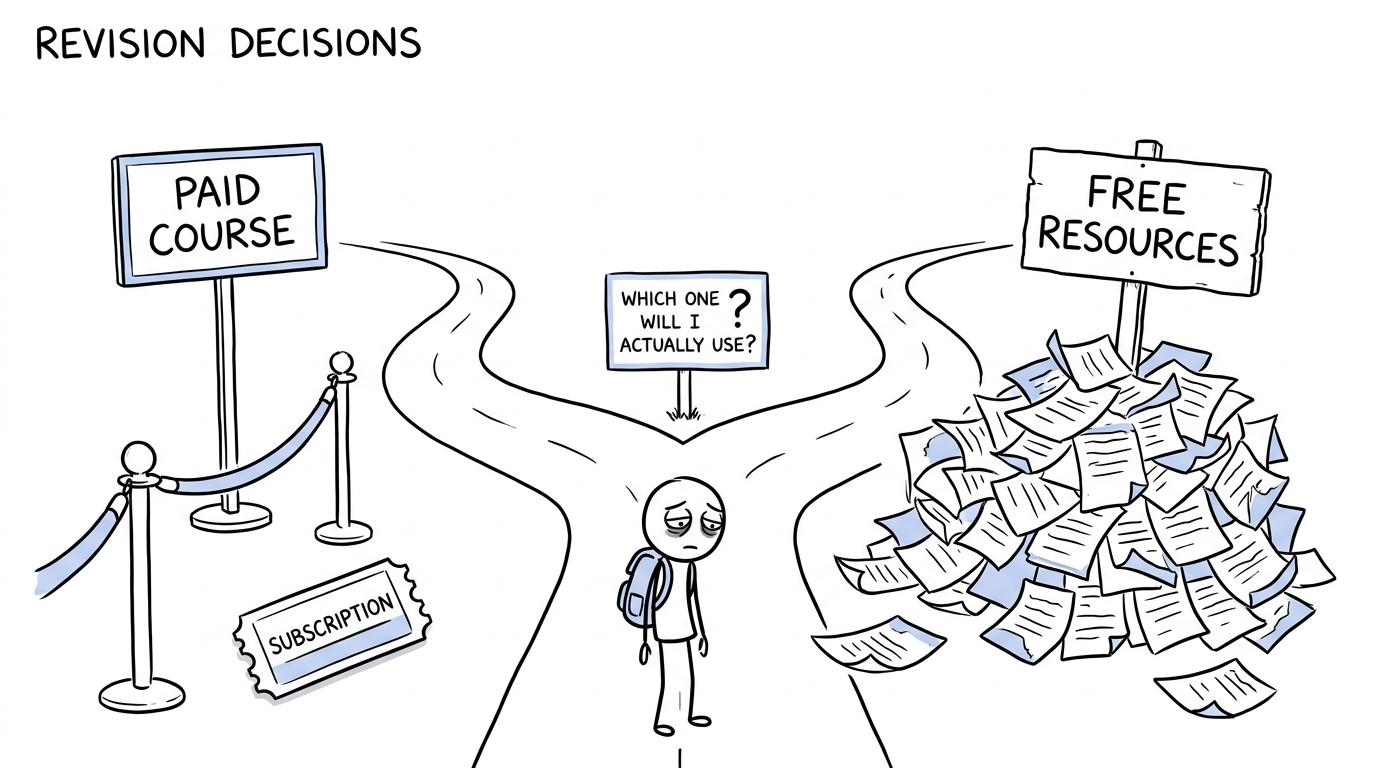 A GCSE student choosing between a paid course and free revision resources
What should an online GCSE combined science revision course cover?
Combined Science is not one vague subject. It brings together biology, chemistry and physics, and its assessment structure depends on the exam board. For example, AQA Combined Science: Trilogy and Pearson Edexcel Combined Science each use six written papers, but paper lengths, marks and topic organisation differ.
A worthwhile provider should therefore ask which specification you take: AQA, Edexcel, OCR or Eduqas, rather than advertising one generic course to everyone.
The course should offer:
- complete specification coverage;
- clear separation between foundation and higher tier content;
- teaching on required practical knowledge;
- mathematical skills in scientific settings;
- exam-style questions and extended responses;
- regular retrieval of earlier topics;
- accurate marking or detailed model answers;
- opportunities to act on feedback;
- realistic paper practice before the exams.
Ofqual requires GCSE Combined Science assessments to include at least 20%20\%20% of marks for mathematical skills. At least 15%15\%15% of marks must also assess knowledge and understanding connected with practical work. A course built almost entirely around memorising definitions is therefore incomplete, even if its videos look polished.
Assessment objectives matter too. Across the qualification, approximately 40%40\%40% of the weighting concerns knowledge and understanding, 40%40\%40% concerns application, and 20%20\%20% concerns analysis and evaluation. You need to know the science, but you must also use it in unfamiliar situations and interpret evidence.
Why maths students should care about science revision
The overlap between GCSE maths and Combined Science is substantial. Science questions may require you to use ratios, percentages, standard form, significant figures, graphs, gradients, averages, unit conversions and rearranged equations.
AQA’s specification, for example, includes substituting into equations, changing the subject, interpreting graphs and working with rates of change. These are mathematical skills placed inside a scientific context. Students can lose marks not because they misunderstand the scientific idea, but because their algebra, calculator use or data handling is uncertain.
That means strengthening maths can improve your science preparation without purchasing another complete course. Use the free GCSE Maths Revision Hub to find lessons and questions, or consult the GCSE maths topics by board and tier when you need to identify a weak underlying skill.
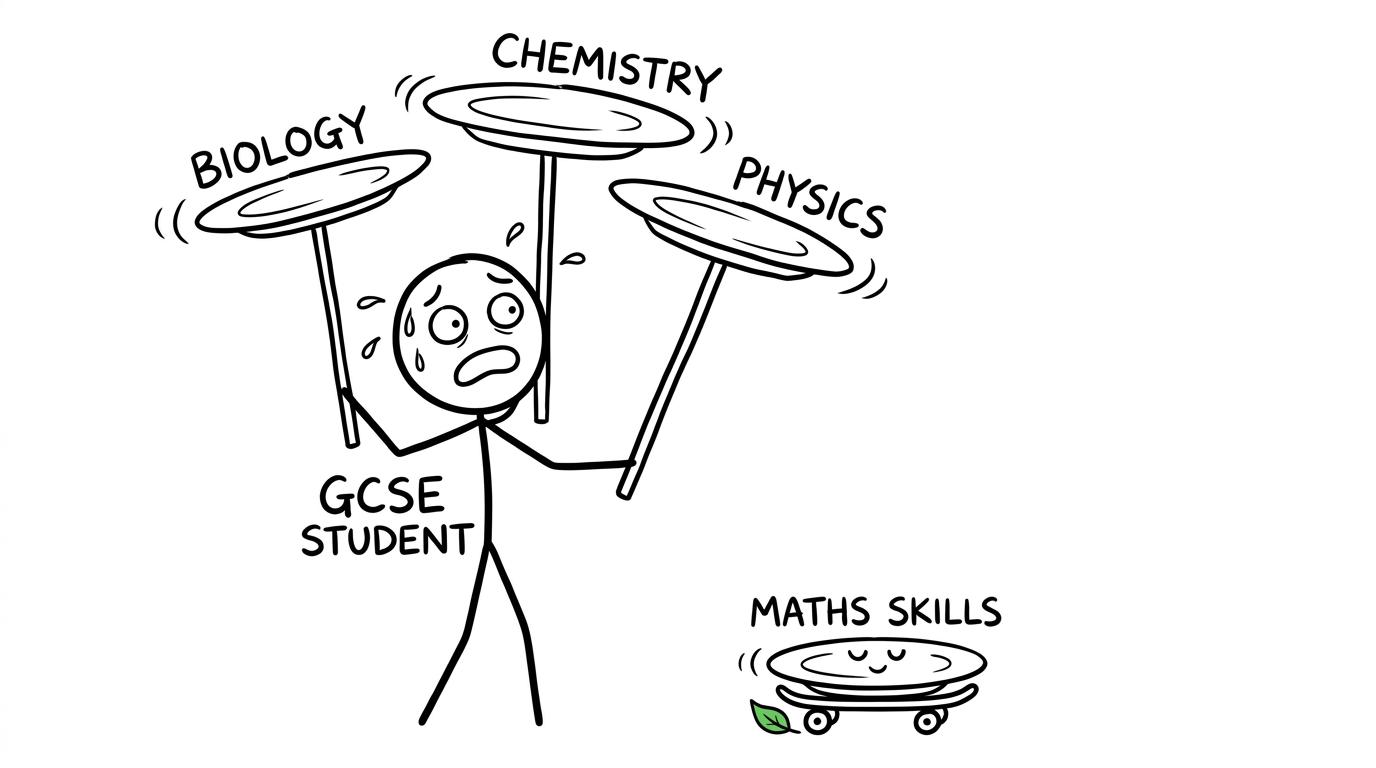 A student balancing biology, chemistry, physics and maths skills
Paid course versus free resources
Price does not determine educational value. Payment can buy structure, interaction and accountability, but it does not remove the need to think, practise and correct mistakes.
What a paid course can do better
A strong paid course may provide a coherent route through a large specification. Instead of spending each evening deciding what to revise, you follow a planned sequence. Live teaching can also let you ask why an answer is wrong, which is more valuable than merely seeing the correct answer.
Personalised marking is another meaningful advantage. Automated quizzes are useful for short factual questions, but they may not diagnose weak reasoning in calculations, practical-method questions or longer explanations. Thoughtful feedback can show whether you lacked knowledge, misread the command word or failed to connect evidence to a conclusion.
The final advantage is accountability. A scheduled session creates a commitment. For some students, that commitment is precisely what makes revision happen.
What free resources can do just as well
Free materials can teach content, provide exam questions and support repeated practice. Your school may already provide specification guidance, homework, intervention sessions and teacher feedback. Exam boards publish specifications, past papers and mark schemes, while free educational platforms provide explanations and practice.
The missing ingredient is often not another explanation. It is a reliable revision process.
For maths, MathsGenie provides free revision lessons, exam questions, worksheets, mini tests and paper practice. You can use AQA GCSE Maths past papers or OCR GCSE Maths past papers to strengthen the mathematical fluency that appears in science. If you take Edexcel maths, the Edexcel predicted papers offer additional timed practice alongside official papers.
Free resources work best when you turn them into a system rather than collecting endless tabs.
A checklist before you pay
Do not judge a course by the number of recorded hours. More content can simply mean more material left unwatched. Ask these questions instead.
Does it match your exact specification?
Confirm the exam board, qualification and tier. “Suitable for every board” may mean that important differences are ignored. Ask for a topic list and compare it with the specification used by your school.
Is the teaching active or mainly passive?
Effective revision should require you to retrieve information, answer questions, interpret data and review errors. Watching a teacher answer every question can feel productive while leaving your own recall untested.
Will you receive useful feedback?
Find out who marks the work, how often feedback is given and whether longer responses are reviewed. “Unlimited questions” means little if answers are delayed, generic or unavailable near the exams.
Can you try it before committing?
Look for a sample lesson, trial period or clear cancellation terms. Check what is included in the advertised fee and whether recordings remain accessible. Because prices and access conditions can change, verify them directly before buying.
Does it fit your existing timetable?
A course that clashes with homework, school support or sleep is unlikely to help. Map the sessions into a realistic plan. Maths students can use the principles in the GCSE maths revision timetable guide to balance subjects without turning every evening into an impossible list.
Test free revision before purchasing
One sensible approach is to run a short free-resource trial. This is not about delaying help indefinitely. It is a way to gather evidence about what you genuinely need.
For roughly one or two weeks:
- list your weakest topics from school assessments;
- revise one clearly defined topic at a time;
- close your notes and recall the key ideas;
- complete exam-style questions;
- mark them on the same day;
- classify each mistake as knowledge, application, maths or exam technique;
- revisit the topic later without looking at your earlier answer.
The Education Endowment Foundation’s guidance supports teaching students to plan, monitor and evaluate their learning in the context of specific subject content. In practical terms, revision should produce information about what you know and what you must do next.
If this free routine works, continue it. If you remain unable to diagnose errors, maintain consistency or understand essential topics, a good paid course may provide the missing structure.
For the maths side of your plan, GCSE mini tests can expose small skill gaps without requiring a full paper. The one-month GCSE maths revision plan also shows how to combine retrieval, topic work and timed practice.
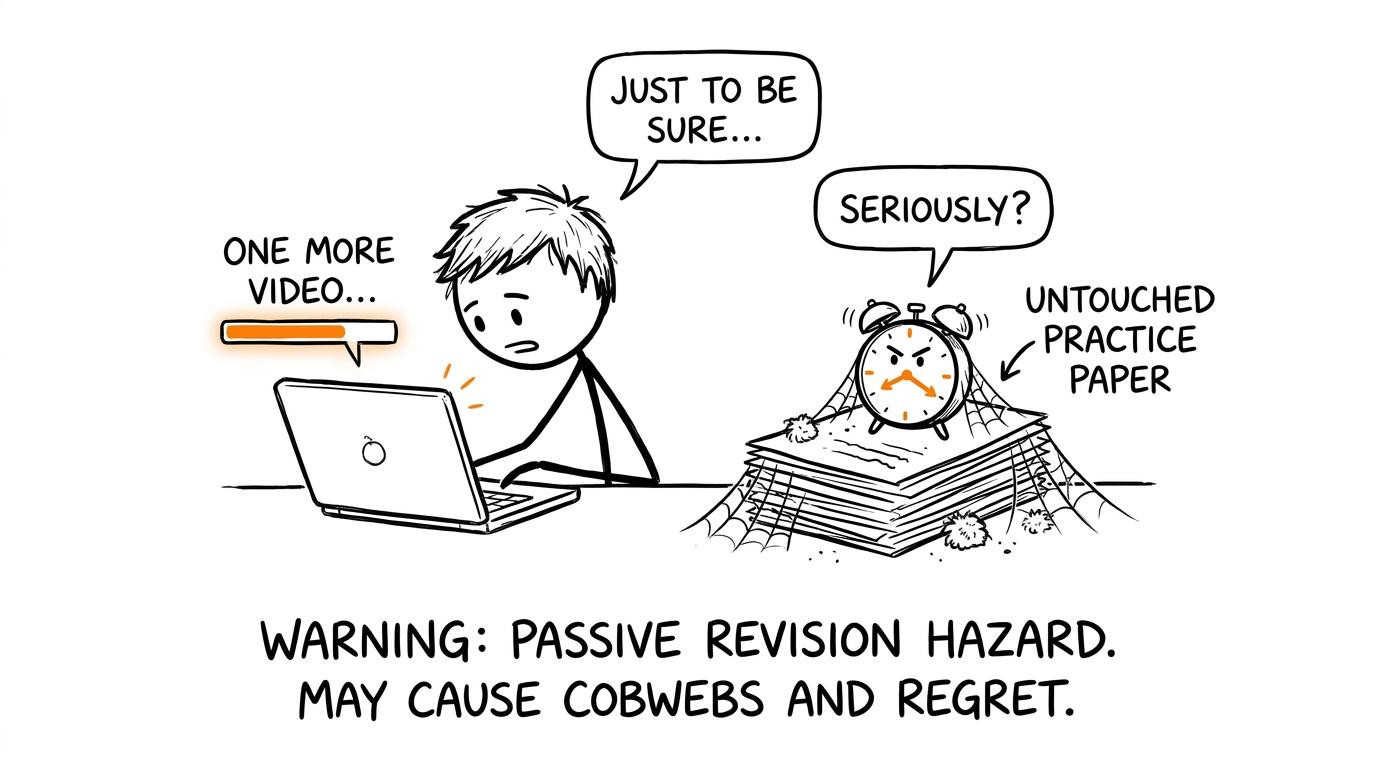 A student watching revision videos while practice papers gather cobwebs
Common mistakes when choosing a revision course
Buying because exams feel frightening
Urgency makes any organised-looking product attractive. Pause and identify the exact problem first. Anxiety about the whole specification does not necessarily mean you need a course covering the whole specification.
Confusing watching with learning
Recorded lessons are convenient, but the decisive work happens when you answer without support. Every lesson should lead to retrieval, questions, marking and another attempt.
Ignoring exam-board differences
A scientifically correct lesson may still omit content you need or emphasise material organised differently by your board. Always compare the course outline with your specification.
Paying for content you already have
Check what your school and existing resources provide. If the course duplicates explanations but offers no feedback or accountability, free resources may deliver similar value.
Neglecting maths inside science
Students sometimes revise scientific facts while avoiding calculations. Yet mathematical skills account for a meaningful share of Combined Science assessment. Use MathsGenie’s free topic lessons to repair percentages, ratios, graphs, standard form and algebra before those weaknesses cost science marks.
Make the decision based on behaviour, not promises
An online GCSE Combined Science revision course is worth paying for when it changes what you do: you revise more consistently, receive better feedback, close genuine knowledge gaps and practise questions matched to your specification. It is poor value when it becomes another library of videos you intend to watch later.
Start with an honest audit. Use free resources for a short, structured trial, then judge the evidence. If you need live explanation, tailored feedback or firm accountability, choose a paid course carefully. If free teaching and school support already meet those needs, keep your money and concentrate on deliberate practice.
And do not allow science revision to push maths aside. Open the MathsGenie GCSE revision area, choose your board and tier, and build a repeatable routine with free revision lessons, practice questions, mini tests, past papers, mark schemes, video solutions and predicted papers. Better revision rarely begins with having more. It begins with using the right resource properly.











