Old Textbook GCSE Spanish: Is It Still Useful?
Old textbook GCSE Spanish advice for the reformed course: learn what remains useful, what has changed and how to fill specification and exam gaps.
A hand-me-down textbook can feel like a bargain until you notice that its publication date belongs to a different GCSE specification. If you searched for old textbook GCSE Spanish advice, the short answer is reassuring: yes, an older book can still help with vocabulary, grammar, reading and translation, but it should not be your only revision resource for exams from 2026 onwards.
The Spanish language has not suddenly changed. Exam specifications have.
For students in England, reformed GCSE French, German and Spanish courses were first taught from September 2024, with the first examinations in summer 2026. The new qualifications use defined vocabulary and grammar content, alongside greater emphasis on sound-symbol correspondences, dictation and reading aloud. That means an old textbook may still teach valuable Spanish while missing parts of the examination you will actually sit.
The quick textbook checklist
Before trusting an older GCSE Spanish textbook, check:
- your exam board and exact specification code
- whether you are taking foundation or higher tier
- the book's publication date and specification reference
- whether its vocabulary matches your board's current prescribed list
- whether it includes dictation and reading-aloud practice
- whether its speaking and writing tasks resemble current sample assessments
- whether your school is following an English, Eduqas or WJEC specification
If any of those details are unclear, ask your Spanish teacher before organising revision around the book. The cover may say “GCSE Spanish”, but that description alone does not prove alignment.
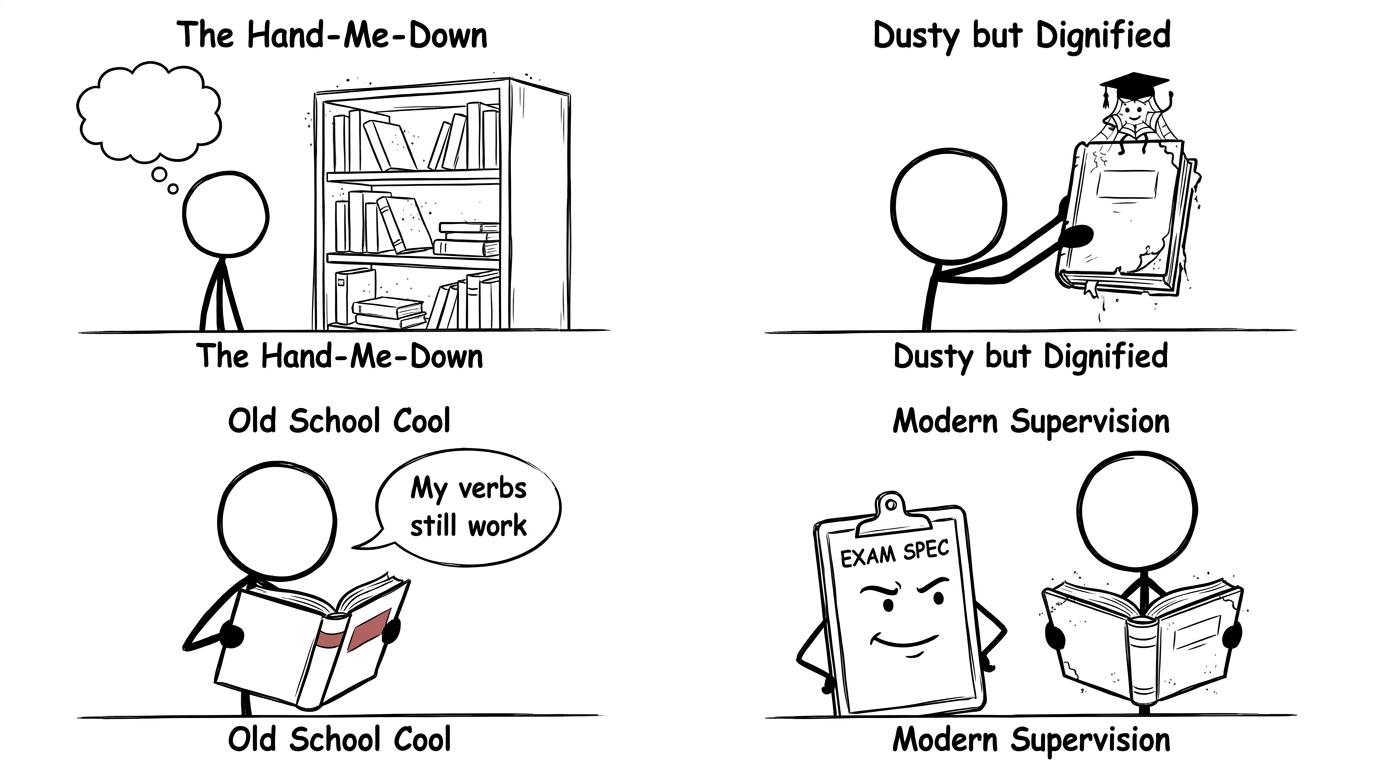 A dusty Spanish textbook insists that its verbs still work
How much has GCSE Spanish changed?
The recent reform is substantial enough that students should use current specification materials, but it has not made every older resource obsolete.
For the new GCSEs in England, the Department for Education requires a comprehensive vocabulary list containing 1,2001,2001,200 lexical items at foundation tier and a further 500500500 at higher tier. At least 85%85\%85% of the vocabulary must come from the 2,0002,0002,000 most frequent words in widely used forms of the language. Exam boards may also include specified multi-word phrases and cultural or geographical items.
This is an important shift. Older specifications included vocabulary guidance, but the new approach defines more tightly what students are expected to know. Current AQA and Pearson Edexcel specifications state that vocabulary outside the prescribed list is limited or handled in controlled ways, such as glossing a small proportion of words in reading texts. The exact rules depend on the board and task.
The reform also gives explicit attention to how Spanish sounds connect to its written form. Students may encounter:
- dictation, requiring accurate transcription of spoken Spanish
- reading aloud, assessing pronunciation using known sound-symbol correspondences
- tightly specified vocabulary and grammar
- revised speaking tasks and thematic contexts
- assessment materials designed specifically for the new qualification
The four broad language skills, listening, speaking, reading and writing, remain central. Translation, grammatical accuracy and communication still matter. The difference lies less in the existence of these skills and more in how the specification defines and assesses them.
Exam board and location matter
AQA GCSE Spanish specification 869286928692 and Pearson Edexcel GCSE Spanish 1SP11SP11SP1 were introduced for first teaching in 2024 and first assessment in 2026. Eduqas also has a reformed qualification for teaching from 2024 and award from 2026.
Students in Wales need particular care. WJEC introduced a Made-for-Wales GCSE Spanish for teaching from 2025 and first award in 2027. It has its own structure and is not simply interchangeable with an English-board textbook. Always check the qualification named by your school rather than assuming that every UK student follows the same course.
What an old GCSE Spanish textbook still does well
A textbook does not become worthless on the day a specification changes. Some knowledge has a long shelf life.
Core grammar remains valuable
Present, past and future time frames, adjective agreement, articles, negatives, pronouns and common verb patterns remain part of learning Spanish. An older textbook can still provide clear explanations and useful exercises on these foundations.
However, the tier allocation and precise grammar requirements may have changed. A structure taught to all students in an older book might now be associated with higher tier, while another may appear differently in the current grammar list. Treat the official specification as the boundary and the textbook as the explanation.
High-frequency vocabulary remains useful
Common words for family, education, travel, food, relationships and everyday activities do not expire. Much of an old book's vocabulary will overlap with a frequency-led modern list.
The difficulty is not that old vocabulary becomes incorrect. It is that the selection may be inefficient. You could spend time memorising a long thematic list while overlooking prescribed words that your current board expects you to recognise and use.
Reading and translation still build fluency
Short passages, comprehension questions and translations can remain excellent practice, provided you recognise that their wording and question style may not mirror the current exam. They help you retrieve vocabulary, notice grammar and sustain attention across a text.
This is similar to using an older maths paper. The underlying skill may remain valuable, but alignment determines whether the resource is a precise exam rehearsal or broader practice. Maths students can see the distinction through the guide to using GCSE past papers properly: practice becomes powerful when you know what it is testing and review the gaps afterwards.
Where a hand-me-down textbook may fall short
An older textbook is most risky when it creates the impression of complete coverage.
It may teach the previous vocabulary selection
The book may organise words around old themes or include material that is no longer prioritised. Extra vocabulary is not harmful in itself, students can use language beyond a prescribed list in productive work where permitted, but learning it should not displace the vocabulary your board explicitly requires.
Use your current list as a tracker. Mark words as secure, developing or unknown, then use the textbook only where its chapters support those gaps.
It may not prepare you for new task types
A book written for the previous course may contain role plays, photo cards and listening exercises without providing enough reading-aloud or dictation practice. Those skills need deliberate preparation.
Reading silently is not a substitute for pronouncing a text. Listening for general meaning is not the same as transcribing a sentence accurately. A student can understand the topic yet lose marks through spelling, accents or an uncertain sound-symbol connection.
Its mock papers may imitate the wrong assessment
Old practice papers can build stamina, but their timings, mark allocations, instructions and task structure may be outdated. Do not use an old textbook's score chart to predict a grade on the current qualification.
Current sample assessment materials and later official papers are better measures of readiness. This is the same principle used in maths revision: AQA GCSE Maths past papers and OCR GCSE Maths past papers are organised by board because exam alignment matters, even when the underlying mathematics overlaps.
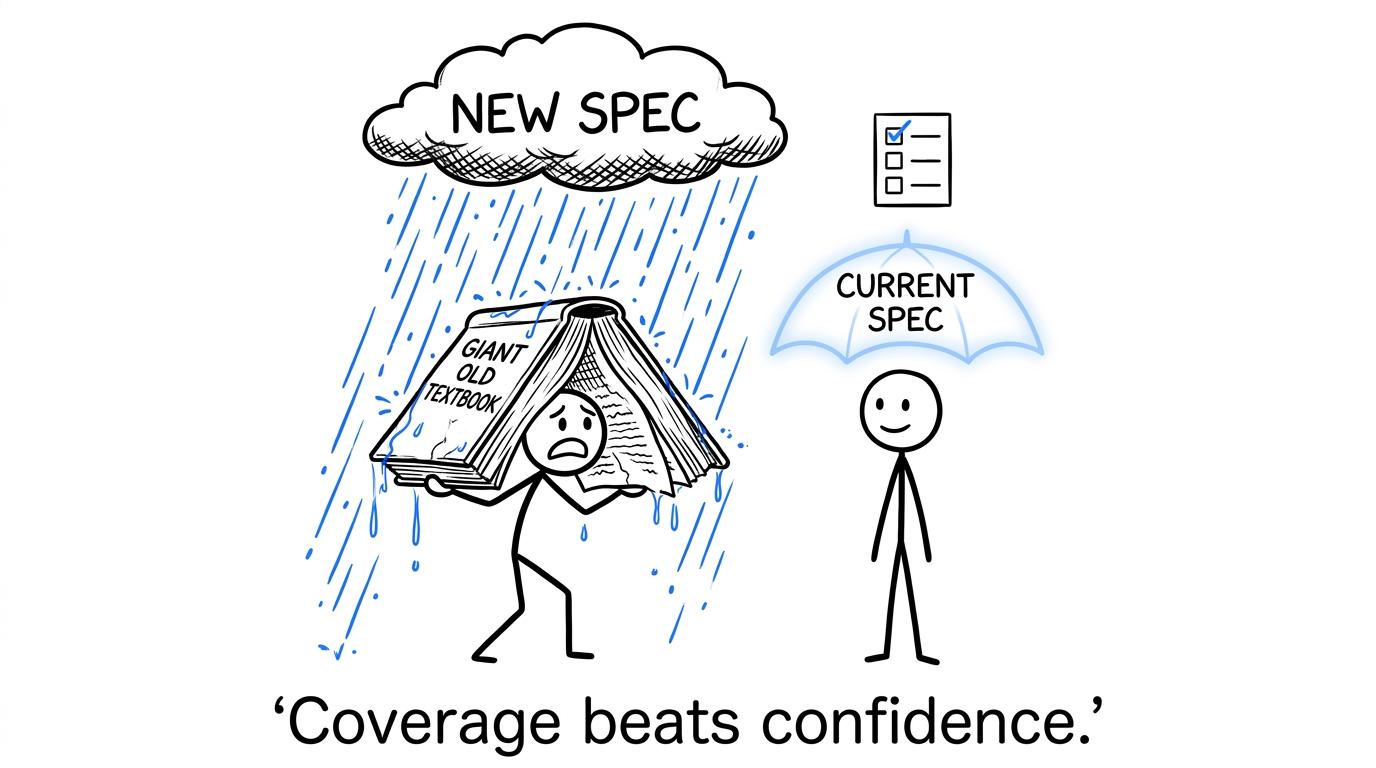 A current specification checklist shelters a student from the new-spec rain
How to use an older textbook safely
The best approach is not “keep it” or “bin it”. It is to give the book a narrower job.
| Use the old textbook for | Use current materials for |
|---|---|
| Grammar explanations | Prescribed vocabulary lists |
| Extra reading practice | Current speaking task formats |
| Verb and adjective exercises | Dictation and reading aloud |
| Translation practice | Official timings and mark schemes |
| Revisiting weak topics | Sample assessments and exam-style papers |
Build a specification bridge
Download the current specification through your school or exam board and compare it with the textbook contents page. You do not need to compare every paragraph. Look for three things:
- covered securely: useful chapters that match current content
- partly covered: topics that need updated vocabulary or task practice
- missing: requirements needing another resource
This turns the book from an uncertain course guide into a dependable practice bank.
Revise actively rather than rereading
A familiar textbook page can create a false sense of progress. Close the book and retrieve vocabulary from memory. Say answers aloud. Write a short response without copying the model. Check errors afterwards.
Students preparing for both Spanish and maths can use the same revision rhythm: learn, practise, mark, diagnose and retest. The MathsGenie GCSE Maths revision hub brings together revision lessons, practice questions, papers and short tests for exactly this reason. A structured one-month GCSE maths revision plan can also help you balance maths with language revision rather than allowing one subject to absorb every evening.
Save current exam materials for realistic testing
Use the old book while building knowledge, then switch to current specimen papers and exam-board materials for timed assessment. Mark strictly and record why each error occurred: missing vocabulary, grammar, listening discrimination, pronunciation, spelling or task misunderstanding.
In maths, Edexcel GCSE Maths predicted papers provide fresh practice matched to the present format. The comparable lesson for Spanish is simple: the closer you are to the exam, the more closely your practice should resemble your actual specification.
Common mistakes when using an old textbook
Assuming “GCSE” means “current GCSE”
GCSE branding can remain visible long after assessment arrangements change. Check the specification code, not just the title.
Learning every word in the book before the official list
Extra vocabulary can enrich your Spanish, but prescribed vocabulary deserves priority. Secure the examinable core first.
Ignoring tier differences
Foundation and higher tier do not share identical vocabulary and grammar expectations. Make sure exercises suit the tier entered by your school.
Using old mock grades as predictions
An outdated paper may have different tasks and boundaries. Treat the result as practice feedback, not a reliable grade forecast.
Replacing listening and speaking with reading
Textbooks naturally encourage page-based revision. Spanish is also heard and spoken. Current audio, dictation, pronunciation and conversation practice must sit alongside the book.
Your old book can help, but the specification leads
A hand-me-down GCSE Spanish textbook can still earn its place on your desk. Its explanations, exercises and reading passages may be genuinely useful. What it cannot do alone is guarantee coverage of the vocabulary, grammar and assessment tasks required by the reformed qualification.
Keep the book. Remove its authority.
Let the current specification decide what you learn, use up-to-date exam materials to test it, and treat older chapters as additional practice. That approach saves money without gambling your revision on an outdated course map.
For the maths side of your GCSE timetable, make MathsGenie your free revision base. Start with revision lessons and practice questions, check progress through mini tests, then move into past papers, mark schemes, video solutions and predicted papers. If you are unsure when to make that transition, the guide to starting GCSE past papers gives you a practical route from topic revision to full exam practice.