

Can You Use an Old Textbook for GCSE Combined Science?
Old textbook GCSE Combined Science advice: learn what remains useful, what may be outdated, and how to check your book against today's specification.
A hand-me-down textbook can feel like either a bargain or a trap. The diagrams still look convincing. The laws of physics have not changed. Yet the cover may mention an unfamiliar grading system, and nobody wants to spend weeks revising material that will not appear in the exam.
The short answer is that an old textbook for GCSE Combined Science can still be useful if it was written for your current exam board and the reformed grades 999-111 qualification. However, it should support the latest specification, not replace it. A book designed for the pre-2016 course is much riskier because content, practical requirements, mathematical demand and assessment structure changed substantially when the present qualifications were introduced.
The age of the book matters less than the course it was written for.
The quick textbook checklist
Before relying on a hand-me-down book, check five things:
- Qualification: Does it say GCSE grades 999-111, rather than A* to G?
- Exam board: Is it for AQA, Edexcel, OCR or Eduqas, as appropriate?
- Specification code: Does the code match the one used by your school?
- Practical work: Does it cover your board's required or core practical activities?
- Current assessment support: Are you also using the latest specification, equation sheet, past papers and mark schemes?
If all five match, the textbook probably remains a useful teaching resource. If the first three do not match, treat it as background reading only.
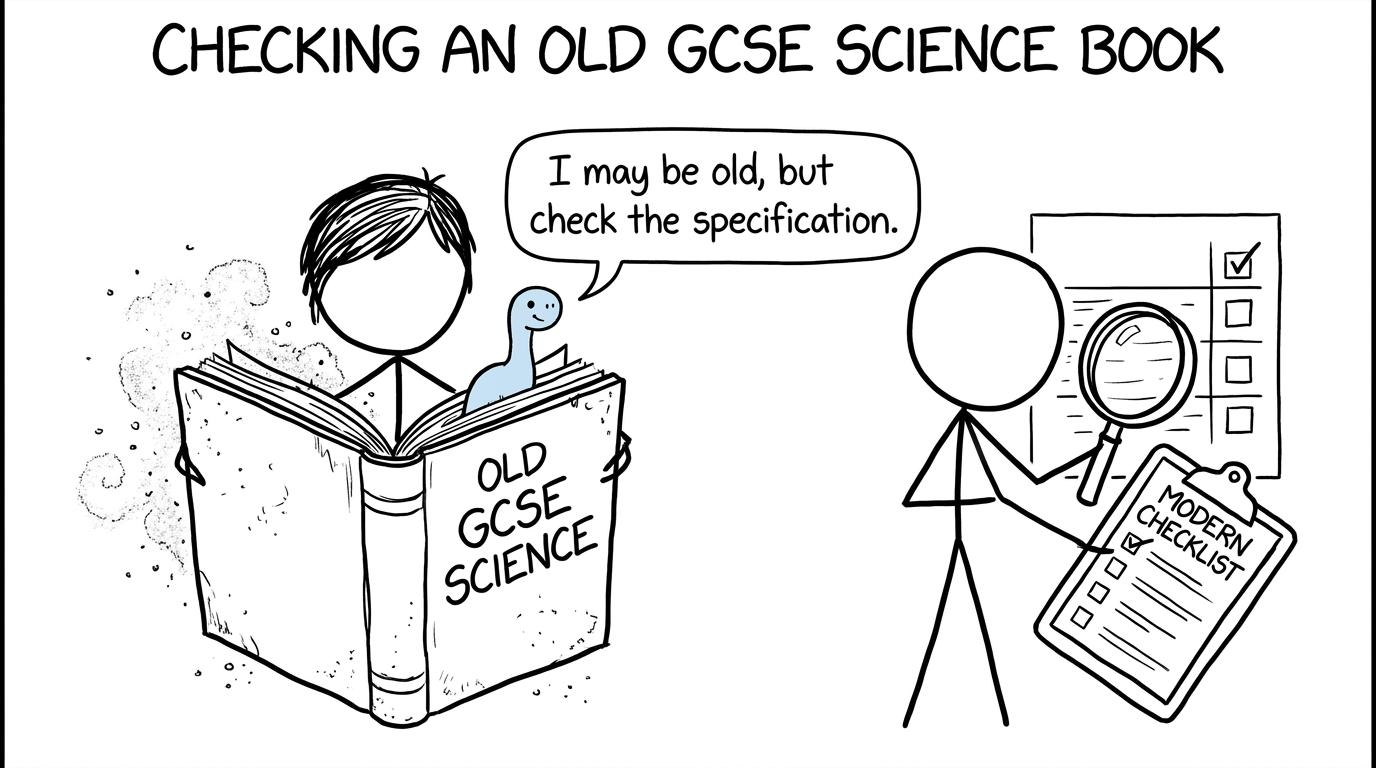 A student discovers that an old textbook still needs a current specification check
How recently has GCSE Combined Science changed?
The present GCSE Combined Science subject content in England was introduced for teaching from September 2016, with the first examinations held in 2018. It is a double award: students receive two linked grades, and the course covers biology, chemistry and physics.
That reform was significant. It introduced the grades 999-111 system, linear assessment at the end of the course and a stronger emphasis on mathematical, practical and analytical skills. Ofqual's rules require at least 20%20\%20% of Combined Science marks to assess mathematical skills, divided across biology, chemistry and physics in the ratio 1:2:31:2:31:2:3. Practical skills are assessed through written examinations rather than a separate controlled-assessment mark.
Since then, the current qualification has not been replaced by a completely new GCSE. Exam boards have issued revised specification versions, but many changes have involved clarifications, corrected wording, administrative updates or the presentation of equations rather than a wholesale rewriting of the course.
For example, OCR added symbol equations to its Combined Science specifications for assessment from 2023 and made minor changes to the way some equations were presented. AQA has also published clarifications to parts of its science specifications. Pearson Edexcel's current specification includes a summary of changes between issues, allowing teachers to distinguish content changes from administrative edits.
A textbook published for the current post-2016 specification therefore does not become useless merely because a newer printing exists. But it may miss a clarification or use an older equation-sheet arrangement. That is why the specification must remain your final checklist.
The next major reforms are being developed separately. Current government planning indicates that new qualifications in subjects including maths and science are intended to begin teaching around 2029 and 2030, although students should always check confirmed arrangements for their own cohort. Those future plans do not make a correctly matched current-specification textbook obsolete today.
Which old textbooks still hold up?
A post-2016 book for the correct board
This is the strongest kind of hand-me-down. AQA Combined Science: Trilogy, Pearson Edexcel Combined Science and OCR Gateway Combined Science organise material differently, use different specification codes and do not always set out practical work in the same way. A correct board match saves you from constantly translating between courses.
Check the copyright page and front cover. A phrase such as “for the 2016 specification” can be more important than the publication year itself. Then compare the chapter list with your board's current online specification.
Most foundational explanations should still hold up: cell structure, atomic structure, chemical reactions, forces, energy, waves and ecology do not expire because the book has been sitting on a shelf. The weakness is usually not the science. It is alignment with what your examiner expects.
A book for another current exam board
This can help when you need a different explanation of a difficult concept, but it is less dependable as your main revision guide. The broad national subject content overlaps, yet boards differ in organisation, required practicals, terminology, paper structure and the depth attached to particular statements.
Use such a book to understand. Do not use its contents page as your revision checklist.
A pre-2016 A* to G textbook
This category requires the most caution. Some explanations remain scientifically sound, but the book was written for a different assessment model. It may omit current content, include material no longer required, underrepresent mathematical questions or describe obsolete coursework arrangements.
A pre-2016 book can still explain a concept. It cannot reliably tell you the complete boundaries of today's course. MathsGenie's archived GCSE Maths A* to G resources make the same distinction explicit: older materials belong to a specification that has ended, while current revision should be based on the live course.
What an older textbook may get wrong or leave out
An old book is rarely wrong on every page. That is what makes it deceptive. The useful material and the gaps sit beside each other.
Look especially carefully at:
- specification-only statements and the required depth of knowledge;
- required or core practical methods, variables, risks and data analysis;
- current paper structure and tiering;
- command words and extended-response expectations;
- equations and which equations are supplied in the examination;
- newer clarifications issued by the exam board;
- questions involving unfamiliar data, graphs and practical contexts.
For the current specifications, foundation and higher tier entries must follow your board's rules. Pearson Edexcel Combined Science, for example, has six externally assessed papers, and candidates are entered at one tier across all six papers. Never assume that the paper arrangement described in a different board's book applies to you.
Equation support also deserves a current check. Formula and equation sheets are provided for GCSE maths, physics and Combined Science examinations under current arrangements, and Ofqual confirmed in 2026 that this support will continue for the remaining lifetime of the present specifications. The sheet does not remove the need to choose, rearrange and apply an equation. It simply changes what must be recalled unaided.
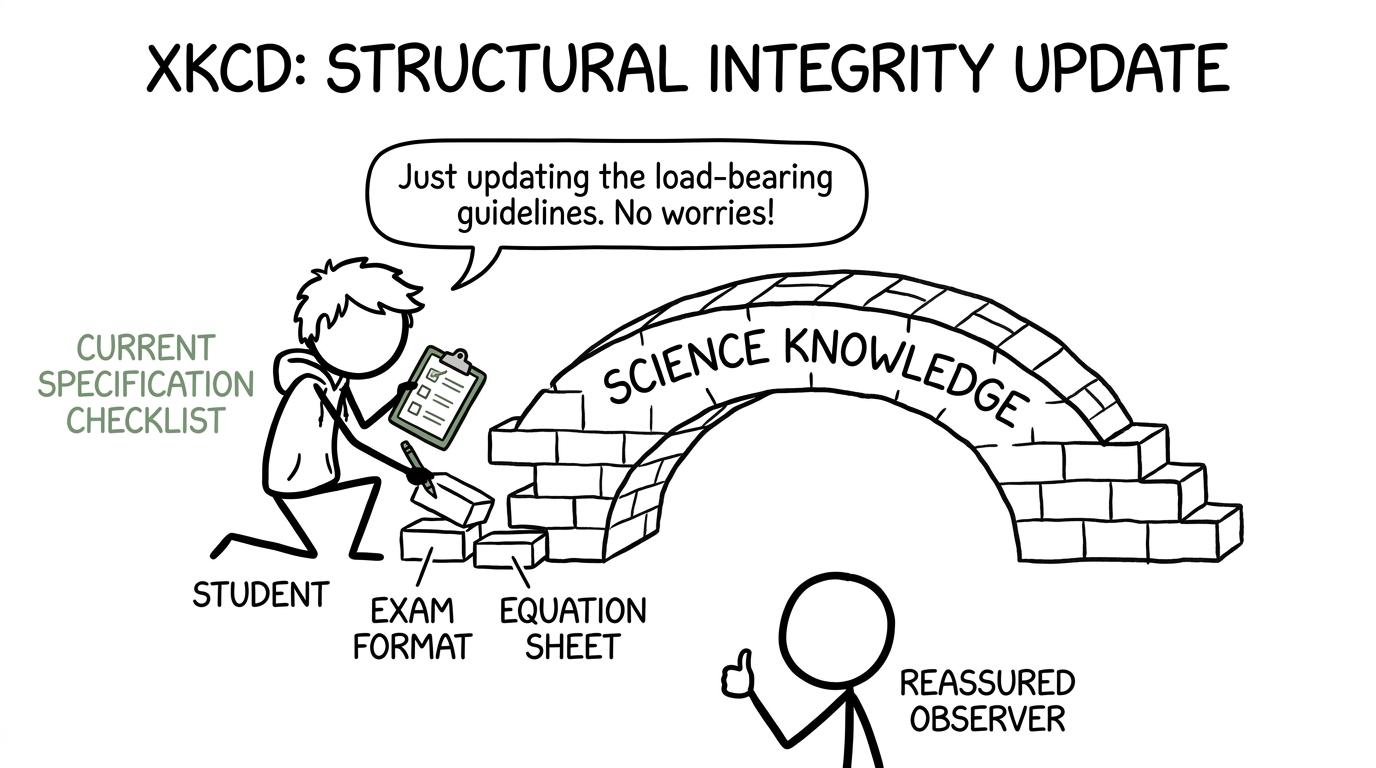 A student repairs the small outdated parts of an otherwise useful science textbook
The maths test your textbook should pass
Combined Science is partly a maths examination wearing a lab coat. A book may explain the science well while giving too little practice in calculations.
Your revision should cover:
- rearranging formulae;
- ratios, fractions and percentages;
- standard form and powers of ten;
- unit conversions;
- gradients and graph interpretation;
- significant figures and appropriate rounding;
- substituting values with consistent units;
- proportional reasoning.
Suppose an older chapter introduces equations only in words. That explanation may remain useful, but current questions can expect you to work confidently with symbols, units and multi-stage reasoning. Build that fluency separately with MathsGenie's rearranging harder formulae revision and standard form revision resources.
For subject-specific planning, the guide to revising GCSE Chemistry with stronger maths skills identifies the arithmetic, percentages, formulae and graph work that often sit beneath chemistry marks. Students taking OCR can also use the OCR Physics and maths revision guide to strengthen formula use, standard form and units.
How to use a hand-me-down textbook safely
The best approach is not to decide whether the book is entirely “good” or “bad”. Give each resource one job.
Use the specification as the map
Download the current specification from your exam board and turn every content statement into a checklist. Mark each item as secure, uncertain or not yet covered. If the textbook has no section matching a statement, use your teacher's resources or current revision materials to fill the gap.
Use the textbook for explanation
Read a small section, close the book and retrieve the main ideas from memory. A textbook is useful when it helps you think. Copying pages can create the feeling of progress without testing whether anything can be recalled.
Use current questions for verification
After learning a topic, answer recent exam-board questions and mark them with the official mark scheme. This exposes missing terminology, weak calculations and unfamiliar question styles much faster than rereading.
MathsGenie's guide to the best order for learning GCSE maths topics offers a useful sequence for repairing the mathematical foundations behind science. You can then use the GCSE maths topics that appear regularly to prioritise number, ratio, algebra, graphs and statistics.
Keep a gap list
Write down anything the book does not match: a missing practical, an old term, a different equation format or a weak set of calculation questions. This turns vague doubt into a manageable list of actions.
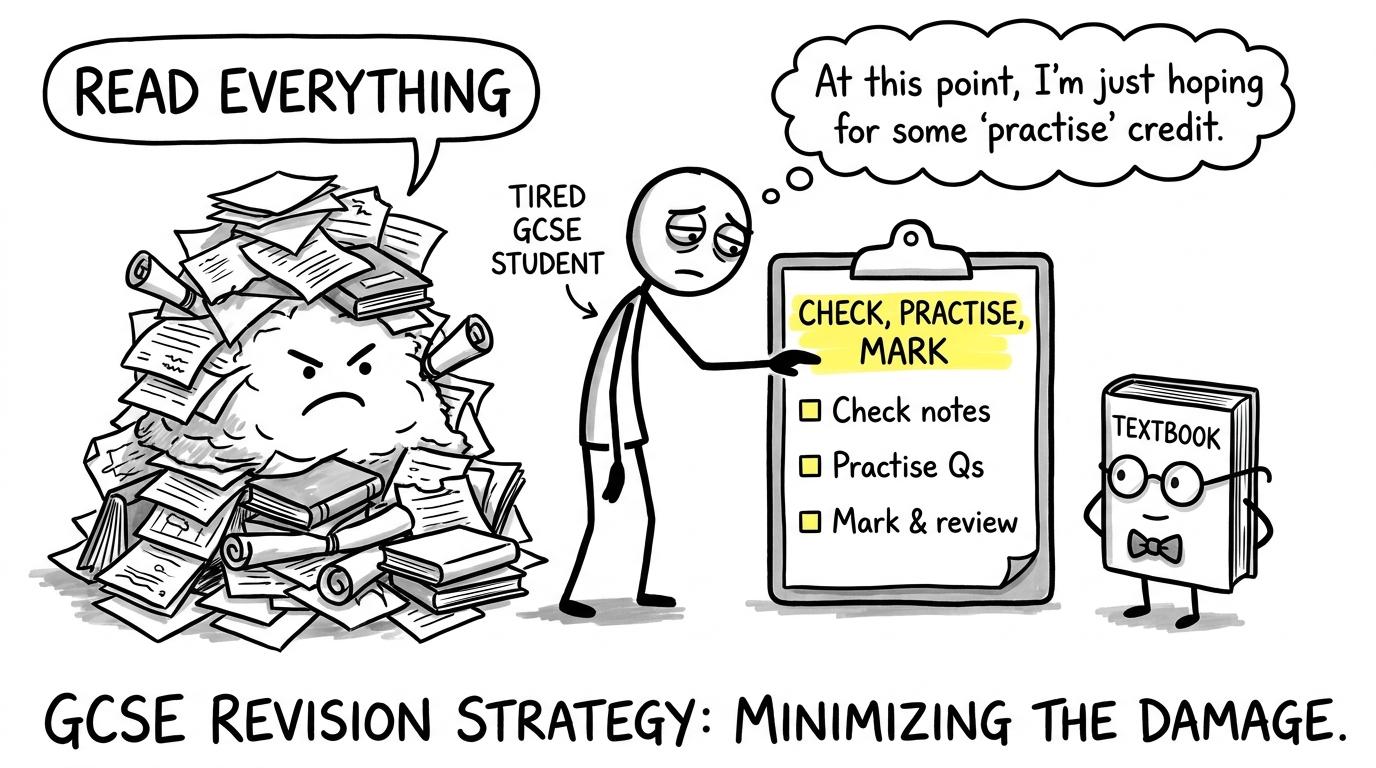 A student chooses a short check, practise and mark routine over reading everything
Common mistakes when using an old science book
Assuming a newer cover means a current specification
Publishers sometimes reprint books. Check the specification code and qualification wording, not just how modern the cover looks.
Matching the subject but not the exam board
“GCSE Combined Science” is not precise enough. Confirm the board, qualification title and code used by your school.
Learning only what appears in the textbook
Even a suitable book is not the official boundary of assessment. Use the current specification as the definitive content checklist.
Ignoring practical knowledge
Practical skills are assessed in written papers. Knowing a result is not enough; you may need to discuss methods, variables, errors, risks, graphs and improvements.
Memorising equations without practising their use
An equation sheet provides information, not judgement. You must still identify the correct relationship, convert units, rearrange accurately and interpret the result.
Using old papers as the final measure of readiness
Older questions can build knowledge, but recent papers and current mark schemes give a more faithful picture of today's language, structure and mathematical demand.
Turn an old resource into current revision
A well-matched hand-me-down textbook can save money and explain the course perfectly well. The safe rule is simple: trust it for teaching only after checking it against the current exam board specification, and trust current exam questions to show how that knowledge will be assessed.
For the maths running through Combined Science, make MathsGenie your free revision base. Use revision lessons and guides to repair a weak method, practise with topic questions and mini tests, check mark schemes and video solutions, then move to past papers and predicted papers when your foundations are secure. A revision planner can keep those small tasks moving.
The textbook does not need to be new. Your revision process does.











