Old Textbook GCSE Chinese: Is It Still Useful?
Old textbook GCSE Chinese advice: see what has changed, which books still match current AQA or Edexcel exams, and how to fill revision gaps safely.
An old textbook GCSE Chinese hand-me-down can look like either a bargain or a trap. The reassuring answer is that a book written for the current grades 999 to 111 qualification can still be genuinely useful. Core vocabulary, grammar, character recognition and translation skills do not suddenly expire.
But the publication date is not the only thing that matters. You must check the exam board, specification, tier, assessed language and question format. A book can teach good Chinese while preparing you poorly for the paper you will actually sit.
The key distinction is simple: use an older textbook to learn the language, but use the current specification and recent exam materials to learn the exam.
The quick textbook checklist
Before committing hours to a hand-me-down book, check:
- Exam board: AQA or Pearson Edexcel
- Specification code: AQA 8673 or Edexcel 1CN0
- Qualification: the current grades 999 to 111 GCSE, first assessed in 2019
- Spoken language: Mandarin, or Cantonese where the Edexcel entry permits it
- Tier: foundation or higher
- Four skills: listening, speaking, reading and writing
- Current tasks: role-play, picture or photo-based work, conversation, translation and extended writing as applicable
- Recent papers: compare the book with current sample materials and past papers
If most of these match, the book probably deserves a place in your revision. If several do not, treat it as a supplementary language resource rather than your main course guide.
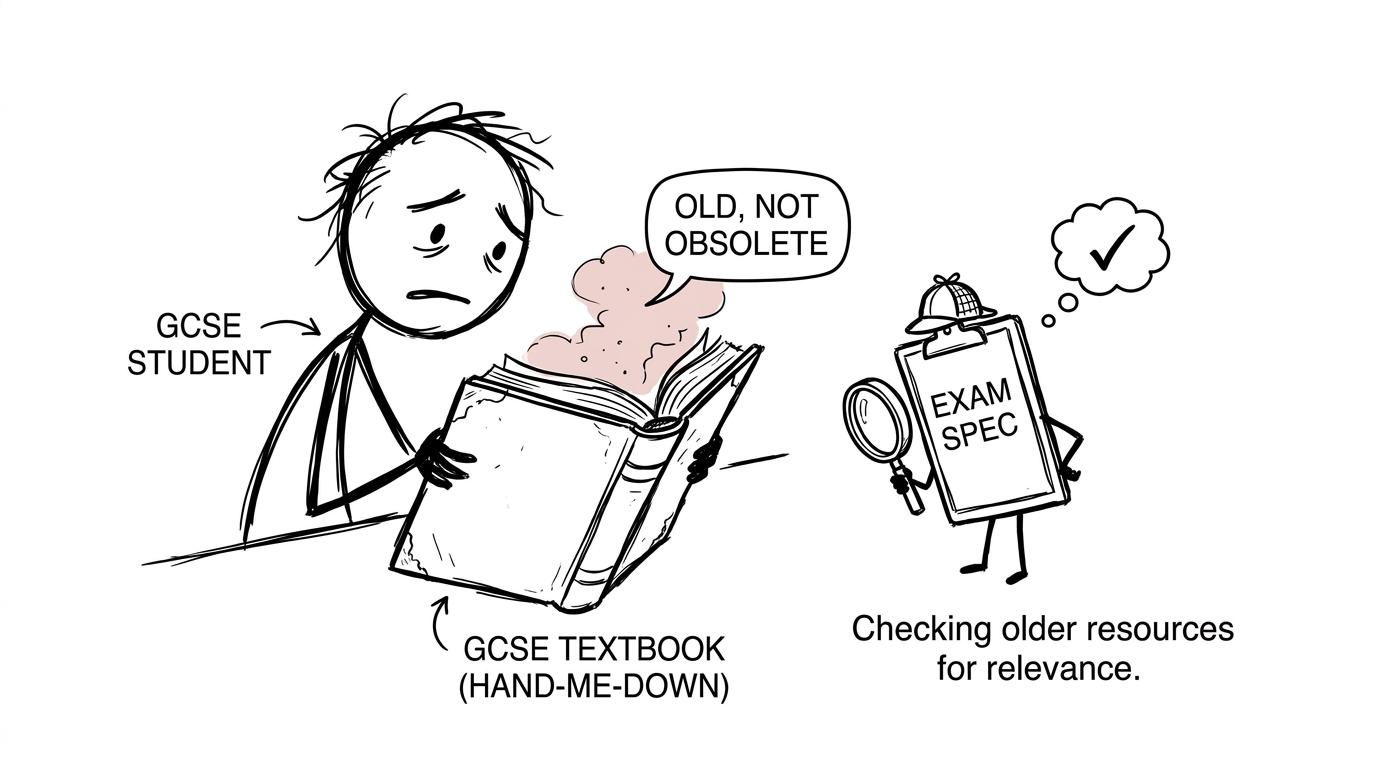 A student and a specification detective inspect a dusty but potentially useful textbook
Has the GCSE Chinese specification changed recently?
This is where understandable confusion arises. Reformed GCSEs in French, German and Spanish began teaching in September 2024, with first examinations in summer 2026. Those reforms introduced more defined vocabulary expectations and altered aspects of assessment.
However, the Department for Education confirms that the earlier modern foreign languages subject content remains current for other GCSE languages, including Chinese. In other words, the 2024 reform programme for French, German and Spanish did not automatically replace GCSE Chinese.
As of August 2026, the current AQA and Pearson Edexcel GCSE Chinese qualifications remain the specifications introduced for teaching from 2017 and first assessed in 2019. That is good news for anyone using a book published for those qualifications: it has not become obsolete merely because French, German and Spanish changed.
What the current courses still assess
Both current specifications develop and assess four language skills:
- listening
- speaking
- reading
- writing
Each skill contributes 25%25\%25% of the qualification. Students enter all components at one tier: foundation or higher. The qualifications are linear, so the components are completed in the final exam series rather than being collected as modular results throughout the course.
The broad subject matter also remains familiar. Students discuss identity, daily life, education, local areas, travel, culture, future plans and wider social or global issues. A slightly older current-specification textbook will therefore contain plenty of relevant vocabulary and grammar.
Yet broad similarity is not perfect alignment. AQA and Edexcel organise themes differently, use different task details and allocate marks differently. That is why the exam-board logo on the cover matters.
When an older textbook still holds up
A hand-me-down textbook is strongest at teaching durable knowledge.
Vocabulary and character recognition
Words for family, school, food, hobbies, travel, work and everyday routines remain useful. Regular reading also builds speed in recognising characters without relying immediately on pinyin.
Do not assume, however, that every list is exhaustive. Check its coverage against your teacher's scheme of work and the current specification. A book may include useful language without covering every context your exam board can assess.
Grammar and sentence construction
Accurate word order, time phrases, comparisons, opinions, connectives and ways of referring to past or future events remain central to communication. A sound explanation of these ideas does not lose its value because the cover design looks dated.
Grammar practice is especially useful when it moves beyond copying model answers. You should be able to adapt a sentence to a different person, time frame or topic. That flexibility is what helps in an unseen task.
Reading and translation practice
Older passages can still develop the habit of identifying gist, locating details and inferring meaning from context. Translation exercises remain useful too, provided you compare their length and demand with current exam-board materials.
Translation is not simply word replacement. Meaning, word order and natural English or Chinese expression matter. Use your textbook for volume of practice, then use recent official mark schemes to understand how answers are credited.
Independent revision habits
A textbook can be valuable precisely because it is finite. You can annotate a chapter, make retrieval cards and return to mistakes without opening another browser tab.
The same principle works in maths. A resource becomes effective when it leads to active practice, checking and correction. Maths students can use the free GCSE Maths revision hub to apply that cycle through revision lessons, topic questions and exam-board materials.
When an old GCSE Chinese textbook is not enough
The danger is rarely that every page is wrong. It is that the book quietly leaves out the thing that now earns marks.
| Textbook situation | Best decision |
|---|---|
| Written for AQA 8673 or Edexcel 1CN0 | Use it, then confirm tasks with recent papers |
| Written for the previous A* to G course | Keep it for language practice, not exam-format guidance |
| Written for a different exam board | Use grammar and vocabulary selectively |
| Designed for Mandarin when you are entered for spoken Cantonese | Confirm all speaking and listening practice with your teacher |
| Contains no current-style speaking or translation tasks | Add current specification materials immediately |
| Gives no mark schemes or assessment criteria | Pair it with official exam-board resources |
Pre-2017 books need particular care
The move to the current grades 999 to 111 qualifications was substantial. The current courses are linear, use foundation and higher tiers across the qualification, and assess listening, speaking, reading and writing with equal weighting. Translation and current speaking-task formats also matter.
A book prepared for the previous A* to G specification may still explain basic language well. It should not be trusted to describe current paper structures, timings, task types or mark allocation.
Think of it as an old map of a familiar town. Many streets are still there. The one-way system may not be.
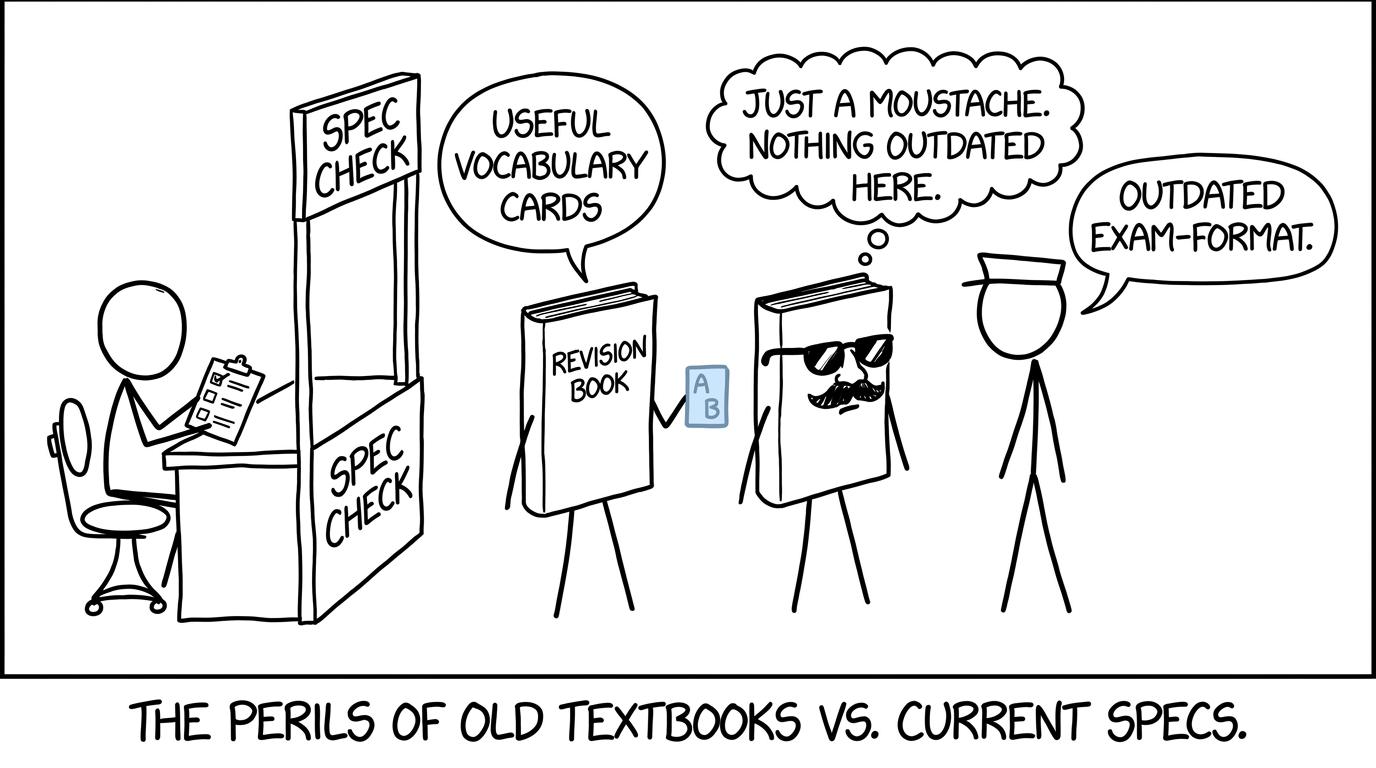 Two revision books face a specification checkpoint while one hides an outdated exam-format moustache
Check whether your book matches AQA or Edexcel
AQA GCSE Chinese (Spoken Mandarin), specification 8673, assesses Mandarin and uses three broad themes: identity and culture; local, national, international and global areas of interest; and current and future study and employment.
Pearson Edexcel GCSE Chinese, specification 1CN0, provides entry routes involving spoken Mandarin or spoken Cantonese. Its content is arranged across five themes, including identity and culture, travel, school, future aspirations and the international dimension.
There is considerable overlap in the language students need, but the specifications are not interchangeable. Check these features directly:
- the order and names of themes
- speaking-task structure
- reading and listening response formats
- translation requirements
- expected writing lengths
- foundation and higher tier demands
- how each task is marked
Do not rely on a retailer's description or a sticker saying “new GCSE”. Use the specification code printed inside the book and ask your school to confirm your entry.
How to use a hand-me-down textbook safely
The best approach is not to choose between the old book and newer resources. Give each a different job.
Build a coverage grid
Write the current specification themes down one side of a page and the relevant textbook units beside them. Mark each area as:
- covered securely
- covered partly
- missing
This turns a vague worry about age into a visible list of gaps.
Separate language learning from exam preparation
Use the textbook for vocabulary, grammar, reading and structured practice. Use recent official papers, sample assessment materials and mark schemes for task format, timing and marking expectations.
This separation is useful across GCSE revision. MathsGenie's guide to using past papers at the right stage explains why papers work best when they test knowledge rather than replace the learning of it.
Add listening and speaking practice
A printed book cannot reproduce the pressure of processing an unfamiliar recording or responding spontaneously. Use current audio materials and practise speaking aloud. Record responses where appropriate, listen back and check whether you answered every part of the task.
Keep a mistake log
Record errors under precise headings such as character, word order, missing detail, tense or time reference, and misunderstood instruction. Then revisit the same weakness later.
Maths students can use the same routine with GCSE mini tests: attempt, mark, identify the exact weakness and retest. The method matters more than the subject.
Common mistakes when using an old textbook
Assuming old means useless
A current-specification book does not become inaccurate because it is second-hand. Condition and curriculum alignment matter more than shininess.
Assuming useful means complete
A book may be excellent for characters and grammar while missing current task guidance. Supplementing it is not a criticism of the book; it is sensible exam preparation.
Mixing exam boards accidentally
AQA and Edexcel share broad skills, but their assessment details differ. Always practise the exact format used by your board.
Revising only from model answers
Memorised passages can make revision feel fluent while leaving you unable to adapt. Practise changing opinions, reasons, time frames and contexts.
Completing work without checking it
Unmarked practice preserves mistakes. Use answer material carefully, ask a teacher about uncertain language and maintain a correction log. The disciplined approach described in how to use Edexcel maths past papers applies just as strongly to language practice.
The final verdict
Yes, you can still use an older textbook for GCSE Chinese, especially if it was written for AQA 8673 or Edexcel 1CN0. The Chinese specifications have not been swept into the recent French, German and Spanish reforms, so a current grades 999 111 book can still align well.
Just do not ask one textbook to do every job. Confirm the specification code, map its contents against the current course, and fill gaps with recent official assessment materials. Keep pre-2017 books for supplementary language practice rather than current exam guidance.
And while your Chinese textbook supports one part of your timetable, MathsGenie can organise the maths side. Start with a realistic GCSE maths revision timetable, strengthen weak topics through free revision lessons and practice questions, then use Edexcel predicted papers, past papers, mark schemes, mini tests and video solutions to prepare for the real exam. Old resources can still help. Current checks make them safe.