Moving Sets GCSE Food and Nutrition: Does It Matter?
Moving sets GCSE Food and Nutrition explained: learn whether a class change affects your final grade, NEA or exam, and use a practical plan to adapt quickly.
A set change can feel like a judgement delivered in a timetable. Move up and you may worry about keeping pace. Move down and it is easy to assume that somebody has quietly lowered the ceiling on your grade. But moving sets GCSE Food and Nutrition classes does not, by itself, determine your final outcome.
Your grade is awarded for the work assessed against your exam board's criteria, not for the number attached to your classroom. For commonly used AQA, OCR and Eduqas specifications, GCSE Food Preparation and Nutrition is not divided into foundation and higher tiers. Students complete a written examination and non-exam assessment, usually called NEA. Moving class does not place a formal cap on the grade available.
What can change is your learning environment: the teacher, pace, practical schedule, feedback and topics already covered. Those differences matter, but they can be managed.
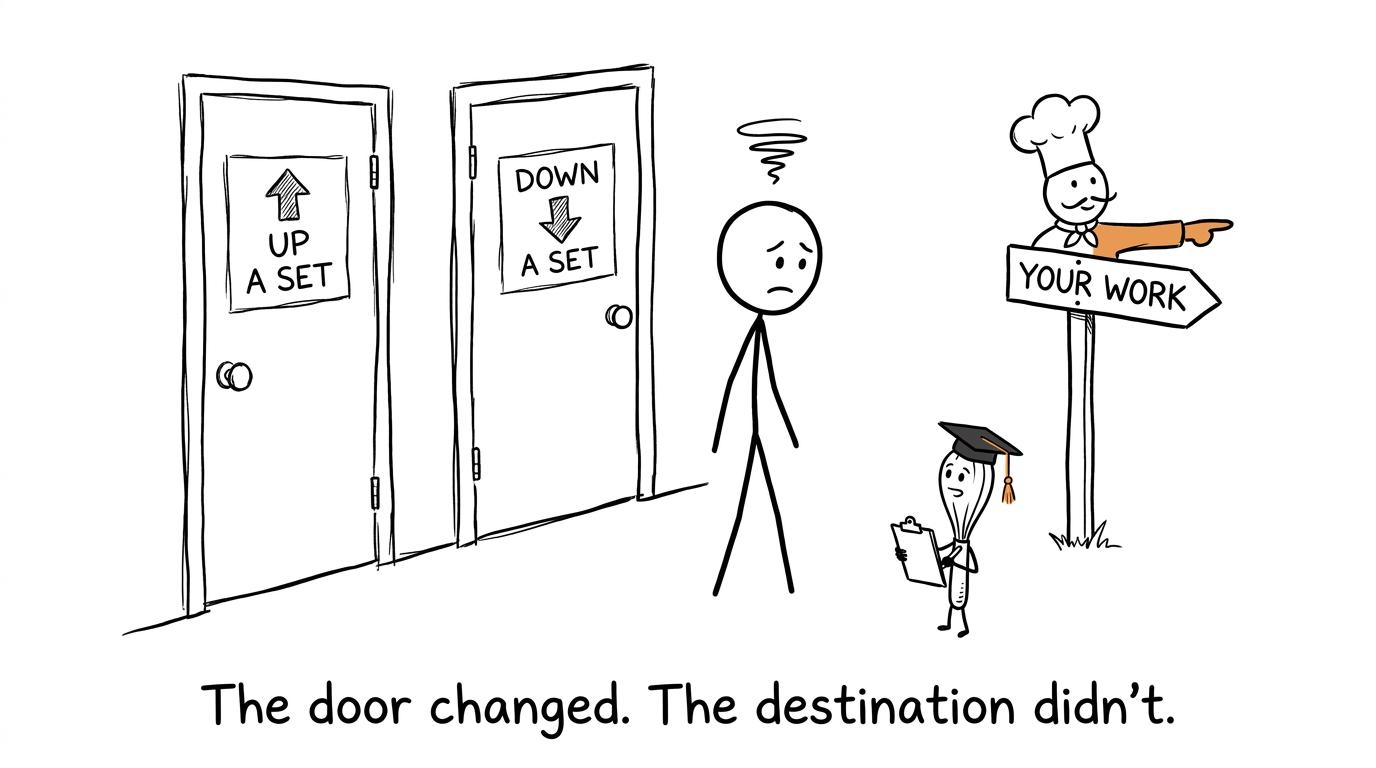 A student choosing between set-change doors while their work points towards the same destination
The short answer and your immediate checklist
A move up or down a set will not automatically raise or reduce your GCSE Food Preparation and Nutrition grade. The important questions are whether you remain entered for the same qualification, whether you have missed any specification content and how your NEA work will continue.
After a change, confirm these points:
- your exam board and qualification title;
- the written examination and NEA arrangements;
- which theory topics the new class has completed;
- where the class is within each NEA task;
- whether practical work, photographs or teacher observations need transferring;
- what you should catch up first;
- when your teacher will review your progress again.
Do not rely on a friend's description of the course. Schools may organise classes differently, while AQA, OCR, Eduqas and other awarding organisations use their own specifications and administrative requirements.
Why your set does not directly decide your grade
A set is an internal school grouping. An examination grade is an assessment outcome. They are connected only indirectly.
Official GCSE Food Preparation and Nutrition specifications assess subject knowledge, application, practical food preparation, investigation, analysis and evaluation. For AQA, OCR and Eduqas, the broad balance is 50%50\%50% written examination and 50%50\%50% NEA, although the component names, task details, timings and mark structures differ between boards.
A useful way to think about the final result is:
Overall assessment outcome=weighted examination performance+weighted NEA performance\text{Overall assessment outcome} = \text{weighted examination performance} + \text{weighted NEA performance}Overall assessment outcome=weighted examination performance+weighted NEA performanceYour classroom label is not part of that calculation.
The NEA is internally assessed by the school and externally moderated by the awarding organisation. That means your teacher applies the board's published criteria, while moderation checks how centres have applied those standards. A set move does not create a separate mark scheme for you.
This is different from GCSE Maths, where foundation and higher tiers affect the range of grades available. Food Preparation and Nutrition is not normally tiered in that way. Moving down a Food class should therefore not be confused with moving from higher to foundation GCSE Maths.
What can genuinely affect your outcome after moving sets
The set number is not the mechanism. The consequences surrounding the move can be.
Gaps in specification coverage
Your old class may have studied food provenance while your new class covered food safety. Both groups could be following the same specification in a different order. Unless someone compares the two schemes of work, the gap may remain invisible until a mock examination.
Ask for a topic checklist and mark each area as secure, partly secure or not yet covered. This turns a vague fear into a finite catch-up list.
Disruption to NEA continuity
NEA is more sensitive to a class move than ordinary theory lessons. You may already have completed investigations, practical trials, evaluations or photographic evidence. Your new teacher needs to know what was completed, under what conditions and what feedback has already been given.
Do not recreate assessed work independently or alter it outside your school's instructions. NEA must follow exam-board rules on supervision, authentication and teacher guidance. Instead, ask your teachers to coordinate the transfer of portfolios, records and practical evidence.
A different pace or level of support
A higher set may move more quickly or expect greater independence. A lower set may spend longer consolidating core knowledge. Neither approach automatically produces a particular grade.
The relevant question is whether the teaching helps you meet the assessment criteria. Fast teaching is not useful if misunderstandings accumulate. More support is not a disadvantage if it helps you write precise explanations, improve practical decisions and evaluate evidence properly.
Confidence becoming confused with evidence
A downward move can feel permanent even when the school's grouping is flexible. An upward move can feel like proof that success is guaranteed. Both interpretations are risky.
Research on setting and streaming does not support the idea that a set label reliably determines an individual student's attainment. The wider evidence is limited and average effects are small. Your most useful evidence is therefore closer to home: marked assessments, teacher feedback, practical performance and the specific knowledge you can retrieve.
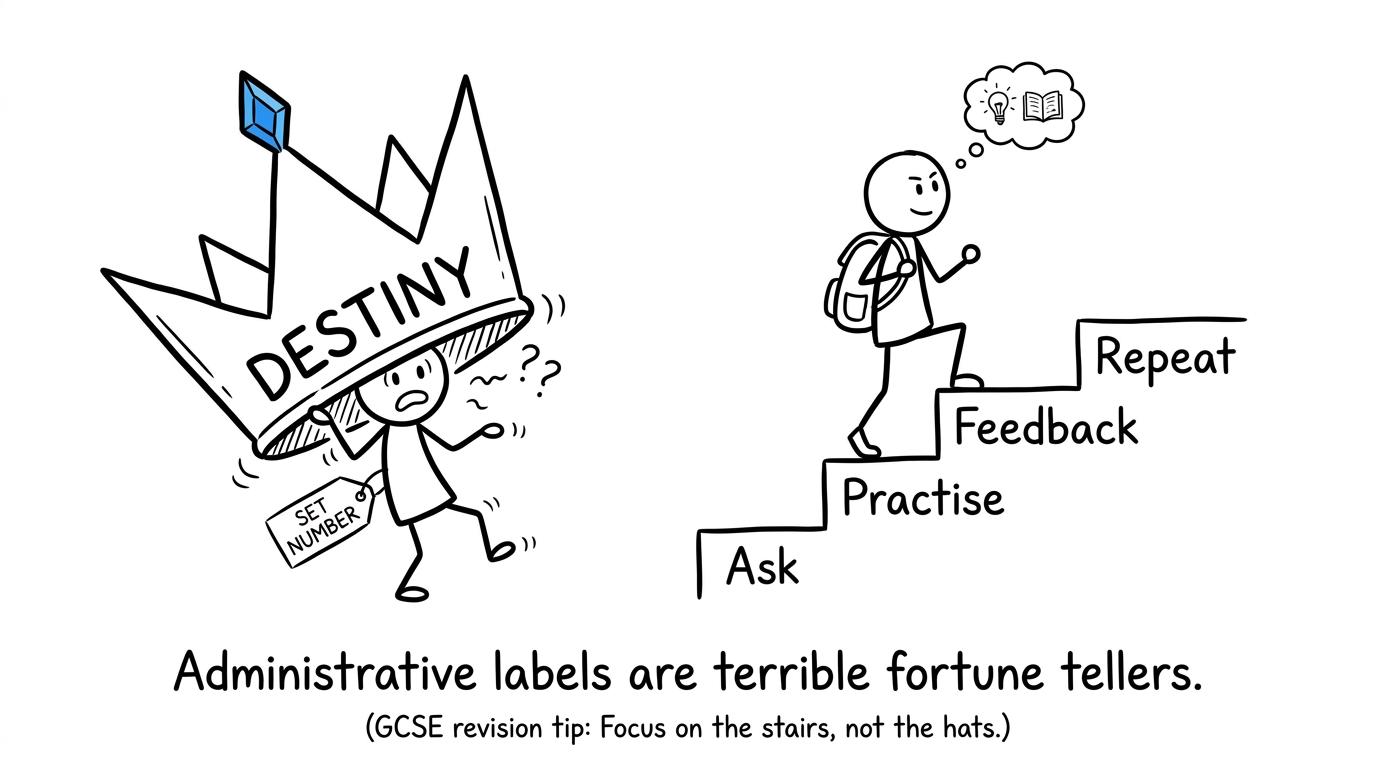 A tiny set number discovers that it makes a poor fortune teller
How to adapt when moving up a set
Moving up usually creates two pressures: pace and assumed knowledge. Deal with both openly.
Ask what the new class has already covered and request the resources used for any missing topics. Compare your most recent assessment with the new class's current work, but do not treat one score as a verdict. Look for exact gaps such as food science terminology, nutritional analysis, food safety reasoning or evaluation.
For each gap, use a compact cycle:
- retrieve what you already know without notes;
- check the specification or class material;
- answer an appropriate exam-style question;
- compare your response with the mark scheme;
- improve the response using precise subject vocabulary;
- revisit the same area later.
Keep your ordinary GCSE Maths revision running as well. A move in another subject can consume attention out of proportion to its practical importance. The MathsGenie GCSE revision timetable can help you protect regular maths sessions while adding short Food catch-up blocks.
How to adapt when moving down a set
First, ask why the move happened. Schools may consider assessment evidence, current support needs, class sizes, timetabling or patterns of completed work. Knowing the reason tells you what to change.
Then ask what remains possible. Because Food Preparation and Nutrition is not normally separated into foundation and higher papers, a lower set should not formally restrict access to the full grade range. However, you still need full specification coverage and opportunities to demonstrate the relevant practical and analytical skills.
Set a review point with your teacher. Agree on evidence that would demonstrate improvement, such as stronger theory assessments, completed catch-up work, better use of feedback or more consistent preparation. Make the target behavioural rather than emotional. “Revise more” is vague; “complete one timed question, mark it and correct it each week” can be checked.
If you believe expectations have become too low, raise the concern calmly with your teacher, head of department, tutor or parent or carer. Ask about content and assessment opportunities rather than arguing only about the set name.
Use maths skills to strengthen Food and Nutrition
Maths is part of Food Preparation and Nutrition even though it is not the same qualification. You may need to interpret nutritional information, compare proportions, scale quantities, use percentages, read graphs, calculate means or organise practical timings.
The key relationships include:
Percentage=partwhole×100\text{Percentage} = \frac{\text{part}}{\text{whole}} \times 100Percentage=wholepart×100and
Scale factor=required quantityoriginal quantity.\text{Scale factor} = \frac{\text{required quantity}}{\text{original quantity}}.Scale factor=original quantityrequired quantity.These are not separate tricks. They are ways of describing evidence accurately.
If numerical work is costing you marks or slowing down practical planning, revisit GCSE percentage skills, the GCSE ratio revision guide and GCSE Statistics revision. Choose resources matching your own maths exam board where possible, but remember that the underlying number skills transfer across subjects.
Build a manageable recovery plan
A set move feels large because it arrives as one event. Recovery works better when divided into small actions.
During the first few days
Confirm your exam board, assessment structure and NEA position. Collect the new class's topic list and identify only the material you have genuinely missed. Introduce yourself to the teacher and explain any existing support arrangements.
During the next two weeks
Prioritise gaps that affect current lessons or upcoming assessments. Keep an error log with three headings: missing knowledge, weak application and unclear examination writing. Ask for feedback on whether your answers are sufficiently specific.
For maths, the same diagnostic principle is explained in how to find your weakest GCSE topics. The subject may differ, but the habit transfers: gather evidence, label the weakness, practise the smallest relevant skill and retest it.
Before the next assessment
Revise from the specification rather than trying to guess what your set is expected to achieve. Practise recalling knowledge and applying it to unfamiliar contexts. Afterwards, separate lost marks caused by content, interpretation, timing and incomplete explanation.
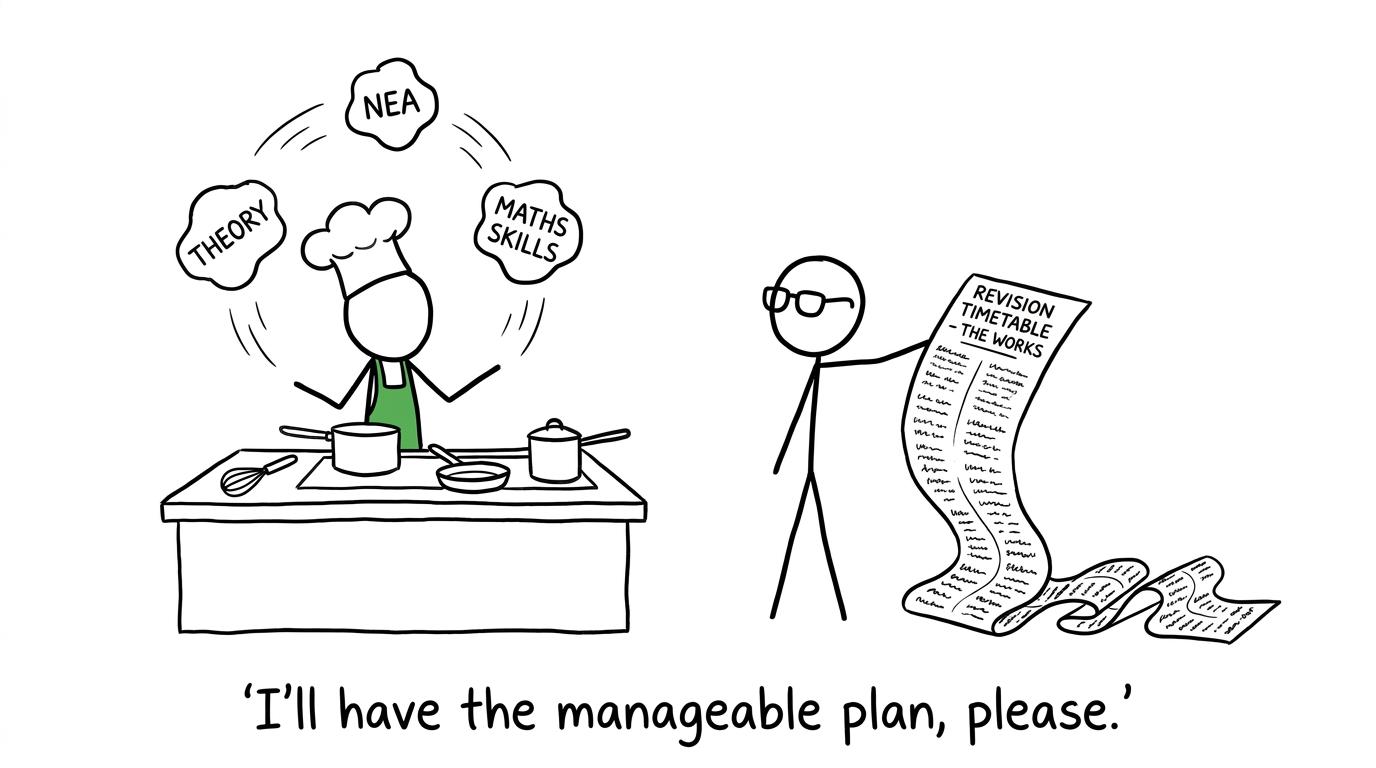 A student chooses a manageable revision plan while juggling theory, NEA and maths skills
Common mistakes after changing sets
Assuming the move fixes or ruins everything
Moving up is an opportunity, not a guaranteed grade. Moving down is a change of teaching group, not a permanent judgement. Continue responding to actual assessment evidence.
Ignoring NEA administration
Do not assume electronic files, photographs, teacher observations and practical records will transfer automatically. Ask both teachers to confirm what has moved and what remains outstanding.
Catching up every topic at once
A long list encourages shallow rereading. Prioritise current lessons, missing specification content and weaknesses shown by assessment.
Comparing marks without context
Different classes may have completed different tests or received different preparation. Compare your work with published criteria and mark schemes, not classroom rumours.
Letting one subject displace all others
A set change can dominate your week. Protect your wider revision plan, particularly compulsory GCSE Maths. Start from the free GCSE Maths revision hub, use topic lessons and practice questions, then check progress through mini tests and past papers.
Your set is a location, not an outcome
A timetable can change in an afternoon. Competence changes more slowly: through feedback, careful practice and repeated contact with the parts you once found difficult.
If you move sets in GCSE Food Preparation and Nutrition, confirm your assessment arrangements, protect the continuity of your NEA and identify any content gaps immediately. Then return your attention to what earns marks. That is the part you can influence.
For your maths preparation, make MathsGenie your free revision base. Use the GCSE Maths revision resources for lessons and practice questions, diagnose gaps with short tests, build confidence through past papers and use GCSE predicted papers nearer the examination. Mark schemes and video solutions then turn each mistake into a specific next step.
Your set may alter the room in which you learn. It does not write the final answer for you.