

Make Own GCSE Sociology Practice Questions: Worth It?
Make own GCSE sociology practice questions effectively. Turn notes into exam-style recall, application and evaluation tasks, then check their quality.
Revision can look productive without asking much of you. A highlighted page grows brighter, a neat summary becomes neater, and familiar sentences begin to feel like knowledge. Then you close the book and discover how little you can retrieve.
So, is it worth trying to make own GCSE sociology practice questions from your notes? Yes, provided you check them against your specification, imitate genuine question styles and write an answer guide. Creating a question forces you to decide what matters, how ideas connect and what an examiner could reasonably ask. But homemade questions should supplement official past-paper questions, not replace them.
This matters particularly if you are balancing sociology with GCSE maths. Both subjects reward active practice, accurate command-word reading and honest marking. The content differs, but the revision habit travels well.
The short answer and your checklist
Making your own questions is worthwhile when you:
- select content directly from your exam board's specification
- include recall, application, analysis and evaluation
- copy the style of official questions without copying their wording
- attach an answer outline or checking criteria
- answer the questions later, without notes
- compare your standard with real past papers and mark schemes
- keep question writing to a sensible share of revision time
It becomes less useful when you spend an hour designing attractive cards, write only easy definition questions or never return to answer what you created.
The goal is not to become an examiner. It is to make your notes demand something from your memory.
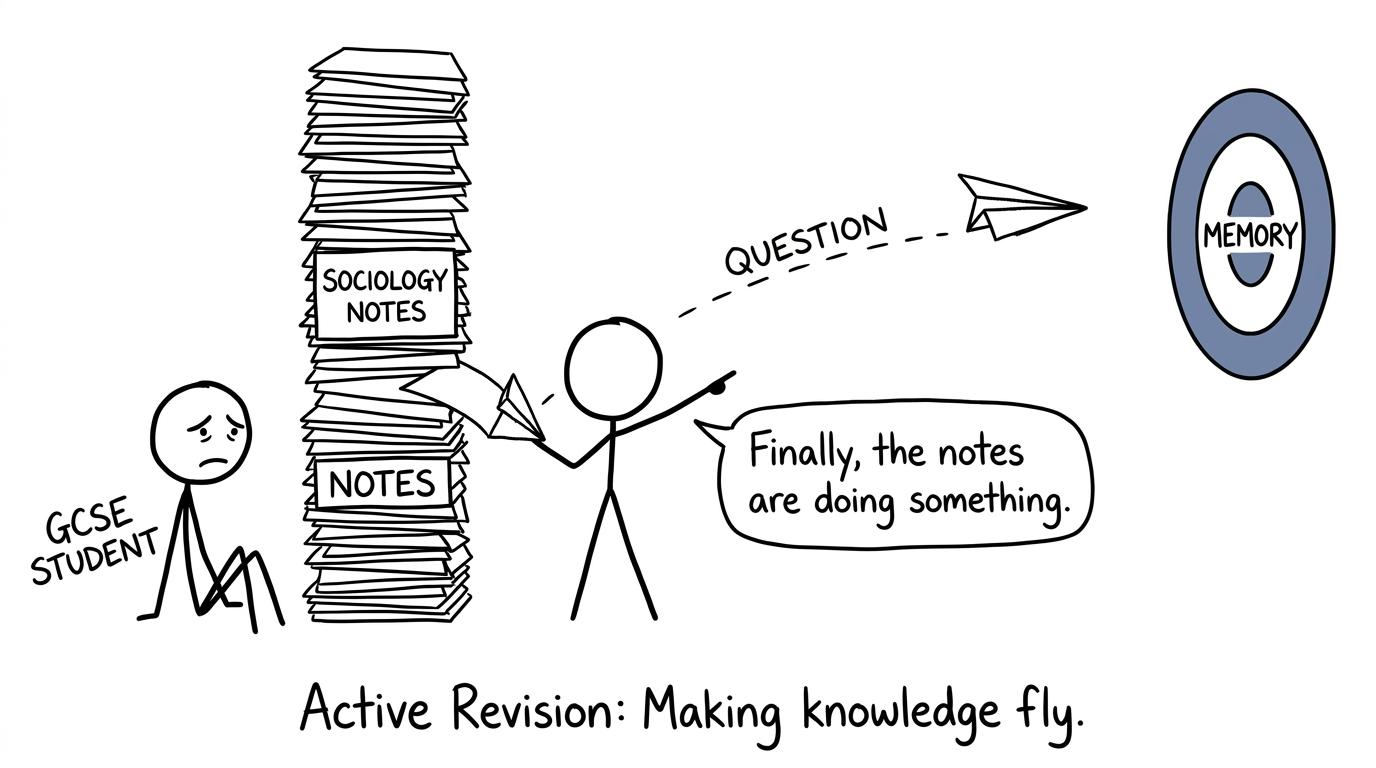 A student turns a tower of passive notes into a question aimed at memory
Why writing questions can teach you
Answering a supplied question tests what you know. Writing a good question tests whether you understand the shape of the knowledge.
Suppose a page of notes covers a sociological theory, supporting evidence, criticisms and links to a social institution. To convert that page into useful questions, you must separate several things:
- the concept that should be defined
- the evidence that could support a point
- the context in which knowledge could be applied
- the disagreement that could be analysed
- the judgement an extended response might require
That selection process can expose vague notes. If you cannot tell what a paragraph could be used to answer, you may not yet understand its role.
Research on retrieval practice broadly supports attempting to recall information rather than relying only on rereading. Evidence specifically about student-generated questions is more mixed. Some research suggests that generating questions can encourage deeper processing, while other studies have found that students' questions may miss important content or fail to match a later assessment. The sensible conclusion is not that homemade questions are automatically powerful. It is that they become powerful when they are accurate, representative and followed by retrieval and feedback.
That is also why MathsGenie's guidance on stopping yourself forgetting GCSE maths content centres on recall, exam-style practice and revisiting mistakes. A revision technique succeeds because of what your brain has to do, not because the page looks organised.
Start with your specification, not your notebook
Your class notes are a record of what was taught. The specification is the boundary of what may be assessed. Use both, but begin with the specification so your question bank has proper coverage.
Under the current GCSE Sociology assessment framework, questions assess three broad objectives:
- AO1: knowledge and understanding of sociological theories, concepts, evidence and methods
- AO2: application of that knowledge and understanding
- AO3: analysis and evaluation used to construct arguments, make judgements and draw conclusions
These objectives apply across GCSE Sociology specifications, although paper structures and question wording vary. AQA uses multiple-choice, short-response and extended-response questions. Eduqas uses recall, structured and extended responses across its components. That difference is important: your homemade bank should resemble the board you actually take, not a generic idea of a sociology exam.
Check your board with your teacher or the front of a mock paper. Then make a topic list from the official specification. Depending on the board, areas may include families, education, crime and deviance, social stratification, cultural transmission and research methods.
This is the same principle used in effective maths revision. The GCSE Maths revision hub separates resources by exam board so students can select appropriate lessons, practice questions and papers rather than revising from an unstructured pile.
How to turn GCSE Sociology notes into questions
Divide each topic into assessable pieces
Take one small section of notes rather than an entire unit. Label the information under headings such as:
- key terms and definitions
- theories and perspectives
- named evidence or studies required by your course
- examples and social contexts
- similarities and differences
- strengths and limitations
- research methods and methodological issues
Small sections make omissions easier to notice. They also stop a question-writing session from becoming an elaborate form of avoidance.
Build a ladder of question types
Begin with short retrieval prompts, but do not stop there. A balanced set might contain:
- Identify or state: retrieve a precise fact, term or feature
- Describe or outline: give accurate developed knowledge
- Explain: show why or how something happens
- Apply: use knowledge in a supplied or hypothetical context
- Compare: identify meaningful similarities or differences
- Evaluate or discuss: weigh arguments and reach a supported judgement
Do not assign marks by guesswork. Look at official papers from your board and notice how many marks are normally attached to each command word. The same verb can carry different expectations depending on the full question and assessment context.
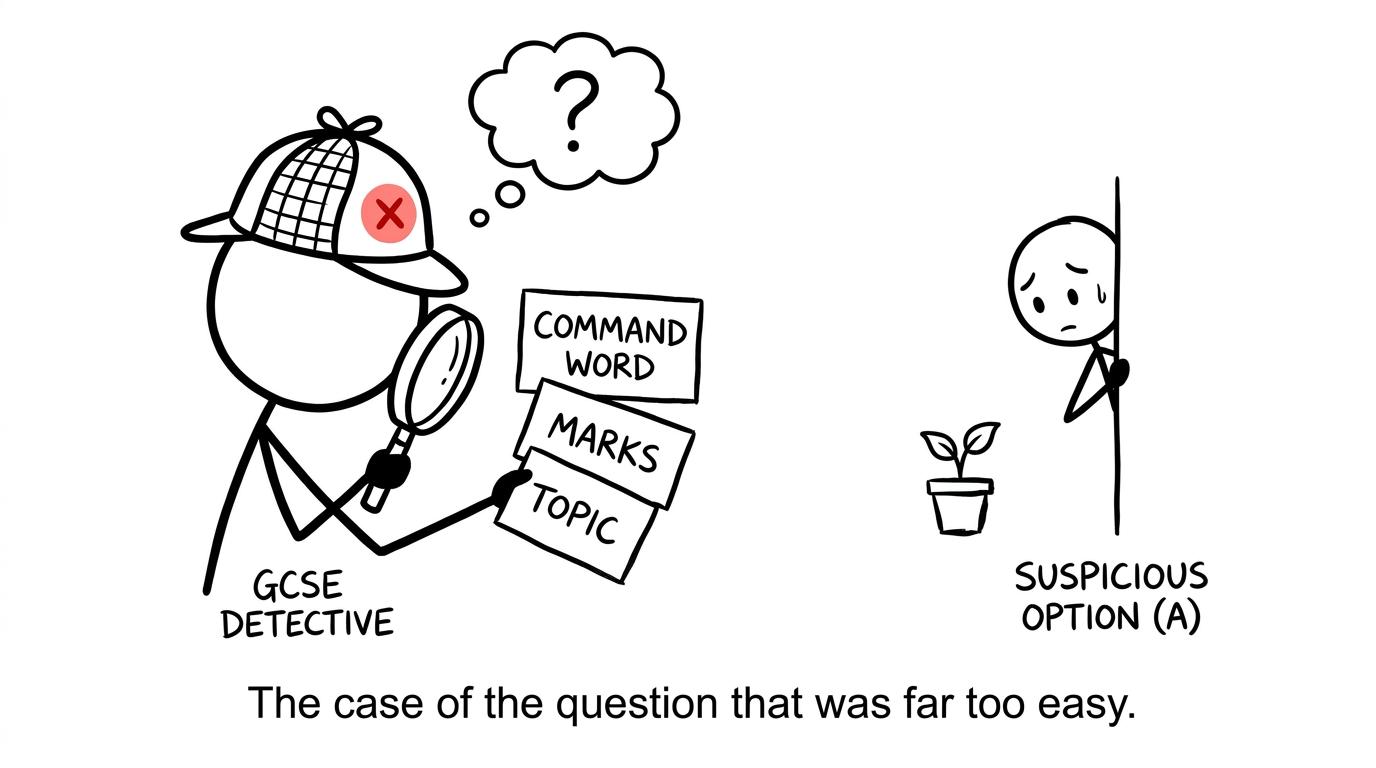 A revision detective investigates command words, marks and topic clues
Turn headings into precise prompts
A weak prompt is broad enough to invite almost anything. A strong prompt identifies the topic, required action and boundaries of the answer.
Instead of asking yourself to write everything you know about education, narrow the task by choosing:
- one perspective
- one claimed cause or consequence
- one comparison
- one methodological issue
- one evaluative judgement
For extended questions, include a balanced issue that genuinely allows argument. Avoid writing prompts where your preferred answer is the only plausible position. Sociology rewards reasoned analysis, not merely repeating a conclusion from your notes.
Write the answer guide immediately
A question without an answer guide can preserve misunderstanding. Beneath each question, record:
- the essential knowledge
- relevant terminology
- acceptable evidence or examples
- the application required
- possible analytical links
- reasonable evaluation points
- what a justified conclusion should address
This need not imitate an examiner's mark scheme. It should be accurate enough for you, a classmate or a teacher to judge whether the response answers the question.
If you are uncertain about the content, flag the question and check it with your textbook, teacher materials or teacher. Do not repeatedly practise an answer whose accuracy you have not established.
Use the questions as retrieval practice
Writing is only the first half of the method. Put the questions away and answer them later with your notes closed. Otherwise, you are testing recognition rather than recall.
A simple cycle is:
- create a small set after finishing a topic
- answer it on another day without notes
- check against your answer guide
- correct missing or inaccurate knowledge
- revisit unsuccessful questions after a gap
- eventually mix them with questions from other topics
Keep two separate labels: question quality and answer quality. A poor response does not always mean the question was good, while an easy full-mark response may reveal that the prompt was too narrow.
Maths students can use the same rhythm with short GCSE maths mini tests: attempt, mark, diagnose and retest. The subject changes, but feedback remains the hinge on which improvement turns.
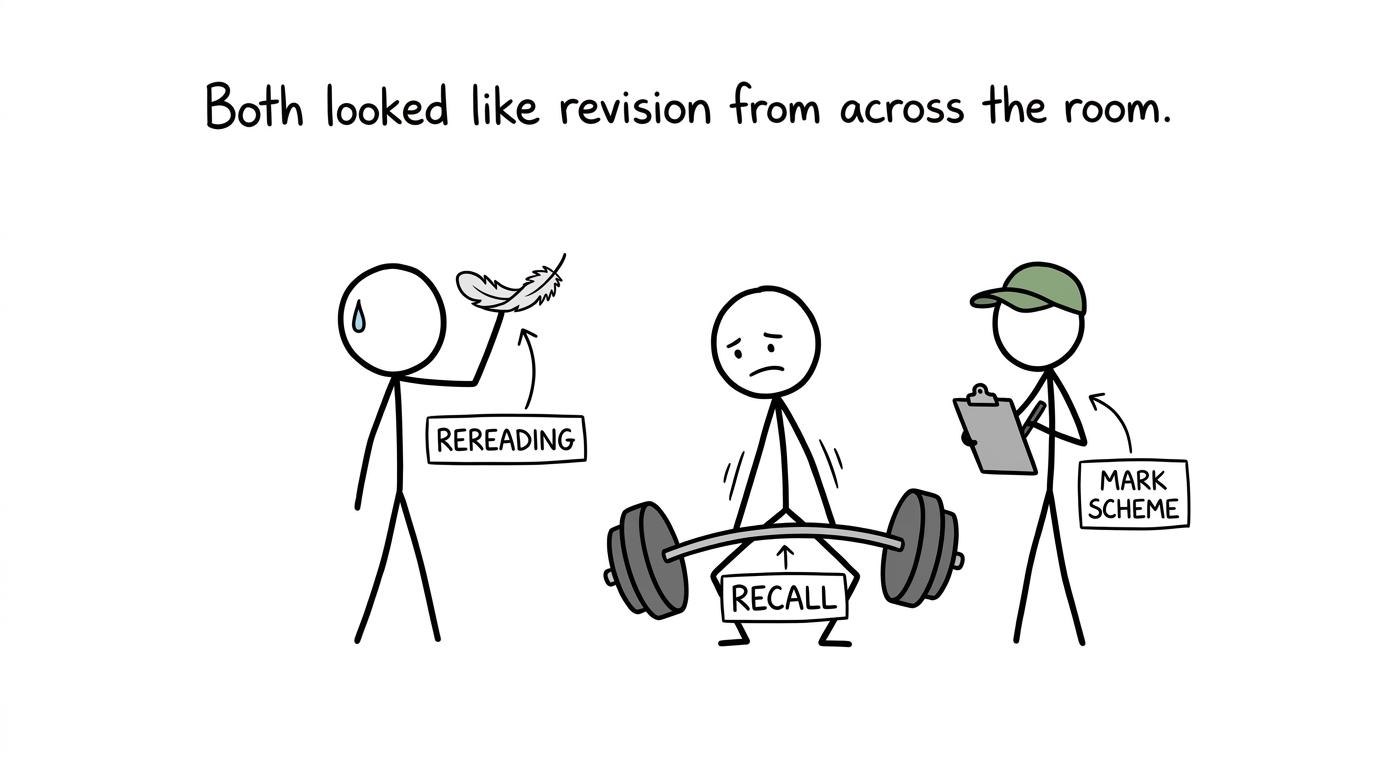 Two students discover that rereading and genuine recall are not the same workout
How much time should question writing take?
Question creation should be a modest part of your revision, not the whole timetable. Most of the benefit arrives when you answer, mark and improve.
For a short session, you could:
- spend the opening portion selecting one specification point
- create a few varied questions
- write brief answer criteria
- answer older questions from memory
- finish by correcting one weakness
A structured timetable prevents interesting tasks from crowding out necessary ones. MathsGenie's one-month GCSE revision plan demonstrates how retrieval, topic practice, marking and timed work can coexist. You can borrow that structure for sociology while using MathsGenie for your maths sessions.
Homemade questions versus past papers
You need both, because they solve different problems.
Homemade questions offer unlimited targeted practice. They are useful when a particular theory, topic or research method is weak. Official past papers show authentic phrasing, mark allocation, paper structure and the level of precision expected by the exam board.
Use your own questions early and throughout revision. As assessments approach, increase your use of official questions and complete papers. This reduces the risk that your personal question style becomes more familiar than the examiner's.
For maths, the equivalent progression is topic questions followed by Edexcel GCSE Maths past papers, with mark schemes and worked solutions used to correct errors. The guide to starting GCSE past papers at the right time explains why paper practice works best as part of a progression, rather than as a last-minute substitute for learning.
Common mistakes when making sociology questions
Writing only questions you can already answer
Familiar topics feel efficient because progress is visible. Build from the specification instead, especially where your notes are thin or your previous answers were weak.
Producing only definition cards
Definitions matter, but GCSE Sociology also requires application, analysis and evaluation. Include questions that ask you to use knowledge, connect evidence and reach conclusions.
Ignoring your exam board's wording
A question that sounds academic may still be unlike anything on your paper. Study official command words, mark tariffs and specimen materials before building your bank.
Making vague answer guides
Writing “mention the theory and evaluate it” gives you little feedback. State the specific knowledge, links and judgement that a strong response would need.
Confusing creation with completion
A folder containing hundreds of untouched questions is not evidence of learning. A smaller bank that you answer, mark and revisit is far more valuable.
Replacing official questions entirely
Your questions reflect your current understanding, including its gaps. Past papers and teacher feedback provide an external standard. In maths, you can learn the same diagnostic habit through MathsGenie's guide to finding your weakest GCSE topics.
Make the method earn its place
It is worth making your own GCSE Sociology practice questions because the act of writing them can reveal what your notes mean, what they omit and how ideas might be assessed. The benefit is not automatic. Questions must follow the specification, cover a range of assessment objectives and lead to closed-book answers, checking and correction.
Keep the system simple: select, write, answer, mark, repair and return. Then use official sociology papers to calibrate your judgement.
When you switch back to maths, let MathsGenie provide the exam-standard material for you. Open the free GCSE Maths revision hub, choose your board and tier, and combine revision lessons with practice questions, mini tests, past papers, predicted papers, mark schemes and video solutions. Good revision does not merely collect resources. It creates repeated moments in which your knowledge has to prove itself.










