Make Your Own GCSE ICT Practice Questions?
Make own GCSE ICT practice questions from your notes, improve active recall and learn how to combine self-testing with reliable exam-board material.
A page of highlighted notes can feel reassuring. Everything looks familiar, so it is tempting to assume that everything is remembered. Then the notes close and the certainty disappears.
That is why it can be worth learning how to make own GCSE ICT practice questions from your notes. Writing a good question forces you to identify what matters, retrieve the knowledge and distinguish a precise answer from a vague one. Answering it later gives you an honest test of whether the idea has stayed.
There is one important qualification: homemade questions should support, not replace, official specifications, teacher guidance and authentic exam questions. If your course is informally called “ICT”, check its exact qualification title and exam board first. The former GCSE ICT subject criteria in England are withdrawn, while schools may now teach qualifications such as GCSE Computer Science or other digital and vocational courses. Names and assessment arrangements can also differ across the UK.
The short answer: is making your own questions worthwhile?
Yes, particularly when you use the process to transform notes into active recall rather than merely rewriting them.
A sensible approach is to:
- check your qualification title, specification and assessment structure;
- select a small section of notes;
- identify the knowledge or skill an examiner could assess;
- write a mixture of recall, application and evaluation questions;
- create a brief answer guide at the same time;
- leave a gap before answering the questions without notes;
- compare your work with reliable exam-board material;
- record weak areas and test them again.
The value comes from the thinking involved. The quantity of cards or questions matters less than their accuracy and usefulness.
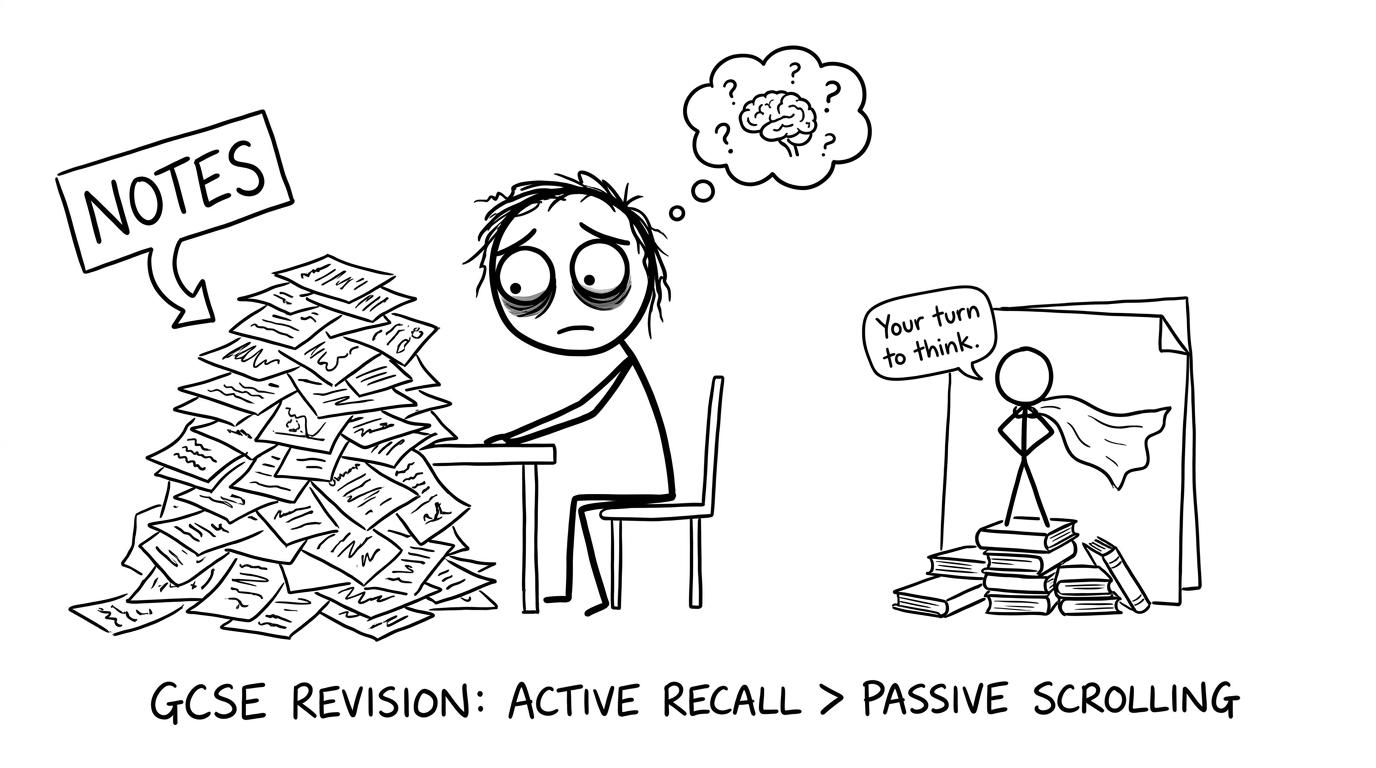 A homemade practice question rescues a student from an enormous pile of passive notes
Why writing questions can teach you so much
Research on retrieval practice supports testing yourself rather than relying only on rereading. A question creates a gap between a prompt and an answer. Your brain must cross that gap without being carried by the wording of the notes.
Question generation adds another layer. Before you can ask something useful, you have to decide:
- which idea is central;
- which details are necessary;
- how the idea might be applied;
- what a weak answer would omit;
- how a complete answer should be structured.
This is close to the judgement required in an examination. You are no longer looking at information as a reader. You are organising it as a question writer and then retrieving it as a candidate.
It also exposes the difference between recognition and recall. Recognising a definition on a familiar page is relatively easy. Producing it accurately when only the term is visible is harder, and more informative.
How to turn GCSE ICT notes into practice questions
Confirm what your course actually assesses
Start with the front of your course materials or ask your teacher for the precise qualification title, exam board and specification. Do not assume that a folder labelled “ICT” tells you enough.
Find out whether your assessment includes written examinations, practical work, internally assessed tasks or a combination. Homemade written questions are useful for knowledge and reasoning, but they cannot reproduce every practical or controlled assessment requirement.
This principle transfers directly to maths revision. MathsGenie’s GCSE maths topics by exam board and tier guide shows why students should match practice to the correct specification, board and foundation or higher tier rather than revising from a generic list.
Break notes into assessable ideas
Do not turn an entire chapter into one enormous question. Divide it into smaller units such as:
- a term and its meaning;
- a process with ordered stages;
- an advantage and disadvantage;
- a security risk and suitable response;
- an ethical, legal or environmental issue;
- a comparison between two technologies;
- a decision made for a particular user or organisation.
Each unit should have a clear purpose. If you cannot state what knowledge the question tests, it is probably too broad.
Change statements into several types of question
A note usually states information. An exam question asks you to do something with it. Use command words to control that difference.
Useful question forms include:
- State or identify: test one precise fact.
- Describe: test what happens or what something is like.
- Explain: require a reason or a linked consequence.
- Compare: require relevant similarities or differences.
- Discuss or evaluate: require balanced reasoning and a justified conclusion.
- Recommend: require an answer suited to a given context.
Avoid changing every sentence into “What is...?” A student can memorise isolated definitions and still struggle when the same knowledge appears inside an unfamiliar scenario.
Add a realistic context
Once a basic question is secure, place the idea in a recognisable setting: a school, small business, hospital, online shop or community organisation. Give only the information needed to make a decision.
The answer should depend on the context. If the same generic paragraph could answer every scenario, the question is not testing application effectively.
Be careful not to imitate an exam board’s branding or claim that your question is an official paper. It is personal revision material. Authentic past questions remain the best guide to wording, demand and mark allocation.
Write the answer guide immediately
A question without a trustworthy answer is difficult to learn from. Alongside each question, record:
- the essential fact or conclusion;
- the reasoning that must be present;
- acceptable alternatives, where appropriate;
- common vague statements that would not be enough;
- the source page or specification section used.
Keep this as an answer guide rather than pretending to create an official mark scheme. Real mark schemes are developed for specific assessments and may accept responses you did not anticipate.
The same discipline matters in maths. MathsGenie’s guide to using GCSE past papers properly explains how marking, logging errors and repairing weak topics turn assessment into useful revision.
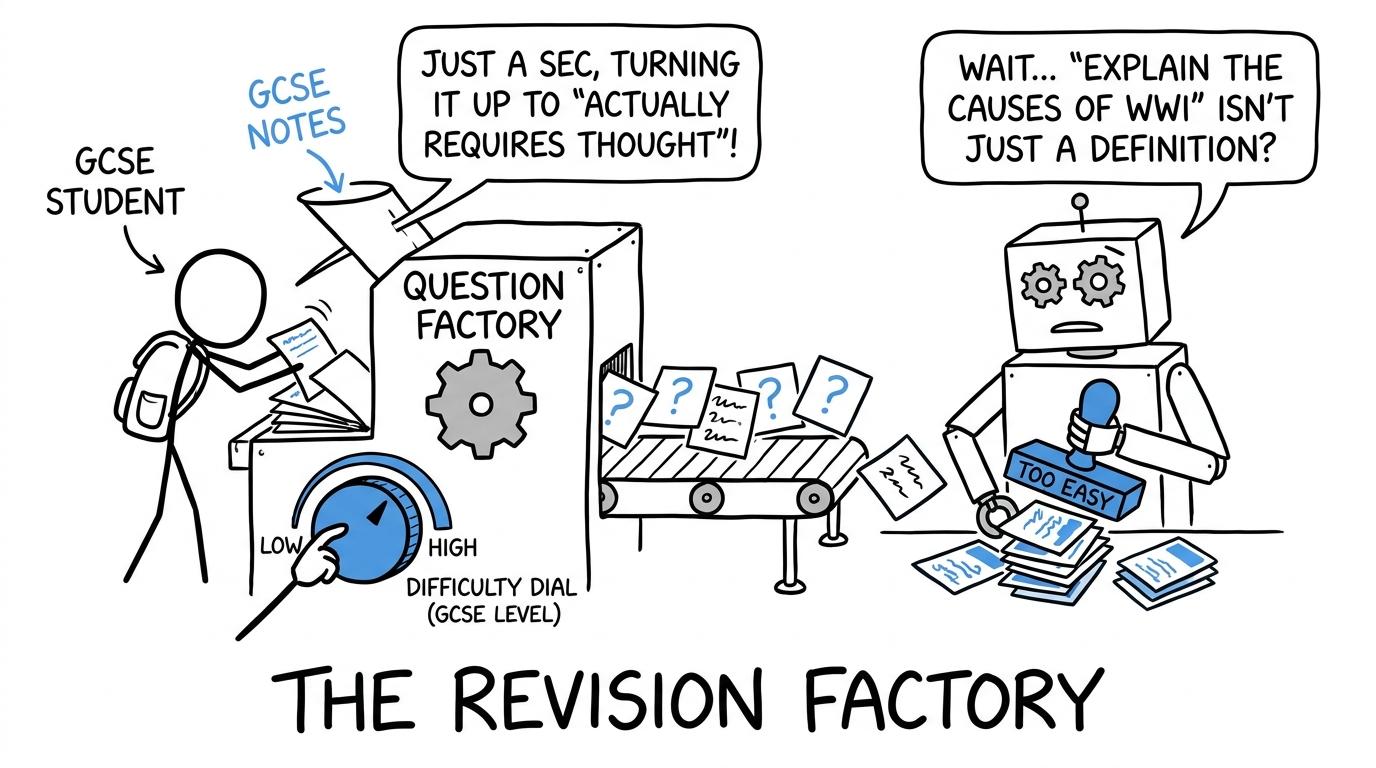 A student operates a question factory while a robot rejects questions that are too easy
How to make homemade questions exam-ready
A useful set should vary in both topic and demand. Include short factual prompts, questions requiring linked explanations and longer decisions based on a scenario. Your teacher and specification should guide the balance because qualifications do not all use identical command words or assessment models.
Multiple-choice questions can help check understanding, but writing plausible incorrect options is difficult. Weak alternatives make the answer obvious. If you cannot explain why every incorrect option is wrong, use a short-answer question instead.
After producing a small set, compare it with genuine assessment material. Look at:
- the command words used;
- how much context candidates receive;
- how narrowly the question is focused;
- what the mark scheme rewards;
- whether answers require knowledge, application or judgement.
For maths preparation, the GCSE maths revision hub provides board-specific revision material, practice papers, topic tests and flashcards. Students following Edexcel can also use Edexcel GCSE maths past papers with mark schemes and solutions. These resources show the standard that homemade questions should complement.
The best way to answer questions you wrote yourself
Do not answer them immediately. At that moment, you may remember the wording you just copied rather than the underlying idea.
Shuffle the order and return after a delay. Close the notes, remove the answer guide and write a complete response. Then mark it strictly. Classify each error as:
- missing knowledge;
- inaccurate terminology;
- weak application to the context;
- incomplete reasoning;
- misreading the command word.
Rewrite or replace questions that are ambiguous. Keep difficult questions in circulation and retire only those you can answer accurately on several separated occasions.
A revision schedule prevents this process from becoming random. The free MathsGenie revision planner can organise maths work around an exam date, while the same principle, plan, retrieve, check and revisit, can shape revision in other subjects.
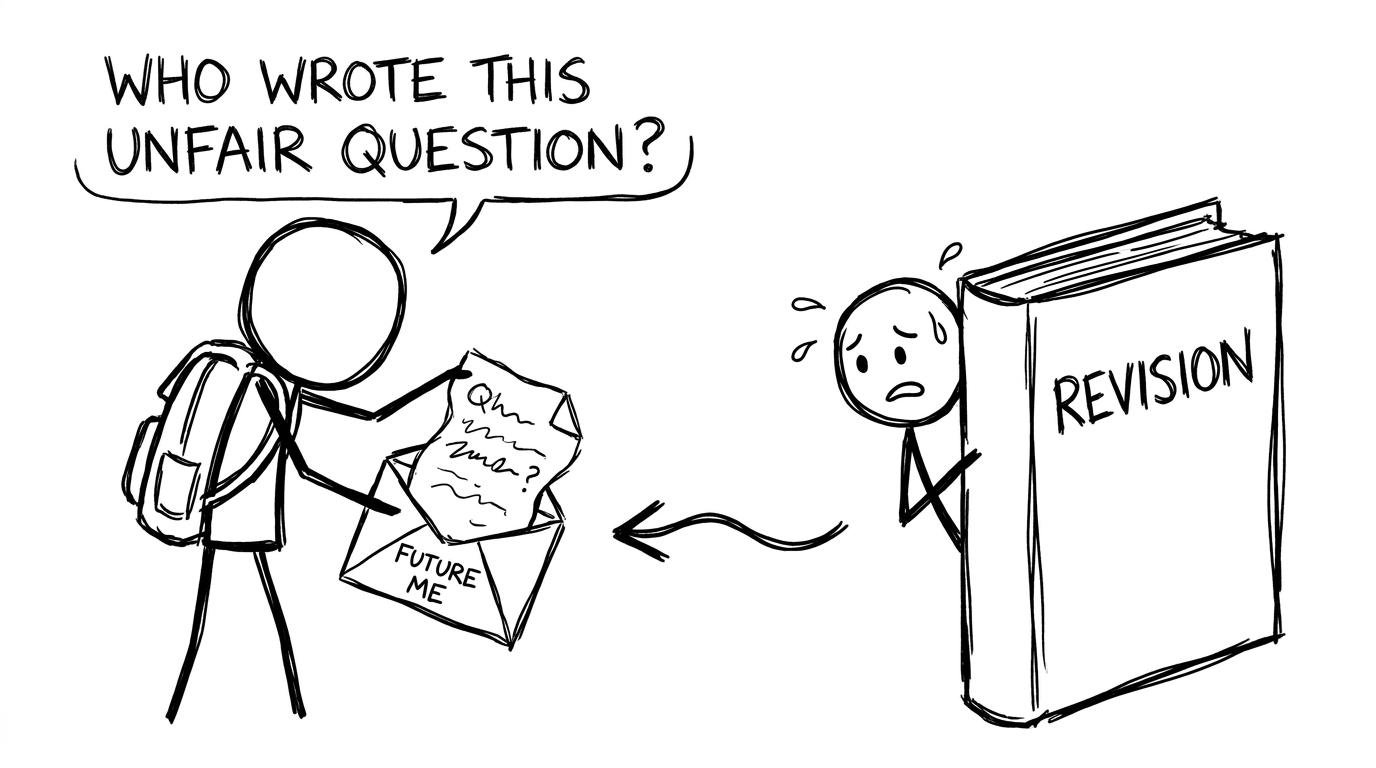 A student receives a difficult revision question from their suspicious past self
When making questions is not the best use of time
Question writing is a tool, not an obligation. It may be inefficient when an examination is very close, your notes are unreliable or you have not yet understood the topic.
In those cases, begin with a teacher explanation, specification-aligned lesson or reliable question set. Once the foundation is secure, create a few questions targeting the gaps that remain.
A useful balance is to use homemade questions for precise recall and personal weak spots, then use authentic papers for exam language, timing and broader coverage. The article on finding your weakest GCSE topics offers a practical model: diagnose, mark, group mistakes, practise and retest.
Common mistakes when making GCSE ICT practice questions
Copying notes without creating a test
A sentence with one word removed can become a guessing exercise. Ask for retrieval, explanation or application instead of preserving all the clues from the original page.
Writing only easy definition questions
Definitions matter, but they do not cover comparison, reasoning or judgement. Build variety gradually and follow the demands of your actual specification.
Inventing marks without understanding them
A homemade mark total can suggest false precision. Focus on the ingredients of a strong answer unless you have closely compared the task with official questions and teacher guidance.
Making the scenario irrelevant
Adding a company name does not automatically create application. The context must affect which advantage, risk or recommendation is most appropriate.
Learning from an inaccurate answer guide
Check each answer against your textbook, specification or teacher-approved materials. Never build a revision bank from unchecked notes or generated content.
Replacing proper papers with homemade questions
Your questions know what you have revised. A full paper can reveal what you forgot to revise. Both have value, but they do different jobs. Maths students can follow a structured one-month GCSE revision plan that combines retrieval, focused practice, mark schemes and timed papers.
Turn question writing into a better revision habit
Making your own questions is worthwhile when it changes your role. You stop being a collector of highlighted pages and become someone who decides what matters, retrieves it and checks it honestly.
Keep the system small. Choose one topic, write a balanced set, verify the answers and return to it after a gap. Then use proper exam materials to test whether that knowledge survives unfamiliar wording and time pressure.
For GCSE maths, MathsGenie gives that cycle a reliable structure. Start with free revision lessons, build accuracy through practice questions and mini tests, then use mark schemes, video solutions, past papers and predicted papers to expose the next gap. Visit the GCSE maths revision area, choose your exam board and turn what you know into marks you can reproduce under pressure.