Learning Styles GCSE Chemistry: Do They Matter?
Learning styles GCSE chemistry evidence explained, with a practical revision plan using retrieval, spacing, feedback, exam questions and stronger maths skills.
A revision method can feel right without working particularly well. Colour-coded notes may look reassuring. A video may feel easier than a page of calculations. Listening to a recording may make an awkward topic seem familiar. But familiarity is not the same as being able to retrieve, apply and explain knowledge in an exam.
So, do learning styles GCSE chemistry strategies actually improve results? The evidence does not support labelling yourself as a fixed visual, auditory or kinaesthetic learner and matching all revision to that label. Preferences are real, but matching instruction to a preferred sensory style has not been shown reliably to improve learning. A better approach is to choose methods that fit the chemistry content, then test whether you can recall and apply it.
The short answer: what should you do?
Use this checklist instead of building revision around a learning-style quiz:
- Treat visual, spoken and practical resources as tools, not identities.
- Retrieve information without looking at your notes.
- Space repeated practice across several days and weeks.
- Answer exam-style questions and check the mark scheme.
- Match the representation to the topic: diagrams for structures, graphs for rates and written explanations for chemical processes.
- Strengthen the maths behind concentrations, reacting masses, percentages and graphs.
- Monitor results and change methods when they are not producing accurate recall.
That final point matters. Effective revision is judged by what you can do later, not by how comfortable the session felt.
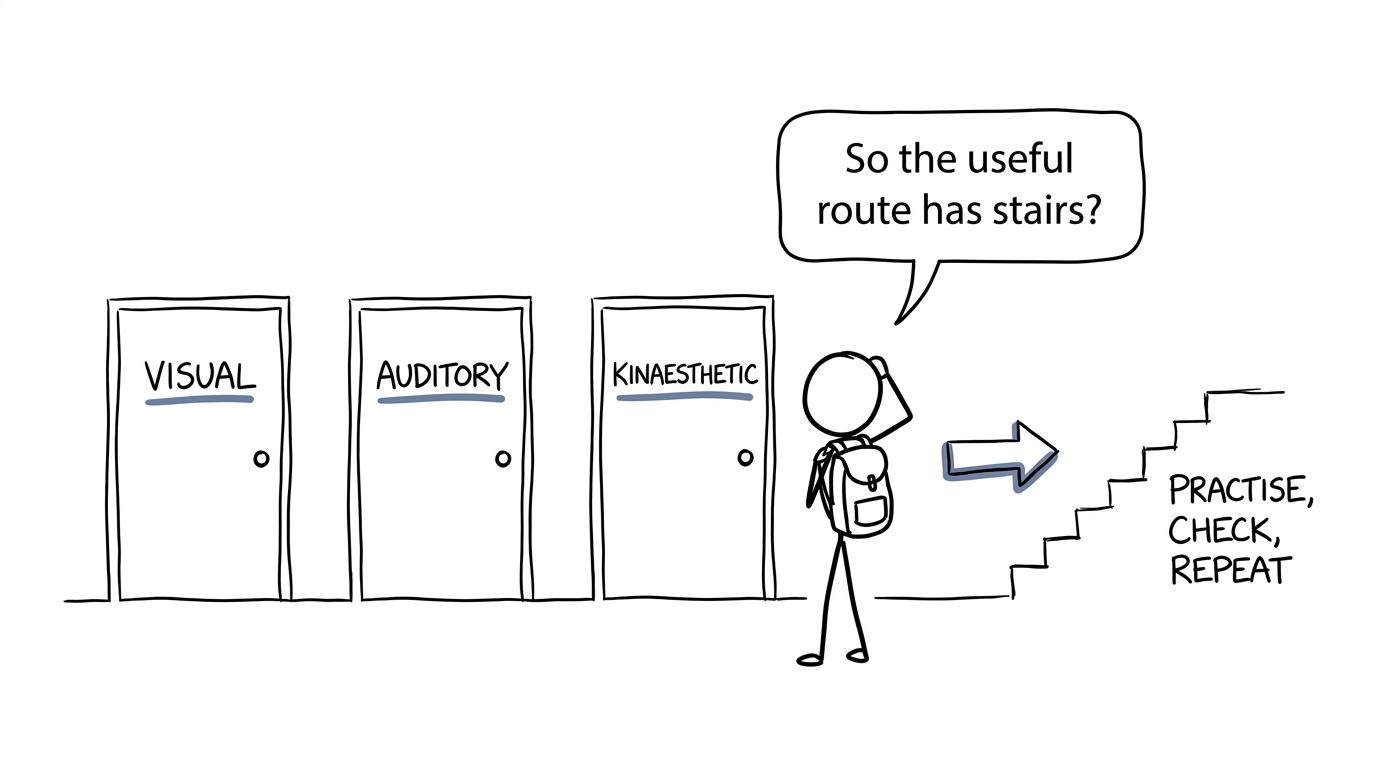 A student choosing between learning-style doors and a staircase marked practise, check and repeat
What does the learning styles idea claim?
The familiar version divides learners into categories such as visual, auditory and kinaesthetic. It then claims that a visual learner should mainly use diagrams, an auditory learner should mainly listen, and a kinaesthetic learner should learn through movement or practical activity.
This is sometimes called the matching or meshing hypothesis. To support it properly, research would need to show a crossover pattern: visual learners would learn better from visual instruction than auditory instruction, while auditory learners would show the opposite result under the same assessment conditions.
Reviews using this standard have generally failed to find reliable support for the claim. A recent meta-analysis did identify a small average benefit across the studies it combined, but results supporting the required crossover pattern were infrequent, study quality was limited and the authors concluded that the evidence did not justify widespread matching by learning style.
The sensible conclusion is not that pictures, explanations or practical experiences are useless. It is that students should not be boxed into one supposedly fixed channel.
Preferences are real, but they are not learning laws
You may genuinely prefer a video to a textbook. That preference can affect motivation and whether you begin revising at all. If a clear video gets you started, it has value.
The problem begins when preference becomes a restriction: “I am a visual learner, so written questions do not work for me.” GCSE Chemistry will still require you to interpret words, use data, complete calculations and construct precise explanations. Avoiding an uncomfortable format may mean avoiding the exact skill the exam assesses.
There is also a difference between enjoying a resource and learning from it. A polished animation can create a strong feeling of understanding because every step seems obvious while it is on screen. Close the video and the important question appears: can you now explain the process from memory or apply it to an unfamiliar question?
That is why MathsGenie combines explanations with active resources. An Edexcel student might begin with the Edexcel GCSE Chemistry revision hub, while an OCR student can select specification-matched material from the OCR GCSE Chemistry revision guides. The resource introduces the idea; retrieval and questions reveal whether it has been learned.
Match the method to the chemistry, not the student label
Different chemistry ideas are best represented in different ways. This is determined by the content, not by a personality category.
Use diagrams when relationships are spatial
Particle arrangements, apparatus, bonding and structural models often benefit from carefully labelled diagrams. A diagram can make relationships visible that would be cumbersome to describe in a paragraph.
But looking is only the opening move. Close the source, redraw the diagram from memory, label it and explain what each feature means. The retrieval attempt is doing much of the learning.
Use spoken explanations to expose weak reasoning
Explaining an idea aloud can reveal gaps hidden by silent rereading. If your explanation becomes vague at the crucial causal step, you have found something to repair.
This does not prove that you are an auditory learner. It shows that producing an explanation is a demanding form of retrieval. You can use the same principle by writing a concise answer and comparing it with a mark scheme.
Use practical activity for practical understanding
Experiments can clarify variables, measurements, hazards and sources of error. However, completing an experiment does not automatically produce exam-ready knowledge. You must still recall the method, justify choices and interpret results.
The OCR practical skills revision page brings together topic learning, questions and active-recall resources. Whatever your exam board, the broader principle remains: practical experience and examination practice perform different jobs, so you need both.
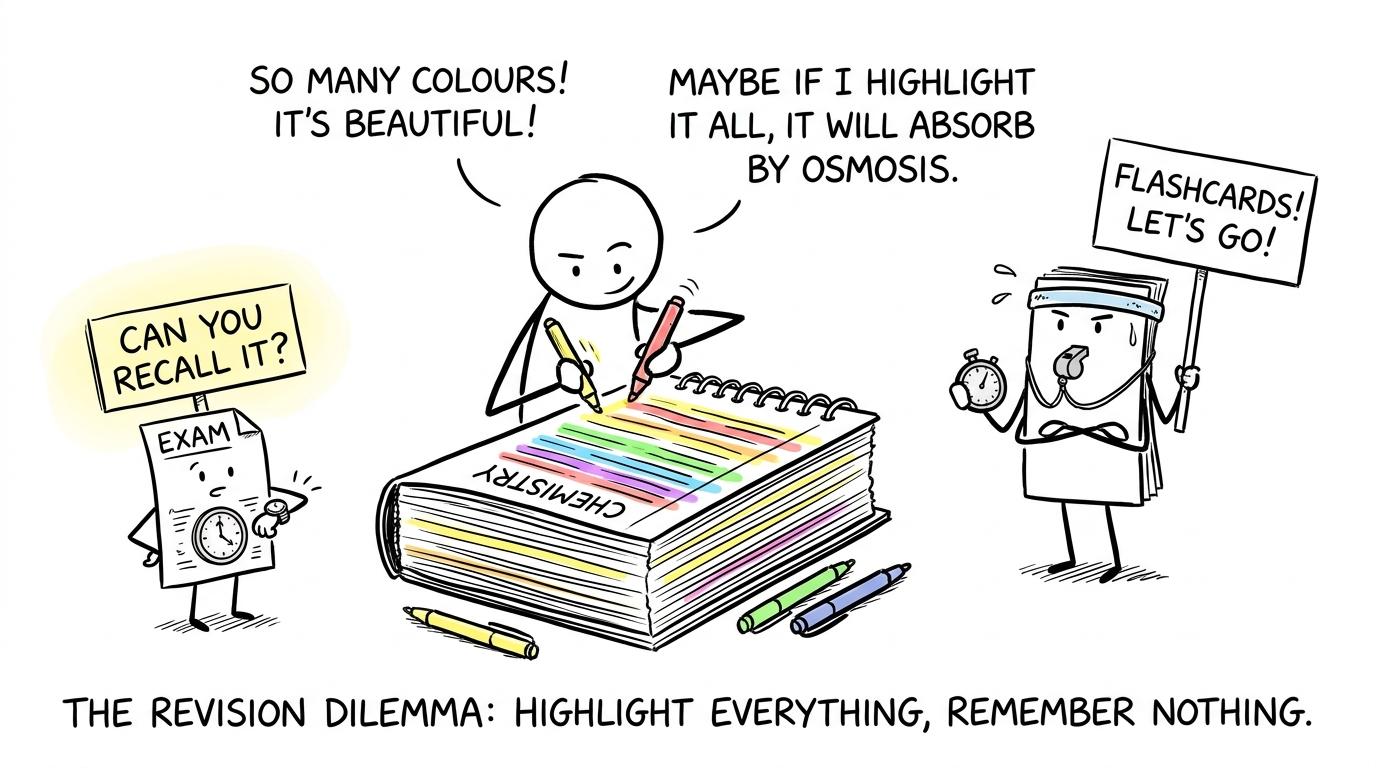 A colourful notebook being challenged by an exam paper asking whether the student can recall it
What works better than revising by learning style?
Retrieval practice
Retrieval means attempting to bring knowledge to mind without first looking at the answer. Flashcards, blank-page recall, low-stakes quizzes and exam questions can all create retrieval practice.
The attempt should be followed by feedback. Otherwise, an incorrect definition or method may be repeated. Check the answer, identify the missing detail and retrieve it again later.
For a focused routine, choose one small topic from a board-matched page such as the AQA GCSE Chemistry key ideas guide. Learn briefly, close the guide, write what you remember and then complete questions.
Spaced practice
Spacing means returning to material after a delay rather than putting the same total effort into one long session. The delay makes retrieval less comfortable, but that difficulty provides useful information about what has survived in memory.
A topic should therefore reappear across your revision plan. An early session might establish understanding; later sessions should demand recall, application and finally timed performance. MathsGenie's guidance on how to revise GCSE Chemistry without wasting time sets out a practical retrieve, check, repair and repeat cycle.
Exam questions and feedback
A student can know a definition but fail to recognise when it is needed. Exam questions bridge that gap because they require selection as well as recall.
Mark your answers strictly. Record whether each lost mark came from missing knowledge, weak application, imprecise language, a maths error or misreading the command word. That classification gives you a next action instead of a vague instruction to “revise more”.
Metacognition
Metacognition means planning, monitoring and evaluating your learning. Evidence reviews support teaching these processes alongside specific subject content rather than as detached thinking exercises.
In practical terms, ask three questions:
- Plan: What precise chemistry knowledge or skill am I revising?
- Monitor: Can I retrieve and use it without support?
- Evaluate: What does my marked work say I should do next?
This is more useful than asking whether a resource suits your learning style. It replaces identity with evidence.
Why maths students should care about chemistry revision methods
GCSE Chemistry is not only a memory test. Across current GCSE Chemistry specifications, at least 20%20\%20% of assessment marks must involve mathematical skills. Relevant skills include ratios, fractions, percentages, standard form, significant figures, algebra, graphs and rates of change.
That makes chemistry revision familiar territory for a maths student. Reading a calculation is not enough. You need to select a relationship, substitute accurately, manage units and judge whether the result is sensible.
Quantitative topics can be reviewed through the Edexcel quantitative analysis revision guides. If the chemistry is understood but algebra causes the error, repair the underlying skill with the changing the subject of a formula revision guide.
This is another reason not to rely on one preferred format. A concentration calculation may combine words, symbols, units and calculator work. Competence comes from moving between these representations, not selecting only the most comfortable one.
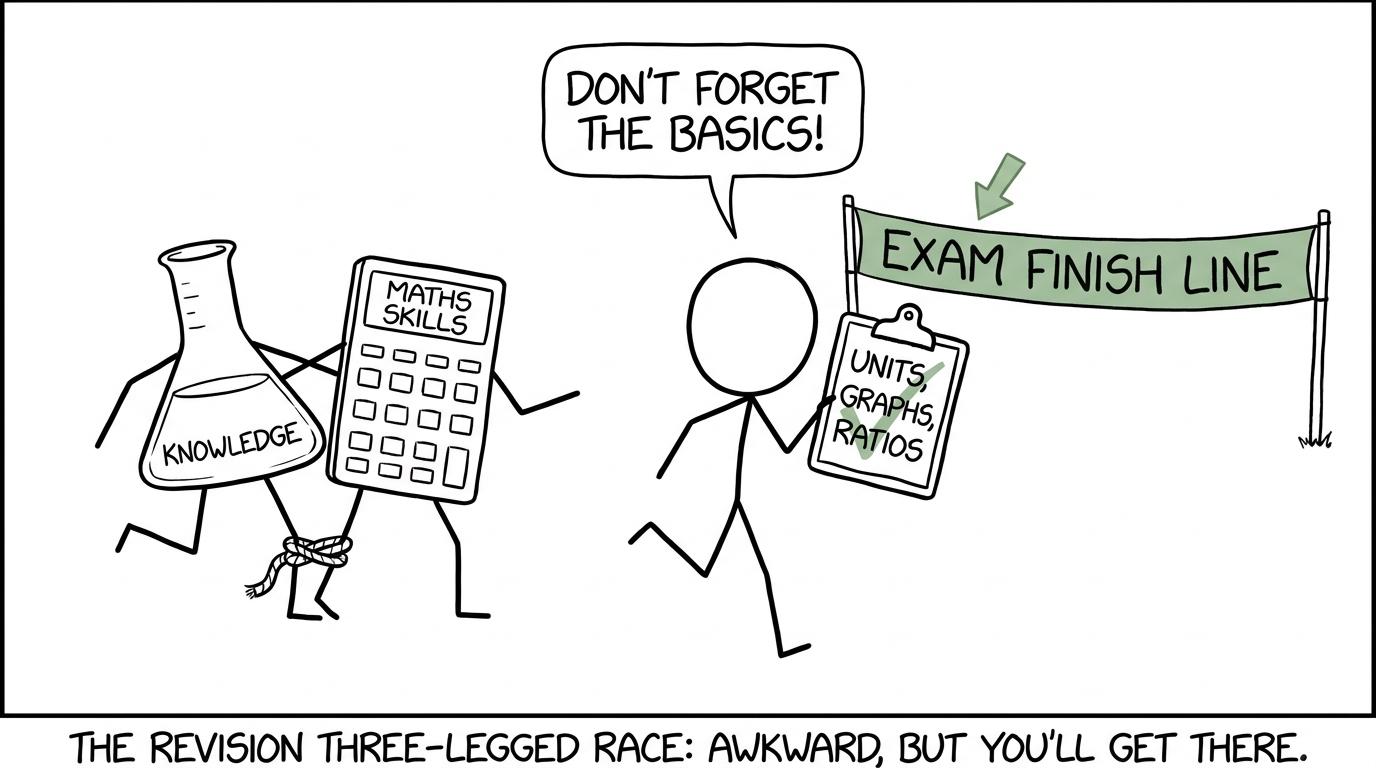 A chemistry beaker and calculator attempting a three-legged race towards an exam
A learning-style-free GCSE Chemistry revision routine
A productive session can be simple:
- Choose one specification-sized topic.
- Retrieve key facts or relationships before opening notes.
- Use a short lesson or guide to correct gaps.
- Complete relevant exam-style questions.
- Mark immediately and record the exact cause of each lost mark.
- Schedule another attempt after a delay.
Vary the resource only when the content or your performance gives you a reason. Use a diagram because it reveals structure. Use a spoken explanation because it tests causal reasoning. Use a practical demonstration because the method matters. Use written questions because that is how much of the examination evidence must be produced.
When full papers become appropriate, follow the same principle used in effective maths revision: attempt, mark, diagnose and repair. MathsGenie's guide to using AQA Chemistry past papers properly explains how to turn lost marks into specific follow-up tasks.
Common mistakes with learning styles and Chemistry revision
Turning a preference into a permanent identity
Saying “I prefer diagrams” is reasonable. Saying “I cannot learn from text” closes off an assessed skill before you have practised it.
Confusing recognition with recall
Rereading and highlighting make content look familiar. Test yourself with the book closed before deciding that a topic is secure.
Making beautiful resources without using them
A flashcard deck, mind map or set of notes is only preparation for revision. The learning comes when you retrieve, check and correct.
Choosing variety without purpose
Using many colours, videos and apps is not automatically effective. Every resource should have a clear job connected to the specification.
Ignoring the maths inside Chemistry
A weak answer may come from units, proportional reasoning, graphs or rearranging rather than chemistry knowledge. Keep a separate calculation-error list so you fix the true cause.
Revise for evidence, not a label
Learning preferences can make revision more inviting, but the evidence does not justify matching all GCSE Chemistry revision to a fixed learning style. Use multiple representations when they suit the content, then rely on retrieval, spacing, questions, feedback and honest monitoring to make knowledge durable.
MathsGenie gives you a free structure for that process: board-matched revision lessons and guides, active-recall resources, practice questions, mini tests, past papers, predicted papers, mark schemes and video solutions. Start with one weak Chemistry topic today, test yourself before looking at the answer, and use MathsGenie's maths resources to repair any calculation skill costing you marks.