Is GCSE Russian Harder Than Before?
GCSE Russian harder than before? See what changed, why the current exam can feel tougher and how to balance language revision with GCSE maths.
A difficult exam can create a strange illusion: it makes the past look easier than it was. Students hear about controlled assessment, old letter grades or shorter-looking papers and reasonably wonder whether GCSE Russian is harder than before.
The short answer is nuanced. The current Pearson Edexcel GCSE Russian is more demanding in some clearly identifiable ways than the qualification it replaced. Translation, questions in Russian, terminal assessment and equal weighting across all four language skills leave fewer places to hide. But that does not automatically mean it is harder to achieve a particular grade. Exam regulators use grade boundaries to account for differences in paper difficulty and maintain comparable standards over time.
For students also preparing for maths, the practical lesson matters more than the historical argument: understand the assessment in front of you, divide it into manageable skills and revise from evidence rather than anxiety.
The quick answer and revision checklist
Here is the clearest summary:
- The present Pearson Edexcel specification was first taught in September 201720172017 and first awarded in summer 201920192019.
- It uses grades 999 to 111 rather than the former A* to G scale.
- Listening, speaking, reading and writing each contribute 25%25\%25% of the qualification.
- Translation is assessed in both directions across the reading and writing papers.
- Some listening and reading questions are set in Russian.
- Students take either foundation or higher tier across all four assessments; tiers cannot be mixed.
- The assessments are completed in one exam series rather than collected gradually as separate components.
- The newer French, German and Spanish GCSE specifications first examined in 202620262026 do not automatically apply to Russian. Russian remains under the existing modern foreign languages subject content and its current Edexcel specification.
Before revising, confirm your specification, tier and exam arrangements with your school. Do not assume that your Russian exam board is the same as your maths exam board.
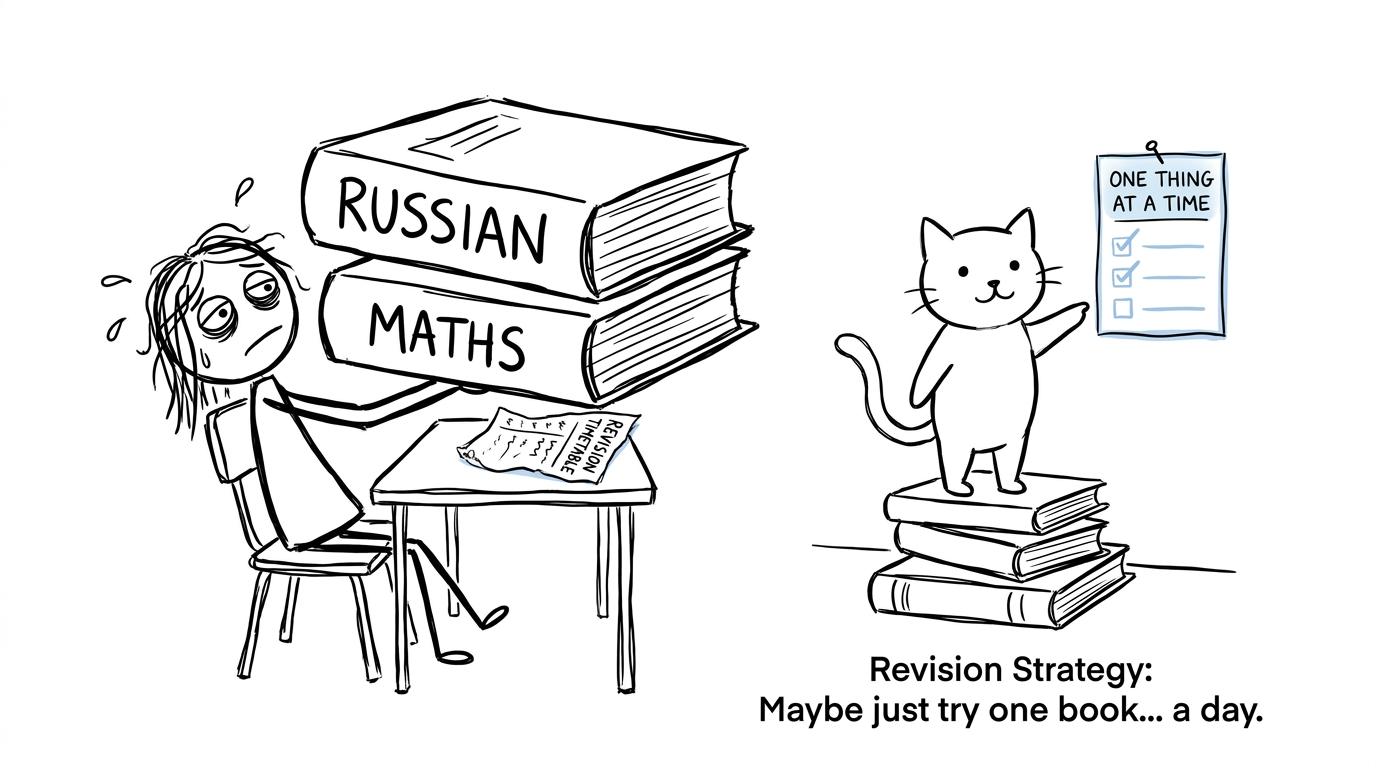 A student balances Russian and maths revision one task at a time
What genuinely changed in GCSE Russian?
Comparisons become useful only when we compare actual assessment requirements. The previous Edexcel Russian GCSE, introduced for teaching from 200920092009, also covered listening, speaking, reading and writing. However, the reform leading to the current qualification changed how those skills are tested and combined.
A linear course places more weight on the final series
The current GCSE is linear. Speaking takes place in the spring assessment window, while listening, reading and writing are taken in the summer of the same year. Students cannot keep a strong mark from one component and resit only another later; a resit means taking the qualification again.
That structure can feel harder because performance is concentrated into one period. Knowledge that seemed secure months earlier must remain available alongside every other GCSE subject.
This is also why a realistic timetable matters. If maths is competing for the same evenings, the MathsGenie GCSE revision timetable guide can help you protect regular maths sessions without letting one subject consume the whole week.
Every skill now has equal influence
The present qualification assigns 25%25\%25% to each of listening, speaking, reading and writing. That balance is easy to understand, but it is unforgiving of a neglected skill.
A student who enjoys conversation but avoids listening practice cannot rely on speaking to compensate completely. Equally, a confident reader still needs accurate written Russian and a prepared speaking performance. The course rewards range rather than one narrow strength.
Translation and Russian-language questions add cognitive demand
Pearson's guide to the reformed specification identified several important changes: short translations into and out of Russian, authentic reading material including adapted literary extracts, and some questions written in Russian in the listening and reading papers.
These features can make the exam feel harder even when the underlying topic is familiar. You may need to understand the source, interpret the question language and construct the required type of response at once. Translation also exposes gaps that recognition exercises can conceal: knowing roughly what a sentence means is different from expressing it accurately.
Speaking is externally assessed
The speaking test is conducted by a teacher at your centre using secure Pearson materials, recorded and externally assessed. It includes a role-play, a picture-based task and a conversation. Foundation candidates have a shorter assessment than higher candidates, but both tiers require preparation across multiple themes.
This can increase pressure because the result does not rest solely on ordinary classroom interaction. Yet the structure also makes revision more focused: role-play habits, picture description and sustained conversation can each be practised separately.
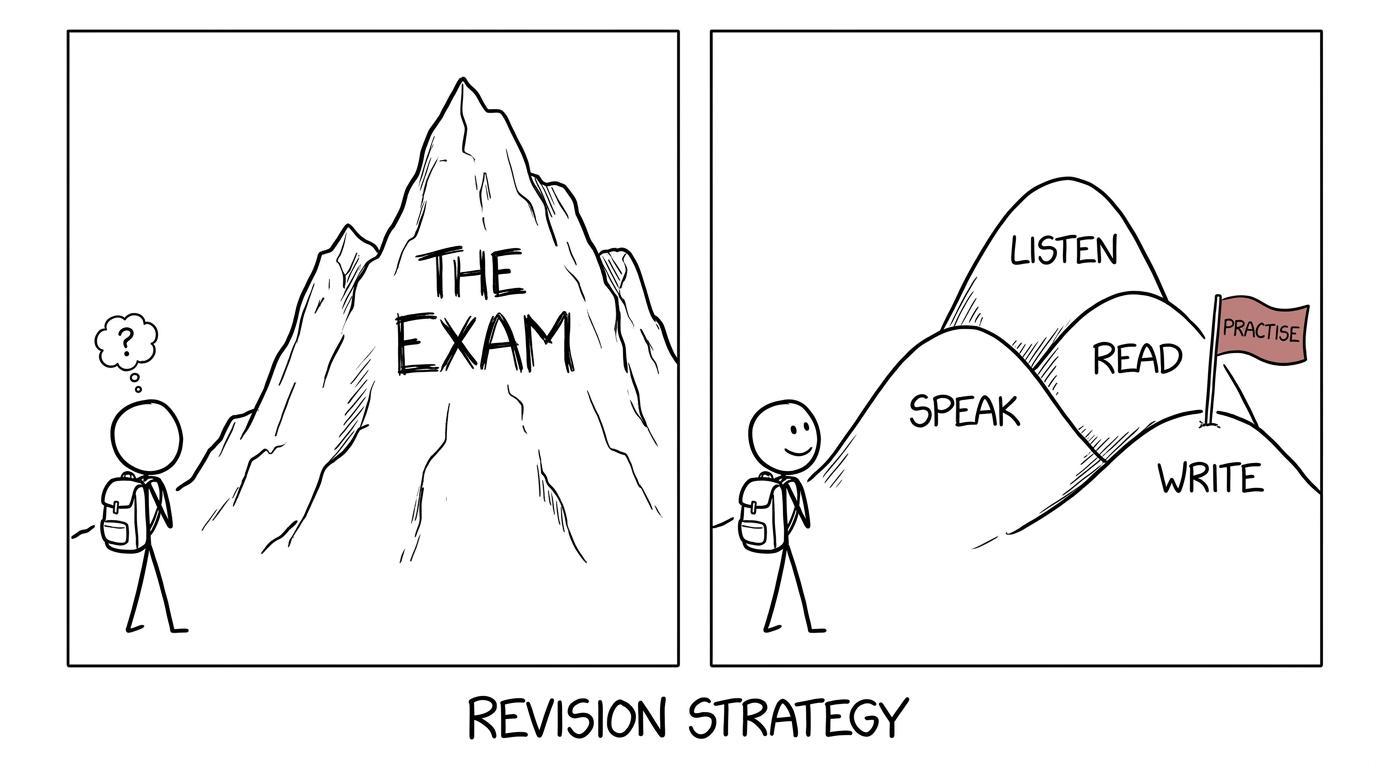 The Russian exam mountain becomes four manageable skill hills
Why GCSE Russian may only feel harder now
Some of the increased difficulty is real. Some comes from how students experience modern GCSE revision.
You see more of the assessment than previous students did
Past papers, mark schemes and online discussion make every demanding question visible. That is useful, but it can distort perspective. Students often compare their own unfinished preparation with a polished description of how somebody else remembers an older course.
Memory edits out uncertainty. Specifications do not.
The fairest comparison is therefore between official requirements, not comments such as “the old GCSE was easy”. The former qualification still tested four complex language skills. Russian grammar, unfamiliar listening and extended communication did not suddenly appear in 201920192019.
Raw grade boundaries are not fixed measures of difficulty
A higher boundary in one year does not prove that the subject became easier, just as a lower boundary does not prove that teaching declined. Boundaries are set after examiners have evidence about how a cohort performed and how demanding the papers were.
Ofqual's stated approach is that it should be comparably difficult to achieve a grade from one year to the next. If a paper proves more demanding, boundaries can be lower; if it proves more accessible, they can be higher. That adjustment is not perfect evidence that every student had an identical experience, but it prevents raw marks from being treated as permanent grade standards.
For revision, use boundaries only with the paper to which they belong. Never apply one year's boundary casually to a different paper.
Small cohorts can make comparisons look unusual
Russian is a smaller-entry GCSE than subjects such as maths. The background experience of candidates can vary considerably, including differences in home exposure to the language. Grade distributions therefore do not tell an individual student how difficult the qualification will be for them.
Your useful measures are more personal: vocabulary retrieval, listening accuracy, grammatical control, speaking fluency and performance on complete papers under the correct conditions.
Is the current GCSE harder to pass?
Not necessarily. “Harder paper” and “harder to achieve a grade” are different claims.
The present assessment may demand a broader and more explicit set of skills than the former course. Nevertheless, grading is intended to preserve standards between years. A challenging listening paper should not simply reduce everybody's grade because it happened to contain difficult extracts.
Tier choice remains important. Foundation provides access to grades 111 to 555, while higher is targeted at grades 444 to 999, with the regulatory possibility of a narrow grade 333 outcome when a candidate narrowly misses grade 444. Your school should select the tier that gives you the most appropriate route through all four papers.
Do not choose higher simply because it sounds more ambitious, or foundation because one practice paper went badly. Decisions should be based on repeated evidence across the complete assessment.
How to balance Russian with GCSE maths revision
Language improvement benefits from frequent recall. Maths improvement benefits from retrieving a method and then applying it. Both are weakened by passive rereading.
Use a simple weekly rhythm:
- Short recall: revisit Russian vocabulary and maths facts regularly.
- Focused practice: train one Russian skill or one maths topic at a time.
- Immediate marking: identify the exact reason each mark was lost.
- Delayed retesting: return to the weakness after a gap rather than assuming one correction has fixed it.
- Timed practice: move from isolated tasks to complete sections and papers.
For maths, begin at the free GCSE maths revision hub, where you can choose your exam board and work through revision lessons, exam questions, worksheets and papers. The principle is the same whether your maths board is Edexcel, AQA, OCR or Eduqas: match every resource to the correct specification and tier.
If exams are approaching, the one-month GCSE maths revision plan provides a structured balance of topic work and paper practice. The one-week maths revision plan is better suited to the final run-in, when priorities must be narrower.
Past papers should diagnose revision, not merely occupy time. The guide to when you should start GCSE past papers explains how to progress from short sets to full timed attempts. Mark schemes and video solutions then turn lost marks into a specific list of actions.
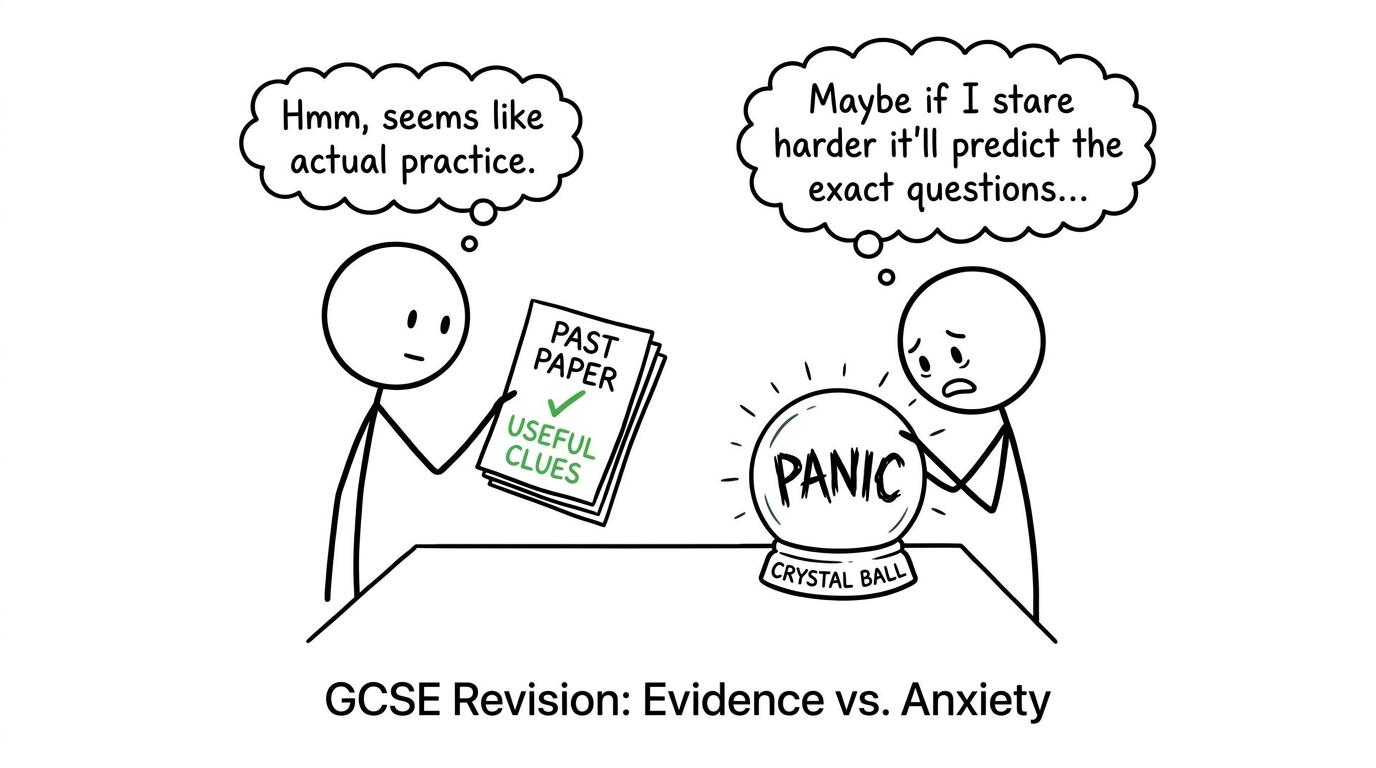 A marked past paper gives better clues than a panic crystal ball
Common mistakes when judging GCSE difficulty
Comparing specifications through hearsay
Comments from former students rarely identify their exact specification, tier or assessment route. Compare official documents and papers instead.
Treating one difficult paper as a trend
An awkward listening extract can make the whole qualification feel harder. One paper is evidence about that paper, not proof of a permanent rise in difficulty.
Comparing raw marks across different years
Grade boundaries move. A mark has meaning only alongside its paper, tier and official boundary.
Revising strengths because they feel reassuring
Repeatedly reading familiar vocabulary or completing comfortable maths topics creates fluency without exposing gaps. Use mini tests and mixed questions to find what actually needs work. Maths students can use the revision approach in how to revise Edexcel GCSE maths without wasting time, even if the wider learn-practise-mark-retest cycle is applied across subjects.
Letting Russian anxiety displace maths preparation
A speaking assessment may feel more immediate because it is personal and performed aloud. That does not make your maths papers less important. Keep both subjects in the timetable and reduce the task size when energy is low rather than abandoning one completely.
The fairest conclusion
GCSE Russian has genuinely become more demanding in certain structural respects compared with the qualification it replaced. The current course includes translation, Russian-language questions, equal weighting of four skills and terminal assessment across one series. Those are meaningful changes.
But it is too simplistic to conclude that students are now automatically less likely to achieve a good grade. Grade boundaries respond to paper demand, and some of the sense that the past was easier comes from selective memory, increased visibility of difficult questions and the pressure of taking several GCSEs together.
Focus on the current specification rather than an imagined older exam. For maths, make MathsGenie's free GCSE resources your starting point: use revision lessons to rebuild understanding, practice questions and mini tests to reveal gaps, past papers and mark schemes to improve exam technique, and predicted papers to add fresh practice near the exam. The aim is not to make every subject feel easy. It is to make the next action clear.