

Is GCSE Drama Harder Than Before? What Changed
GCSE drama harder than before? See what changed in assessment, why it feels tougher, and how maths students can balance rehearsals with exam revision well.
A subject can change without its name changing. Drama still involves scripts, rehearsals, performance and creative decisions, but the qualification beneath those familiar activities is not identical to the GCSE taken by earlier generations.
So, is GCSE drama harder than before? In one important sense, yes: the reformed qualification introduced for teaching from 2016, with first assessment in 2018, created a consistent written examination worth 40%40\%40% of the GCSE. Earlier specifications varied, with non-exam assessment accounting for between 60%60\%60% and 100%100\%100% of the marks. However, that does not mean Drama has become progressively harder every year. The present structure has been established for several exam cycles, and difficulty still depends heavily on a student's strengths, school and exam board.
For maths students, the practical issue is workload. Drama rehearsals happen at fixed times, while maths revision can quietly be postponed. Understanding the demands of both subjects makes that trade-off easier to manage.
The short answer and revision checklist
The fairest conclusion is that GCSE Drama has become more standardised and more explicitly academic, rather than simply harder in every respect.
Use this checklist to understand what that means:
- The current GCSE in England allocates 40%40\%40% of marks to examination and 60%60\%60% to non-exam assessment.
- Students are assessed on devising, live performance, theatrical knowledge, analysis and evaluation.
- There is no foundation or higher tier in Drama.
- The qualification uses grades 9-1.
- Exact components, set texts and examination timings depend on the exam board.
- Practical talent alone is not enough; students must explain and evaluate theatrical choices.
- Comparisons with older GCSE results cannot, by themselves, prove that the subject is harder.
That final point matters. A qualification can feel more demanding because its assessment has changed, even when awarding arrangements are intended to maintain standards between years.
What genuinely changed in GCSE Drama?
The current framework was part of the wider reform of GCSE qualifications in England. It applies common assessment requirements while allowing AQA, Edexcel, OCR and Eduqas to organise their components differently.
| Area | Earlier GCSE specifications | Current GCSE Drama |
|---|---|---|
| Written assessment | Varied between specifications | 40%40\%40% examination |
| Non-exam assessment | Usually between 60%60\%60% and 100%100\%100% | 60%60\%60% |
| Grading | A* to G | Grades 9-1 |
| Assessment objectives | Varied under previous rules | Four common objectives |
| Tiering | Not tiered | Not tiered |
The change was not equally dramatic for everyone. Some older specifications already used a balance close to the current 60%60\%60% practical and 40%40\%40% examined model. Students following specifications with very high levels of coursework or practical assessment experienced a larger shift.
The written examination carries real weight
The most visible change is the guaranteed 40%40\%40% written examination. Depending on the board, students may need to write about a set text, theatrical roles, staging, design decisions and a live production.
For example, the current AQA course includes a written paper lasting 111 hour 454545 minutes and worth 40%40\%40% of the qualification. Edexcel also assigns 40%40\%40% to its written component, although its component structure and question format differ. Students should therefore revise from their own specification rather than assuming every board works like a friend's course.
This written emphasis can make Drama feel closer to English literature than students expect. Knowing what happened in a play is not sufficient. Strong answers connect precise theatrical choices to meaning and audience response.
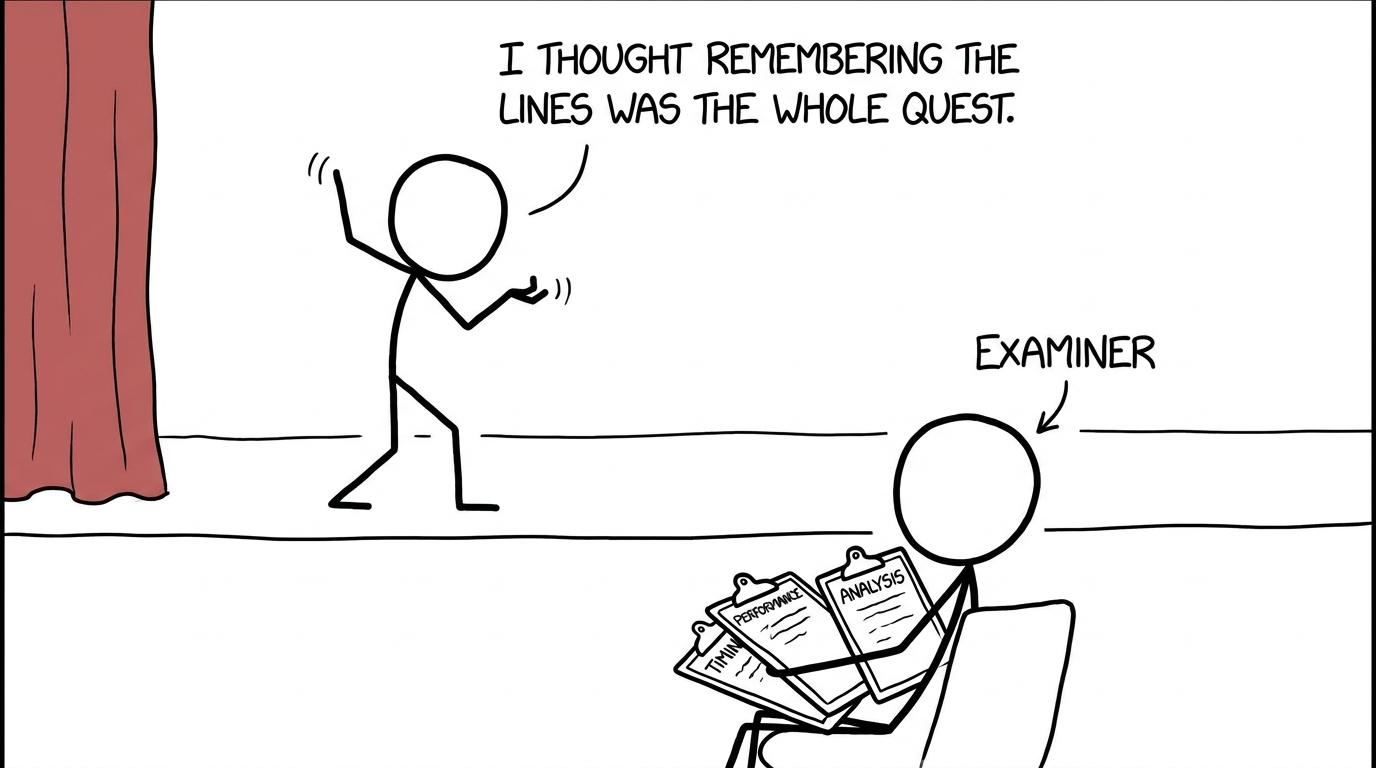 A GCSE actor discovers that performance is only part of the assessment
The assessment objectives reward several kinds of skill
Current GCSE Drama assessment in England is built around four objectives:
- AO1: creating and developing theatrical ideas, worth 20%20\%20%;
- AO2: applying theatrical skills in live performance, worth 30%30\%30%;
- AO3: demonstrating knowledge and understanding, worth 30%30\%30%;
- AO4: analysing and evaluating work, worth 20%20\%20%.
This distribution explains why an excellent performer may not automatically receive the highest grade. Half of the qualification is attached to knowledge, analysis and evaluation through AO3 and AO4. Equally, a confident writer cannot ignore the practical demands represented by AO1 and AO2.
The course asks students to move repeatedly between doing, observing and explaining. That breadth is one genuine source of difficulty.
Why GCSE Drama may feel harder than it is
Difficulty is partly about the specification and partly about how work is experienced. A maths worksheet has a visible beginning and end. A rehearsal may occupy an afternoon but still leave unresolved decisions about movement, interpretation or design.
Group work reduces your control
Drama contains collaboration in a way that most GCSE examinations do not. Your preparation can be affected by attendance, rehearsal space and the readiness of other performers. Assessment remains focused on individual contribution, but the process leading to that contribution is shared.
This creates uncertainty. Students often interpret uncertainty as difficulty because progress is harder to measure.
Practical work can hide written workload
Rehearsing feels like the centre of the course, yet devising records, analysis, set-text knowledge and live-theatre evaluation also demand attention. A student may spend many hours performing and still discover that the weakest area is written precision.
The solution is not to write more for its own sake. It is to use the assessment language accurately: identify a choice, describe how it was realised, explain its intended meaning and evaluate its effect.
Drama and maths require different mental gears
Maths often rewards a chain of logical steps. Drama requires interpretation, judgement and evidence from an evolving process. Switching between them can be tiring, especially when deadlines converge.
That does not make the combination unmanageable. It means your revision plan must protect both kinds of work. MathsGenie's GCSE maths revision timetable guide can help you reserve focused maths sessions around rehearsals instead of hoping spare time appears.
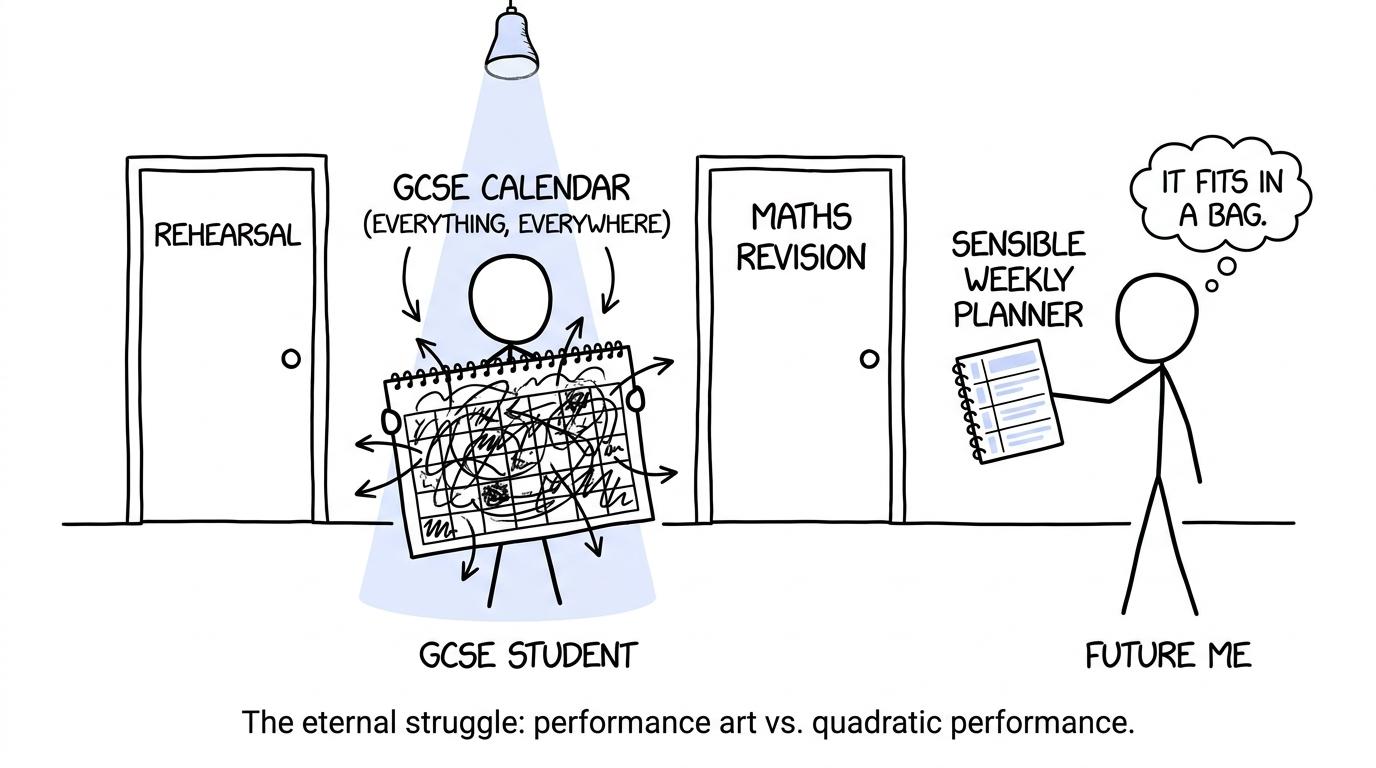 A student tries to balance rehearsals and maths revision
Does a fall in entries prove Drama is harder?
No. National data show that GCSE Drama entries have declined substantially since the middle of the 2010s, but entry numbers do not isolate qualification difficulty.
Students' options are influenced by school timetables, staffing, accountability measures, access to facilities and which subjects a school offers. A smaller cohort may also differ from an earlier cohort. Comparing raw grade percentages without considering those changes can therefore be misleading.
Nor should one unusually generous or severe-looking set of grade boundaries be treated as proof. Boundaries can change when papers differ in demand. The more defensible conclusion comes from the specification itself: Drama now guarantees a substantial examined element and explicitly assesses knowledge, analysis and evaluation. Those are real changes. They do not establish that every modern student faces a harder route than every student under an older specification.
How to balance Drama with GCSE maths revision
The danger is rarely one long rehearsal. It is the repeated loss of small maths sessions until several topics become unfamiliar.
A calmer approach is to give each subject a different kind of slot:
- Put rehearsals and performance deadlines into your calendar first because their timing is often fixed.
- Add short, protected maths sessions around them.
- Choose one maths topic before each session begins.
- Finish with questions and marking, not passive rereading.
- Use a longer weekend session for timed papers when rehearsals allow.
If exams are approaching, the one-month GCSE maths revision plan provides a practical weekly structure. Start paper practice early enough to learn from it; the guide to when you should begin GCSE past papers explains how topic work and timed papers can fit together.
Maths revision is particularly suitable for measurable sessions. Complete a small set, mark it and record the exact reason for each lost mark. MathsGenie's Edexcel GCSE Maths predicted papers can add fresh practice near the examination, while predicted papers should support rather than replace official past papers.
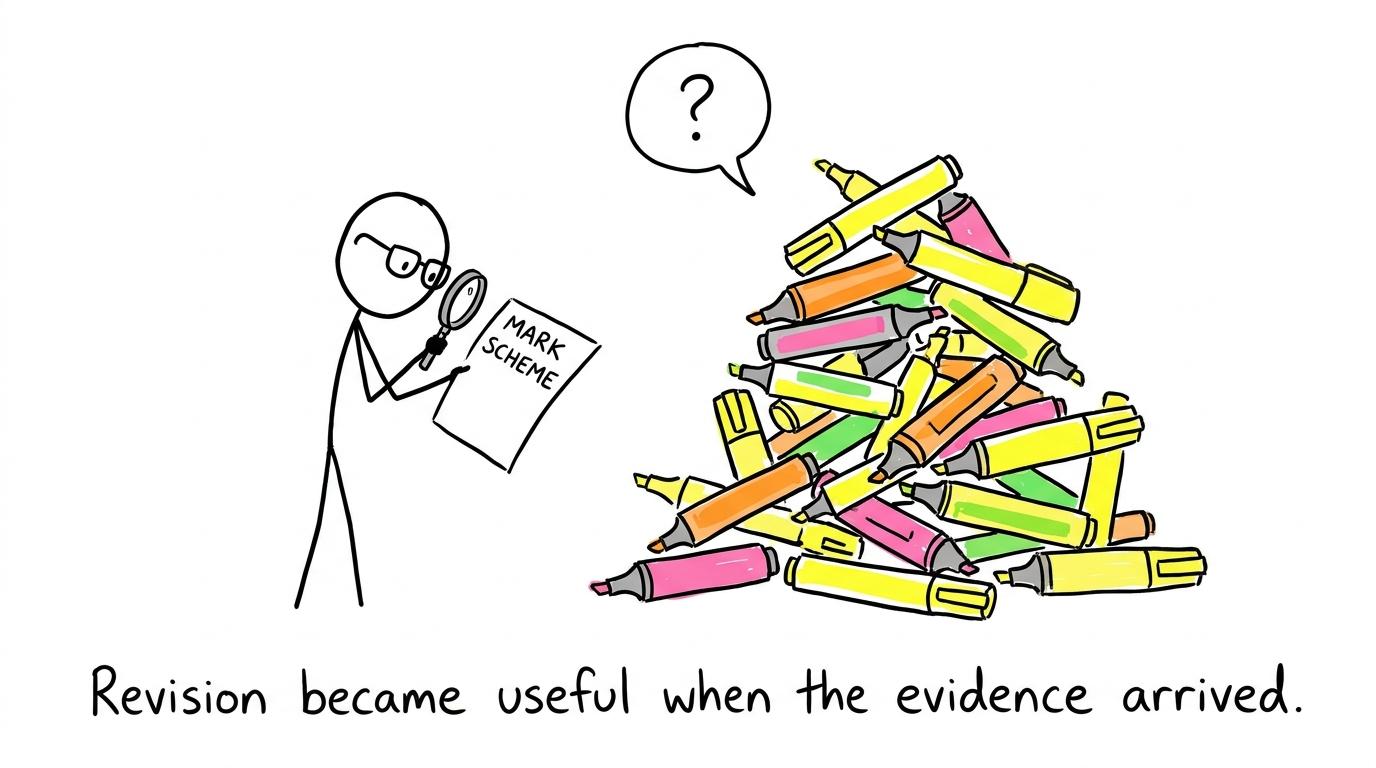 A student chooses evidence from a mark scheme over decorative highlighting
Common mistakes when judging or revising the course
Assuming Drama is an easy practical subject
Performance is central, but it is not the whole qualification. Written knowledge, theatrical terminology, analysis and evaluation account for substantial marks.
Comparing different exam boards directly
The national weighting is shared, but component names, set texts, timings and task details vary. Always check the specification and materials provided by your school.
Treating busyness as effective revision
Long rehearsals may be necessary, but hours alone do not reveal which assessment objective improved. The same applies to maths: completing a paper without reviewing the mark scheme leaves much of its value unused.
Letting one subject consume every evening
A looming performance can make maths feel postponable. Protecting even a short, focused session is better than allowing a complete break in retrieval and practice. If time is very tight, use the GCSE maths night-before plan to prioritise sensible preparation rather than panic.
Revising only predicted content
Predictions can focus final practice, but no prediction guarantees what will appear. The same principle applies across subjects. MathsGenie's guide to predicted GCSE topics shows how to use predictions without narrowing revision recklessly.
The verdict: changed, broader, but not endlessly harder
GCSE Drama is more explicitly balanced between practical creation and academic explanation than some older versions of the course. The fixed 40%40\%40% examination, common assessment objectives and demand for precise evaluation can make it genuinely harder for students expecting performance alone.
But the qualification has not simply become tougher year after year. The present framework dates from the reforms first assessed in 2018, and older specifications were not all equally easy. For many students, the feeling of difficulty comes from breadth, collaboration and competing deadlines as much as from the standard of the work.
The useful response is not to argue with the label. It is to make each demand visible. Check your Drama specification, separate practical and written preparation, and protect regular maths practice around rehearsals.
Start at MathsGenie's free GCSE and A Level maths revision hub. Use revision lessons and practice questions to repair individual topics, mini tests to check recall, and past papers, predicted papers, mark schemes and video solutions to build examination confidence. Drama may ask you to manage the stage. MathsGenie helps you manage the marks waiting beyond it.










