How to Revise Maths If You Hate Maths
How to revise maths if you hate maths: follow a calm routine of short sessions, targeted questions and review for GCSE or A Level exams more calmly.

A student sits at the kitchen table. The maths book is open, but the phone is more interesting. A parent offers encouragement, which somehow makes the book feel heavier. Both are thinking the same thing: how can revision work when the subject itself creates resistance?
If you are wondering how to revise maths if you hate maths, the direct answer is this: stop trying to enjoy long revision sessions and build a short, repeatable routine instead. Choose one weak topic, learn only what you need, answer questions without notes, mark them, and revisit your mistakes a few days later.
You do not need to love maths. You need a method that reduces the number of decisions, gives you visible evidence of progress and is manageable even on an unenthusiastic day.
The short version: your practical checklist
Use this routine for GCSE or A Level maths revision:
- Schedule short, specific sessions rather than vague blocks labelled “maths”.
- Start with a manageable topic, not necessarily the hardest topic in the course.
- Review a lesson or video briefly, then answer questions yourself.
- Mark every attempt and record the reason for each mistake.
- Revisit incorrect questions after a gap.
- Mix familiar and less familiar topics as exams approach.
- Use full past papers once you have repaired important topic gaps.
- Adjust the plan according to your results, not your mood.
For the wider structure, the GCSE maths revision timetable guide explains how to fit maths around other subjects. If you are unsure about workload, read how many hours to revise for GCSE rather than guessing at an unrealistic target.
Why hating maths makes revision feel harder
Disliking maths is rarely just a preference. It may be connected to confusion, previous low marks, fear of being wrong or the feeling that everyone else understands more quickly.
That creates a loop. You expect the session to be unpleasant, so you delay starting. The delay leaves less time to improve, and the next difficult question appears to confirm that maths is simply something you cannot do.
The useful response is not forced positivity. It is reducing the size of the next step.
Instead of writing “revise algebra” on a timetable, write “watch one lesson on factorising, answer six questions and mark them”. The second instruction has a finish line. A clear task is easier to begin than a subject.
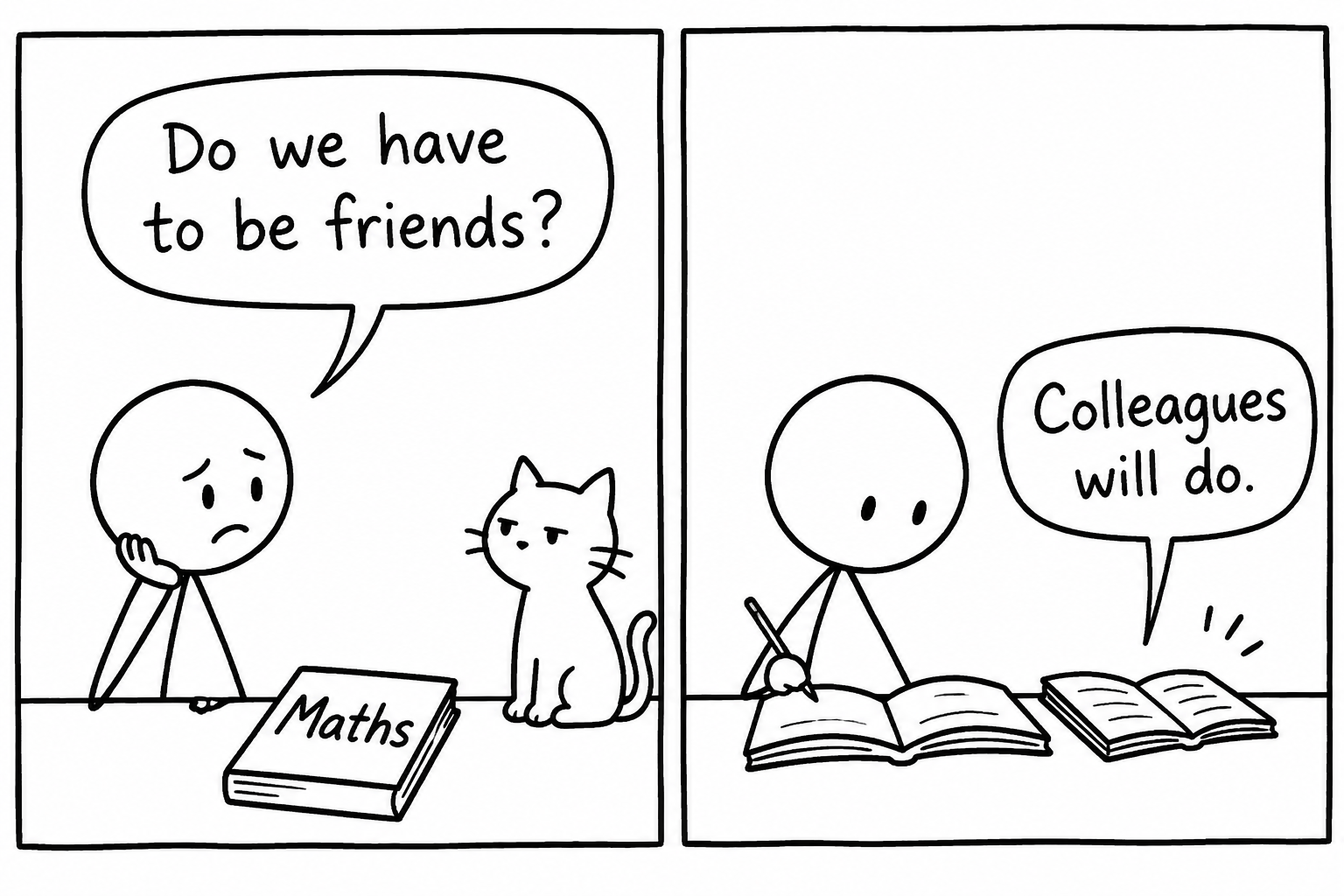 A student negotiates a professional working relationship with a maths book
You are not asking maths to become your favourite subject. You are asking it to become a task you can complete.
Use a revision cycle that works on bad days
A useful study technique has four stages: diagnose, learn, practise and return.
Diagnose one small gap
Begin with a mini test, a set of mixed questions or part of a past paper. Do not use the result to judge your intelligence. Use it to locate the next useful piece of work.
Sort each mistake into one of three categories:
- Knowledge gap: you did not know the rule, fact or method.
- Application gap: you knew the method but did not recognise when to use it.
- Accuracy gap: the method was suitable, but arithmetic, notation or copying caused the error.
These need different responses. A knowledge gap needs explanation. An application gap needs varied exam questions. An accuracy gap needs slower checking and a written trail of working.
MathsGenie's GCSE maths revision hub provides topic resources, past papers and mark schemes organised for revision. A Level students can apply the same diagnose-and-repair process to their own specification topics.
Learn only what the next questions require
Watching an hour of videos can feel productive because nothing is testing you. But recognition is not the same as recall.
Use a revision lesson or video solution briefly. Pause before each important step and try to predict what comes next. Then close the explanation and write the method from memory in your own words.
The aim is not beautiful notes. It is being able to begin a question when the explanation is no longer visible.
Practise without notes
Answer a small set of questions independently. If you get stuck, give yourself a genuine attempt before returning to the lesson. Even an incomplete attempt reveals where your thinking stopped.
Then mark the work immediately. Mark schemes are not only for counting marks. They show the precision examiners expect, including necessary working, notation and conclusions.
Return after a gap
A question answered correctly once is encouraging, but it is not yet secure. Return to the topic several days later and try a fresh question without warming up first.
This combines retrieval practice with spaced practice. In plain terms, you bring the method back from memory and revisit it over time. That is more informative than repeatedly copying a solution while it still feels familiar.
You now have the method; if setting up every topic and return session feels like another burden, build your schedule in the Revision Planner so the work has a clear place before motivation disappears.
A weekly rhythm for students who avoid maths
Consistency matters more than producing one heroic evening followed by several days of avoidance. A workable week might contain:
- one diagnostic session to identify a weak area;
- two short topic sessions using lessons and practice questions;
- one return session covering previous mistakes;
- one mixed or timed session when appropriate.
Sessions can be modest. What matters is that each one has a named topic and an output, such as completed questions, corrected errors or a marked mini test.
If exams are close, the balance should gradually shift towards mixed questions and timed papers. The guide to when to start GCSE past papers explains why topic practice and full papers serve different purposes.
Students working within a tight timeframe can adapt the one-week GCSE maths revision plan. With more time available, the one-month maths revision plan provides a broader structure. These are frameworks, not punishments. Reduce the volume if the plan cannot survive school, college, sleep and other subjects.
What parents can do without increasing the pressure
A parent cannot remove every difficult feeling about maths, but they can make the routine easier to follow.
Ask practical questions rather than repeatedly asking whether revision has been done. “Which topic is scheduled today?” or “Do you need quiet while you mark that paper?” is more useful than “Why are you not revising?”
Praise behaviours the student controls: starting on time, showing working, correcting an error and returning to a weak topic. Avoid turning every mark into a prediction of the final grade. One difficult set of questions is evidence about what to practise next, not a verdict.
It also helps to agree when a session ends. A student who knows they are completing a defined task is less likely to experience revision as an evening with no boundary.
Common mistakes when revising a subject you dislike
Waiting to feel motivated
Motivation often follows action rather than preceding it. Make the opening task extremely small: open the correct page, write the date and attempt the first question.
Revising only comfortable topics
Familiar questions create reassuring marks but can hide specification gaps. Keep some secure topics for confidence, while giving most attention to weaknesses that are relevant to your tier or course.
Starting with the hardest possible topic
Beginning with the worst topic can reinforce avoidance. Build momentum with a manageable weakness, then move towards more demanding material.
Watching instead of doing
Videos and revision lessons explain methods, but questions reveal whether you can use them. Most of a maths session should eventually involve writing, calculating, reasoning and checking.
Completing papers without reviewing them
A marked paper becomes valuable when it changes the next week of revision. Record recurring errors and return to the relevant topic. Otherwise, another paper may simply reproduce the same mistakes.
Making an impressive timetable you cannot follow
A crowded colour-coded plan can fail after one busy day. Effective revision planning includes spare time and can be adjusted after missed sessions. For additional guidance, see how many hours to revise each day for GCSE.
Make maths manageable from here
The student at the kitchen table does not need a new personality. They need fewer decisions, shorter tasks and a routine that turns mistakes into the next piece of revision. Knowing that plan helps, but following it across several busy weeks is the real gap.
Exams have fixed dates, and each unplanned week reduces the time available to revisit weak topics. Build your schedule in the MathsGenie Revision Planner and give your next maths session a clear purpose.