How Many Hours Should You Revise a Day for GCSE?
GCSE revision hours explained: how long to revise each day, what to do in that time, and a maths-first plan using YesGenie past papers and lessons.

If you’ve ever sat down to revise and thought, “How many hours should I do for GCSE?” you’re not being lazy; you’re being logical. Maths revision isn’t like filling a bucket where more hours automatically means more marks. It’s closer to training: the right sessions, at the right intensity, repeated often enough to change what you can do under pressure.
The uncomfortable truth is that two students can both “revise for three hours” and get completely different results. One does active practice, checks a mark scheme, fixes mistakes, sleeps, and comes back stronger. The other highlights notes until their brain feels busy, but their answers don’t improve.
This guide will help you choose a realistic number of hours for GCSE revision, then show you how to spend those hours so they actually count, especially for GCSE Maths, whether you’re on foundation or higher tier.
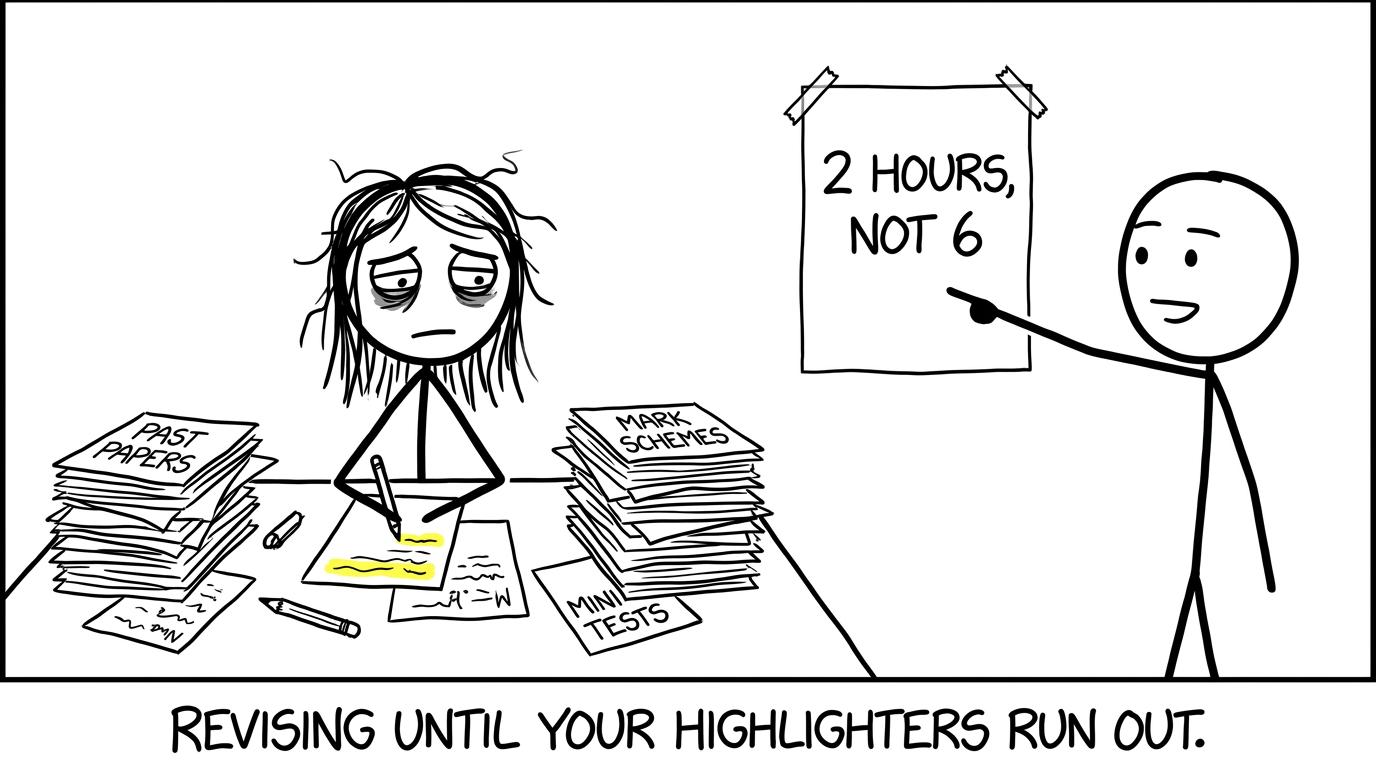 A student choosing 2 hours not 6
The GCSE revision hours checklist (what matters more than the number)
Before you decide on a daily target, check these first. They determine whether “1 hour” becomes powerful, or whether “4 hours” becomes noise.
- Consistency: 606060 minutes daily beats 555 hours on Sunday.
- Active practice: doing exam-style questions, not just reading.
- Feedback loop: using mark schemes and video solutions quickly.
- Spacing: revisiting topics across weeks, not cramming.
- Exam realism: timed papers, calculator/non-calculator practice.
YesGenie is built for this loop: lessons, topic practice, mini tests, and then full exam practice through Edexcel GCSE Maths Past Papers and Edexcel GCSE Maths Predicted Papers.
So, how many hours should you revise a day for GCSE?
Most students do best with a range, not a single perfect number. Your GCSE workload changes across the year, and your brain has limits (especially if you’re juggling multiple subjects, sport, and normal life).
A sensible daily range for GCSE students
- Year 10 (or early Year 11): 303030 to 909090 minutes per day.
- Mid Year 11 (a few months out): 111 to 2.52.52.5 hours per day.
- Final 6-8 weeks: 222 to 444 hours per day (total across subjects), with at least one lighter day each week.
For GCSE Maths specifically, many students see the biggest improvement from 454545 to 909090 minutes on most days, plus one longer paper session weekly.
Why “more hours” can backfire
When revision hours climb, quality often drops. You stop checking every line, you stop reflecting on errors, and you start collecting half-finished attempts. In maths, that’s costly because marks come from method, accuracy, and exam habits.
A better question than “How many hours?” is:
“How many high-quality question cycles can I complete today?”
A cycle is: attempt →\to→ mark →\to→ diagnose →\to→ fix →\to→ re-attempt.
Build your daily GCSE maths session (a simple 60-minute structure)
If you’re revising maths for GCSE, this structure keeps the session honest. It’s short enough to do most days, and strict enough to work.
Warm-up (10 minutes)
Pick one skill you want to stay fluent in: fractions, expanding, rearranging, standard form, etc. Keep it quick.
Good sources:
- Topic notes and examples from Edexcel GCSE Maths Revision Guides
Main practice (35 minutes)
Do exam-style questions (not just exercises). If you’re stuck, don’t spiral for 202020 minutes; check one hint, then continue.
You can also choose a single topic page if you’re plugging a gap, for example:
Feedback and repair (15 minutes)
Mark your work. Write down one sentence per mistake: what went wrong and what you’ll do next time. Then re-attempt one question properly.
If you’re doing papers, use a page with video walkthroughs like November 2020 Paper 2 - Video Solutions to close the loop quickly.
A worked example: planning your GCSE maths revision hours like a mathematician
When students ask about GCSE revision hours, they usually want certainty. Maths can’t promise certainty, but it can give you a plan with assumptions you can adjust.
Example goal: move from Grade 5 to Grade 7 in GCSE Maths
Assume:
- You have 888 weeks until your first GCSE Maths paper.
- You can revise maths 555 days per week.
- You can manage 757575 minutes per session.
Total focused maths time:
8×5×75=3000 minutes 8 \times 5 \times 75 = 3000 \text{ minutes} 8×5×75=3000 minutesConvert to hours:
3000÷60=50 hours 3000 \div 60 = 50 \text{ hours} 3000÷60=50 hoursThat’s not “revision for 505050 hours” in a vague way. That’s 404040 short sessions plus some paper practice, each with marking and repair.
Now make it real by splitting the 505050 hours:
- 60%60\%60% topic gaps: 0.6×50=300.6 \times 50 = 300.6×50=30 hours
- 40%40\%40% exam performance: 0.4×50=200.4 \times 50 = 200.4×50=20 hours
So your plan becomes:
- 303030 hours using revision guides and targeted practice
- 202020 hours doing timed papers and predicted papers, then fixing errors
This is why daily GCSE revision hours matter less than the distribution of effort.
How to scale your GCSE revision hours across the year
Your daily target should change as your confidence changes.
If you’re still building foundations
If higher tier content keeps collapsing into basic errors, keep hours modest and practise the basics until they’re automatic. A consistent 454545 minutes with full marking beats a shaky 222 hours.
Use one clear hub for your board so you don’t waste time bouncing between resources. For Edexcel, start at Edexcel GCSE Maths Revision.
If you’re already solid but need exam sharpness
At this point, more of your GCSE revision hours should go into timed papers. Use:
- Edexcel GCSE Maths Past Papers
- Edexcel GCSE Maths Predicted Papers
- The wider set of timed practice from Resources
And if you’re tempted to guess your grade from vibes, ground it using Edexcel GCSE Maths Grade Boundaries as a reality check.
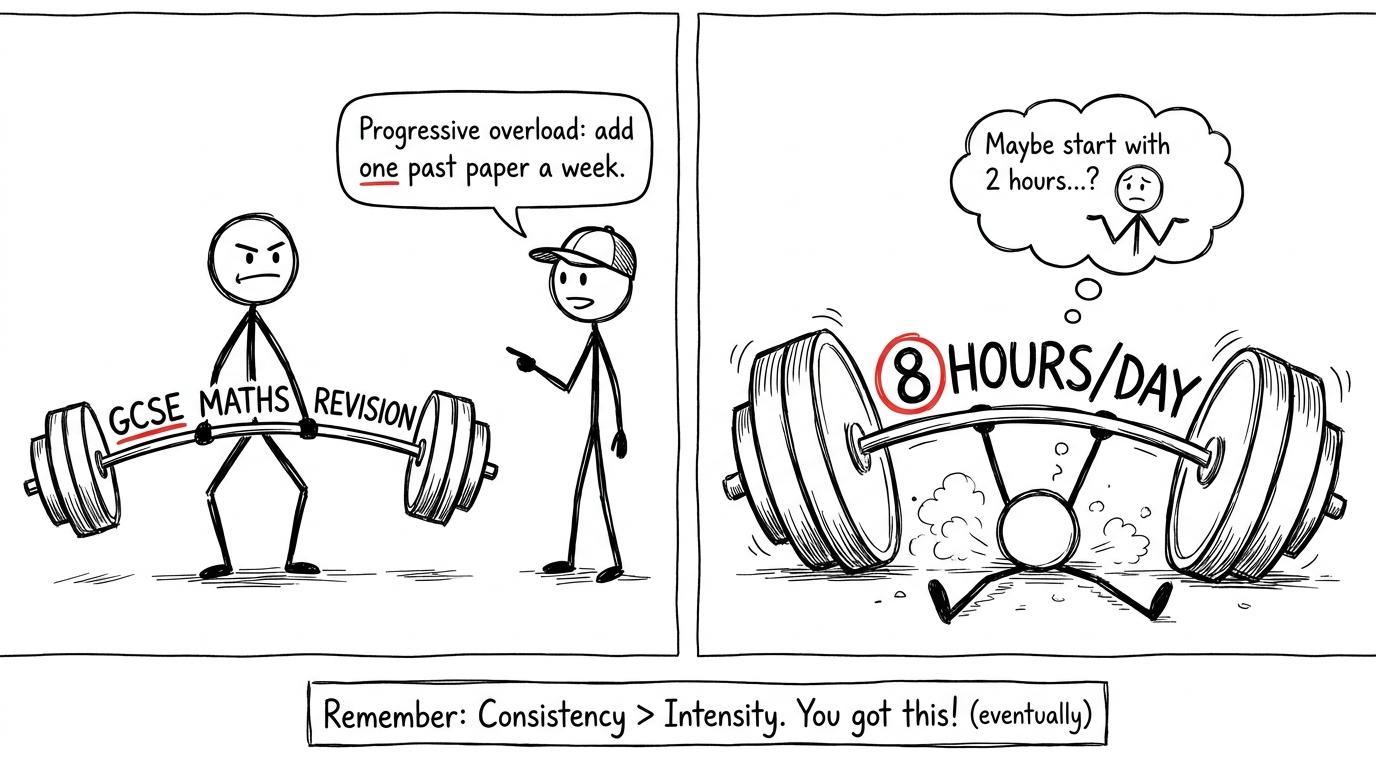 Progressive overload for revision
The 90-minute GCSE paper session (weekly routine that raises grades)
Once a week, do a paper session. This is where GCSE marks start to move because you practise stamina, time management, and decision-making.
Structure
- 60 minutes: do a timed section (or half a paper).
- 15 minutes: mark it carefully.
- 15 minutes: pick your top 333 errors and write corrected solutions.
If you have a full set of three papers, rotate: Paper 1 (non-calculator), then Papers 2 and 3 (calculator). Use video solutions to learn exam phrasing, not just answers.
Common mistakes when deciding GCSE revision hours
Thinking revision time is the same as revision progress
If you spend 222 hours and never mark your work, you’re collecting effort, not learning. GCSE Maths rewards corrected thinking.
Doing only “favourite topics”
Comfort creates the illusion of competence. Your daily GCSE plan should include at least one uncomfortable topic each week.
Cramming papers without repair
A past paper done once is a snapshot. A past paper done, marked, repaired, and re-attempted becomes training.
Revising until sleep collapses
Sleep is not a luxury add-on; it’s how your brain consolidates skills. If revision hours steal sleep, your accuracy drops and silly errors rise.
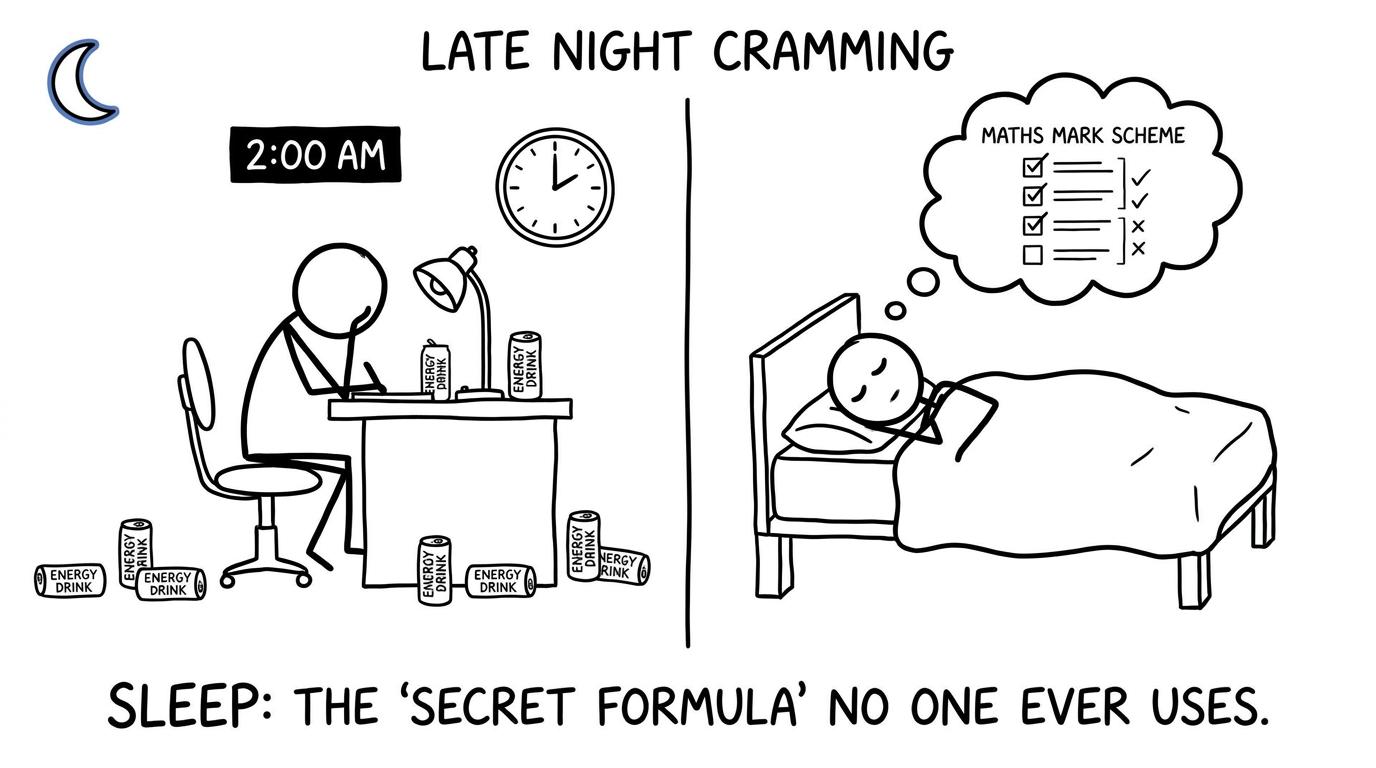 Sleep as the secret formula
A calm answer: the right GCSE revision hours are the ones you can repeat
If you take nothing else from this: GCSE revision hours only matter if you can sustain them, and if you use them in a way that creates feedback. For maths, the best plan is boring in the best way: practise questions, mark them, learn from the mark scheme, and return a few days later to prove you can still do it.
Build your routine around YesGenie:
- Use revision lessons and topic notes from Edexcel GCSE Maths Revision Guides
- Strengthen exam technique with Edexcel GCSE Maths Past Papers
- Sharpen your final run-up using Edexcel GCSE Maths Predicted Papers
- Explore timed practice formats via Resources
Pick a daily target you can keep, even on a tired Tuesday. Make it active. Make it marked. Then watch your GCSE confidence become something you can rely on in the exam hall.