How to Prioritise Weak Maths Topics
How to prioritise weak maths topics using a simple audit, smart scoring and a realistic revision plan for GCSE and A Level exams with MathsGenie.

A student sits at the kitchen table with a parent, a mock paper and a blank revision timetable. The paper says algebra needs work. So do probability, vectors and graphs. The timetable has room for two maths sessions this week. Everything feels urgent, which makes choosing anything surprisingly difficult.
Learning how to prioritise weak maths topics means making three decisions: identify the topics costing you marks, rank them by importance and schedule the highest priorities first. Begin with recent exam evidence, not confidence alone. Then use short topic practice to distinguish a small gap from a deeper weakness.
You do not need to repair the entire specification at once. You need to know what comes next.
Your weak-topic priority checklist
Use this process for GCSE or A Level maths:
- collect evidence from a recent paper, test or set of mixed questions;
- record each weak topic precisely;
- check that it appears on your exam board specification and tier;
- score its weakness, importance and dependency value;
- revise one manageable topic at a time;
- test it without notes;
- revisit it later through spaced practice;
- update your list when the evidence changes.
This method fits inside a wider GCSE maths revision timetable. It does not require a completely separate timetable or an unrealistic number of hours.
Start with evidence, not feelings
Students often judge weakness by discomfort. A topic feels confusing, so it goes on the list. Another topic feels familiar, so it is ignored. Familiarity, however, is not the same as being able to answer an exam question independently.
Use three sources of evidence:
Marked exam questions
Complete a suitable past paper or mixed assessment, then use its mark scheme to classify every lost mark. MathsGenie's guide to when to start using GCSE past papers explains how papers can move from diagnosis to timed exam practice.
Write the specific cause beside each lost mark. “Algebra” is too broad. “Changing the subject when the variable appears twice” is useful. “Graphs” is vague. “Finding the equation of a perpendicular line” gives you something you can practise.
Include questions you answered correctly only after substantial help or guessing. A lucky mark is not yet secure knowledge.
Topic questions without notes
If a paper suggests a weakness, try several questions on that topic without watching a solution first. This tells you whether the error was isolated or repeated.
The GCSE maths revision hub brings together revision materials, exam questions, worksheets and past papers by exam board. GCSE students should also check the maths topics by exam board and tier, particularly when deciding whether a topic belongs to foundation or higher tier.
A Level students can use the same diagnostic process, but should record the exact skill and context. For example, difficulty with differentiation might arise from the differentiation itself, rearranging an equation or working with indices.
Teacher feedback
Comments in exercise books, mini tests and mock feedback often reveal patterns that one paper misses. Look for repeated prompts such as “show more working”, “use the correct theorem” or “give an exact value”. Some apparent topic weaknesses are really errors in notation, reasoning or exam technique.
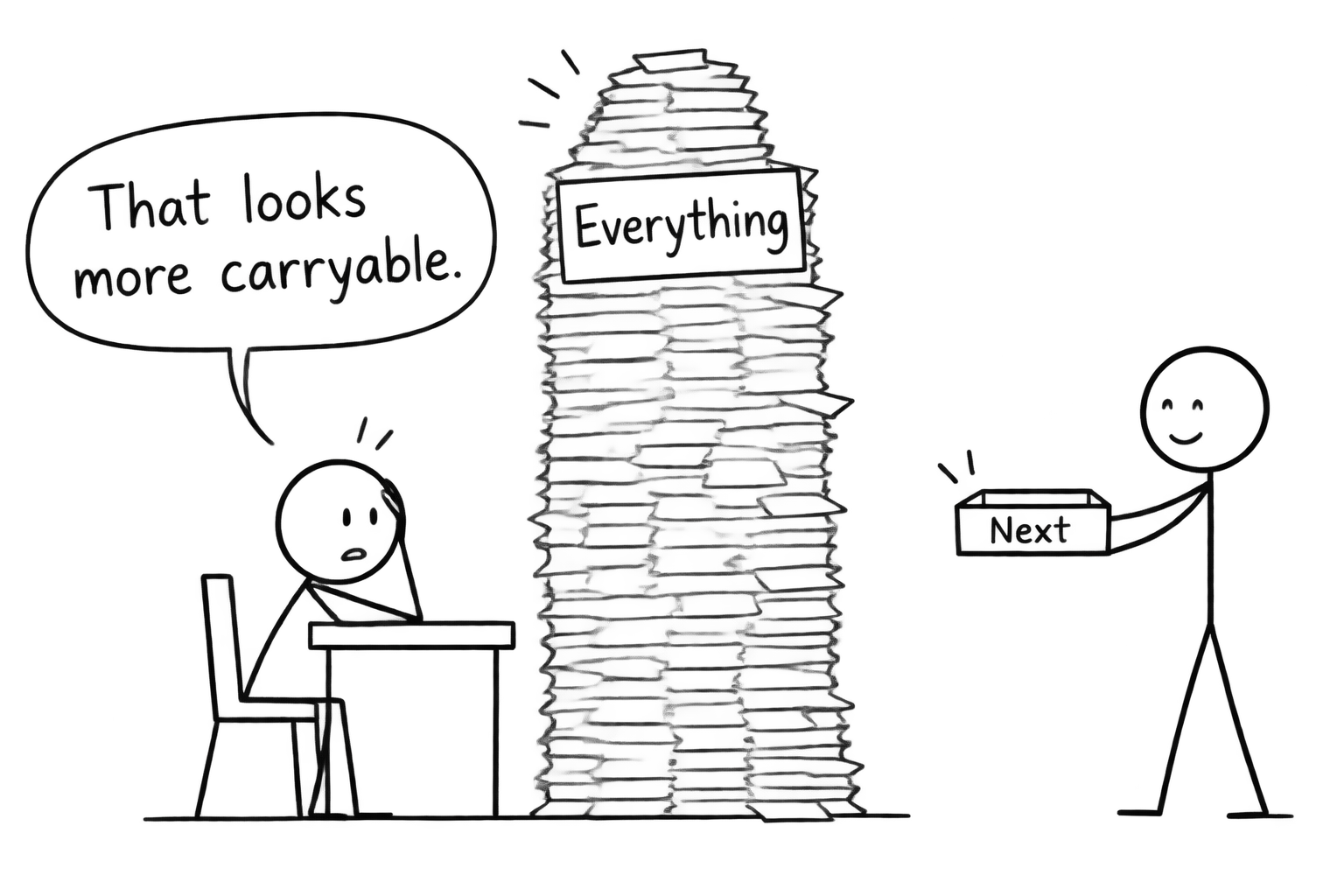 A student choosing the manageable next revision task instead of carrying everything at once
Rank weaknesses with a simple priority score
A long red list creates anxiety but not direction. Turn it into a ranked list by scoring each topic from 000 to 333 in three categories.
| Factor | Question to ask |
|---|---|
| Weakness | How consistently do I lose marks on this skill? |
| Relevance | Is it on my specification, tier and upcoming paper? |
| Dependency | Will improving it unlock several other topics? |
Add the three scores:
priority score=weakness+relevance+dependency\text{priority score}=\text{weakness}+\text{relevance}+\text{dependency}priority score=weakness+relevance+dependencyA high score moves the topic towards the top. This is a decision tool, not a prediction of how many marks will appear in an exam. Exam boards do not guarantee that every topic will occur in a particular paper.
Dependency deserves special attention. Fractions, negative numbers, algebraic manipulation and proportional reasoning support many GCSE topics. At A Level, algebra, functions, trigonometry and differentiation methods connect to substantial parts of pure maths and applied problems. Repairing a foundational gap can therefore make several later topics easier.
Do not rank a topic highly merely because it looks advanced. A difficult topic outside your tier, specification or immediate needs should not displace a recurring foundational weakness.
Turn the ranking into a weekly plan
Choose the first three to five priorities rather than scheduling every red topic. Give each one a short sequence:
- Learn: review the method through a revision lesson or video solution.
- Practise: answer focused questions with full working.
- Check: mark the work carefully and correct each error.
- Retrieve: attempt fresh questions later without notes.
- Mix: include the skill in a mini test or mixed paper.
Spacing the checks matters. Returning to knowledge over time is generally more useful for long-term recall than placing all practice in one sitting. A practical rhythm might revisit a topic later in the week and again the following week, but the exact interval should fit your exam date and current understanding.
Keep sessions realistic. The 20-minute maths revision routine is useful when school days are crowded, while the guide to how many hours to revise for GCSEs can help you balance maths with other subjects rather than allowing one weak area to consume every evening.
Once you have ranked the topics and chosen your available sessions, you can build the schedule in the MathsGenie Revision Planner instead of arranging every revisit on paper.
Know when a topic is ready to move down the list
A topic is not secure because you watched a clear explanation. It moves down your priority list when you can answer an appropriate range of questions independently, explain your method and avoid repeating the original error.
Use a simple traffic-light review:
- Red: you cannot begin without help or repeatedly make the same error.
- Amber: you understand the method but make mistakes or need prompts.
- Green: you can solve unfamiliar exam-style questions independently.
Green does not mean “never revise again”. Move the topic into occasional mixed practice. Meanwhile, promote the next red or amber topic.
This makes revision planning responsive. The list changes as you improve, rather than preserving decisions made after one difficult mock.
Common mistakes when prioritising maths revision
Revising favourite topics first
Success feels productive, so students often repeat topics they can already do. Begin a session with a brief confidence-building question if helpful, but spend most of the time on the chosen weakness.
Treating every weakness equally
A one-off arithmetic slip is different from being unable to form an equation. Look for frequency, relevance and dependencies before assigning time.
Watching without practising
Videos and worked solutions can make a method feel obvious. Close the explanation and answer questions independently. Retrieval exposes the difference between recognition and usable knowledge.
Doing full papers too early
Past papers are valuable diagnostic tools, but repeatedly completing them without fixing the identified gaps can reproduce the same errors. Alternate full papers with targeted topic practice and mark-scheme review.
Never updating the plan
A revision list should shrink, reorder and occasionally grow. Review it weekly. Parents can support this process by asking what the evidence shows rather than repeatedly asking whether revision happened. MathsGenie's guide to supporting GCSE maths revision without nagging offers a calmer framework for those conversations.
Make the next decision easy
The student at the kitchen table does not need a perfect master plan. They need to turn a marked paper into a short ranked list, practise the first weakness and schedule its return. The challenge is often not understanding the method, but following it consistently while exams move closer.
You have seen how the plan works. Your turn: enter your exam date, available revision time and weakest topics, then let the planner organise the sequence. Build your schedule in the MathsGenie Revision Planner.