

How to Know Your Revision Is Working
How to know your revision is working: use recall, exam questions and mistake tracking to measure real progress in GCSE and A Level revision each week.

Imagine a parent looking into a bedroom on Sunday evening. The desk is covered in highlighted notes, the revision timetable is full of ticks, and several hours have apparently been completed. Yet when they ask, “What did you learn?”, the student cannot explain much without opening the textbook.
This is the uncomfortable problem behind how to know your revision is working. Time spent is not enough. Revision is working when you can recall knowledge without help, answer unfamiliar exam questions more accurately, explain your method, and make fewer repeated mistakes after a delay.
That answer applies whether you are preparing for GCSE grades 9-1 or A Levels. A neat timetable can organise your time, but only evidence from memory and exam performance can show whether that time is changing what you know.
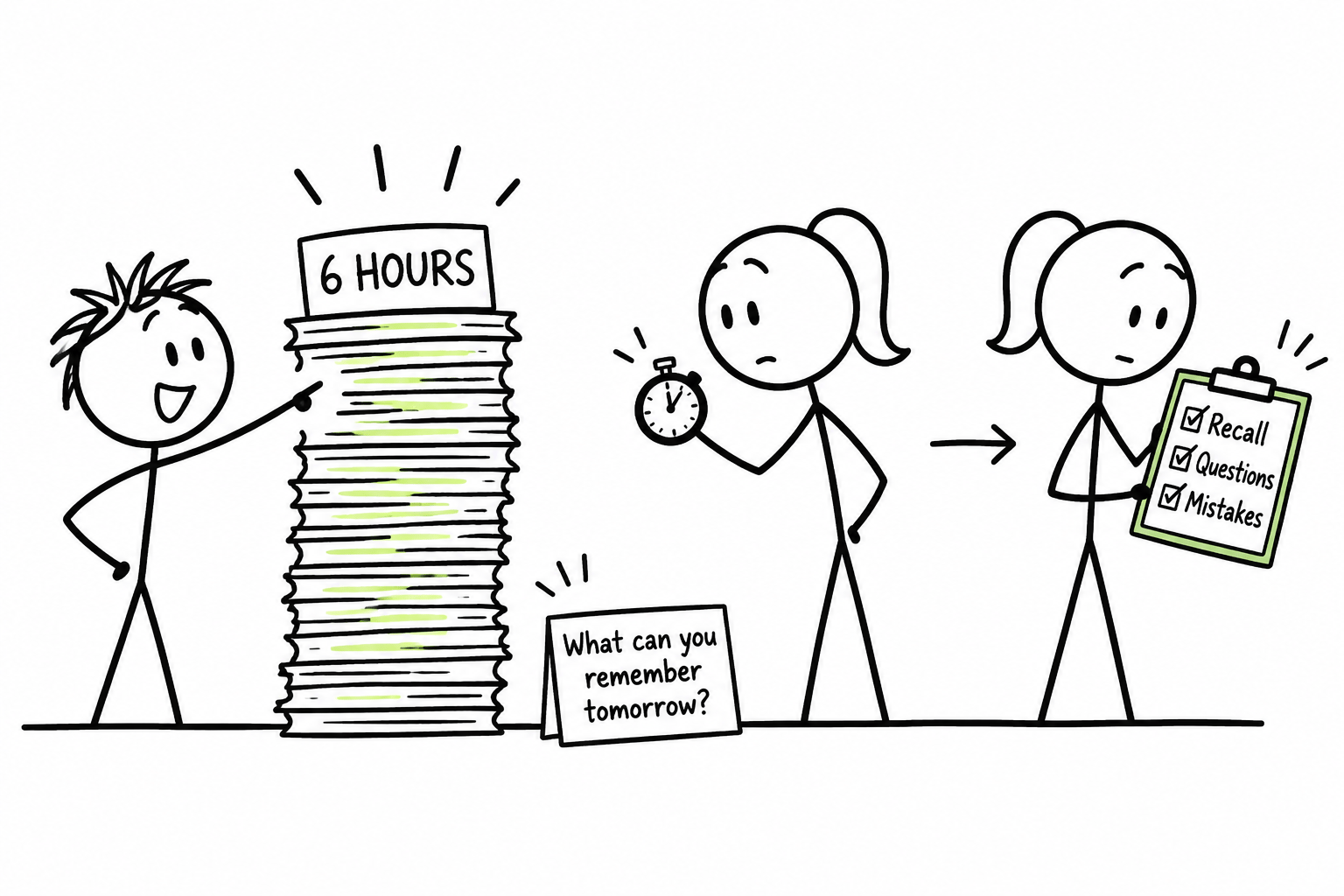 A student discovers that a pile of highlighted notes cannot answer tomorrow's quiz
The signs that revision is working
Use this short checklist at the end of each week:
- You can recall key facts, formulas or methods with your notes closed.
- You can answer exam questions without copying a model solution.
- Your marks on comparable questions are gradually improving.
- Mistakes that once repeated are becoming less frequent.
- You can still remember material several days after revising it.
- You can identify weak topics more precisely than “I am bad at maths”.
- You are completing planned sessions without needing every evening to be perfect.
No single difficult paper proves that revision has failed. Equally, one successful evening does not prove that a topic is secure. Look for a pattern across several sessions.
Measure learning, not hours
Our hypothetical student has been recording hours because hours are visible. Their parent can see them too. But hours measure attendance, not learning.
A more useful revision record has three columns:
| Topic | Evidence collected | Next action |
|---|---|---|
| Quadratic equations | Completed questions without notes | Correct errors, then retest later |
| Cell biology | Recalled most key terms | Practise the missing processes |
| Poetry comparison | Planned an answer from memory | Write one timed paragraph |
This does not mean time is irrelevant. You still need enough protected time to revise, and the guide to how many hours you should revise can help you set realistic expectations. The important distinction is that time is an input. Recall, accuracy and independence are outputs.
For broader revision planning, the GCSE revision timetable guide explains how to create a sustainable weekly structure. Once that structure exists, the measures in this article tell you whether it is producing results.
Use a simple test, review and retest cycle
The clearest study technique is not complicated. Choose a topic, test what you know before reviewing it, practise the weak areas, and test it again after a gap.
Start with closed-book recall
Before opening your notes, write down everything you remember. For maths, that might mean listing the steps needed to solve a particular type of problem. For science, it could mean sketching a process from memory. For an essay subject, it might involve recalling quotations, arguments or evidence.
Closed-book recall feels harder than rereading because it exposes uncertainty. That discomfort is useful information. Retrieving knowledge from memory also gives you a better indication of what may be available in an exam, when the textbook will not be beside you.
Answer questions independently
Next, complete practice questions without looking at the solution. MathsGenie’s GCSE maths revision resources include revision lessons, exam-style practice, mini tests and longer papers. Video solutions can clarify a method afterwards, but the first attempt should reveal what you can do independently.
Mark the work using the mark scheme. For Edexcel, AQA, OCR or Eduqas questions, pay attention to what the specification and mark scheme actually reward. Record whether each lost mark came from:
- missing knowledge;
- an incorrect method;
- an arithmetic or algebraic slip;
- misunderstood wording;
- incomplete working;
- poor timing.
A mark alone tells you the size of the gap. The reason for the lost mark tells you how to close it.
Retest after a delay
Return to the topic several days later without rereading everything first. Use different questions where possible. If you can still retrieve the method and apply it, learning is becoming more durable.
This delayed check matters because immediate familiarity can be misleading. A worked solution may seem obvious moments after you have read it. The real test is whether you can reconstruct the approach later.
You now have the complete cycle: recall, questions, marking, correction and delayed retesting. If setting that cycle across several subjects feels cumbersome, build your schedule in the MathsGenie Revision Planner rather than trying to hold every task in your head.
Track the right kind of progress
Progress is rarely a perfectly rising line. Papers vary in difficulty, topics overlap, and tiredness affects individual sessions. Use several indicators rather than treating every mark as a verdict.
Compare like with like
Compare similar question sets completed under similar conditions. A short foundation topic test should not be compared directly with a full higher tier paper. For A Level students, a focused mechanics exercise and a mixed timed paper measure different things.
MathsGenie mini tests can help with focused checks, while past papers and predicted papers are more useful for mixed practice, timing and switching between topics.
Keep a mistake log
A mistake log should be brief enough to use. Record the topic, what went wrong and what you will do next. “Careless” is usually too vague. “Expanded the bracket but did not multiply the second term” gives you something specific to watch for.
Review the log weekly. Revision is working if old errors disappear, even while new and more demanding errors appear. In fact, encountering more advanced mistakes can be a sign that you are attempting harder material.
Notice increasing independence
One of the strongest signs of progress is needing less support. At first, you may need a full revision lesson. Later, a short reminder may be enough. Eventually, you should be able to solve the question and explain why the method works.
For GCSE maths, the scheme of learning provides a structured journey through content, lessons and tests. It can help you distinguish a missing prerequisite from difficulty with the current topic.
What parents should look for
Parents often ask about time because it feels objective: “How long did you revise?” A better conversation begins with evidence.
Try asking:
- What can you do now that you could not do last week?
- Which mistake did you correct today?
- When will you test this topic again?
- Which subject needs a change of approach?
These questions encourage reflection without turning every session into an inspection. A student who can name a weakness and choose an appropriate next step is developing control over their revision.
Parents should also avoid interpreting one disappointing score as proof that nothing is working. The score may expose gaps that passive revision had hidden. What matters next is whether those gaps produce a specific change in the plan.
Common revision mistakes
Rereading until the page feels familiar
Familiarity is not the same as recall. Close the book and reproduce the idea before deciding that you know it.
Checking solutions too early
A solution can make a question look easier than it was. Attempt it fully first, then use the mark scheme or video solution to diagnose the gap.
Repeating only comfortable topics
Successful revision should sometimes feel difficult. If every session confirms what you already know, your weakest areas remain untouched.
Changing methods after one poor result
A single score can be noisy. Correct the errors, retest after a delay and look for a trend before abandoning a sensible approach.
Building a timetable with no feedback loop
A timetable tells you where to begin, not whether to continue in the same way. The GCSE maths revision timetable guide shows how lessons, practice questions, papers and marking can fit together. Shorter deadlines may suit the one-week maths revision plan, while a longer run-up can use the one-month maths revision plan.
Turn evidence into your next schedule
The student in our opening scene did not need to work endlessly. They needed to replace ticks and highlighted pages with recall checks, marked questions and planned retests. Knowing that system is the first step; following it across GCSE or A Level subjects is the harder gap.
Exams have fixed dates, so every week without a workable plan removes time you cannot recover. Build your schedule in the MathsGenie Revision Planner, placing weak topics, independent practice and delayed retests into the weeks you have left.















