How to Get Grade 7 GCSE Geography: Revision Guide
How to get grade 7 GCSE Geography with a practical plan for case studies, fieldwork, data skills, extended answers, past papers and feedback.
A geography revision guide can look reassuringly complete. Every case study is highlighted. Every process has a diagram. Yet when a past-paper question asks you to assess, evaluate or use evidence, the knowledge can suddenly feel less secure.
If you are wondering how to get grade 7 GCSE Geography, the short answer is this: know your specification, retrieve knowledge without notes, apply it to unfamiliar resources, write developed judgements and use mark schemes to repair recurring weaknesses. A grade 777 is not built by memorising everything. It comes from turning accurate knowledge into answers that match the question.
There is no universal percentage that guarantees a grade 777. Grade boundaries are set after the exams and can change according to the difficulty of the papers. Your most useful target is therefore not a guessed percentage, but consistently strong performance across knowledge, application, geographical skills and extended writing.
Your grade 7 revision checklist
Use this checklist to keep your preparation focused:
- Confirm your exam board and exact specification: AQA, Pearson Edexcel, OCR or Eduqas.
- Audit every topic as secure, developing or weak.
- Learn case studies as connected geographical stories, not isolated statistics.
- Practise command words, especially explain, assess, evaluate and justify.
- Complete unfamiliar map, graph and data questions every week.
- Reconstruct your own fieldwork enquiry from memory.
- Write timed extended responses and compare them with mark schemes.
- Keep a short mistake log and retest each weakness.
- Use full papers only after targeted topic repair.
Geography GCSE is not divided into foundation and higher tier. All students taking the same specification sit its common assessment route, so your revision should match your board rather than a maths tier.
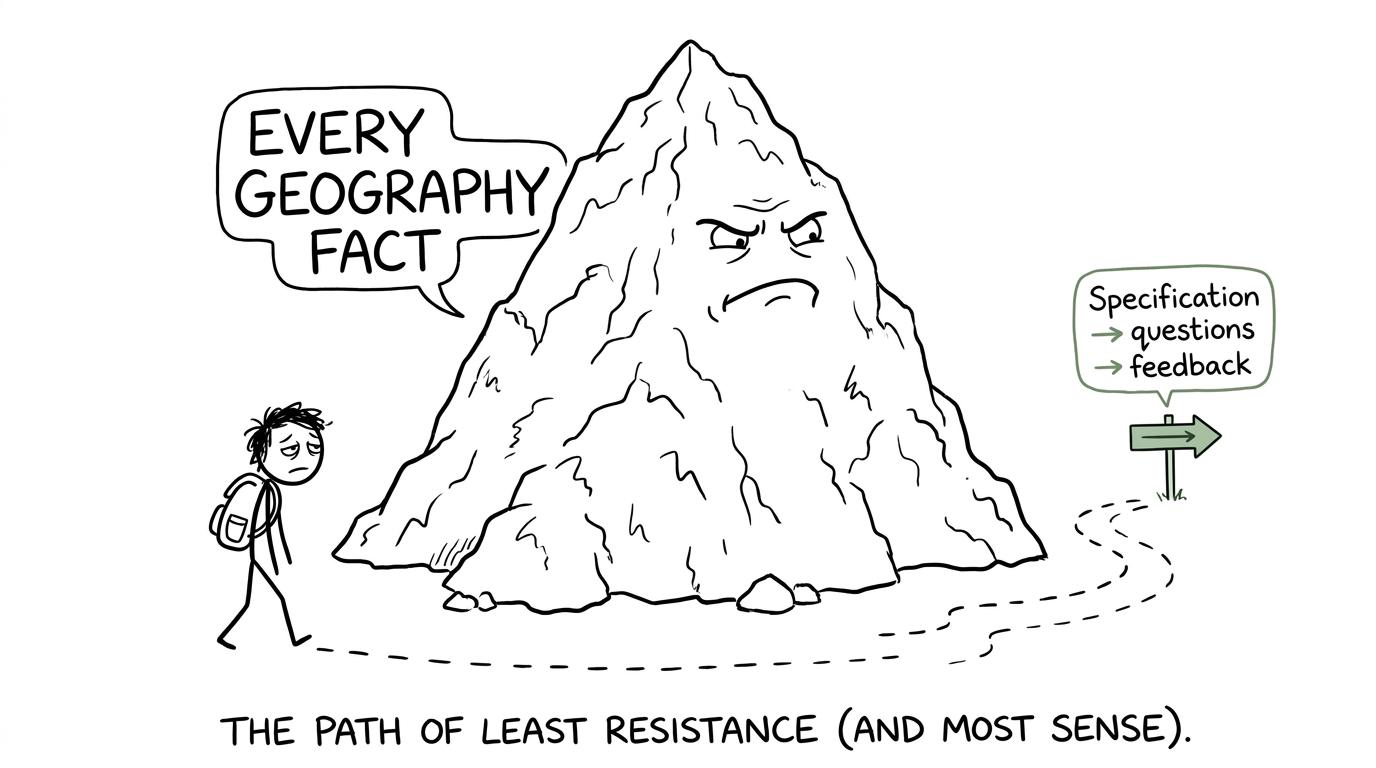 A student choosing a sensible specification and feedback path instead of climbing the mountain of every geography fact
Start with the specification, not the textbook
Textbooks are designed to teach. Specifications define what can be assessed. That distinction saves time.
Print or download your board's specification and turn it into a traffic-light audit. Break broad headings such as natural hazards or urban change into precise requirements. “Coasts” is too vague; erosion processes, landforms, management strategies and a named landscape are useful revision targets.
The assessment objectives used across GCSE Geography reward four broad abilities:
- accurate knowledge of places, environments and processes;
- geographical understanding and connections;
- application, analysis, evaluation and judgement;
- geographical skills and communication.
The weighting differs in presentation between specifications, so check your own board. For example, AQA currently gives substantial weight to application and evaluation, not just recall. This explains why rereading notes can feel productive without producing grade 777 answers: recognition is not the same as application.
Build a one-page tracker with columns for knowledge, case studies, skills and exam questions. Review it weekly. A calm plan is more useful than a heroic revision session, and the rhythm in MathsGenie's one-month GCSE revision plan can be adapted for geography.
Change revision from input to retrieval
Reading, highlighting and watching explanations are inputs. They help initially, but they do not prove that you can retrieve the material in an exam.
After learning a section, close everything and produce one of the following:
- a blank-page summary;
- a labelled process diagram;
- a sequence of causes, effects and responses;
- a comparison between two places;
- a spoken explanation using the correct terminology;
- a plan for an extended question.
Then check your version and add only what was missing. Revisit the topic after a short gap and again the following week. Each return should require less prompting.
A useful session has four stages: retrieve, check, apply and record. Retrieve the content from memory, check it against reliable notes, apply it to an exam question, then record the specific reason for any lost marks. “Revise rivers” is not a diagnosis. “I described flood management but did not evaluate its long-term effectiveness” is.
Learn case studies as arguments
Students often collect case-study facts as if marks are awarded for owning the largest pile. Examiners need something more useful: relevant evidence supporting a geographical point.
For each required example, organise your knowledge under six prompts:
- Where is it, and why does its location matter?
- What happened or changed?
- Which geographical processes caused it?
- Who or what was affected?
- How was it managed?
- How successful, sustainable or unequal were the outcomes?
Select a small bank of accurate, distinctive evidence. Place names, dates, quantities and named strategies can strengthen an answer, but only when they help explain significance. Avoid memorising uncertain statistics. A correct, relevant comparison is worth more than a dramatic number used in the wrong context.
Make case studies flexible. The same urban example might support questions about opportunities, inequality, migration, environmental pressure or sustainable planning. Practise reshaping knowledge around different questions instead of rehearsing one fixed essay.
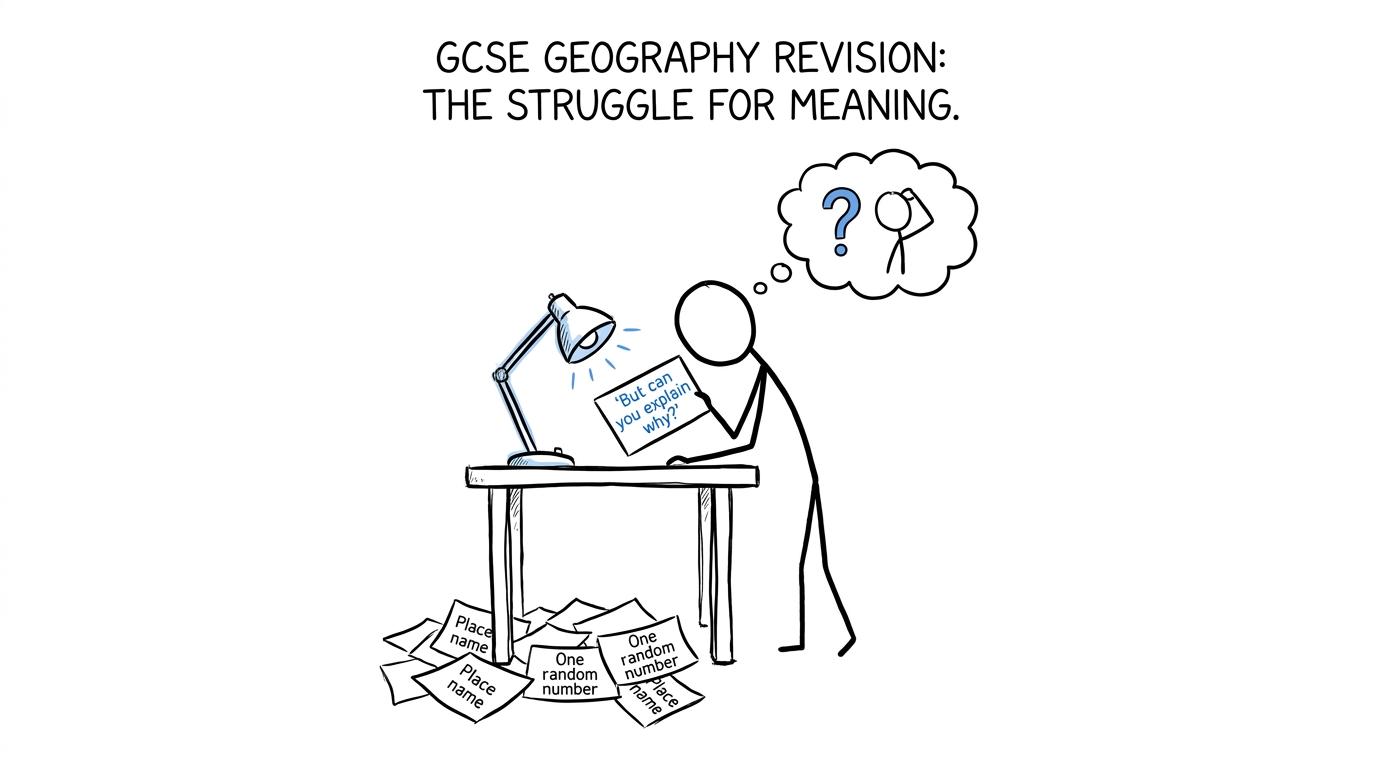 A student questioning whether a case-study flashcard can explain why
Match your answer to the command word
A strong student can lose marks by answering a nearby question rather than the actual one. Command words are instructions, not decoration.
Describe and compare
Describe questions require characteristics, patterns or changes. Use evidence from the resource when one is provided. Compare questions need direct links between both places, groups or data sets; writing one paragraph about each separately can leave the comparison implicit.
Explain and suggest
Explain requires a developed chain showing how or why something happens. A reliable structure is point, process and consequence. Suggest usually asks you to apply geographical understanding to an unfamiliar context, so clues in the resource matter.
Assess, evaluate and justify
These commands require judgement. Consider more than one factor, criterion or viewpoint, then decide what matters most and explain why. A conclusion should resolve the question rather than repeat the introduction.
Before writing, underline the command word, topic, location, resource instruction and any limiting phrase such as “to what extent”. Match the depth of your response to the available marks. Brief questions need precision; extended questions need developed reasoning and a supported judgement.
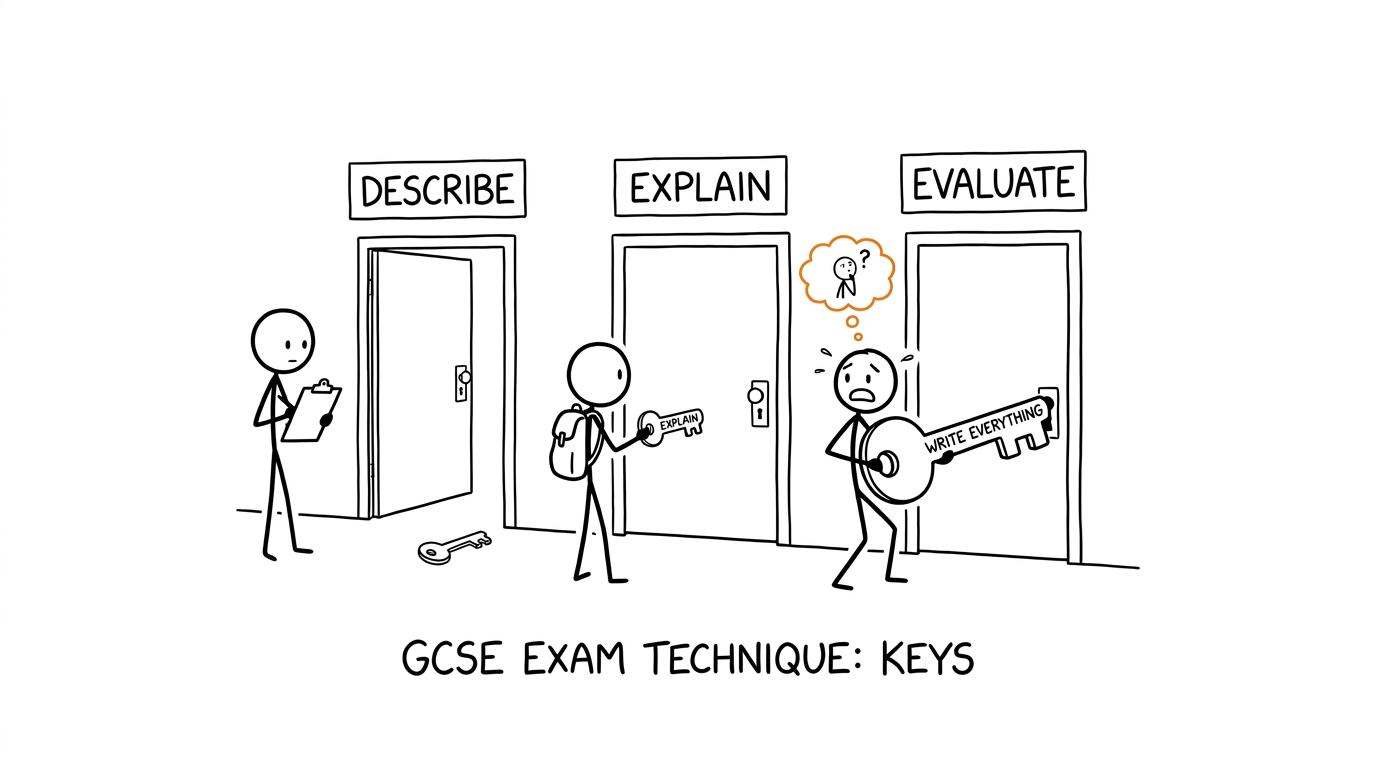 An examiner's command-word doors being opened with the correct key
Secure the maths and data skills inside geography
Geography specifications include cartographic, graphical, numerical and statistical skills. These may appear alongside physical geography, human geography or fieldwork rather than in a separate “maths” section.
Practise:
- scale, distance, direction, contours and grid references;
- ratios, proportions and unit conversions;
- percentage increase and decrease;
- mean, median, mode, range and interquartile range;
- scatter graphs, lines of best fit, trends and anomalies;
- interpreting choropleth maps, population pyramids and unfamiliar charts;
- judging whether data supports a conclusion.
For percentage change, remember:
percentage change=new value−original valueoriginal value×100\text{percentage change}=\frac{\text{new value}-\text{original value}}{\text{original value}}\times 100percentage change=original valuenew value−original value×100For spread:
range=highest value−lowest value\text{range}=\text{highest value}-\text{lowest value}range=highest value−lowest valueDo not stop at calculation. State what the result means geographically, include appropriate units and avoid claiming that correlation proves causation.
MathsGenie's free AQA Geography statistical skills guide covers averages, spread, percentage change, scatter graphs and misleading presentations. If data handling remains a weakness, use the wider GCSE Statistics revision hub or the detailed Edexcel GCSE Statistics resources for extra practice.
Rebuild your fieldwork from memory
Fieldwork is not simply a trip you need to remember. It is an enquiry process you need to understand.
For each investigation, reconstruct:
- the question or hypothesis;
- the geographical theory behind it;
- the location and why it was suitable;
- primary and secondary data collected;
- sampling strategy and equipment;
- presentation and analysis methods;
- results, anomalies and conclusion;
- limitations and realistic improvements.
Evaluation must be specific. “Collect more data” is weak unless you explain where, when or from whom, and how that would improve reliability or representativeness. Distinguish reliability, accuracy and validity rather than treating them as synonyms.
Also practise unfamiliar fieldwork. You may need to select a sampling method, identify risk, interpret results or challenge a conclusion in a context you have never visited. The enquiry logic remains the same even when the location changes.
Use past papers as a feedback system
A completed paper is not automatically useful. Its value comes from what you do after marking it.
Begin with topic questions, then timed sections, then full papers. Use the mark scheme strictly and classify each lost mark:
- knowledge gap;
- weak application;
- missing development;
- poor resource use;
- unsupported judgement;
- geographical-skills error;
- timing or misreading.
Repair the weakness before attempting another full paper. The method described in MathsGenie's guide to redoing GCSE past papers effectively transfers well to geography: diagnose, relearn, practise and retest.
Predicted papers can provide fresh practice, but they cannot forecast every question and should never replace your specification or official past papers. MathsGenie's GCSE predicted-paper guidance explains why predictions work best as a late-stage supplement rather than a revision shortcut.
Common mistakes that keep students below grade 7
Revising topics instead of answering questions
Knowing coastal management does not guarantee that you can assess its sustainability. Attach every revision block to an exam task.
Listing case-study facts
Evidence needs a purpose. Link each detail to a process, effect, comparison or judgement.
Ignoring the resource
If the question says “use Figure”, quote or interpret something specific from it. Do not merely mention that the figure exists.
Writing balanced answers without deciding
Evaluation is not two lists joined by “however”. Establish criteria, weigh the evidence and reach a supported conclusion.
Treating fieldwork evaluation as a script
Generic comments about human error rarely earn strong credit. Identify the precise weakness, its effect and a feasible improvement.
Doing paper after paper without repair
Repeated testing measures the same gap. Improvement happens between papers, when you correct and retest the underlying weakness.
Build a repeatable weekly routine
A productive week might include three retrieval sessions, one data-skills session, two timed extended answers and one paper section. Keep the workload realistic enough to repeat.
The habit that tends to move students towards grade 777 is not endless revision. It is a tighter feedback loop: learn less at once, retrieve it properly, apply it under exam conditions and fix the exact reason marks disappeared.
Turn knowledge into marks with MathsGenie
A grade 777 becomes more realistic when your revision produces evidence: topics recalled without notes, case studies used flexibly, calculations interpreted correctly and extended answers improved through feedback.
Start with the free MathsGenie revision website and strengthen the quantitative skills that geography exams demand. Use revision lessons and practice questions to repair weak methods, mini tests to build fluency, and past papers with mark schemes and video solutions to develop disciplined exam habits. MathsGenie's Edexcel predicted papers can also sharpen your maths preparation alongside geography, particularly if graphs, percentages and statistics are costing you marks.
Choose one weakness today. Retrieve it, answer a question, mark it and write down the next correction. Grades often change through improvements that look small from one day to the next, but become difficult to miss when repeated.