How to Get a Grade 6 in GCSE Spanish
How to get a grade 6 in GCSE Spanish through focused vocabulary, grammar, speaking and exam practice across listening, reading and writing.
A grade can feel like a verdict when it is really the result of hundreds of small decisions: whether you test yourself or reread, whether you speak aloud or stay silent, and whether you correct a mistake or simply count the mark.
If you have searched for how to get grade 6 GCSE Spanish, the short answer is this: you need to take Higher tier, build reliable knowledge of the prescribed vocabulary and grammar, and practise retrieving it across listening, speaking, reading and writing. A grade 6 does not require flawless Spanish. It requires enough accurate, relevant communication across the whole qualification.
The most useful changes are usually ordinary ones, repeated consistently.
Your grade 6 checklist
Use this as a quick diagnosis before changing your revision plan:
- Confirm that you are being entered for Higher tier, because Foundation tier is capped at grade 5.
- Check your exam board and current specification. AQA, Edexcel, OCR and Eduqas do not use identical tasks.
- Learn vocabulary through recall rather than passive rereading.
- Secure common verbs, time frames, opinions, reasons and connectives.
- Practise listening little and often.
- Speak aloud several times each week.
- Complete board-specific reading, translation and writing tasks.
- Use mark schemes or assessment criteria to diagnose lost marks.
- Keep an error log and revisit it.
- Train every assessed skill rather than relying on your favourite paper.
The reformed GCSE French, German and Spanish qualifications taught in England from September 2024 were first assessed in summer 2026. Current specifications place explicit emphasis on prescribed vocabulary, grammar, comprehension and accurate communication. Check the materials supplied by your school before using older papers, because task formats can change.
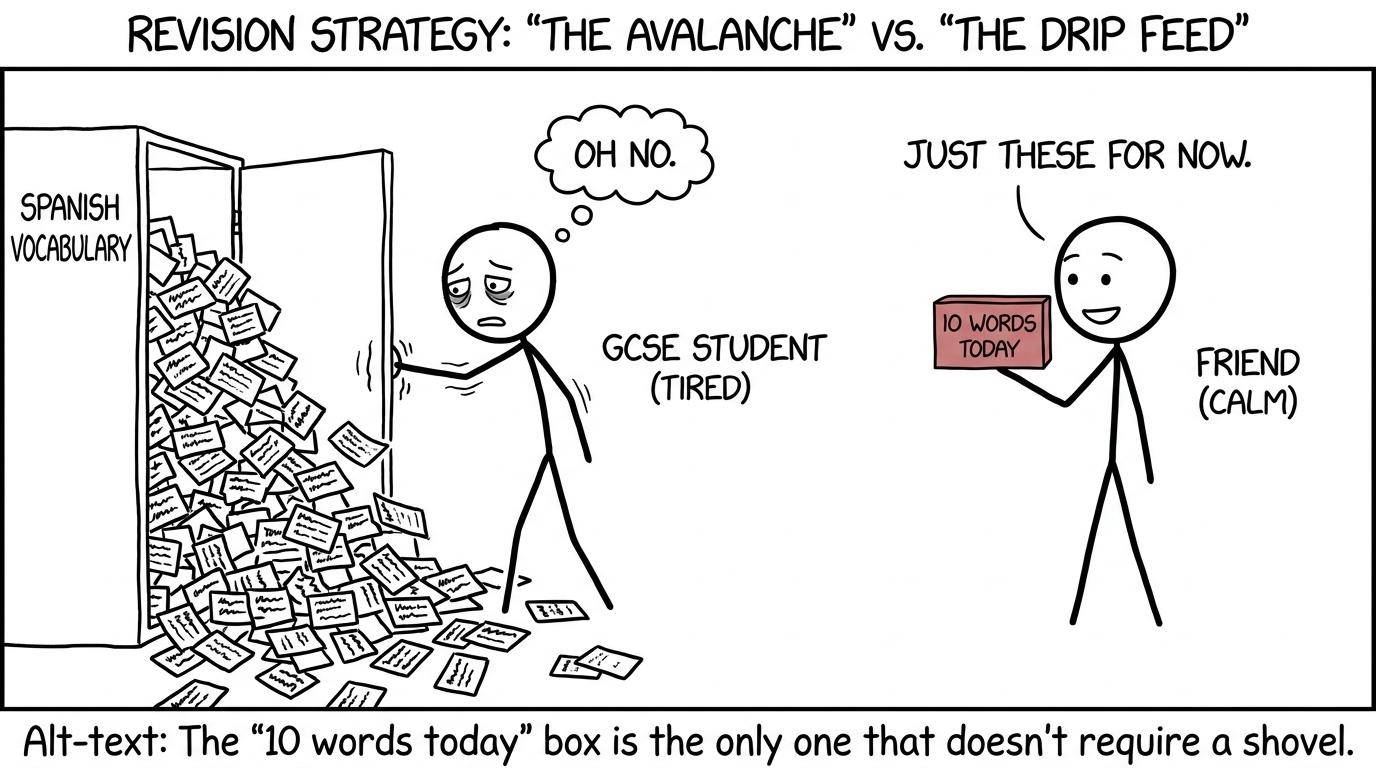 A cupboard full of vocabulary cards compared with a manageable daily revision box
Understand what a grade 6 demands
GCSE Spanish normally assesses four components: listening, speaking, reading and writing. On current AQA and Edexcel specifications, each component contributes 25%25\%25% of the qualification. Exact tasks, timings and mark totals vary by board, so use your own specification rather than assuming every online resource matches your exam.
The final grade is based on your total subject mark, not a separate grade for each paper. This matters. A weak listening performance can be balanced to some extent by stronger work elsewhere, but neglecting an entire skill leaves too many marks exposed.
Grade boundaries are set after papers have been taken and marked. They change because the difficulty of an examination changes, so there is no permanent percentage that guarantees a grade 6. You can inspect previous Edexcel GCSE Spanish grade boundaries, but treat them as historical context rather than a target for a new specification.
Your practical target should be broader: produce clear Spanish, understand familiar language in unfamiliar combinations, and avoid giving away accessible marks through incomplete answers or preventable grammar errors.
Turn vocabulary into usable language
Many students recognise a word when it appears on a page but cannot produce it during a speaking or writing task. Recognition feels like knowledge. The exam reveals the difference.
Replace long vocabulary-reading sessions with short retrieval sessions. Look at the English meaning and say or write the Spanish from memory. Then reverse the direction. Separate secure words from uncertain ones and spend more time on the uncertain pile.
Revise vocabulary in useful clusters:
- a noun with its article and gender
- a verb with the person who performs it
- an opinion with a reason
- an adjective with its possible endings
- a time phrase with the tense it naturally introduces
Ten carefully recalled words are more valuable than fifty words glanced at once. Revisit them after a delay and mix old vocabulary with new vocabulary. This makes practice harder, but difficulty during revision is often the evidence that memory is doing some work.
Make grammar accurate before making it impressive
Students sometimes chase impressive phrases while losing marks on high-frequency language. A grade 6 answer benefits more from dependable foundations than from one memorised sentence surrounded by avoidable errors.
Prioritise:
- present-tense forms of common regular and irregular verbs
- the correct use of infinitives
- noun gender and adjective agreement
- negatives
- question words
- preterite or other required past forms
- near-future and relevant future forms
- comparatives, connectives and justified opinions
Build a small bank of structures you can adapt across topics. Do not memorise entire essays and hope the question matches. Examiners reward an answer to the task in front of you, not a rehearsed response to a different task.
When checking writing, read once for meaning and once for accuracy. On the second reading, inspect verbs, agreements, accents and whether every required bullet point has been addressed. A short, relevant answer with controlled language can outperform a longer answer that becomes unclear.
Train listening as a separate skill
Listening often feels unfair because the words disappear as soon as they are spoken. The solution is not simply to play more audio. It is to listen with a purpose.
Use short extracts and complete three passes when the resource allows it:
- First identify the context and overall message.
- Then listen for names, time markers, negatives, opinions and changes of tense.
- Finally check what caused each wrong answer.
Common traps include hearing a familiar word and selecting an answer before the speaker contradicts it. Train yourself to wait for the complete idea. Words such as pero, aunque, nunca and antes can change the meaning of a sentence.
Current specifications may include dictation, depending on your board. If yours does, practise spelling what you hear rather than merely identifying the gist. Sound-spelling relationships, accents and verb endings become part of the task.
Speak before you feel ready
Speaking improves through physical practice. Silent preparation cannot fully train pronunciation, pace or the ability to recover when a sentence goes wrong.
Record short responses on your phone or speak to a classmate, teacher or family member. Practise describing, giving an opinion, explaining a reason and referring to different time frames. Answer unexpected follow-up questions instead of rehearsing only one perfect script.
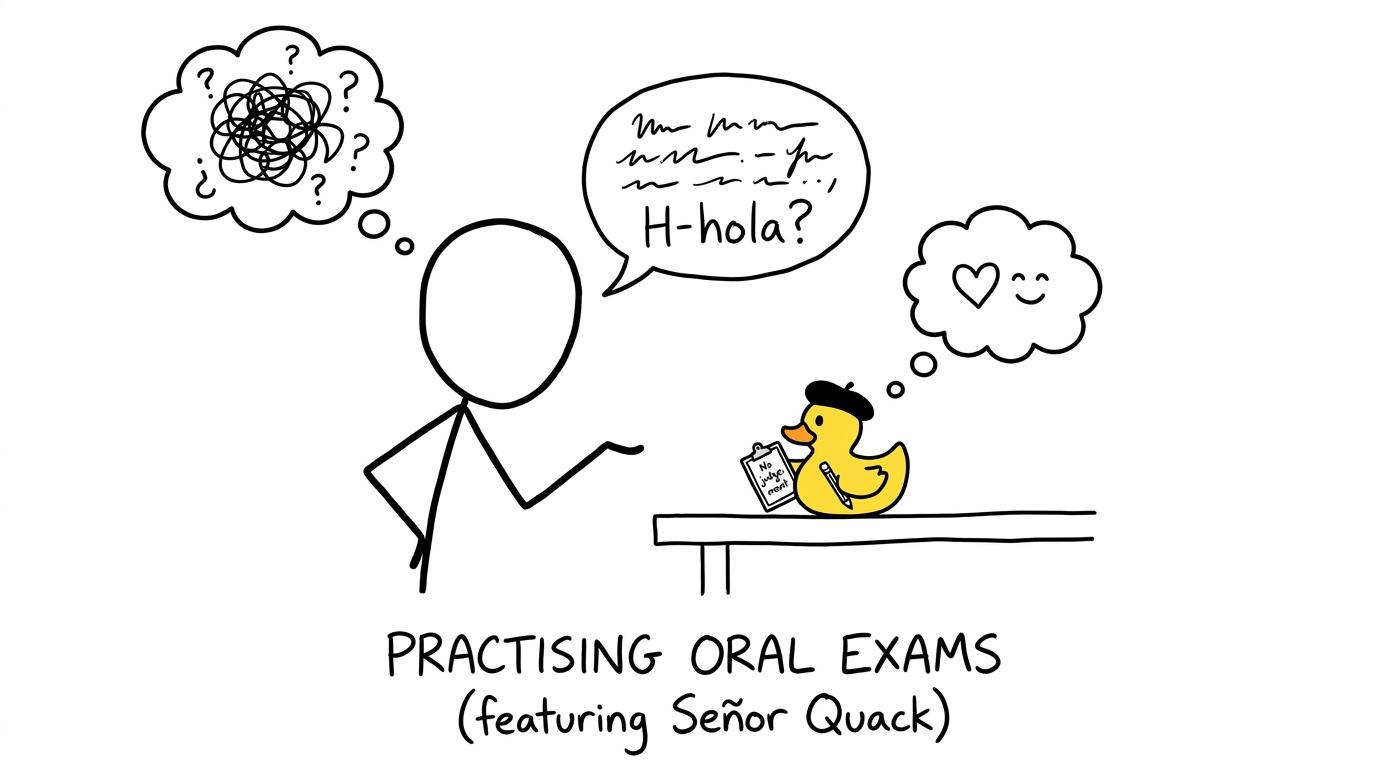 A student practising Spanish with a reassuring rubber duck
Clear communication matters more than adopting a dramatic accent. If you forget a word, simplify the thought or describe it another way. That ability to keep communicating is more useful than stopping while searching for a perfect expression.
Check your board's speaking format carefully. Reformed specifications can include tasks such as reading aloud, role-play, visual stimuli and unprepared interaction, while the precise arrangement differs between boards and specifications.
Use reading and translation to expose gaps
Reading practice should become diagnostic. When an answer is wrong, decide why:
- Was the vocabulary unknown?
- Was a negative missed?
- Was the wrong person or time frame identified?
- Was the Spanish understood but the question misread?
- Was the answer too vague?
Translation is especially revealing because it removes the option to avoid difficult structures. Mark each attempt against the official material where available, then rewrite only the inaccurate sections. Keep a list of recurring failures, such as adjective agreement or confusing ser and estar.
Past and sample papers are most useful when they match your specification. The same principle applies in maths: a paper creates value only when its mistakes become the next revision tasks. MathsGenie's guide to using past papers properly explains this feedback loop in more detail.
Build a weekly routine that can survive busy days
A dramatic revision weekend is less dependable than a routine you can repeat. Aim for several short sessions across the week, with each session producing something you can check.
A balanced week might contain:
- two short vocabulary retrieval sessions
- one focused grammar session
- one listening and dictation session
- one speaking recording
- one timed reading, translation or writing task
- one review of your error log
Adapt the balance to your evidence. If speaking is already strong but listening is consistently weak, equal revision time is not sensible.
For help building a realistic pattern around all your subjects, use the GCSE revision timetable guide. Maths students can also use MathsGenie's GCSE revision hub for free lessons, practice questions, papers and shorter tests alongside Spanish revision.
Practise under exam conditions gradually
Do not wait until the final week to discover how your knowledge behaves under time pressure. Begin with one task, then a paper section, and eventually a complete assessment where suitable.
After each attempt:
- mark it using the relevant mark scheme or criteria
- classify each lost mark
- choose the two or three most important gaps
- practise those gaps separately
- retry the original task without notes
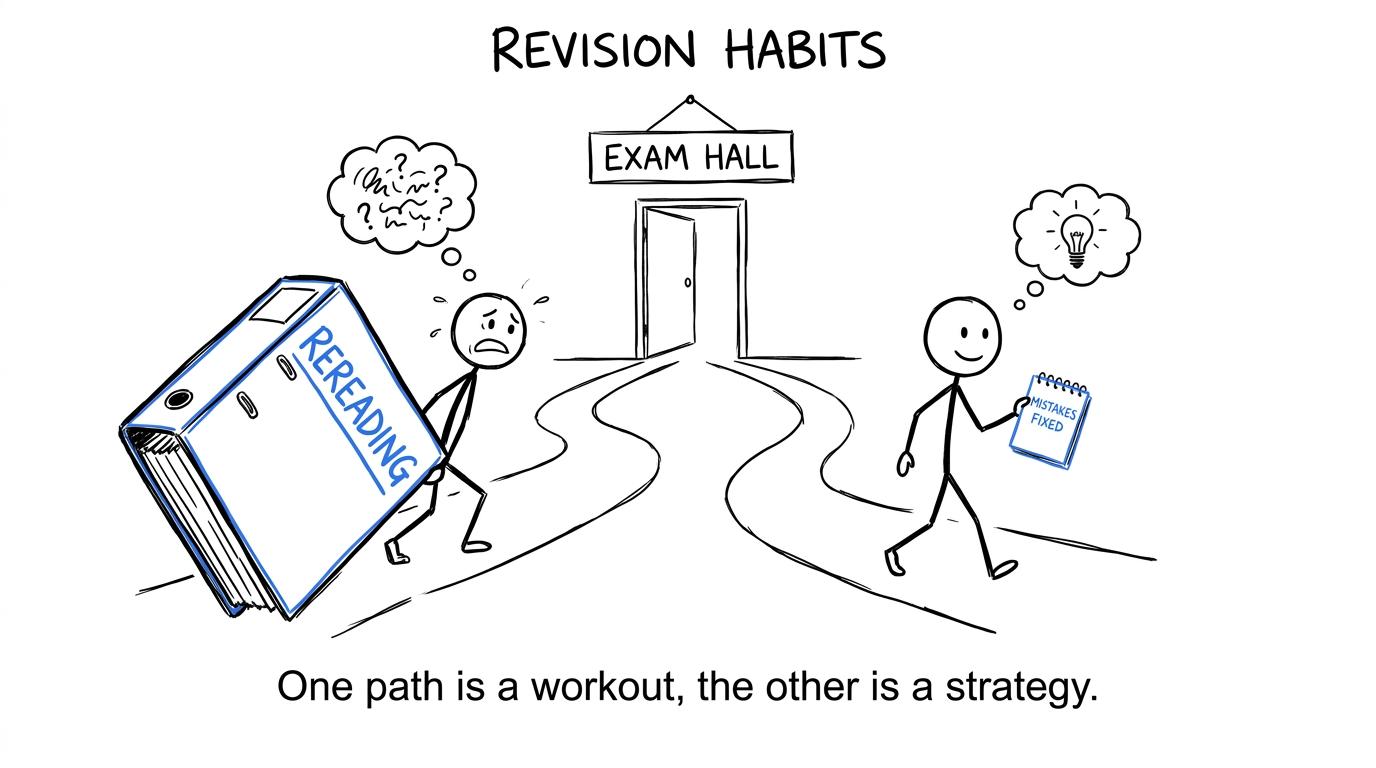 A student carrying fixed mistakes easily while another drags a giant rereading binder
This is the same progression explained in when to start GCSE past papers. Short assessments can make the first step less intimidating. For maths, MathsGenie target tests provide that focused practice; for Spanish, recreate the idea using one translation, one listening extract or one speaking card.
Common mistakes that hold students below a grade 6
Revising only vocabulary
Vocabulary is essential, but knowing isolated words does not guarantee accurate sentences or successful comprehension. Combine vocabulary with grammar and exam tasks.
Avoiding speaking because it feels uncomfortable
The discomfort is the training. Speak in low-pressure situations frequently so that the assessed conversation is not the first time you have had to think aloud.
Writing everything you know
Marks come from answering the actual question. Cover every bullet point and keep each sentence relevant before adding complexity.
Using old papers without checking the specification
Older papers can still support language practice, but their tasks may not reflect your current examination. Prioritise current sample assessment materials and teacher-approved resources.
Counting marks without correcting errors
A score measures the attempt. The correction changes the next attempt. Keep a brief record of what went wrong and what you will do differently.
Cramming on the night before
Last-minute work should refresh secure knowledge, not attempt to rebuild the course. The GCSE night-before revision plan offers a calm structure that can be adapted across subjects.
Your next step
Getting a grade 6 in GCSE Spanish is less about finding one secret phrase and more about closing small, repeated gaps. Retrieve vocabulary. Secure the grammar you use most. Speak aloud. Train your ear. Complete the right tasks for your board, and make every mistake pay for itself by turning it into fresh practice.
Then apply the same disciplined system across your timetable. Start with MathsGenie's free GCSE maths revision resources, where revision lessons, practice questions, mini tests, past papers, predicted papers, mark schemes and video solutions help turn weak areas into clear next steps. Progress becomes easier when you always know what to do next.