How to Get Grade 6 GCSE Sociology: Revision Guide
How to get grade 6 GCSE Sociology with focused recall, stronger evidence, better evaluation, past-paper practice and a practical weekly revision plan.

Getting a grade 6 rarely depends on producing the most colourful notes or remembering every sentence in the textbook. The real shift is learning to retrieve precise sociology, apply it to the question and evaluate it clearly under timed conditions.
If you are wondering how to get grade 6 GCSE Sociology, begin with four changes: revise from your specification, test yourself without notes, practise the exact question types used by your exam board, and turn every marked mistake into a specific follow-up task. A grade 6 comes from repeatedly converting knowledge into marks, not simply spending more time reading.
Your grade 6 Sociology checklist
Use this as your starting point:
- Confirm whether you study AQA or Eduqas and download the correct specification.
- List every topic and rate your confidence honestly.
- Learn concepts, theories, evidence and research methods together.
- Replace repeated reading with active recall.
- Practise short answers as well as extended responses.
- Use mark schemes to identify missing application or evaluation.
- Keep a mistake log and revisit errors within a few days.
- Complete timed sections before moving to full papers.
- Review conclusions, timing and question interpretation separately.
This is not a promise of a particular grade. Grade boundaries are set after papers have been marked and can change from year to year. Your useful target is therefore the quality of work associated with the grade, supported by a margin of safety in practice papers.
Know what your exam board rewards
Revision becomes much easier when you stop treating Sociology as one enormous body of notes and begin treating it as a defined specification.
For AQA GCSE Sociology, students currently sit two written papers. Each lasts 1 hour 45 minutes, carries 100 marks and contributes 50% of the qualification. Paper 1 covers families and education, while Paper 2 covers crime and deviance and social stratification. Relevant theory, methodology and research methods are assessed across the course.
Eduqas also uses two 1 hour 45 minute components, each worth 50%. Its content is organised differently, including cultural transmission, families, education, research methods, social differentiation and stratification, crime and deviance, and applied methods of sociological enquiry.
Do not borrow an essay structure or topic checklist without checking that it matches your board. Edexcel and OCR are familiar names in GCSE assessment, particularly in maths, but you should use the Sociology board and specification confirmed by your school.
Across current GCSE Sociology specifications, the assessment objectives are built around three abilities:
- AO1: knowledge and understanding of theories, concepts, evidence and methods.
- AO2: application of that knowledge and understanding.
- AO3: analysis and evaluation used to construct arguments, reach judgements and draw conclusions.
For AQA and Eduqas, the overall weighting is 40% AO1, 40% AO2 and 20% AO3. That balance explains why memorising definitions alone is not enough. Knowledge matters, but a large share of the assessment depends on using it in context.
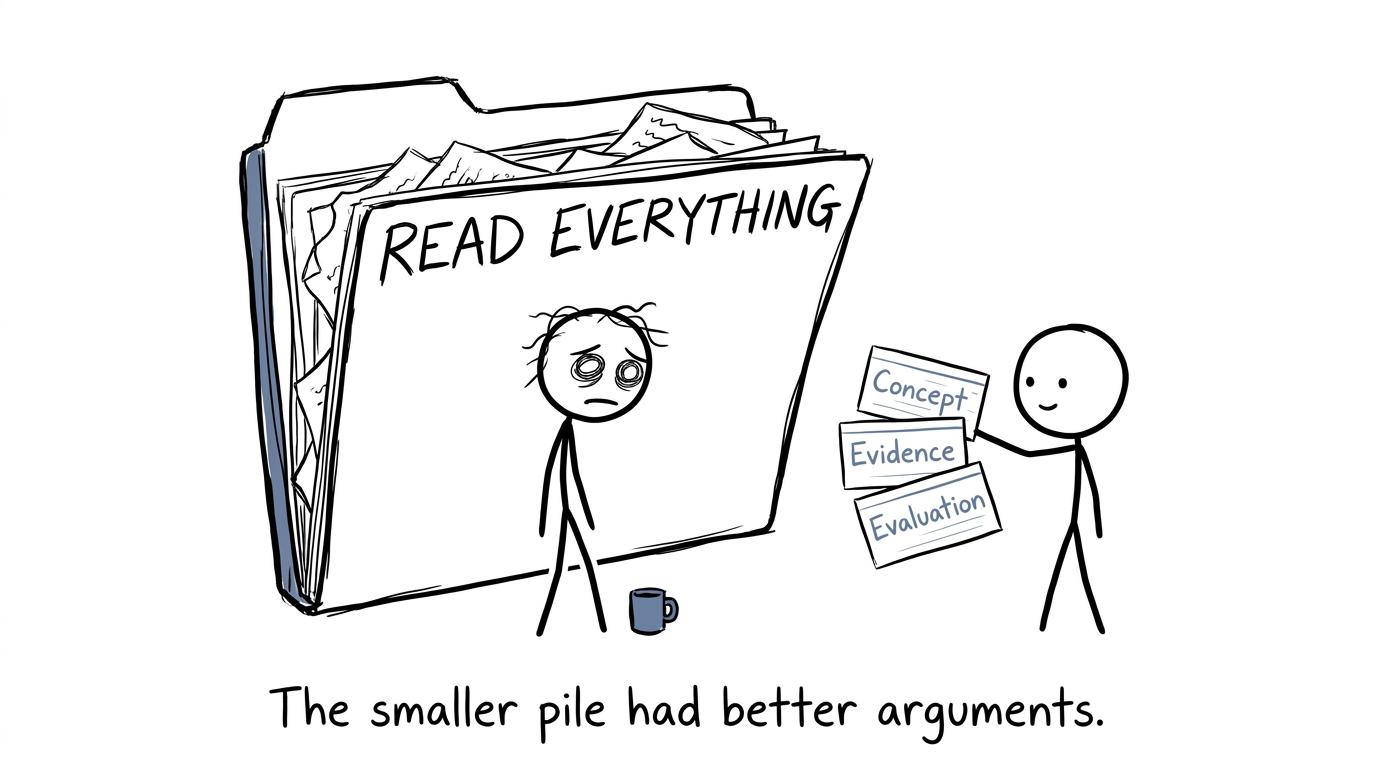 A student discovers that three useful revision cards can beat an enormous folder
Build knowledge that can survive a closed book
A familiar page creates a comforting feeling: I know this. An exam asks a harder question: Can you produce it unaided?
For each specification point, create a compact retrieval prompt. A useful card might ask for:
- the meaning of a concept;
- one relevant theory or perspective;
- named or specific supporting evidence where required by your course;
- one criticism or alternative explanation;
- a link to research methods or the question context.
Answer aloud or on paper before checking your notes. If your response is vague, shorten the material and test it again. The aim is not to make hundreds of cards. It is to create prompts that reveal whether you can retrieve usable knowledge.
Interleave topics once the basics are secure. A revision session might combine one families question, one crime concept and one research-methods prompt. That forces you to identify the correct knowledge rather than relying on the chapter heading as a clue.
This habit works across subjects. MathsGenie's guide to GCSE revision for students who struggle to start uses a similar cycle: learn briefly, attempt questions, mark immediately and fix one precise weakness. For Sociology, substitute definitions, evidence and paragraph planning for mathematical methods.
Turn knowledge into application
Students hovering below a grade 6 often know more than their answers show. The missing step is application.
Application means selecting material that addresses the wording, source, item or social group in the question. It is not achieved by copying a phrase from the item and returning to a rehearsed essay.
Before writing, identify:
- the command word;
- the topic and social group;
- any source or item you must use;
- the number of separate ideas required;
- whether the question asks for knowledge, explanation, evaluation or judgement.
Then make each paragraph answer the exact question. Name the relevant idea, explain the sociological link and connect it explicitly to the context. If a paragraph could be pasted unchanged into several unrelated answers, its application is probably too weak.
A useful practice drill is to plan three questions on the same topic with different wording. You will quickly notice which facts are genuinely flexible and which paragraphs have merely been memorised.
Improve evaluation without writing empty criticism
Evaluation is not the word “however” followed by an unrelated fact. Strong evaluation tests the argument.
Depending on the question, you might consider:
- evidence that supports or challenges a perspective;
- whether an explanation overlooks class, gender, ethnicity or another relevant difference;
- an alternative sociological theory;
- weaknesses in the research method behind a claim;
- whether evidence is outdated or difficult to generalise;
- the relative importance of competing explanations.
After presenting a criticism, explain why it matters. Does it weaken the whole argument, limit it to certain groups or suggest that another explanation is more convincing?
Conclusions should also do more than repeat the introduction. Reach a direct judgement and justify it using the argument developed in the answer. A qualified conclusion is often stronger than an absolute one because social explanations commonly interact.
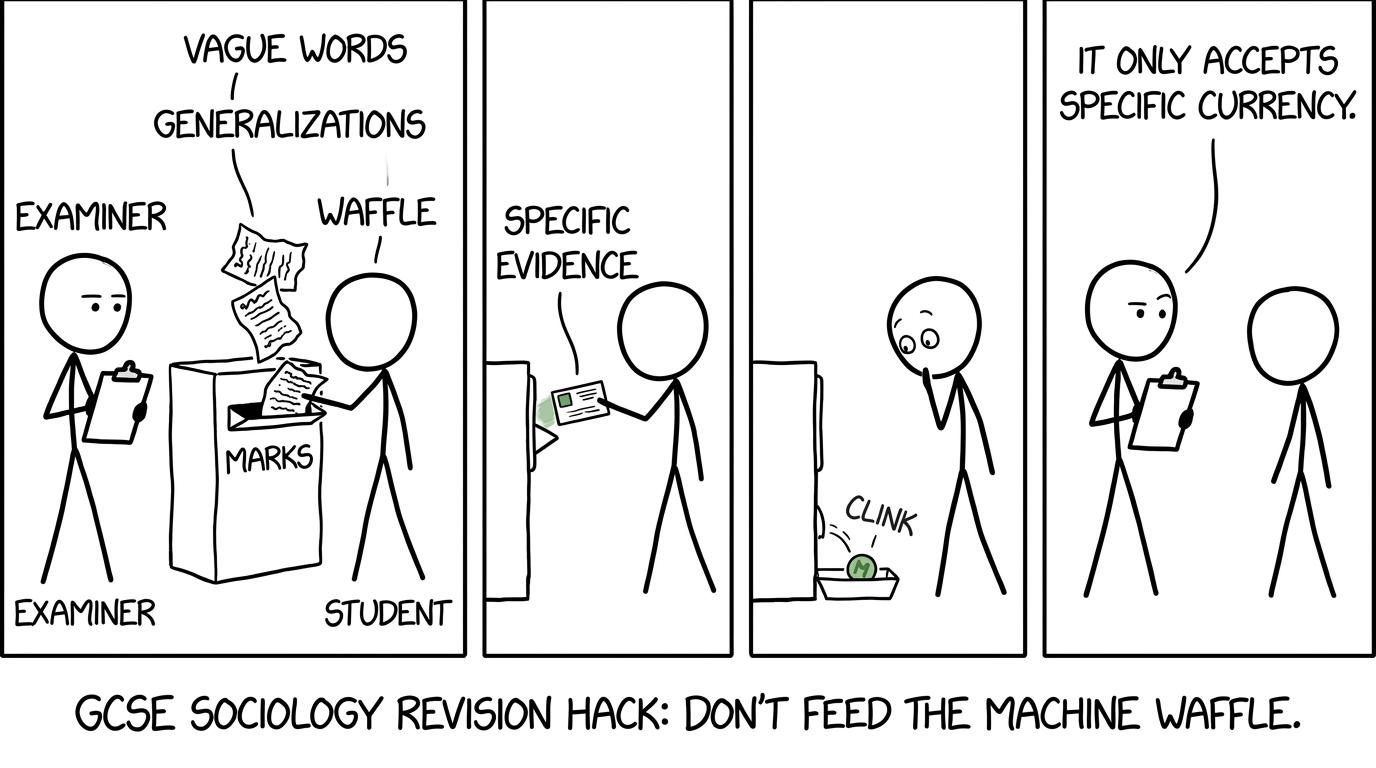 An examiner's marks machine accepts specific evidence rather than vague words
Treat research methods as mark-winning content
Research methods can feel detached from families, education or crime. In the exam, they are often connected.
Know the distinctions between primary and secondary data, qualitative and quantitative data, and common sampling approaches. For each method, revise practical, ethical and theoretical considerations. Reliability, validity and representativeness should be understood as ideas you can apply, not isolated definitions.
When evaluating a method, connect the issue to the proposed study. An interview may produce detailed qualitative data, for example, but the importance of that detail depends on the research aim and participants. Generic lists of advantages and disadvantages are less effective than contextual reasoning.
Research methods should appear every week in your plan. Leaving them until the end creates two problems: the content remains insecure, and you miss opportunities to use methodological evaluation in broader answers.
Use past papers as diagnosis, not decoration
Completing a paper is only the first half of the task. The improvement happens afterwards.
Start with individual questions or timed sections. Use your board's official papers and marking materials, then record each lost mark under one of four headings:
- missing knowledge;
- weak application;
- limited analysis or evaluation;
- timing or question interpretation.
Write a next action beside every important error. “Revise education” is too broad. “Retrieve three explanations for class differences in achievement, then plan one item-based response” is useful.
MathsGenie's article on using GCSE mark schemes as a revision coach explains the feedback principle well. Although the examples concern maths, the habit transfers: find the first place your answer stopped meeting the scheme, write a short correction and attempt another question requiring the same skill.
As exams approach, move from untimed plans to timed sections and then full papers. The guide to when GCSE students should start past papers can help you organise those phases without using all your papers too early.
Follow a weekly grade 6 revision routine
A realistic week is better than an ambitious plan abandoned after two days.
Two knowledge sessions
Choose one or two specification areas. Retrieve definitions, theories, evidence and criticisms without notes, then check and correct them.
One application session
Use items, sources or differently worded questions. Practise selecting knowledge rather than writing everything you remember.
One exam-writing session
Complete a timed set containing both short and extended responses. Mark it carefully and annotate where AO1, AO2 and AO3 were demonstrated.
One repair session
Return to your mistake log. Reattempt weak questions or write fresh plans on the same skills. This session is often more valuable than starting another topic.
If planning is difficult, adapt the structure in MathsGenie's one-week GCSE revision plan. You can also borrow the diagnose-and-retest approach from the guide to finding your weakest GCSE topics.
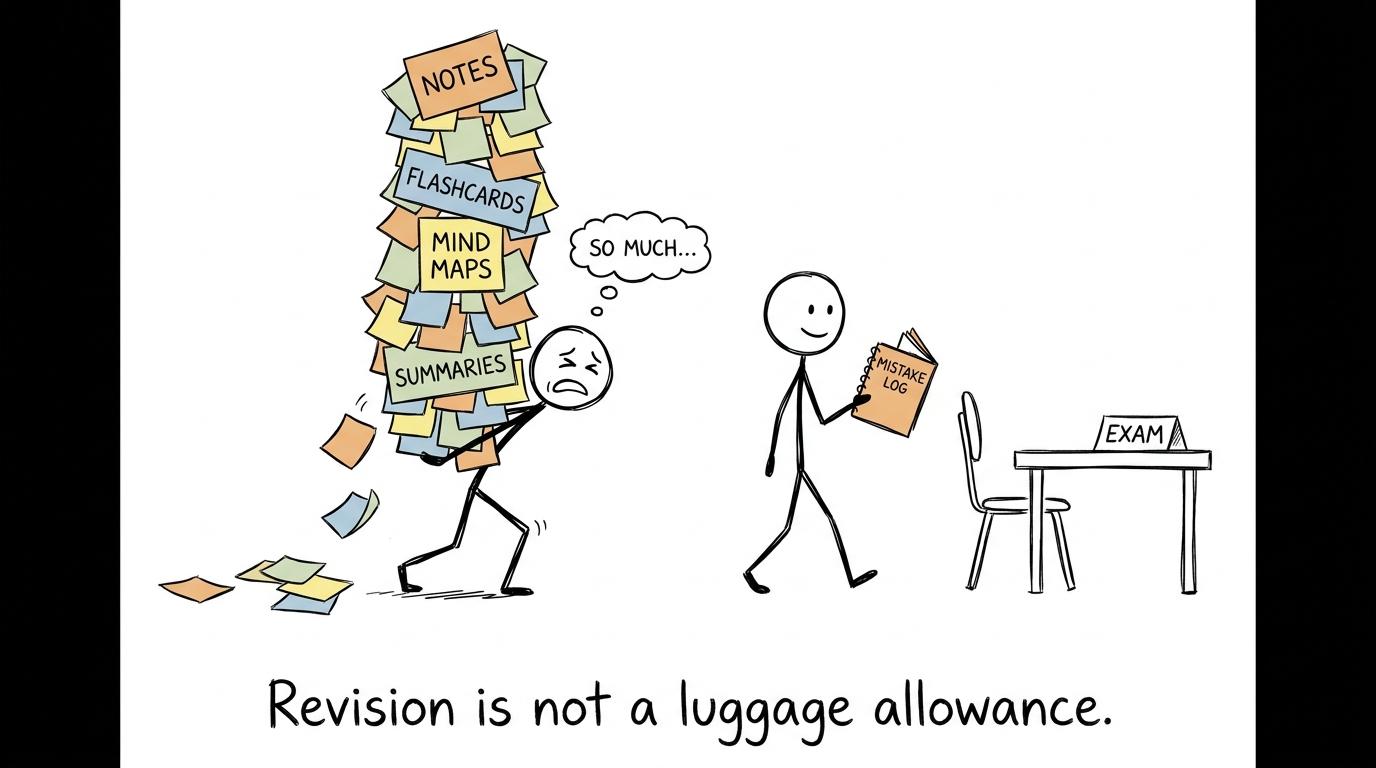 A small mistake log wins a race against an enormous tower of revision notes
Common mistakes that keep students below grade 6
Rewriting the textbook
Long notes can consume revision time without testing memory. Compress the content, close the book and retrieve it.
Naming a theory without explaining it
A label is not an argument. Explain what the perspective claims and why it answers the question.
Using vague evidence
Phrases such as “a study showed” rarely demonstrate secure knowledge. Learn the precise evidence required by your course and connect it accurately to the claim.
Treating every question like an essay
Short questions require disciplined, proportionate answers. Follow the command word and use the marks available to judge the likely depth.
Adding disconnected evaluation
A memorised criticism earns little if it does not test the argument being discussed. Explain the consequence of the criticism.
Ignoring research methods
Methods are part of the course, not an optional final chapter. Revise and apply them regularly.
Counting papers instead of correcting them
Five hurried papers may teach less than one paper reviewed properly. A paper is complete only when its main weaknesses have shaped your next revision tasks.
Depending on a predicted boundary
Boundaries change because papers differ in difficulty and are set after marking. Build consistent performance instead of aiming at an unofficial mark prediction.
Make the next revision session count
The distance between a grade 5 and a grade 6 is often made up of small, repeated improvements: a definition recalled precisely, an item used properly, an evaluation developed one sentence further, or a conclusion that finally makes a justified judgement.
Begin today with one specification topic and one exam question. Retrieve the content, attempt the question, mark it and schedule the repair. Then repeat the cycle.
MathsGenie does not provide GCSE Sociology lessons, but it can remain your free home base for the maths side of your GCSE timetable. Use the GCSE Maths revision hub for revision lessons, practice questions, past papers, predicted papers, mark schemes and video solutions. Shorter Edexcel GCSE Maths mini tests can keep maths moving while you protect focused time for Sociology.
Good revision is rarely dramatic. It is a quiet feedback loop, repeated until your answers become more precise, more relevant and easier to produce under pressure.