How to Get a Grade 6 in GCSE French
How to get grade 6 GCSE French: build vocabulary, grammar, listening and exam technique with a realistic weekly revision plan that improves marks steadily.
A student can spend an hour highlighting French vocabulary and still be unable to recall pourtant when the listening recording starts. That is the frustrating gap between recognising French and producing it under pressure.
If you are wondering how to get grade 6 GCSE French, the short answer is this: take Higher tier, develop reliable vocabulary and grammar, practise all four skills every week, and use marked exam questions to identify exactly where you lose marks. A grade 6 does not require flawless French. It requires broad understanding, clear communication and enough accuracy to perform consistently across listening, speaking, reading and writing.
The habits below are designed for students balancing French with GCSE maths and other subjects. They focus on changes that make revision measurable rather than simply longer.
Your grade 6 checklist
Use this as the foundation of your plan:
- Confirm that you are entered for Higher tier.
- Learn vocabulary through active recall, not repeated reading.
- Practise present, past and future time frames until they are dependable.
- Speak French aloud several times each week.
- Train listening with short audio extracts, transcripts and repetition.
- Complete reading, translation and writing tasks under time pressure.
- Mark every substantial task and keep an error log.
- Revisit mistakes until you can answer without support.
- Use papers from the correct exam board and specification.
The principle is familiar from effective maths revision: attempt, mark, diagnose, fix and retest. The MathsGenie revision planner can help you organise that cycle across both subjects.
Understand what a grade 6 requires
GCSE French is tiered. Foundation tier offers grades 1-5, while Higher tier offers grades 4-9, with a narrow grade 3 safety net for students who fall just below grade 4. Therefore, a grade 6 is only available through Higher tier. All components must be taken at the same tier.
Current GCSE French specifications assess four skills:
- listening;
- speaking;
- reading;
- writing.
For current AQA, Pearson Edexcel and Eduqas specifications, each component contributes 25%25\%25% of the qualification. The exact order, timings and task formats vary between exam boards, so check whether you take AQA, Pearson Edexcel, OCR or Eduqas before choosing practice material.
The reformed specifications first assessed in summer 2026 also place clear emphasis on prescribed vocabulary, grammar, dictation and reading aloud. For example, current specifications use a core of approximately 1,2001,2001,200 lexical items at Foundation tier, with a further 500500500 at Higher tier. That does not mean memorising a dictionary. It means knowing common words well enough to recognise and use them in different contexts.
There is no permanent percentage that guarantees grade 6. Grade boundaries are set after each examination series and can change with paper difficulty. Use recent boundaries only as a rough reference, and judge progress across several marked papers rather than one score.
Replace passive vocabulary revision with retrieval
Vocabulary creates the ceiling for listening, reading, speaking and writing. Yet copying a list is weak preparation because the exam asks you to retrieve meaning without seeing the answer first.
A stronger routine is:
- look at the English word and produce the French;
- reverse the direction and translate French into English;
- say the word aloud;
- put difficult words into short, reusable sentences;
- revisit missed words after a delay;
- mix topics once individual sets become familiar.
Prioritise common verbs, opinion phrases, connectives, question words, negatives, time expressions and vocabulary from the official list for your tier. These words travel between topics. A secure verb can help in a discussion about school, holidays, technology or the environment.
Do not abandon a word after recalling it once. Keep a small “not secure yet” deck and remove an item only after several successful recalls on different days.
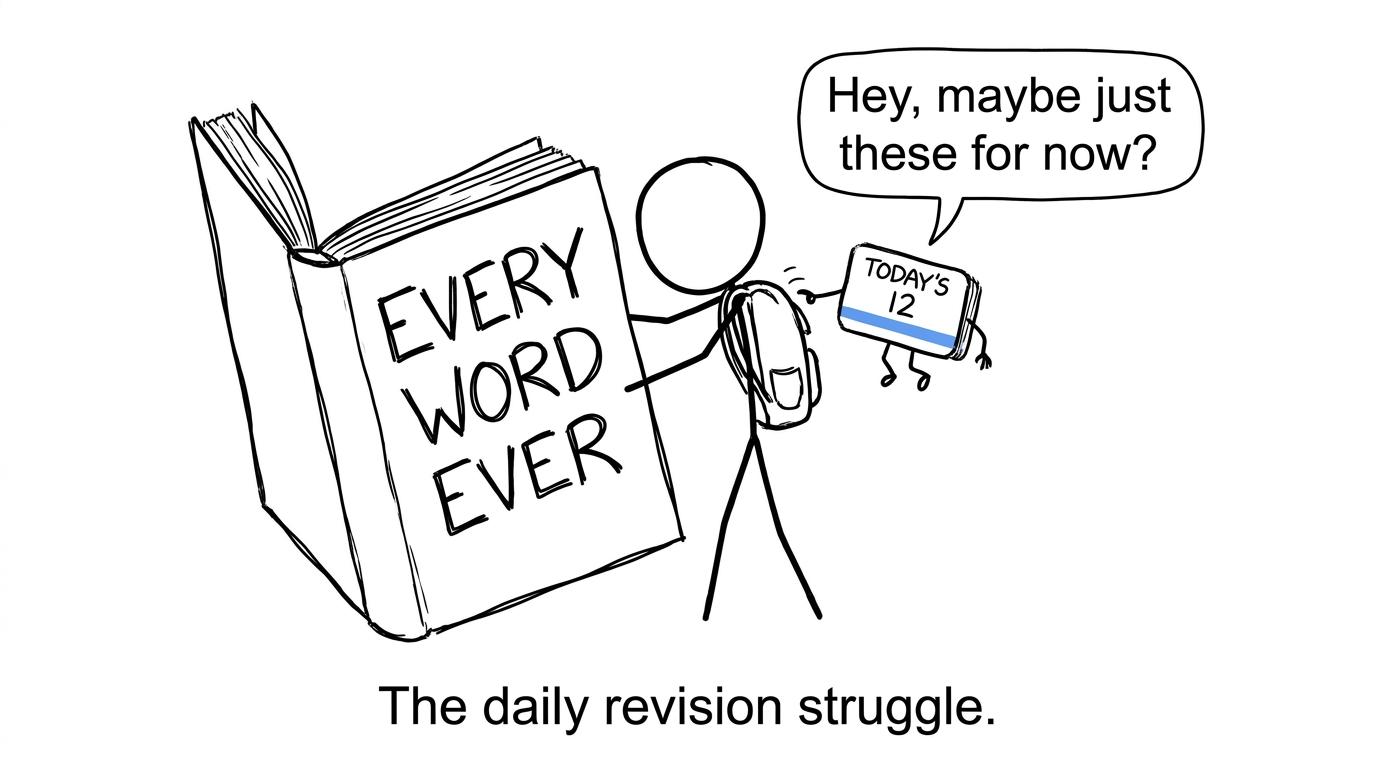 A student choosing a manageable daily flashcard deck instead of every French word
This is the same reason short tests work in maths: retrieval reveals what familiarity hides. Maths students can see that approach in the GCSE mini tests, which provide a useful model for creating brief French vocabulary and grammar checks.
Build a small grammar system you can trust
Students aiming for grade 6 often know plenty of French but lose control when sentences become longer. The answer is not necessarily more ambitious language. It is greater control over essential structures.
Focus first on:
- accurate present-tense forms of frequent verbs;
- the perfect tense for completed past events;
- a reliable future form;
- adjective agreement;
- negatives;
- pronouns and possessive adjectives;
- infinitive constructions;
- question formation;
- common irregular verbs.
Keep a grammar error log with three columns: the mistake, the corrected form and the reason. Review recurring patterns weekly. If adjective agreement appears repeatedly, that deserves a focused session; it should not remain a vague instruction to “be more accurate”.
In writing and speaking, controlled variety is usually safer than forcing elaborate phrases you cannot adapt. Build flexible sentence frames, but change their person, tense and topic during practice. Memorised paragraphs can collapse when the question is slightly different.
Train listening as a skill, not a test
Listening can feel unfair because spoken French disappears immediately. But that is precisely why replaying entire papers without analysis produces limited improvement.
Use short extracts and follow this sequence:
- listen once for the overall situation;
- listen again for names, times, opinions, negatives and changes of mind;
- write down the sounds or words you can identify;
- check the transcript;
- identify why you missed the answer;
- listen again without the transcript;
- repeat or shadow a short section aloud.
Classify mistakes carefully. Did you not know the word? Did you know it on paper but fail to recognise its pronunciation? Did a negative reverse the meaning? Did you write the first opinion before the speaker changed their mind?
Dictation now appears in reformed GCSE French assessments, making sound-to-spelling practice especially valuable. Short, frequent practice is better than waiting until a full listening paper feels manageable.
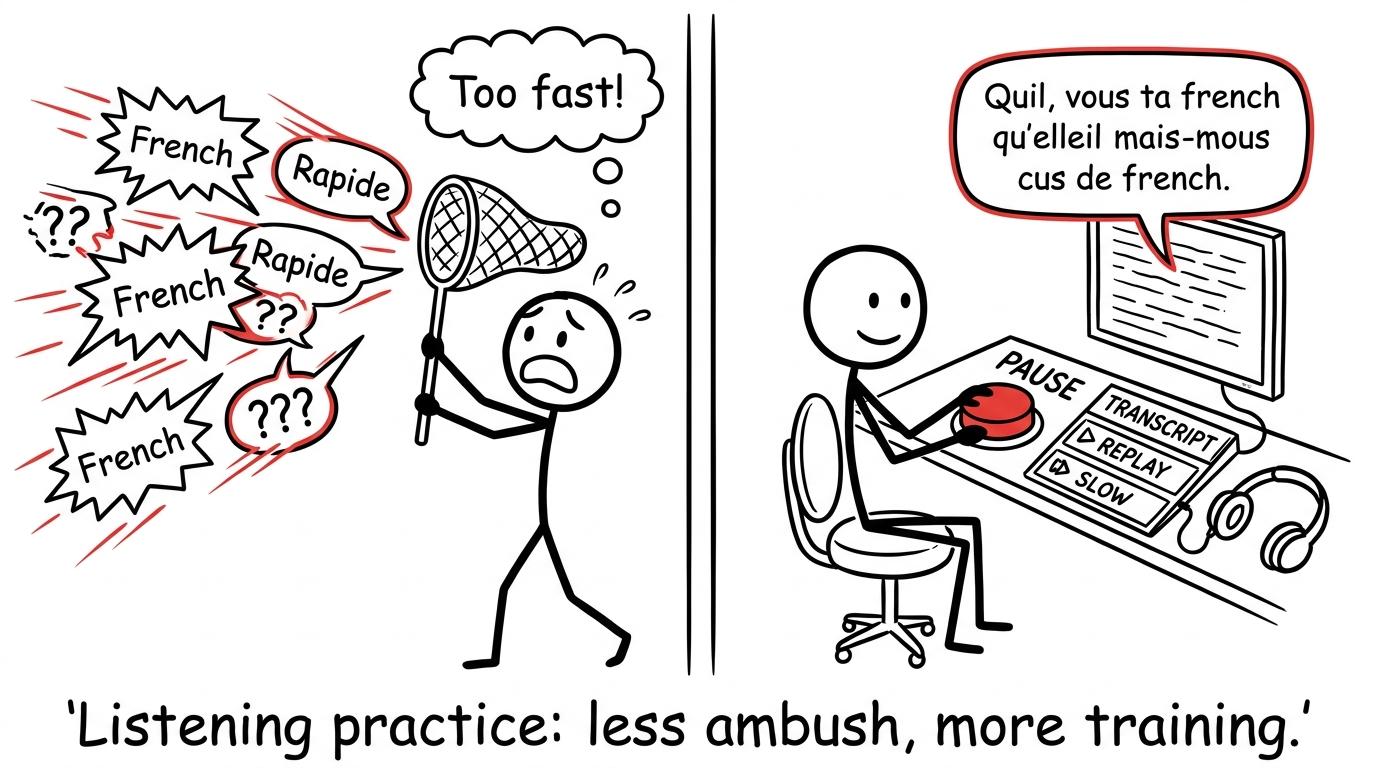 A student turning fast French listening into controlled replay practice
Make speaking ordinary
Speaking improves when it stops being reserved for the mock examination. Spend a few minutes speaking aloud on most revision days. Describe a photograph, answer a topic question, read a passage or record a short response and listen back.
Current speaking assessments can include reading aloud, role play, visual stimuli and unprepared conversation, although precise arrangements depend on your board. Preparation should therefore cover pronunciation and spontaneous communication rather than only memorised answers.
When practising, check whether you:
- answered the actual question;
- gave an opinion and reason;
- referred to more than one time frame where appropriate;
- pronounced key sounds clearly;
- recovered when you forgot a word;
- asked a question when the task required one.
A hesitation is not a disaster. Silence caused by searching for the perfect sentence is usually less useful than a simpler sentence communicated clearly.
Improve reading and translation deliberately
Reading practice should move beyond finding words you already recognise. Train yourself to notice negatives, pronouns, time markers, contrasting connectives and the difference between fact and opinion.
When an unfamiliar word appears, use its position, surrounding grammar and wider context before guessing. Current specifications explicitly assess the ability to infer plausible meanings in context.
For translation, preserve meaning before elegance. Check every detail after completing the first draft: person, tense, negative, adjective, quantity and time expression. Avoid inserting information that is not present in the source.
Begin with untimed accuracy, then introduce timed sections. The staged approach mirrors the advice in when to start GCSE past papers: develop the component skills before expecting consistent full-paper performance.
Turn writing feedback into your next revision session
A corrected writing task is valuable only if it changes the next one. After receiving feedback, sort each issue into a category:
- vocabulary gap;
- verb or tense error;
- agreement error;
- misunderstood bullet point;
- weak development;
- inaccurate translation;
- poor time management.
Then rewrite only the affected sentences before producing another response on a different topic. This forces you to transfer the correction rather than copy it.
Plan before writing. Identify every bullet point, choose suitable time frames and reserve a few minutes for checking. During the final check, look specifically for the errors in your log. General proofreading often misses familiar mistakes; targeted proofreading is more effective.
Follow a weekly grade 6 revision routine
A manageable week might include:
| Session | Main focus | Useful outcome |
|---|---|---|
| Monday | Vocabulary retrieval and pronunciation | A short list of words to revisit |
| Tuesday | Grammar and sentence manipulation | One recurring grammar weakness corrected |
| Wednesday | Listening and dictation | Misheard sounds added to the error log |
| Thursday | Speaking or reading aloud | A recorded response checked for clarity |
| Friday | Reading and translation | One timed extract marked carefully |
| Weekend | Writing or a mixed paper section | Exam feedback converted into next steps |
This need not replace your maths revision. Put both subjects into one realistic timetable using the GCSE maths revision timetable approach or adapt the one-month GCSE revision plan. The subject content differs, but the structure transfers: retrieval, focused practice, feedback and spaced retesting.
French-specific sample and past papers should come from your exam board or school. Check the year and specification carefully, especially because courses first assessed from 2026 introduced new task formats. Use older material selectively for general language practice rather than assuming it matches your current paper.
Common mistakes that keep students below grade 6
Revising only the strongest skill
Reading may feel comfortable, while speaking feels awkward. That is exactly why speaking needs scheduled practice. With each component carrying substantial weight, one neglected skill can limit the overall result.
Learning complete answers word for word
Memorisation can create confidence but weak adaptability. Learn flexible structures and vocabulary, then practise applying them to unfamiliar questions.
Treating mistakes as a final judgement
A low practice mark is information. The useful question is not “Am I grade 6?” but “Which repeated errors are keeping these marks unavailable?” This diagnostic mindset is central to the MathsGenie past papers system.
Using the wrong tier or specification
A grade 6 requires Higher tier. Make sure every timed paper matches your exam board, tier and current specification.
Doing papers without fixing weaknesses
Completing another paper can feel productive while preserving the same mistakes. Mark the task, select the most costly patterns and practise those before attempting another full paper. Maths students can see the same principle in how to use GCSE past papers properly.
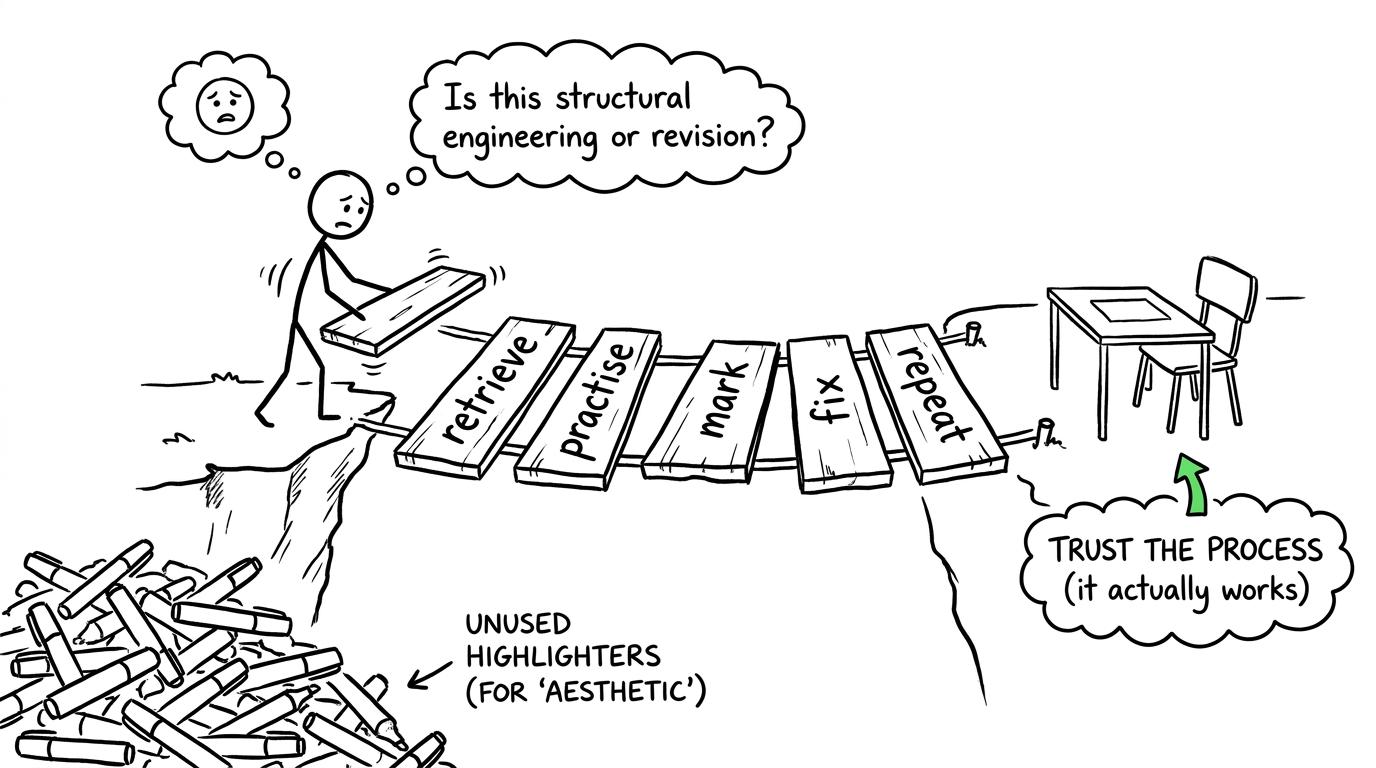 A student building an exam bridge from retrieval, practice and feedback
Make grade 6 the result of a repeatable process
The jump to grade 6 rarely comes from one spectacular revision weekend. It comes from making French easier to retrieve: vocabulary seen repeatedly, grammar corrected deliberately, audio replayed with purpose and speaking made normal.
Start with one diagnostic task from your French exam board. Record where the marks went, choose two weaknesses and schedule their return. Then use the MathsGenie GCSE revision hub to apply the same disciplined process to maths through free revision lessons, practice questions, mini tests, past papers, predicted papers, mark schemes and video solutions.
Your subjects are different, but the route to improvement is remarkably similar. Practise what the exam asks you to do, study the feedback and return to the weakness before it has time to become permanent.