

How Stressful Is GCSE English Language vs Other GCSEs?
How stressful is GCSE English Language? See how it compares with maths, science and other GCSEs, then learn practical ways to reduce exam pressure.
The difficult thing about GCSE English Language is that you cannot memorise the exact text waiting in the exam. You walk into the room knowing the skills, but not the words you will meet. That uncertainty explains much of the anxiety behind the question: how stressful is GCSE English Language compared with other GCSEs?
The short answer is that students commonly regard it as one of the more stressful GCSEs, but not usually the single most stressful. In a recent student exam-anxiety survey, English Language ranked fifth, behind biology, chemistry, maths and computer science. That is useful context, but not an official national league table. Stress is personal, and rankings change according to who is surveyed and how the question is asked.
For students already preparing for maths, the comparison is especially helpful. Maths often creates stress through right-or-wrong answers and accumulated knowledge gaps. English Language creates a different pressure: unseen material, extended writing, interpretation and tight timing.
The quick comparison
Here is the clearest way to think about English Language stress:
- Usually high, but not consistently the highest: student reports often place sciences and maths above it.
- More stressful than many option subjects for some students: it is compulsory, important for future progression and based heavily on timed examinations.
- Different from English Literature: Language has unseen texts and writing tasks rather than a set collection of novels, plays and poems to revise.
- Different from maths: there is no foundation or higher tier in GCSE English Language, and answers can feel less objectively right or wrong.
- Highly dependent on the student: confident writers may find it manageable, while students who dislike ambiguity or extended writing may find it exhausting.
The practical lesson is not to decide which subject is objectively worst. It is to identify what type of pressure each subject creates, then practise that exact pressure in controlled amounts.
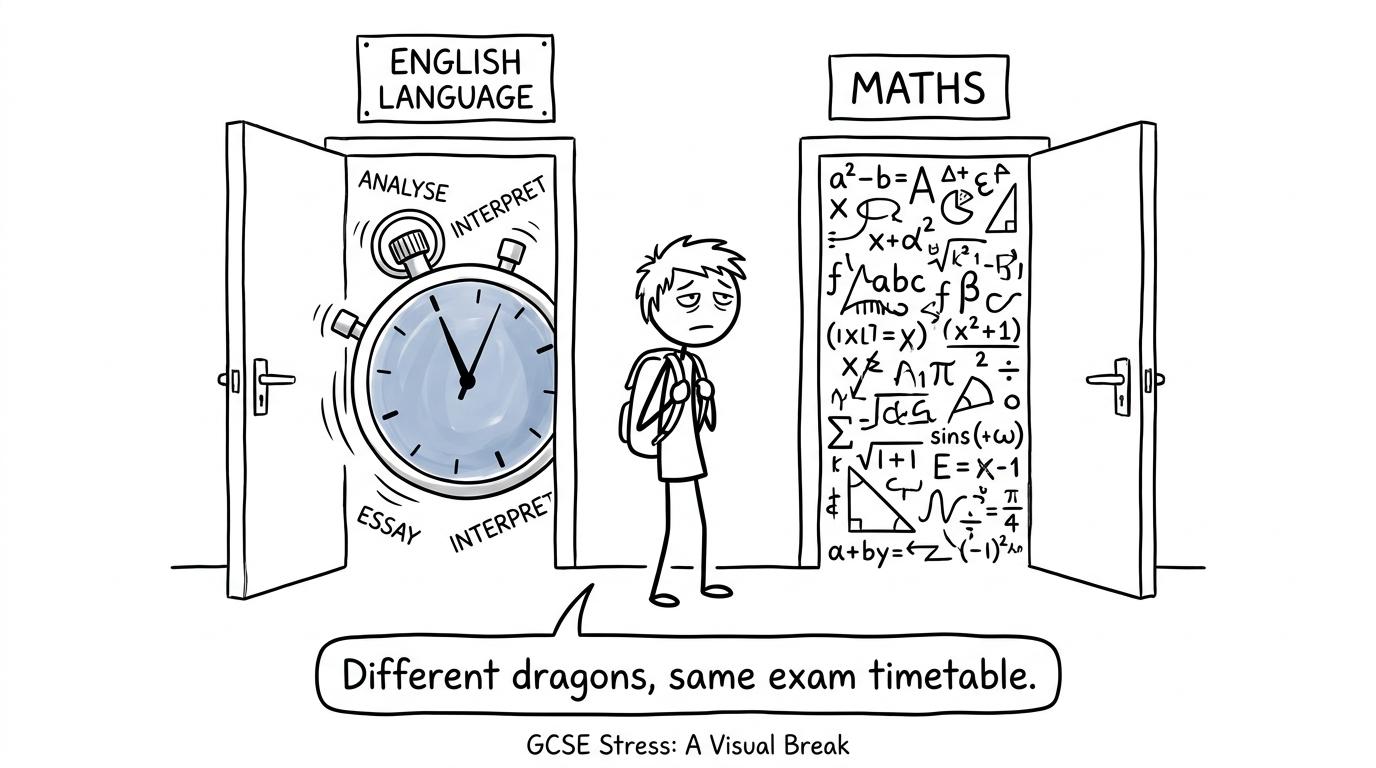 A GCSE student choosing between different exam dragons
Where GCSE English Language tends to rank for stress
There is no authoritative Ofqual ranking of GCSE subjects from most to least stressful. Available comparisons generally come from student surveys, forum activity or self-reported anxiety, so they should be treated as signals rather than permanent facts.
One recent student survey placed the most anxiety-inducing subjects in this order near the top:
| Reported position | Subject |
|---|---|
| First | Biology |
| Second | Chemistry |
| Third | Maths |
| Fourth | Computer science |
| Fifth | English Language |
English Language was reported above business, economics, art, physics and English Literature in that particular survey. Other analyses of student discussions have produced different orders, with content-heavy sciences, computing and coursework-heavy subjects appearing prominently. The sensible conclusion is modest: English Language belongs in the higher-stress group, but student reports do not establish it as the hardest or most stressful GCSE for everyone.
There is also a difference between difficulty and stress. A student can understand English well and still feel stressed by the clock. Another may find algebra difficult but feel calmer because every maths topic has a defined method. Perceived familiarity, difficulty and the importance attached to an assessment can all influence anxiety.
Why GCSE English Language feels stressful
The texts are unseen
Across the main English exam boards, students are assessed using unseen material. You can prepare analytical and writing skills, but you cannot learn the examination passages in advance.
That creates a particular kind of uncertainty. Revision does not always feel as concrete as memorising quotations for English Literature or practising a known procedure in maths. Yet the underlying question types and assessment objectives are predictable. Past-paper practice turns an unfamiliar text into a familiar process.
Timing combines reading, thinking and writing
English Language requires several activities at once. You must read accurately, interpret implications, select evidence, plan a response and write clearly. Extended answers also need enough development to access higher levels of the mark scheme.
The exact format depends on the specification. AQA uses two written papers lasting one hour and 45 minutes each. OCR uses two papers lasting two hours each, while Eduqas uses papers of different lengths and weightings. Students should therefore learn the timings and question structure for their own board rather than borrowing a friend’s strategy.
Marking can feel less predictable
In maths, a correct method and answer normally have a visible relationship with the marks. English responses are assessed against levels and objectives involving analysis, evaluation, communication and technical accuracy. There can be more than one defensible interpretation, provided it is supported convincingly.
This does not mean English marking is random. It means that improvement comes from understanding what the assessment objectives reward, comparing responses with mark schemes and learning how precise evidence supports a line of reasoning.
The qualification carries emotional weight
English Language is a compulsory GCSE, graded from 999 to 111, and it is untiered. Unlike GCSE maths, there is no choice between foundation and higher tier. Everyone sits the same qualification, although exam boards structure their papers differently.
Because English and maths are frequently central to post-161616 progression requirements, students may attach more importance to them than to some optional subjects. Higher perceived stakes can make an ordinary examination feel much larger.
English Language compared with GCSE maths
English Language and maths can both be stressful, but they usually expose different fears.
| GCSE English Language | GCSE maths |
|---|---|
| Unseen texts create uncertainty | Unfamiliar problem-solving creates uncertainty |
| Responses require interpretation | Questions often lead towards defined answers |
| Extended writing increases time pressure | Multi-step calculations increase time pressure |
| One untiered qualification | Foundation and higher tiers |
| Skills are applied across whole responses | Knowledge gaps can often be traced to specific topics |
Maths stress often grows quietly. A weak understanding of fractions may later affect ratio, percentages, probability and algebra. English stress can arrive more suddenly when a difficult extract appears or a writing task feels uninspiring.
The solution for both is remarkably similar: reduce the size of the unknown. For maths, use the GCSE maths revision hub to choose the correct exam board and turn a vague worry into named topics. If you are unsure where the gaps are, follow the weakest-topics diagnostic process rather than revising everything equally.
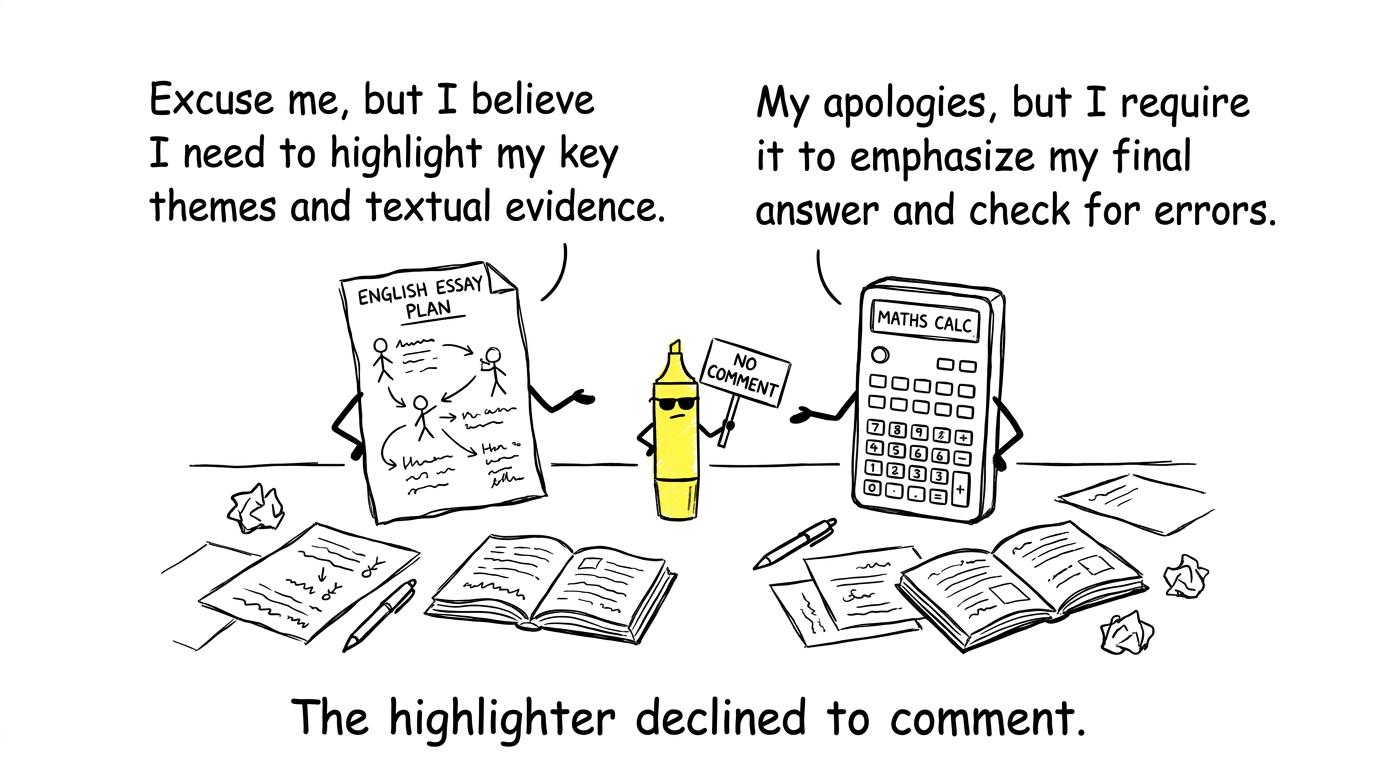 An English plan and calculator competing for a highlighter
How it compares with science, humanities and creative subjects
Science subjects frequently rank highly in student stress reports because they combine substantial content with application, calculations and practical knowledge. Biology can feel especially dense; chemistry links abstract models with equations; physics demands both conceptual and mathematical confidence.
Humanities create another form of pressure. History and geography involve knowledge, interpretation and longer responses, although the balance varies by specification. Students may find them stressful because remembering content is only the beginning; it must then be selected and shaped around the question.
Creative subjects can be stressful over a longer period. Art, design and performance courses may involve portfolios, practical work or non-examined assessment. Their pressure can build through deadlines rather than being concentrated entirely in written papers.
English Language sits between these experiences. It does not demand the same volume of set content as some sciences or humanities, but its unseen texts and extended writing concentrate a great deal of judgement into the examination room.
A revision approach that lowers stress across subjects
Separate workload from worry
A large revision timetable can look reassuring while hiding the real problem. Instead, write down the specific source of stress for each subject:
- English Language: finishing the final writing task
- Maths: equations involving fractions
- Biology: recalling required practicals
- History: selecting evidence for essays
A named problem can become a practice task. An unnamed problem remains a cloud.
Practise the format, not just the content
For English, use papers from your own exam board and rehearse reading, planning and writing within the correct time. For maths, choose board-specific material such as Edexcel GCSE maths past papers, AQA GCSE maths past papers or OCR GCSE maths past papers.
Not every session needs to reproduce a complete exam. A section, mini test or short timed response can train one part of the performance without exhausting you.
Build a feedback loop
The most useful revision loop is simple:
- attempt a question without help;
- check it against a mark scheme or model;
- identify the exact weakness;
- practise that weakness;
- return to a similar question later.
MathsGenie brings together free GCSE revision resources, including revision lessons, practice questions, mini tests, predicted papers, mark schemes and video solutions. If a full evening feels impossible, the 20-minute maths revision routine provides a smaller starting point.
Plan for the whole exam season
English Language is rarely the only source of pressure. A strong plan must account for the fact that several GCSEs compete for the same time and energy.
Use the one-month GCSE maths revision plan as a model for breaking preparation into diagnosis, focused topic work, timed practice and final review. Apply the same rhythm to English: identify the weakest paper skill, practise it, check the feedback and revisit it.
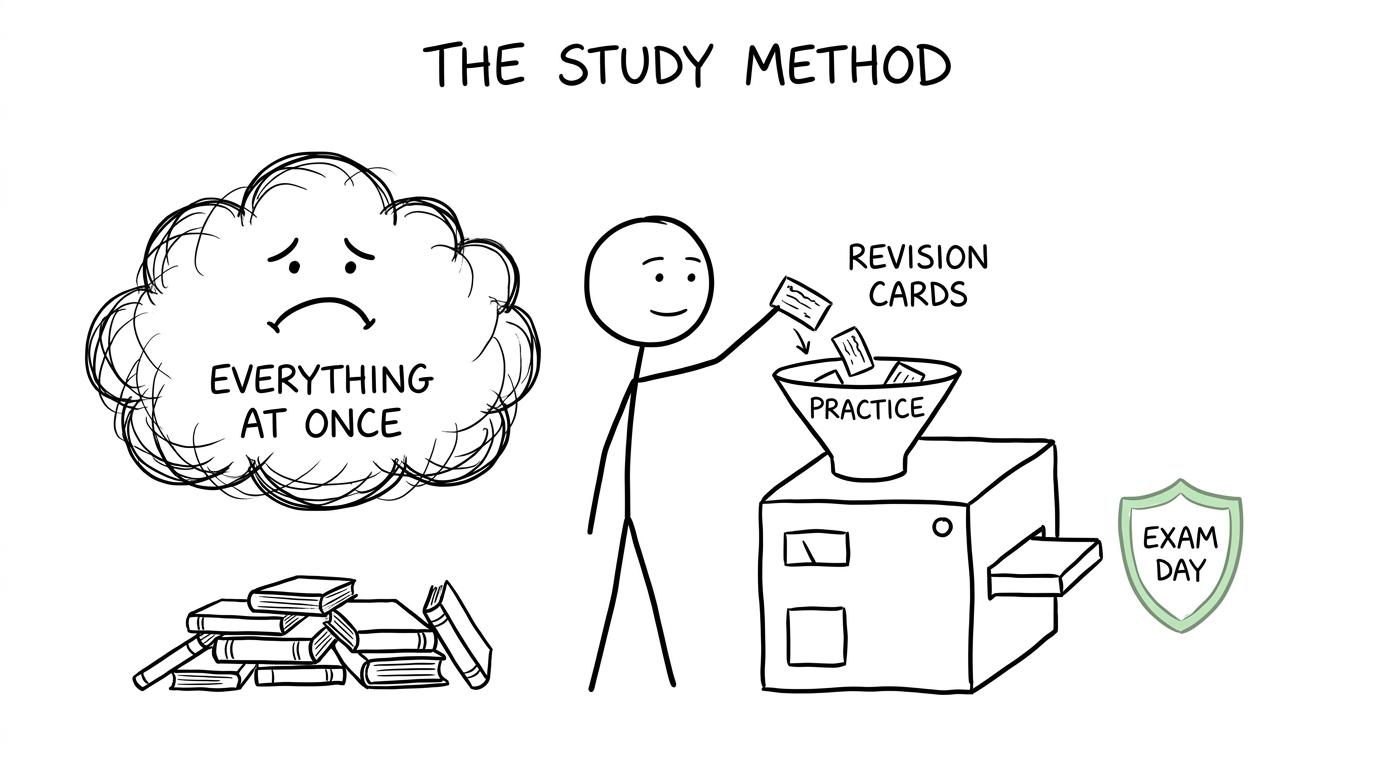 Small practice sessions turning into an exam-day shield
Common mistakes when managing GCSE stress
Treating a subject ranking as a prediction
If other students call English Language stressful, that does not predict your result. Rankings describe groups. Your own mocks, teacher feedback and timed practice provide better evidence about your needs.
Revising English by reading notes alone
Knowing persuasive techniques or language terminology is not the same as producing a timed response. English revision needs active reading and writing, just as maths revision needs completed calculations rather than watched solutions.
Completing papers without reviewing them
A paper is only useful when it changes the next revision session. Record whether lost marks came from knowledge, interpretation, accuracy, timing or misunderstanding the command word.
Giving every subject equal time
Equal time can feel fair but may be strategically poor. Give more attention to repeated weaknesses while keeping stronger subjects active through shorter retrieval sessions.
Responding to panic with an extreme timetable
An unrealistic plan creates another test to fail. Choose a daily minimum that remains possible on a difficult day, then add more when energy allows. Consistency is calmer than repeatedly starting again.
Stress is information, not a subject grade
So, how stressful is GCSE English Language? Student reporting suggests it is often among the more stressful GCSEs and may sit just below maths and the most anxiety-inducing science or computing subjects. But there is no universal ranking, and the reason matters more than the position.
If unseen texts worry you, practise unseen texts. If timing worries you, rehearse sections under time. If maths is consuming the rest of your revision energy, make it more structured rather than simply making it longer.
Start with the MathsGenie GCSE maths revision hub. Choose your exam board and tier, use revision lessons and practice questions to repair weak topics, then build confidence with mini tests, past papers and predicted papers. Mark honestly, use the video solutions when a method is unclear, and let each mistake decide the next task.
Stress grows when everything feels unknown. Good revision makes the unknown smaller.










