

How Long Should You Revise GCSE Astronomy Per Week?
How long should you revise GCSE Astronomy per week? Build a realistic plan by months remaining, including maths practice, observations and exam skills.
Revision plans often fail in the same quiet way: the timetable looks impressive, but it asks for more hours than the week can hold. If you are searching how long revise GCSE astronomy per week, the practical answer is usually 1.51.51.5 to 333 hours of independent revision each week, rising to around 333 to 555 hours during the final two months.
That is a starting point, not a compulsory quota. The right amount depends on how many months remain, how secure your knowledge is and whether you still need to complete observational work. What matters most is not collecting hours. It is using each session to recall facts, answer questions, practise mathematical skills and correct mistakes.
GCSE Astronomy is currently offered by Pearson Edexcel. It is an untiered GCSE, so there is no foundation or higher paper. The qualification has two equally weighted written papers: Naked-eye Astronomy and Telescopic Astronomy. It also requires students to undertake at least one unaided and one aided observation, with observational knowledge and skills assessed in the written examinations.
Your weekly revision checklist
A balanced week should include:
- active recall of astronomical facts and definitions;
- mathematical practice involving units, standard form, graphs and formulae;
- exam-style questions followed by careful marking;
- review of one weak topic;
- observation planning, analysis or evaluation when required;
- a short return to older material so it is not forgotten.
Do not try to cover all of these in every session. Spread them across the week and keep the plan repeatable.
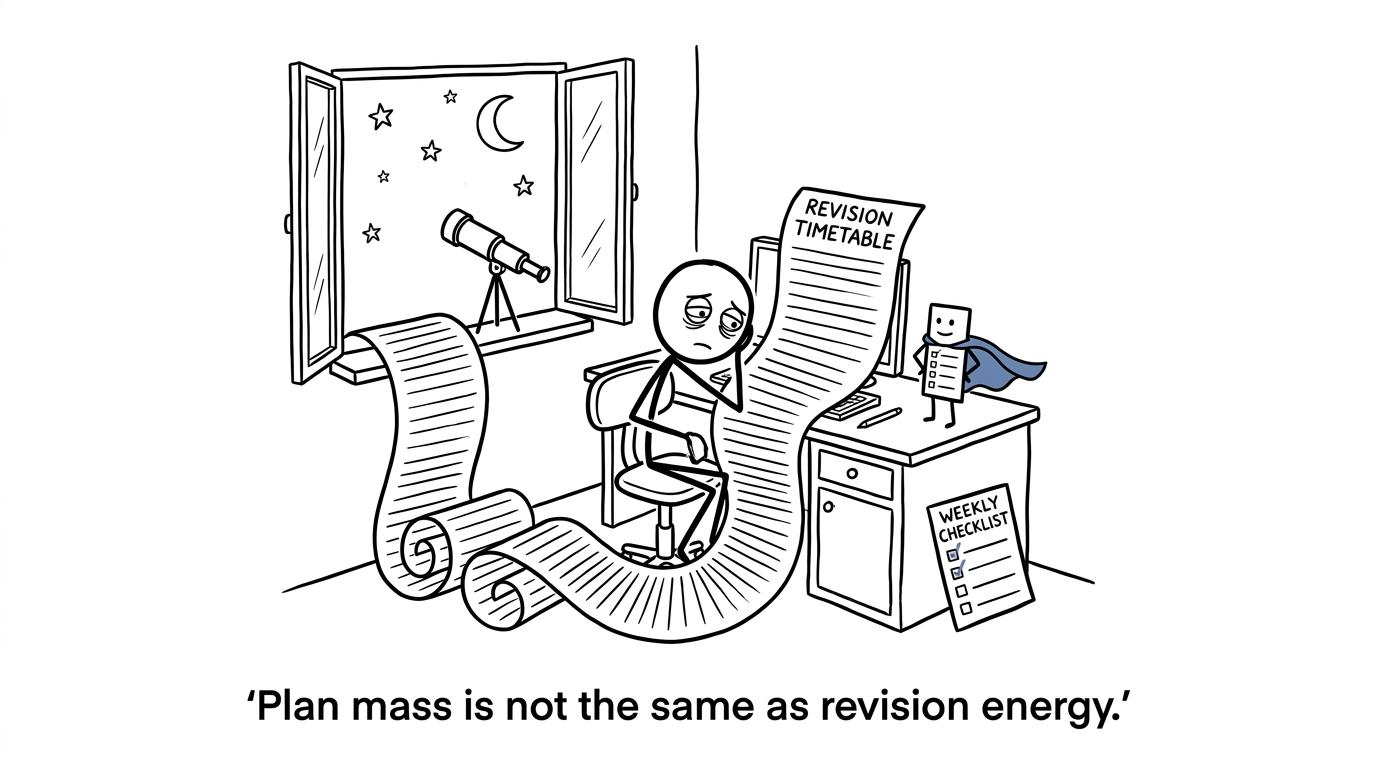 A huge revision timetable competes with a small sensible weekly checklist
How long to revise GCSE Astronomy based on time remaining
There is no official rule prescribing a number of independent revision hours per week. The estimates below are practical ranges. They sit outside your normal lessons and should be adjusted around your other GCSE subjects.
| Time before the exams | Suggested independent revision | Main priority |
|---|---|---|
| More than 666 months | 111 to 1.51.51.5 hours per week | Build knowledge and keep observation records organised |
| 333 to 666 months | 1.51.51.5 to 2.52.52.5 hours per week | Strengthen weak topics and begin regular exam questions |
| 666 to 121212 weeks | 2.52.52.5 to 444 hours per week | Combine topic repair with timed sections and past papers |
| Fewer than 666 weeks | 444 to 555 hours per week | Practise under time pressure and correct recurring errors |
| Final week | Around 333 to 444 focused hours in total | Recall, corrections and calm review rather than cramming |
These ranges assume you have followed most of the course. If you are learning substantial content independently, you may need more time. If your recall is already secure and your exam answers are consistently accurate, you may need less.
An extra hour is useful only when it solves a real problem. If fatigue means you are rereading the same page without remembering it, stopping is usually more productive than continuing.
More than six months to go
At this stage, consistency matters more than intensity. Two sessions of approximately 303030 to 454545 minutes can be enough. Use one for course content and the other for retrieval or mathematical practice.
This is also the time to take observational work seriously. Pearson's specification requires at least one unaided and one aided observation. Your school or centre manages the formal requirements, so follow your teacher's instructions and keep the necessary records as you go. Observation cannot always be postponed neatly: weather, visibility and access to equipment may affect when it can happen.
Three to six months to go
Move towards three shorter sessions each week. One might review a topic, another might focus on calculations or data, and a third might contain exam-style questions.
Begin recording why marks are lost. Categories such as knowledge, application, mathematics, units and evaluation are more useful than a page marked simply “wrong”. MathsGenie's guide to finding your weakest GCSE topics explains how to turn lost marks into a focused repair list.
Six to twelve weeks to go
This is the point where revision should become more exam-shaped. Aim for approximately 2.52.52.5 to 444 hours across the week, rather than one long weekend session.
Include timed sections from official GCSE Astronomy papers, then compare your responses with the relevant mark scheme. Do not wait until every topic feels complete. The principles in MathsGenie's guide to when to start GCSE past papers transfer well: papers are most valuable while there is still time to act on what they reveal.
After marking, return to the precise weakness. A paper diagnoses the problem; targeted practice repairs it.
Fewer than six weeks to go
A temporary rise to around 444 or 555 hours per week can be realistic, provided it does not damage sleep or consume the time needed for other subjects. Divide that total into manageable blocks.
Your week should now contain a mixture of:
- timed questions from both Astronomy papers;
- retrieval of facts, processes and definitions;
- calculation and graph practice;
- correction of previous responses;
- observational planning and evaluation questions;
- one longer timed section to build concentration.
Redoing selected questions can reveal whether a correction has lasted. The MathsGenie guide to redoing past papers shows why a gap between attempts is important: immediate familiarity can look like understanding when it is really memory of the answer.
Why GCSE Astronomy revision must include maths
Astronomy may feel like a science built around stars, telescopes and planetary systems, but mathematical fluency is part of the assessment. Ofqual's subject requirements state that at least 20%20\%20% of the total marks must reward mathematical skills at an appropriate level of demand.
Relevant skills include standard form, ratios, percentages, inverse-square relationships, logarithms, significant figures, means, unit conversion, graphs, angles and trigonometry. This does not mean you should revise mathematics in isolation. It means you should be able to use it inside an astronomical context.
Useful weekly priorities include:
- rearranging equations accurately;
- converting between astronomical and standard units;
- using suitable significant figures;
- interpreting gradients and scales;
- checking whether an answer has a sensible order of magnitude;
- showing enough working to make your method clear.
MathsGenie's free GCSE maths revision hub provides board-specific lessons, worksheets, question banks and revision guides for Edexcel, AQA, OCR, Eduqas, WJEC and CCEA. Your Astronomy GCSE is untiered, but your separate maths GCSE may be foundation or higher tier, so choose maths resources matching the paper you will actually sit.
A weekly structure that is easy to maintain
For a student aiming for roughly 333 hours per week, a sensible structure is:
| Session | Length | Focus |
|---|---|---|
| Topic recall | 404040 minutes | Retrieve key ideas, then check gaps |
| Mathematical skills | 353535 minutes | Units, formulae, graphs or standard form |
| Exam questions | 505050 minutes | Complete questions without notes |
| Mark and repair | 353535 minutes | Use the mark scheme and correct responses |
| Observation or mixed review | 202020 minutes | Review methods, data or an older topic |
The sessions do not need to happen on consecutive days. In fact, spacing them gives you repeated opportunities to retrieve knowledge after some forgetting has occurred.
If the plan is too large to repeat next week, reduce it. A modest routine completed regularly is more valuable than an ambitious timetable abandoned after three days.
Match revision time to evidence, not anxiety
Students often add hours when they feel worried. A better response is to collect evidence.
Use a topic test, a section of a past paper or questions selected by your teacher. Mark it carefully and ask:
- Which content could I not recall?
- Where did I misread the command word?
- Which calculations broke down?
- Did I include units and suitable precision?
- Could I analyse or evaluate an observation clearly?
- Was time pressure genuinely the problem?
Then allocate next week's revision accordingly. If most lost marks came from graph interpretation, another evening of reading about galaxies is unlikely to help.
 A student uses a telescope to find a tiny units monster hiding on the Moon
For your parallel GCSE maths preparation, MathsGenie's free predicted papers and topic resources can provide fresh diagnostic practice. Predicted papers should supplement official past papers rather than replace them, and they are maths resources rather than GCSE Astronomy papers.
Common mistakes when planning Astronomy revision
Counting passive reading as a complete session
Reading notes can refresh knowledge, but it does not prove that you can retrieve or apply it. Close the notes and write what you remember, answer questions or explain the idea in precise scientific language.
Ignoring observational skills until the end
Observational work is not an optional extra. Students need experience of designing, making, analysing and evaluating observations. Follow your centre's schedule and keep records organised rather than trying to reconstruct them later.
Revising only memorable topics
Planets, black holes and cosmology may be interesting, but the paper also rewards careful work with time, coordinates, optics, data and observational methods. Let question performance decide what returns to your timetable.
Doing papers without repairing mistakes
Completing many questions can create the appearance of progress. Improvement happens during the correction. Use the mark scheme, identify the missing knowledge or method and test it again later.
Borrowing time from sleep and other GCSEs
Astronomy is one qualification within a larger exam timetable. A sudden plan of several hours every night is unlikely to be sustainable. MathsGenie's one-week GCSE revision plan offers useful principles for prioritising work when time is short, although its paper resources are designed for maths.
Treating every week as identical
Observation deadlines, mock examinations and weak topics change. Review your timetable weekly. Keep the total realistic, but move the emphasis as new evidence appears.
Build a plan you can repeat
The best answer to how long you should revise GCSE Astronomy per week is not the largest number you can tolerate. It is the smallest reliable routine that keeps knowledge active, exposes weak areas and gives you enough time to correct them.
Start with 1.51.51.5 to 333 hours a week when the exam is months away. Increase towards 333 to 555 hours as the final weeks approach, adjusting for your starting point, school workload and observation requirements. Split the time across recall, maths, exam questions and corrections.
For the mathematical side of your preparation, make MathsGenie your free revision base. Use revision lessons and practice questions to repair individual skills, mini tests to check recall, and past papers, mark schemes, video solutions and predicted papers to develop exam technique. A strong timetable does not merely contain revision. It creates feedback, and then gives you time to use it.











