

Hate GCSE Engineering? How to Revise and Keep Going
Hate GCSE Engineering? How to revise with less friction, tackle difficult topics, strengthen the maths and build an achievable exam routine that works.
There is a particular kind of frustration that comes from revising a subject you dislike. You open the book, recognise none of the enthusiasm you think you should feel, and quietly decide that reorganising your desk is urgent.
If your search is hate GCSE engineering how to revise, the practical answer is this: stop waiting to enjoy the subject. Make each session small, specific and active. Choose one weak area, recall what you know without notes, answer questions, check your work and record one improvement. Motivation often arrives after you begin, not before.
You do not need to fall in love with engineering. You need a system that still works on an ordinary, unmotivated Tuesday.
Your low-motivation revision checklist
When the subject is not clicking, reduce the number of decisions you must make:
- Confirm your exact specification and assessment requirements with your teacher.
- Break the course into small topics rather than writing "revise engineering".
- Set a minimum session of just 101010 or 151515 minutes.
- Retrieve information before reopening your notes.
- Practise questions and compare your response with the mark scheme.
- Keep a short list of lost marks and recurring errors.
- Revisit difficult material after a gap.
- Use your stronger GCSE maths skills to make engineering calculations less intimidating.
- Ask for help when you cannot explain an error yourself.
This is deliberately simple. A revision plan is useful only if you can follow it when your motivation is low.
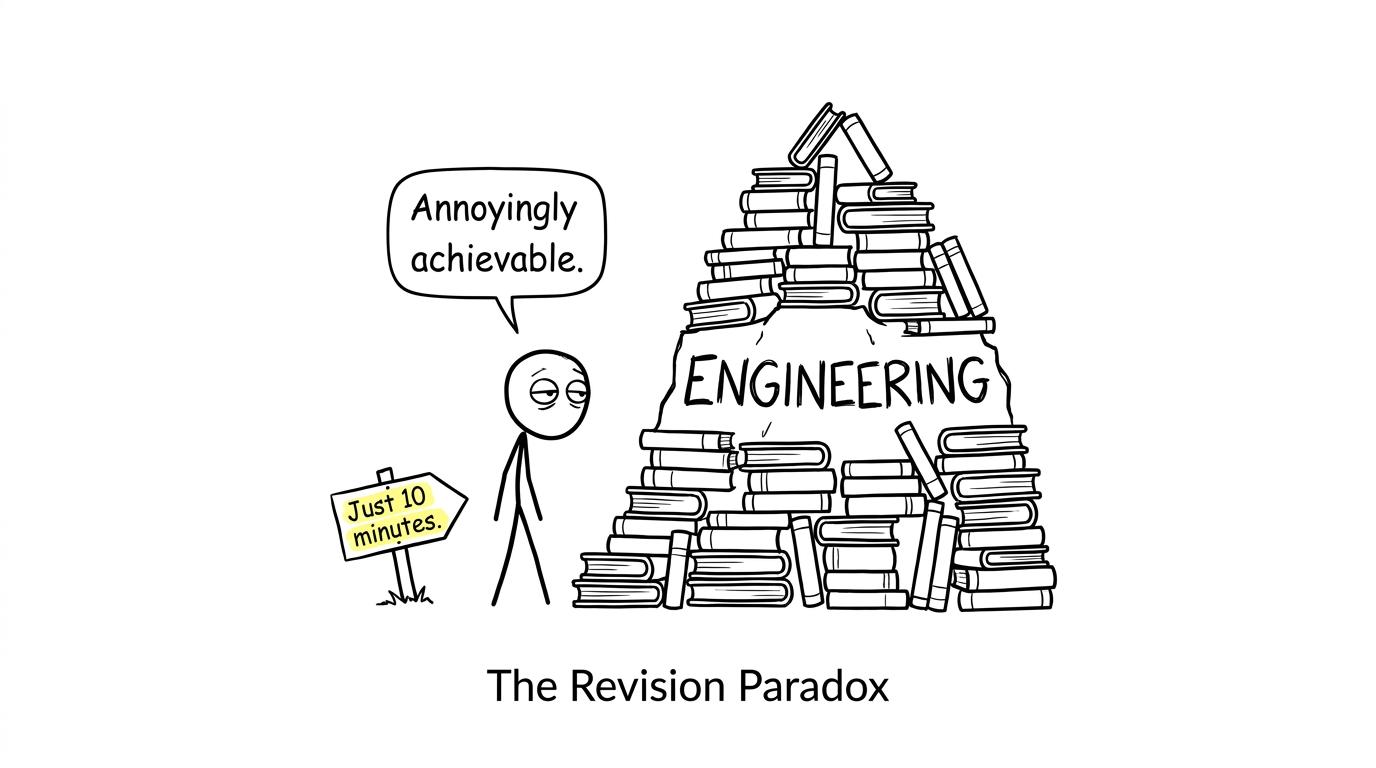 A tired student chooses an annoyingly achievable ten-minute climb up the engineering revision mountain
Begin with the specification, not the textbook
Disliking a subject often makes it feel shapeless. Everything becomes one large category called "engineering", and large categories are difficult to start.
Turn the specification into a finite list instead. For AQA GCSE Engineering 885288528852, the current course content is organised around engineering materials, processes, systems, testing and investigation, the contribution of modern technologies, and practical engineering skills. Assessment includes a written paper and non-exam assessment, so revision should reflect both theoretical knowledge and the ability to apply it in engineering contexts.
Your school may use a different qualification or course structure. Check the exam board, specification code and current assessment information rather than relying on a generic online checklist. GCSE Engineering is not organised into foundation and higher tiers in the same way as GCSE Maths.
Now label each part:
- Green: I can explain and apply this without notes.
- Amber: I partly understand it but make errors.
- Red: I cannot yet recall or apply it.
Start with one amber topic. Red topics can feel so difficult that they stop the session before it begins, while green topics can create confidence without repairing many weaknesses. Amber is often the useful middle ground.
Use action to create motivation
Students often imagine the sequence as:
motivation⟶revision⟶progress\text{motivation} \longrightarrow \text{revision} \longrightarrow \text{progress}motivation⟶revision⟶progressIn practice, it can run the other way:
small action⟶visible progress⟶more motivation\text{small action} \longrightarrow \text{visible progress} \longrightarrow \text{more motivation}small action⟶visible progress⟶more motivationSet a minimum that feels almost too easy: one flashcard set, one diagram from memory, or 101010 minutes of questions. You may continue once you have started, but continuing is optional. Keeping the minimum small protects the habit on difficult days.
Make the task concrete. "Revise materials" is vague. "Recall four properties used when selecting a material, then check my notes" gives your brain a finish line.
The Education Endowment Foundation's guidance on metacognition supports a cycle of planning, monitoring and evaluating learning. In student language, that means deciding what you will do, checking whether it is working, and changing the approach when it is not.
A useful session therefore has three questions:
- What exact knowledge or skill am I practising?
- Can I produce it without looking?
- What must I change before the next attempt?
Replace passive reading with recall, checking and fixing
Rereading can feel comfortable because the page looks familiar. Familiarity, however, is not the same as being able to produce an answer in an examination.
Close the material and retrieve first. You might:
- sketch a system diagram from memory;
- list the properties of a material;
- explain why a process suits a particular production scale;
- write down an engineering equation and its units;
- plan the main points of an extended response;
- answer a past-paper question under a short time limit.
Then check against reliable course materials or a mark scheme. Feedback matters because repeatedly retrieving an incorrect idea can strengthen the misconception. Write a precise correction such as "confused toughness with hardness" or "converted length but not area". Avoid broad judgements such as "I am bad at engineering". They contain no instruction for the next session.
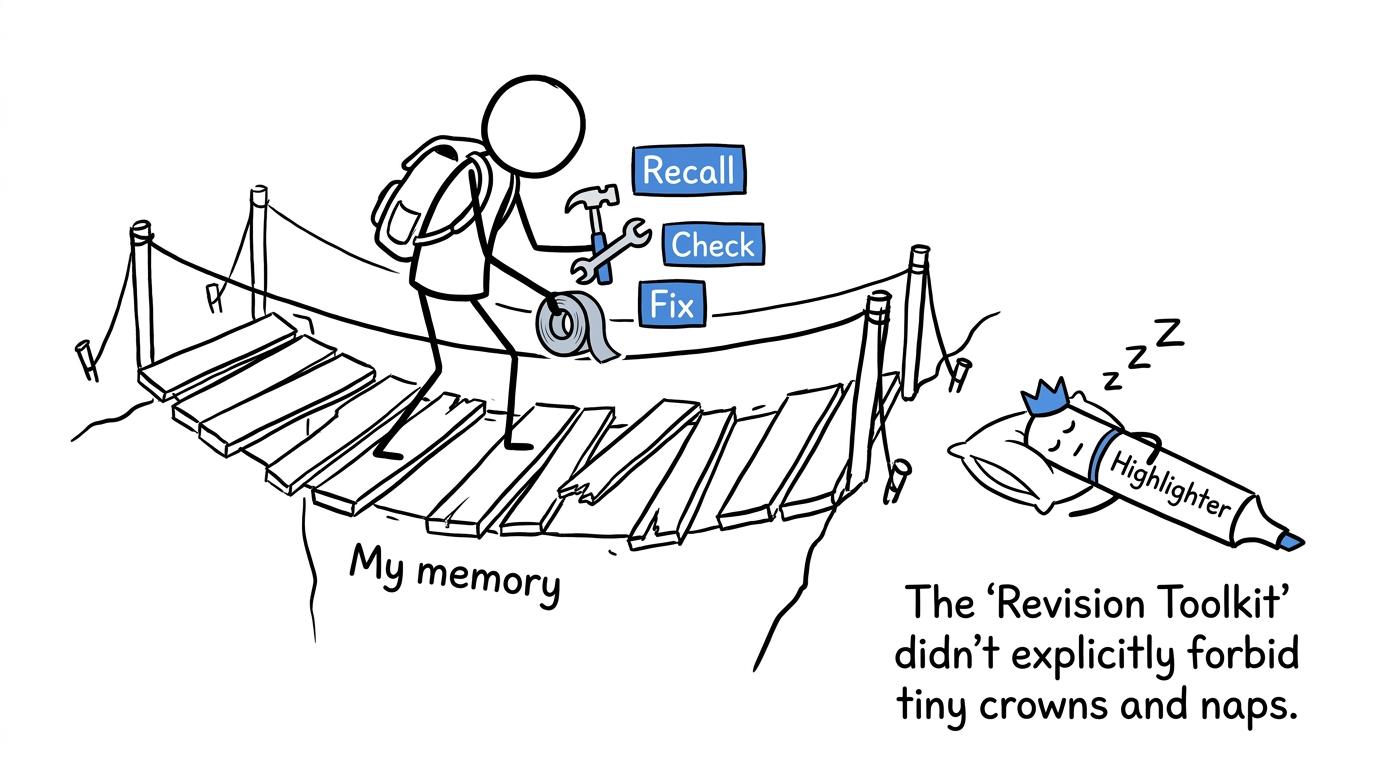 Recall, check and fix repair a wobbly bridge while passive highlighting watches
Use GCSE maths as your route into engineering
Engineering may feel less hostile when part of it becomes familiar maths. The AQA specification expects students to apply Key Stage 333 and 444 mathematical knowledge, including ratio, percentages, standard form, trigonometry, Pythagoras, algebra, graphs, units and significant figures.
It also includes relationships such as:
ρ=mV,P=FA,I=VR\rho = \frac{m}{V}, \qquad P = \frac{F}{A}, \qquad I = \frac{V}{R}ρ=Vm,P=AF,I=RVas well as area, volume, stress, strain, gear ratio and mechanical advantage. Do not merely memorise the letters. Know what each quantity means, keep units consistent and understand when the relationship applies.
If formulas are a weak point, use MathsGenie's Changing the Subject of a Formula revision guide. For compound measures and unit awareness, work through Speed and Density GCSE revision. Very large or small quantities become easier after revisiting the Standard Form revision guide.
The aim is not to replace engineering revision with maths revision. It is to remove mathematical obstacles so that you can concentrate on the engineering decision inside the question.
Keep an equation and units sheet
For every required relationship, record:
- the equation in symbols;
- the meaning of each symbol;
- the standard units;
- any common conversion;
- the situations in which it is used.
Test yourself by covering everything except the relationship's name. When checking calculations, ask whether the answer has a sensible size and whether its unit matches the requested quantity.
MathsGenie's main GCSE Maths revision hub lets you choose Edexcel, AQA, OCR or Eduqas resources for your separate maths qualification. Select the board and tier you actually sit when strengthening these shared skills.
Build a routine for days when you hate it
A reliable routine does not ask you to negotiate with yourself every evening. Try a 252525-minute engineering block:
- First 555 minutes: retrieve an older topic without notes.
- Next 101010 minutes: review one weak idea using the specification and class resources.
- Next 888 minutes: answer questions or plan an exam response.
- Final 222 minutes: check and write the next action.
Stop at the agreed time if necessary. A completed short session is more useful than an ambitious two-hour plan that is repeatedly postponed.
Space the topic across several days rather than trying to finish it in one sitting. Return to it after a delay and attempt retrieval again. If you want a broader structure for your examination season, adapt MathsGenie's one-month GCSE revision plan and replace its daily topics with your engineering specification areas.
When choosing between revision methods, remember that each tool has a job. Flashcards suit definitions and properties. Diagrams suit processes and systems. Practice questions reveal whether you can apply knowledge. Past papers build familiarity with command words, timing and mark allocation.
Make past questions diagnostic, not judgemental
A poor practice response is information, not a forecast of your final grade. Its purpose is to expose what needs fixing while there is still time to fix it.
Use engineering papers supplied by your exam board or teacher, then:
- answer without notes;
- mark honestly;
- separate knowledge errors from calculation and question-reading errors;
- rewrite only the part that failed;
- reattempt the question after a gap.
Do not rush into full papers if individual topics remain inaccessible. Start with short sets, then timed sections, then complete papers. The same progression is explained in MathsGenie's guide to when to start GCSE past papers.
For your GCSE Maths preparation, MathsGenie's free revision resources include topic lessons, practice questions, mini tests, past papers, predicted papers, mark schemes and video solutions. Improving overlapping skills such as formula manipulation, graphs, percentages, area and volume can support both subjects.
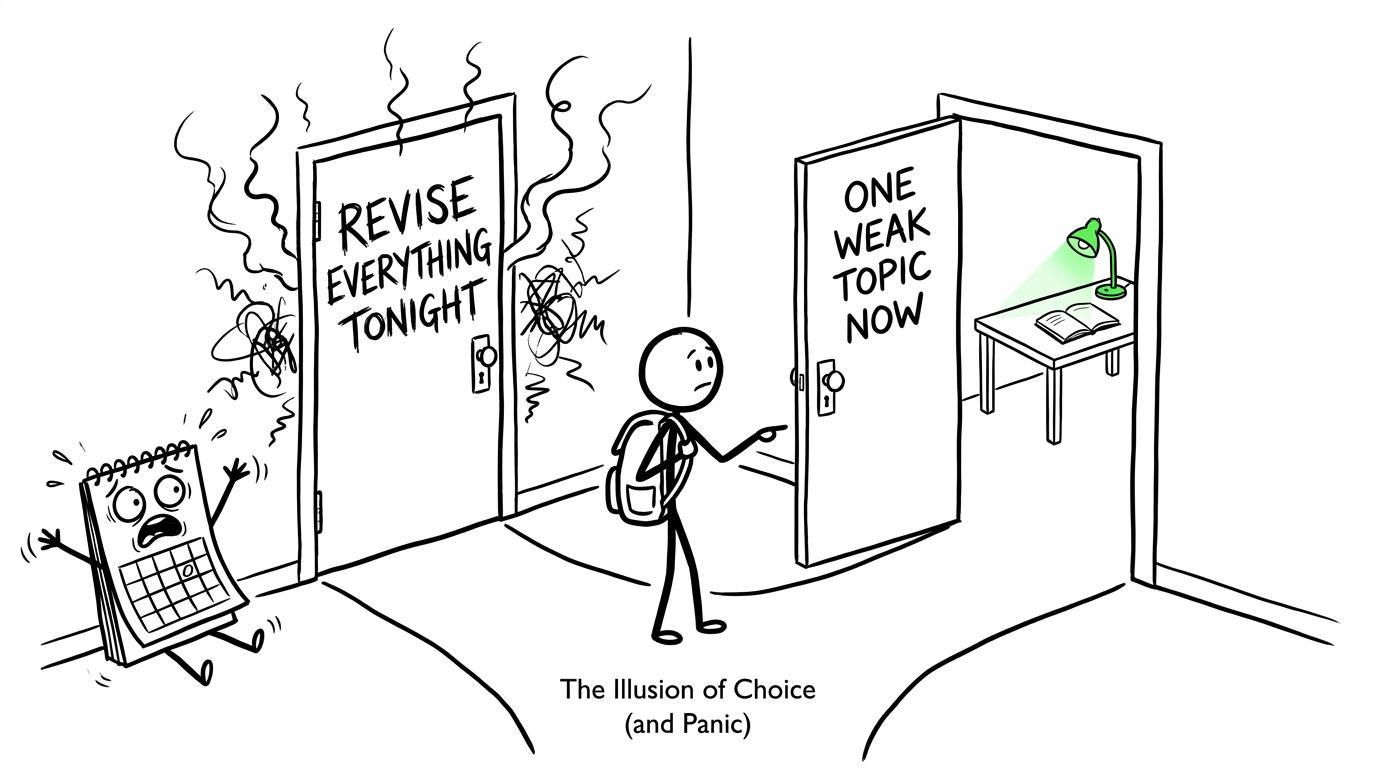 A student wisely chooses one weak topic instead of revising everything in one night
Common mistakes when revising GCSE Engineering
Waiting until you feel motivated
Feelings are unreliable scheduling tools. Decide the time, place and first tiny action in advance. Starting is the target; enthusiasm is optional.
Highlighting without testing yourself
Highlighting may help organise a first reading, but it does not prove recall. Close the page and reproduce the key idea, diagram or explanation.
Treating every topic equally
Spend more time on specification content that repeatedly costs marks. Keep a marks-leak list and let evidence, not mood, choose the next task.
Memorising equations without units or meaning
An equation is useful only when you can identify the quantities, select consistent units and interpret the result. Practise formula skills through MathsGenie's guide to the best order for learning GCSE Maths topics.
Avoiding questions until you feel ready
Questions are part of learning, not merely a final test. Begin with small, topic-specific tasks and use feedback immediately.
Ignoring the precise command word
"State", "describe", "explain", "calculate" and "evaluate" require different responses. Use the available marks and mark scheme to judge the expected depth.
Making the plan too demanding
A plan built only for your most energetic day will collapse on normal days. Set a small daily minimum and add extra work when capacity allows.
You do not have to like it to improve
Hating a subject can make every difficulty feel like proof that revision will not work. It is not. It usually means your system must demand less motivation and provide more visible feedback.
Choose one amber topic. Work for 101010 minutes. Retrieve, check and fix. Strengthen the maths underneath the engineering, then use short questions before moving towards complete papers. Tomorrow, repeat the process.
For the mathematical skills that appear across engineering contexts, make MathsGenie your free revision base. Use the GCSE Maths revision hub for lessons and practice questions, then build confidence with mini tests, past papers, predicted papers, mark schemes and video solutions. You are not trying to manufacture endless enthusiasm. You are building a process capable of carrying you forward without it.










