

Harder GCSE Psychology or Sociology?
Harder GCSE psychology or sociology? Compare content, essays, research methods and revision workload, then choose the subject that fits your strengths best.
Choosing a GCSE can feel strangely permanent. You look at two subject names, hear a few opinions in the corridor and are expected to predict which course your future self will handle better.
So, which is the harder GCSE: psychology or sociology? There is no universal winner. Psychology is often harder for students who dislike scientific research, data and remembering detailed studies. Sociology may feel harder if constructing arguments, comparing theories and writing extended answers under time pressure are not your strengths.
The fairest answer is that both involve substantial content and written evaluation. Your preferred way of thinking matters more than either subject's reputation.
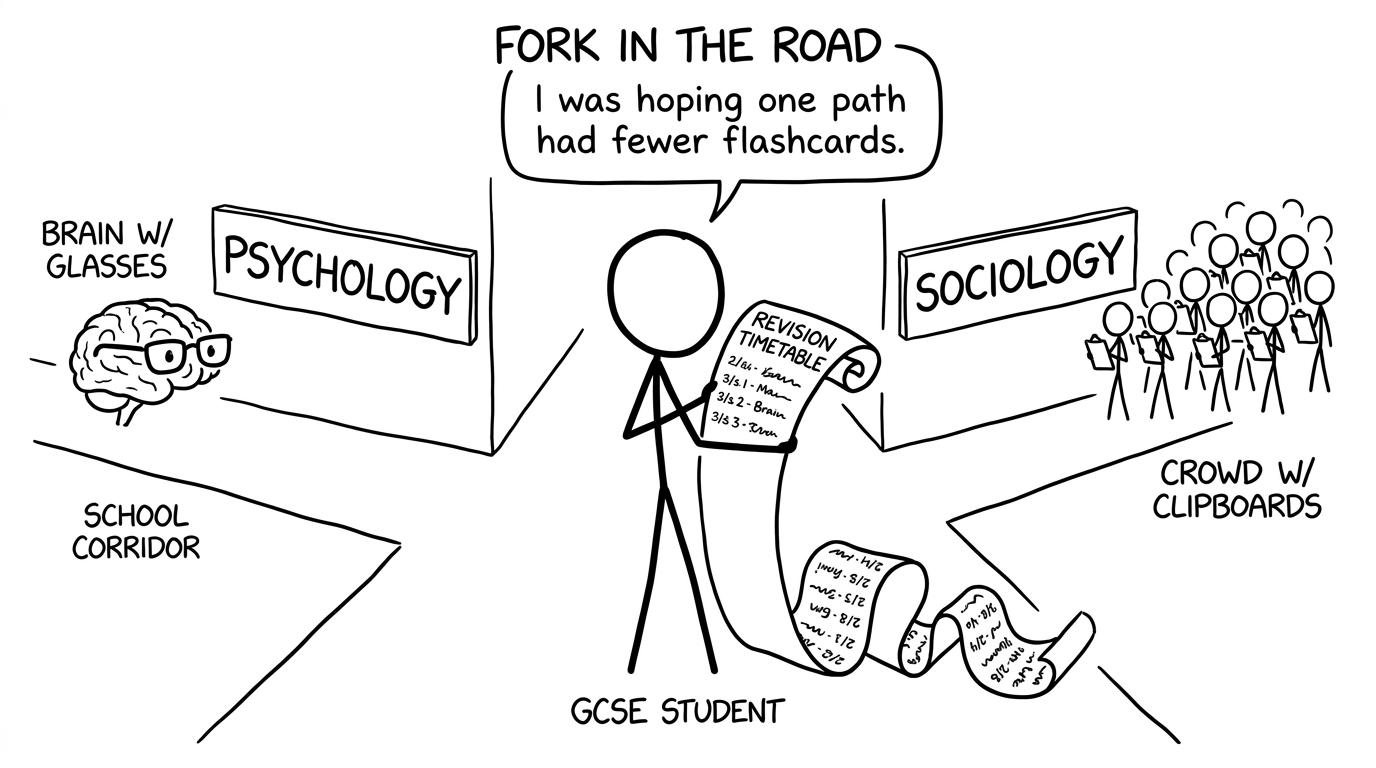 A student choosing between psychology and sociology while carrying an enormous revision timetable
The short comparison checklist
Before choosing, ask yourself which column sounds more manageable:
- Psychology: individual behaviour, memory, the brain, named studies, research design, data and scientific evaluation.
- Sociology: society, families, education, crime, inequality, competing theories and sustained written arguments.
- Both subjects: specialist terminology, research methods, application to unfamiliar situations, extended writing and final written examinations.
- Psychology has a clearer mathematical element: at least 10%10\%10% of the qualification must assess mathematical skills in the context of research methods.
- Sociology is usually more argument-led: you must connect evidence and sociological perspectives to reach supported conclusions.
Do not choose purely by asking which subject has less work. Ask which kind of work you are more likely to complete carefully and consistently.
How the actual GCSE assessments compare
Exact content depends on your exam board, so check the specification used by your school. AQA currently offers directly comparable GCSE specifications for both subjects, while Eduqas also offers GCSE Sociology.
Under AQA, both qualifications are linear and assessed through two written papers at the end of the course. Each paper lasts 111 hour 454545 minutes, carries 100100100 marks and contributes 50%50\%50% of the final GCSE. On exam time alone, therefore, neither subject is lighter.
The assessment objectives reveal a more useful distinction:
- In GCSE Psychology, approximately 35%35\%35% of marks assess knowledge, 35%35\%35% assess application and 30%30\%30% assess analysis and evaluation.
- In GCSE Sociology, approximately 40%40\%40% assess knowledge, 40%40\%40% assess application and 20%20\%20% assess analysis and evaluation.
These figures do not prove that psychology is harder. They show that psychology places a slightly greater formal weighting on analysis and evaluation, while sociology places more combined weight on knowing sociological material and applying it appropriately. Both still require clear judgement rather than simple recall.
Why GCSE Psychology can feel harder
Psychology examines behaviour through a scientific lens. On the AQA course, students cover memory, perception, development, research methods, social influence, language and communication, brain and neuropsychology, and psychological problems.
The memory burden is not just a list of definitions. You may need to remember the purpose, procedure, findings and conclusions of studies, understand theories, and evaluate their strengths and weaknesses. Similar-sounding research can become difficult to separate unless your notes are organised carefully.
Research methods create another layer. National subject requirements state that at least 20%20\%20% of GCSE Psychology marks must assess research methods, with the mathematical component contained within that area. Relevant skills can include interpreting tables and graphs, calculating averages, understanding percentages, recognising variables and drawing conclusions from data.
Students who enjoy GCSE maths statistics may find this reassuring. The GCSE Statistics revision hub can strengthen skills such as sampling, averages, data presentation and interpretation. These skills do not replace psychology revision, but they can make the quantitative parts of research methods less intimidating.
Psychology may suit you if you like precise explanations and are comfortable moving between evidence and conclusions. It can feel demanding if you prefer broad discussion but dislike learning the details of how evidence was collected.
Why GCSE Sociology can feel harder
Sociology moves the lens away from the individual and towards society. In the AQA specification, students examine families, education, crime and deviance, social stratification, social theory and sociological research methods.
Its difficulty often lies in connection. You are not merely learning isolated facts about education or crime. You must understand how sociological perspectives offer different explanations, apply those ideas to a question and build an argument supported by evidence.
A student may remember several theorists yet still lose marks by describing them separately. Strong sociology answers compare viewpoints, use relevant concepts and explain why the evidence supports a conclusion. That requires both knowledge and control of extended writing.
The content may initially feel familiar because families, schools and inequality are part of everyday life. Familiarity can be deceptive. Sociology asks you to replace casual opinion with disciplined analysis. Phrases such as “everyone knows” are not evidence; claims need sociological reasoning.
Sociology may therefore feel harder for students who struggle to plan essays quickly or distinguish closely related perspectives. It often suits students who enjoy debate, current social questions and weighing alternative explanations.
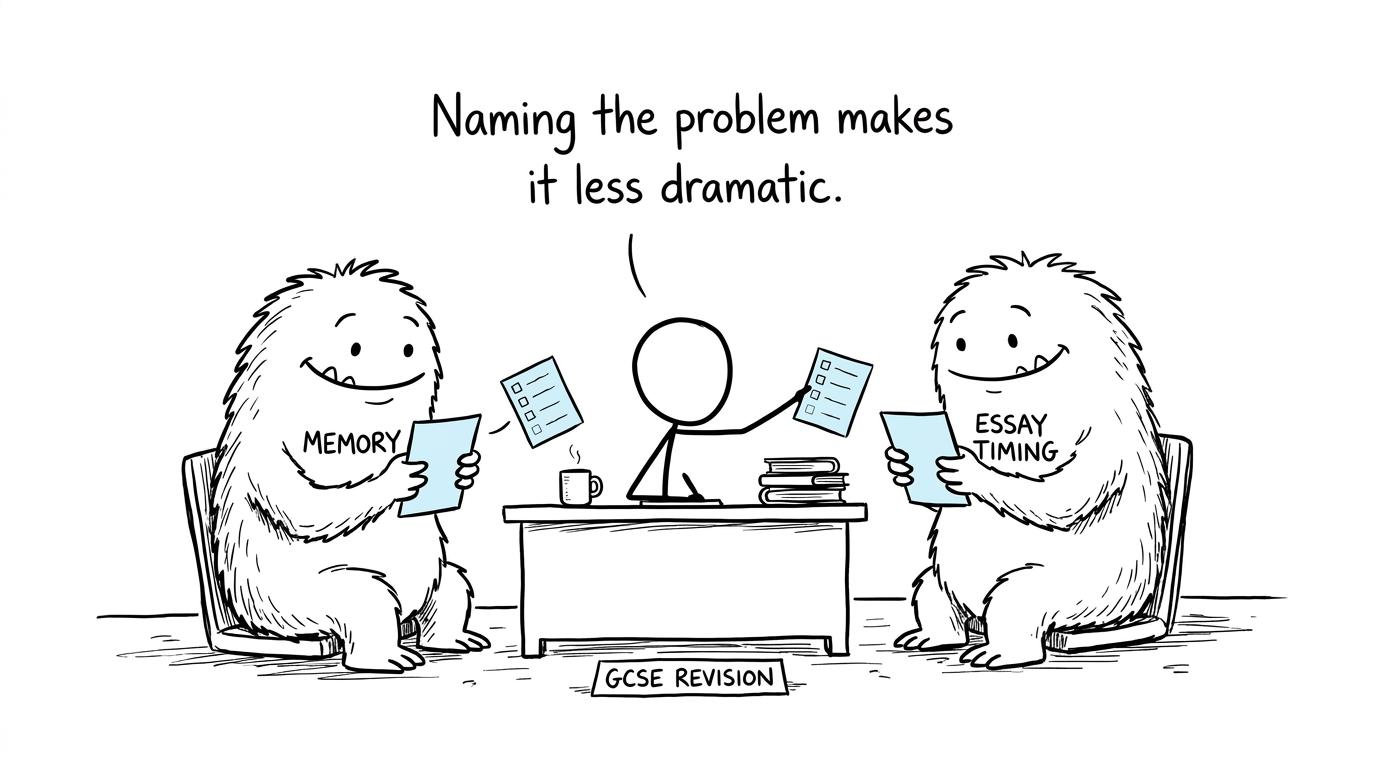 A student calmly confronting the revision monsters called memory and essay timing
Which subject is harder for a maths-focused student?
For many students preparing seriously for GCSE maths, psychology has the more obvious overlap. Research methods use numerical and statistical thinking, including interpreting evidence rather than accepting a claim at face value. The full GCSE maths revision area covers probability and statistics alongside number, algebra, ratio and geometry.
That overlap does not automatically make psychology easier. A student can be confident with graphs and averages but find detailed studies difficult to recall. Equally, a strong essay writer may prefer sociology even if there is less direct connection with maths.
Consider your response to these tasks:
- If you enjoy examining whether an experiment was reliable, psychology may feel natural.
- If you enjoy comparing explanations for patterns across society, sociology may fit better.
- If you prefer short, precise application questions, psychology may be more comfortable.
- If you enjoy building a longer chain of argument, sociology may be more rewarding.
- If both appeal, compare your school's teaching plans, available teachers and specification before deciding.
Your current maths tier should not determine your choice. GCSE Psychology and Sociology are not divided into foundation and higher tier. However, your overall timetable matters. A subject becomes difficult when its revision repeatedly gets postponed behind maths, English and science.
Comparing the real revision workload
Both courses reward regular retrieval rather than last-minute reading. Their workload is similar in size but different in shape.
For psychology, effective revision usually includes:
- recalling terminology, theories and named studies;
- linking studies to particular topics;
- practising research-methods questions;
- interpreting data accurately;
- evaluating evidence with specific strengths and limitations.
For sociology, effective revision usually includes:
- learning concepts, theories and supporting evidence;
- comparing sociological perspectives;
- planning arguments before writing;
- practising application to extracts or scenarios;
- completing extended responses within a time limit.
A sensible subject decision is based on the work you can imagine doing each week, not the course description that sounds most interesting for five minutes.
Use a combined revision plan so that an essay subject does not quietly consume your maths time. MathsGenie's guide to building a GCSE maths revision timetable explains how to prioritise weak areas, revisit topics and build towards timed papers. The GCSE maths topics by exam board and tier can also help you see what must fit around your option subjects.
A practical way to make your decision
Try a small sample of authentic work from each subject before choosing. Read part of your school's specification, inspect a past paper and look at the mark scheme. Pay attention to what the examiner expects, not simply whether the topic title sounds interesting.
Then rate each subject from 111 to 555 for:
- genuine interest;
- confidence with the question styles;
- willingness to learn the content repeatedly;
- compatibility with your other GCSEs;
- support and teaching available at school.
This is not a formula that can make the decision for you. It is a way to separate evidence from rumours. A subject that is slightly challenging but genuinely interesting is often a better choice than an allegedly easy subject you avoid revising.
You can use the same evidence-led approach in maths. The guide to finding your weakest GCSE topics shows how short assessments can reveal the difference between what feels difficult and what is actually costing marks.
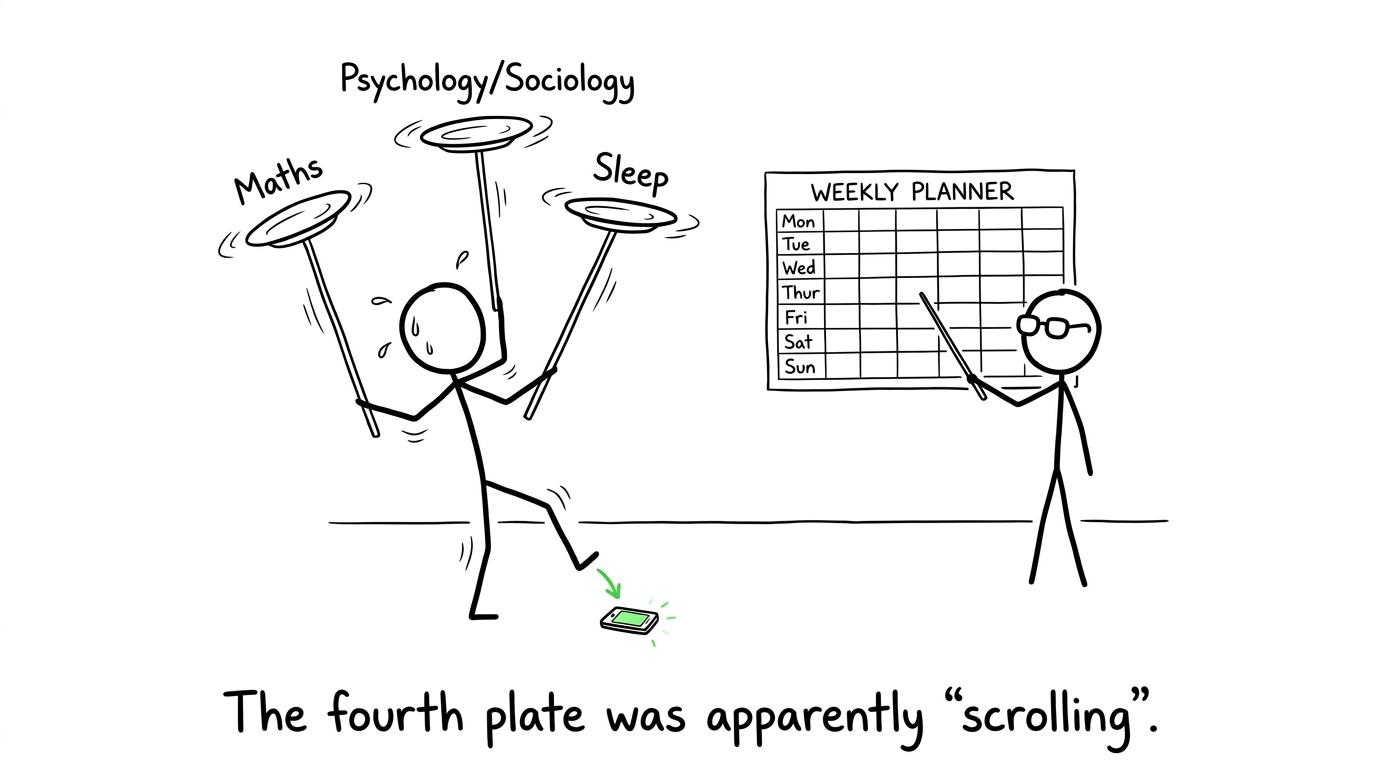 A student balancing maths, an essay subject and sleep while a forgotten plate represents scrolling
Common mistakes when comparing the subjects
Believing one subject is universally easier
Difficulty depends on the specification, your teacher, your interests and your skills. Another student's experience is useful context, not a guaranteed prediction of yours.
Choosing psychology to avoid essays
Psychology includes multiple-choice and short-answer questions, but it also assesses extended writing, application and evaluation. It is not simply a collection of interesting facts about the brain.
Choosing sociology because it sounds like common sense
Everyday experience can help you engage with sociology, but high-mark answers require specialist concepts, evidence and structured arguments. Personal opinion alone is insufficient.
Ignoring research methods
Research methods are central to psychology and also form part of sociology. Leaving them until the end creates avoidable pressure. Build confidence with data early through GCSE Statistics revision.
Letting option revision displace maths practice
Reading notes can expand to fill an evening. Protect shorter, focused maths sessions using Edexcel GCSE maths mini tests, then build towards Edexcel GCSE maths past papers or the correct board-specific resources for your course.
The fairest final verdict
GCSE Psychology is likely to feel harder if you dislike scientific studies, research methods, data and detailed evaluation. GCSE Sociology is likely to feel harder if you dislike extended arguments, theoretical perspectives and applying ideas across social issues.
Neither is an easy shortcut. Both reward curiosity, accurate terminology and regular exam practice. Choose the kind of difficulty you are willing to work on.
Once your options are settled, keep maths revision simple and measurable. Start with MathsGenie's free revision lessons and practice questions, diagnose gaps with mini tests, and develop exam technique through past papers, predicted papers, mark schemes and video solutions. The goal is not to make every subject feel easy. It is to know what the work involves and have a reliable plan for doing it.










