Harder GCSE Arabic or Modern Hebrew? A Fair Guide
Harder GCSE Arabic or Modern Hebrew? Compare assessment, literacy, speaking and revision workload fairly, then choose the course that suits you best.
Choosing a GCSE can feel strangely permanent. A subject sits in a timetable box today, yet it may shape hundreds of revision hours later. If you are wondering whether it is harder GCSE Arabic or Modern Hebrew, the honest answer is that neither qualification is universally harder. Arabic usually has longer written examinations and can create a gap between spoken dialect and formal Arabic. Modern Hebrew has its own demanding grammar, reading and spontaneous speaking requirements.
Your starting level matters more than the subject name. The easier option will normally be the language in which you can already read accurately, understand natural speech, write independently and receive strong teaching.
That matters to maths students in particular. Language revision has to share the week with algebra, geometry and statistics. The real question is not simply, “Which language is harder?” It is, “Which language will require more of my limited revision time?”
The quick comparison
Here is the fairest short answer:
- Both GCSEs assess listening, speaking, reading and writing. Each skill contributes 25%25\%25% of the qualification.
- Both are tiered. Foundation targets grades 111-555, while higher targets grades 444-999, with the regulatory provision for an allowed grade 333 just below the higher-tier grade 444 boundary.
- Arabic has longer reading and writing examinations, particularly at foundation tier.
- Arabic may be unexpectedly difficult for dialect speakers if their formal reading and writing are less developed.
- Modern Hebrew may feel harder if you have limited experience reading ordinary unvocalised text or forming accurate verb patterns.
- Neither choice should be made from reputation alone. Teacher support, literacy, vocabulary, listening exposure and speaking confidence are better evidence.
Before deciding, ask your school which course and tier it actually offers. The current qualifications compared here are Pearson Edexcel GCSE Arabic and AQA GCSE Modern Hebrew. The details below were checked against the official specifications available in August 2026.
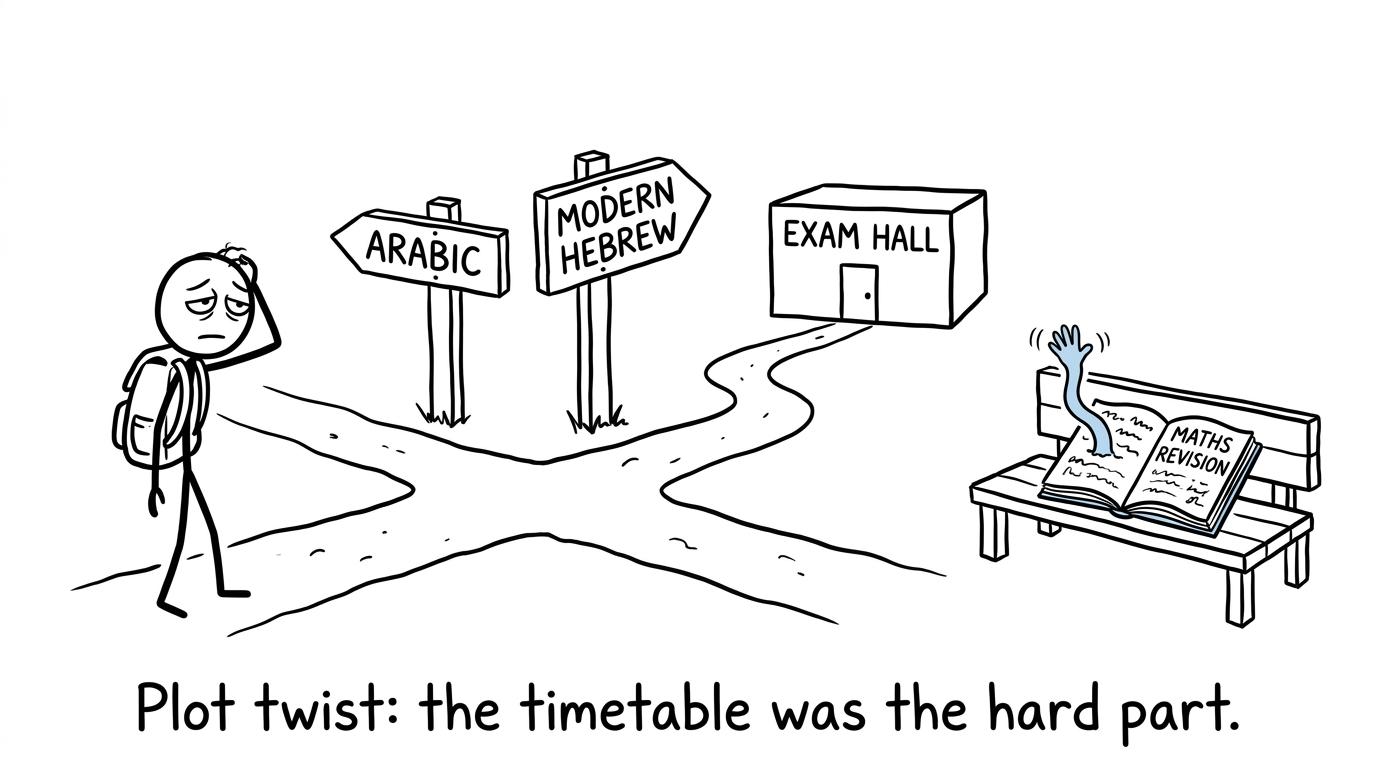 A student discovers that choosing the language was only part of the challenge
Comparing the actual assessment workload
On paper, the two qualifications are remarkably similar. They are linear GCSEs, all four skills are compulsory, and students enter the same tier across the qualification. Neither offers a route where you can take foundation listening but higher writing.
The main measurable difference is examination time.
| Component | GCSE Arabic | GCSE Modern Hebrew |
|---|---|---|
| Listening | Foundation: 353535 minutes; higher: 454545 minutes | Foundation: 353535 minutes; higher: 454545 minutes |
| Speaking | Foundation: 777-999 minutes; higher: 101010-121212 minutes, plus preparation | Foundation: 777-999 minutes; higher: 101010-121212 minutes, plus preparation |
| Reading | Foundation: 505050 minutes; higher: 656565 minutes | Foundation: 454545 minutes; higher: 606060 minutes |
| Writing | Foundation: 808080 minutes; higher: 858585 minutes | Foundation: 606060 minutes; higher: 757575 minutes |
| Weighting | Four components worth 25%25\%25% each | Four components worth 25%25\%25% each |
Arabic therefore involves more time in the reading and writing examination room. At foundation tier, its writing paper is 202020 minutes longer. At higher tier, it is 101010 minutes longer.
That is a genuine workload difference, but it does not prove that Arabic is academically harder. A longer paper may contain different task structures, response lengths and mark allocations. Difficulty concerns what a student must know and do; duration only tells us how long the assessment allows.
Both subjects include translation in the reading and writing components. Their speaking assessments also require more than a memorised presentation: students must handle role-play, stimulus-based discussion and conversation. That makes regular, responsive practice essential in either language.
When GCSE Arabic is likely to feel harder
Arabic may be the more demanding option when your spoken knowledge comes mainly from a regional dialect. Modern Standard Arabic is associated particularly with formal education, writing and public contexts, while spoken varieties are used in everyday conversation. Research into Arabic diglossia recognises that the distance between these varieties can affect literacy-related tasks.
A student may therefore speak confidently with relatives but still need substantial work on:
- formal vocabulary and sentence structures;
- accurate reading of connected Arabic script;
- spelling and written expression;
- understanding standard spoken Arabic;
- translation between Arabic and English;
- switching away from familiar dialect forms in assessed responses.
This does not make home experience worthless. It can provide valuable listening instinct, vocabulary and confidence. But conversational fluency and examination literacy are not identical.
Arabic may also feel harder for a complete beginner because letters change form depending on their position and most letters connect within words. Reading needs to become automatic enough that script recognition does not consume the attention required for comprehension.
The longer writing papers add a stamina demand too. Students must sustain accurate written Arabic while covering every required detail. If handwriting and spelling remain slow, the extra examination time may not feel generous.
When GCSE Modern Hebrew is likely to feel harder
Modern Hebrew may be harder when a student has learnt prayers, set texts or isolated phrases but has limited experience with contemporary language. Biblical or liturgical familiarity should not be confused with the GCSE Modern Hebrew course, which assesses communication across everyday themes such as identity, culture, local and global issues, education and employment.
Students need to understand and produce language referring to past, present and future events. The AQA specification also expects control of grammatical gender, agreement, nouns, adjectives and verb forms. At higher tier, longer reading passages and extended writing demand more independent manipulation of language.
Reading can be a particular dividing line. Recognition of the alphabet is only the beginning. Students must process connected meaning efficiently, including vocabulary and forms that may need to be inferred from context. Someone who decodes slowly can understand the grammar in lessons yet still struggle under timed conditions.
Modern Hebrew speaking also rewards spontaneity and fluency. A prepared bank of sentences helps, but it cannot cover every follow-up question. If spontaneous speaking is your weakest skill, the qualification can feel substantially harder than classroom exercises suggest.
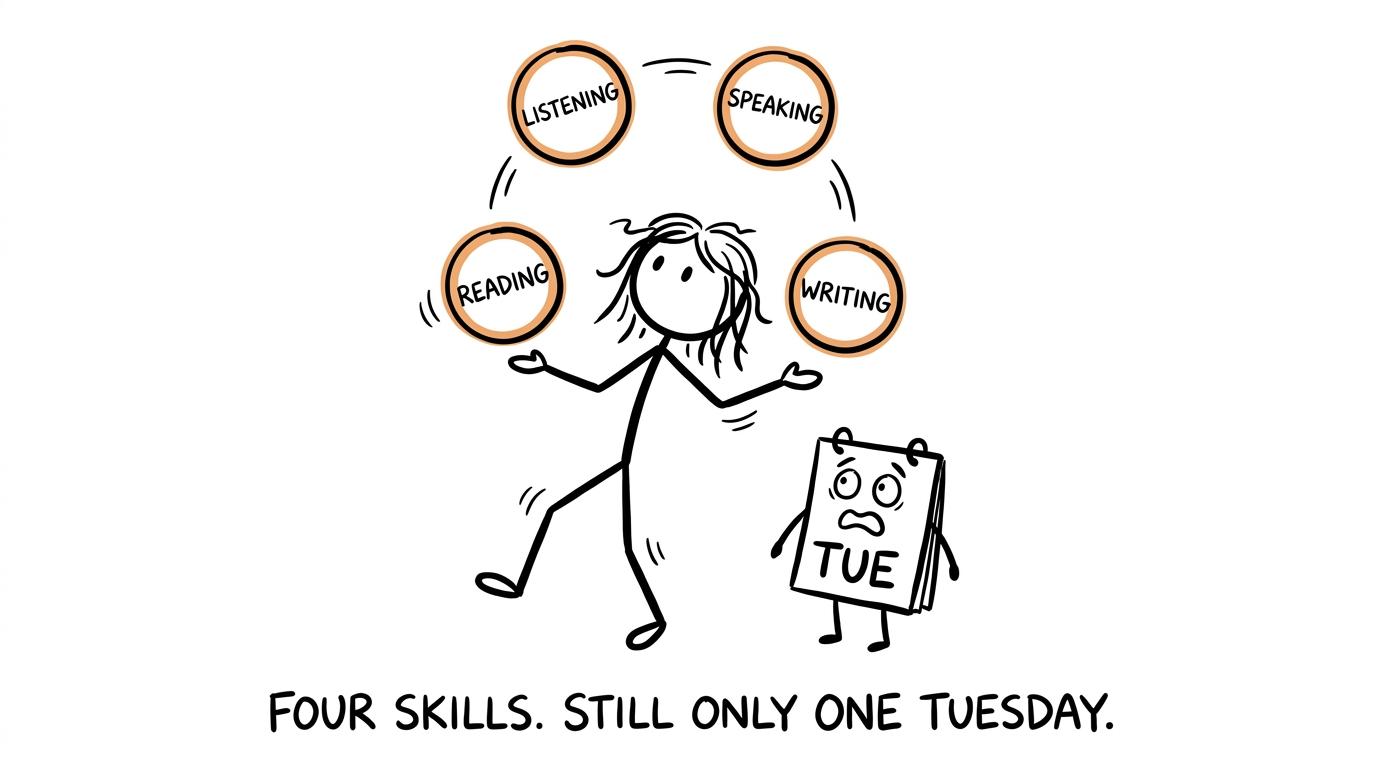 A GCSE student juggles the four assessed language skills
The factors that matter more than the language
Your literacy, not just your speaking
Test the four skills separately. Can you follow an unfamiliar recording? Can you read a short passage without translating every word? Can you write connected sentences from memory? Can you answer an unexpected spoken question?
A “heritage speaker” label does not answer any of those questions. Two students who use the same language at home can have completely different levels of formal literacy.
The teaching available
A well-organised course with regular feedback is usually more manageable than a supposedly easier language taught irregularly. Find out whether your school provides a specialist teacher, speaking practice, marked writing, listening tasks and access to current specimen or past papers.
Also ask how many taught hours you will receive. An extra GCSE completed largely outside school can create a much heavier workload than one embedded in the normal timetable.
Your current GCSE timetable
Revision capacity is finite. Every hour spent building language literacy is an hour unavailable for another subject. This does not mean avoiding a challenging language; it means budgeting honestly.
If maths is a priority, use the GCSE maths revision hub to identify how much work your current foundation or higher tier needs. A short diagnostic is more useful than assuming maths will “sort itself out”. The GCSE one-month revision plan also shows how topic practice and timed papers can fit around other subjects.
Evidence from real assessment tasks
Do not choose from a course description alone. Ask your teacher for current specimen materials in both languages and attempt comparable listening, reading, speaking and writing tasks. You are not trying to earn a grade yet. You are measuring where effort will be required.
Use the same principle in maths: finding your weakest topics is more reliable than judging difficulty from how a subject feels after one lesson.
A practical decision checklist
Before choosing, answer these questions for each language:
- Can I read the script accurately at a useful pace?
- Can I understand standard speech rather than only familiar speakers?
- Can I write without copying or transliterating first?
- Can I use more than one time frame?
- Can I answer an unplanned question aloud?
- Will I receive regular specialist teaching?
- Can someone mark my writing and correct my speaking?
- Is the course taught in school or mainly outside lessons?
- How many weekly hours will it take alongside maths and other GCSEs?
- Have I looked at the correct board and tier materials?
The best choice is usually the language with the strongest combination of current literacy, structured teaching and realistic practice opportunities. Interest matters as well. Motivation cannot replace skill, but it makes the repeated vocabulary, listening and correction required to develop that skill more sustainable.
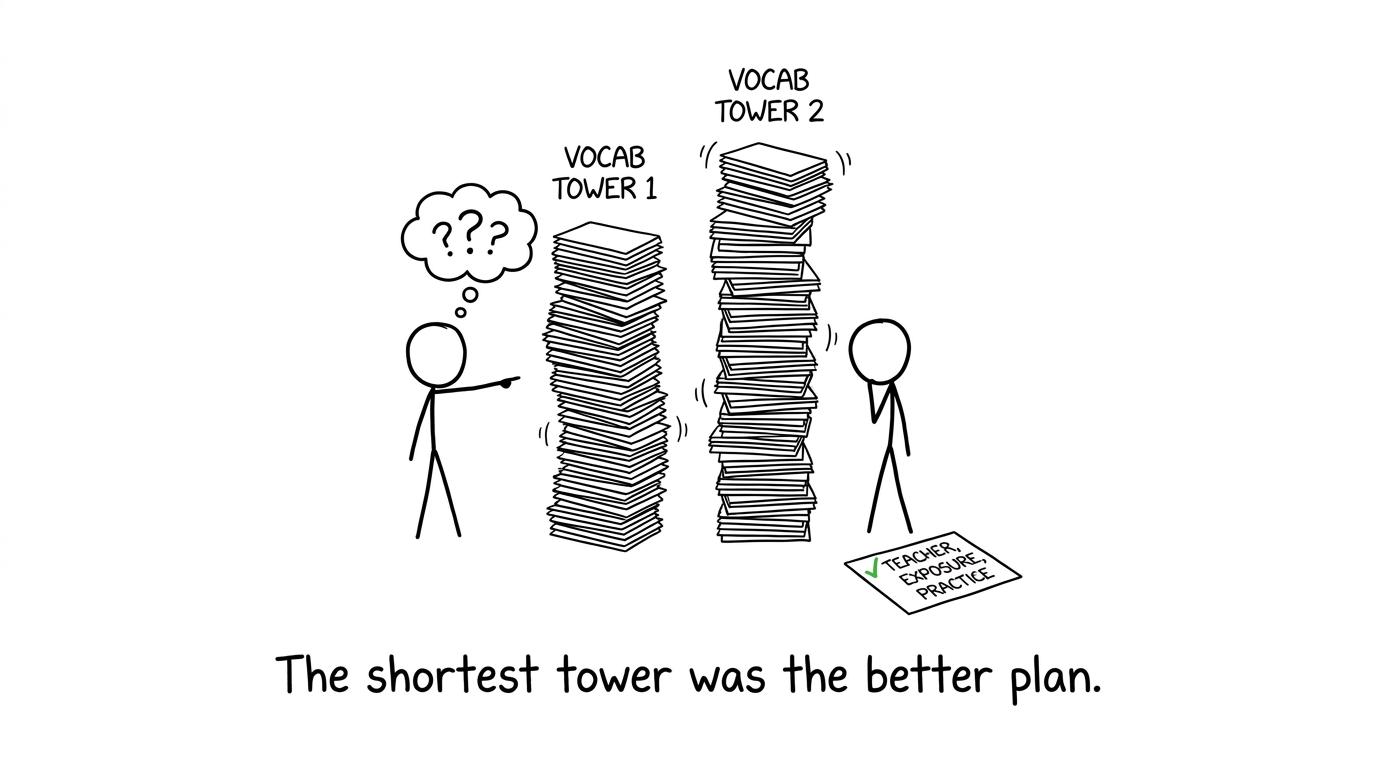 Students discover that practical support matters more than towering flashcard piles
Common mistakes when comparing the two GCSEs
Assuming speaking at home guarantees an easy grade
Home conversation can be a major advantage, but the examinations assess formal reading, writing, translation and controlled grammar too. Diagnose each skill separately.
Treating Modern Hebrew and Biblical Hebrew as interchangeable
They are different qualifications with different purposes and assessments. Confirm that your school is discussing AQA GCSE Modern Hebrew rather than Pearson Edexcel GCSE Biblical Hebrew.
Comparing raw marks between exam boards
Arabic and Modern Hebrew use different raw totals and assessment designs. Raw marks are scaled where required, and grade boundaries are set for each qualification. One paper having more marks does not automatically make it harder.
Ignoring the tier decision
Foundation and higher are not simply the same paper with a few harder questions added. The available grades, task demands and expected language differ. Discuss entry decisions with your teacher rather than choosing from pride or fear.
The same principle applies in maths. The guide to moving from foundation to higher GCSE maths explains why evidence from performance matters more than the tier label.
Counting revision materials instead of using them
Collecting vocabulary lists and past papers feels productive because nothing has yet gone wrong. Real progress starts when you attempt a task, mark it and repair the weakness it reveals. Maths students can build this habit through Edexcel GCSE maths past papers and mark schemes or the guide to using past papers properly.
So which GCSE should you choose?
Choose GCSE Arabic if your formal Arabic literacy is stronger, you can understand standard spoken Arabic, and you have dependable support for writing and grammar. Choose GCSE Modern Hebrew if your contemporary reading, listening and spontaneous communication are stronger and the teaching available is better.
If your starting points are genuinely equal, Arabic has the heavier timed written workload. Yet that difference is smaller than the effect of weak literacy, limited teaching or unfamiliarity with the assessed language variety. The harder GCSE is usually the one in which you must build more skills from the beginning.
Once you have made the decision, protect the rest of your timetable. MathsGenie gives you free revision lessons, practice questions, mini tests, past papers, mark schemes, predicted papers and video solutions, so maths revision does not become another source of uncertainty. Start with the MathsGenie GCSE revision resources, identify one weak area and build a routine you can repeat alongside your language course. A good choice reduces guesswork. A good revision system keeps it reduced.