Group vs 1:1 Tutoring GCSE Statistics
Group vs 1:1 tutoring GCSE Statistics: compare feedback, confidence, cost and exam practice to choose the support that best fits your revision needs.
A statistics question can look perfectly manageable until it asks you to justify a sampling method, compare two distributions or explain why correlation does not prove causation. At that point, students often decide they need more support. The difficult question is what kind.
For group vs 1:1 tutoring GCSE Statistics, neither option is automatically better. One-to-one tutoring usually suits students with specific gaps, low confidence or a need for highly personalised feedback. Small-group tutoring often suits students who benefit from discussion, shared problem-solving and a more affordable structure. The best choice depends on your needs, the tutor's quality and how each session connects to independent exam practice.
The short answer: which tutoring format is better?
Choose one-to-one tutoring if you:
- have several precise knowledge gaps;
- find it difficult to ask questions in front of other students;
- need lessons adapted to your pace;
- repeatedly lose marks for the same misunderstanding;
- have limited time before an examination or resit.
Choose small-group tutoring if you:
- learn by hearing different explanations;
- need the routine and energy of revising with others;
- are comfortable asking questions in a group;
- want regular support at a potentially lower cost per student;
- have broadly similar targets and weaknesses to the other students.
Before paying for either, complete an exam-style assessment and identify where your marks are going. MathsGenie's guide to finding your weakest GCSE topics provides a practical diagnostic process.
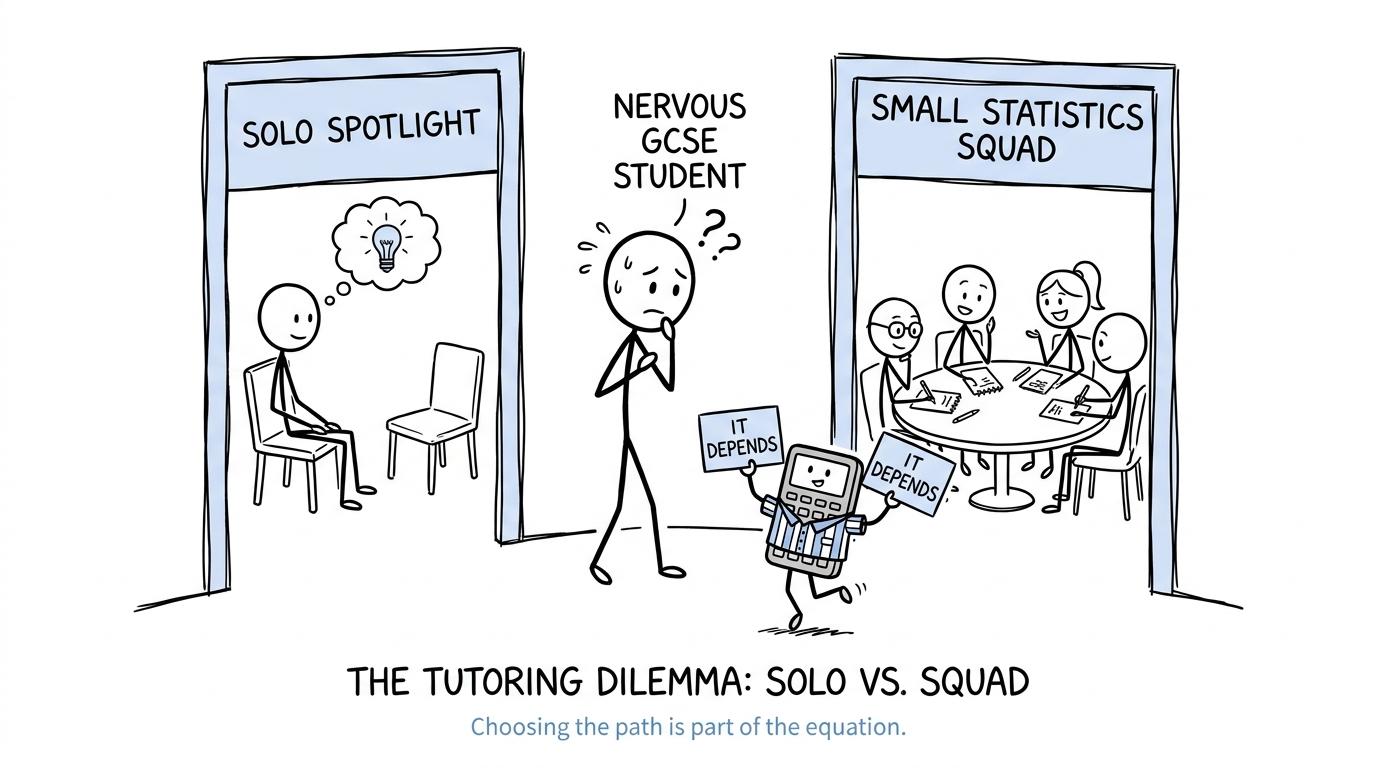 A student choosing between a solo tutoring spotlight and a small statistics squad
What the tutoring evidence really tells us
The Education Endowment Foundation describes small-group tuition as one tutor working with approximately two to five pupils. Its evidence synthesis reports positive average effects for both formats, with one-to-one tuition showing a slightly higher average impact than small-group tuition.
That finding needs careful interpretation. It covers different ages, subjects and educational settings. It is not proof that every GCSE Statistics student will make more progress with an individual tutor. The evidence also suggests that tutoring works best when it is targeted to assessed needs, delivered regularly and connected to normal classroom learning.
This leads to a more useful conclusion: format matters, but implementation matters more. A focused group of four students working on shared weaknesses may be more effective than an unfocused individual lesson. Equally, a skilled one-to-one tutor who identifies a misconception quickly may achieve something that a mixed-ability group cannot.
Progress should therefore be measured through changed performance: fewer repeated errors, clearer interpretations and improving marks on unseen questions. Pleasant lessons are valuable, but they are not evidence of learning on their own.
The real advantages of one-to-one GCSE Statistics tutoring
Every explanation can respond to you
In an individual lesson, the tutor can stop as soon as your reasoning becomes uncertain. That matters in statistics because an incorrect answer may come from several different sources: choosing the wrong measure, mishandling the calculator, misreading a graph or failing to interpret the result in context.
A tutor can ask follow-up questions until the real cause becomes visible. Instead of revising an entire chapter on averages, you might discover that the actual problem is deciding when the median is more representative than the mean.
The pace is genuinely flexible
One-to-one teaching can spend most of a session on standard deviation, sampling bias or the statistical enquiry cycle if that is where the evidence points. Students following Edexcel can use MathsGenie's Edexcel GCSE Statistics revision hub to match support to the correct specification and tier. AQA students should use the corresponding AQA GCSE Statistics resources.
This flexibility is particularly useful when gaps are uneven. A student may be confident with calculations but weak at evaluating methodology. Another may understand interpretations but struggle to select and apply formulae accurately.
Feedback is immediate and private
Some students avoid asking what they fear is an obvious question. In a private session, that social pressure is reduced. The tutor can also inspect every stage of the student's reasoning rather than seeing only a final answer.
The disadvantage is that individual attention can become a crutch. If the tutor prompts every decision, the student may appear fluent while support is present but struggle alone. Strong one-to-one tuition must include silent, independent attempts and delayed re-testing.
The real advantages of group GCSE Statistics tutoring
Other students reveal questions you had not noticed
Statistics involves judgement as well as calculation. When several students compare interpretations, they encounter alternative ways of describing evidence and evaluating conclusions. One student may notice an outlier; another may question the sampling frame; another may spot that a prediction is an extrapolation.
That discussion can strengthen statistical language. It also exposes students to plausible mistakes without requiring each person to make every mistake personally.
Explanation becomes part of revision
A student who explains why a histogram uses frequency density must organise the idea clearly. The important relationship is:
frequency density=frequencyclass width\text{frequency density}=\frac{\text{frequency}}{\text{class width}}frequency density=class widthfrequencyNo calculation is needed here to recognise the learning principle: explaining a method can reveal whether understanding is secure or merely familiar. A well-run group creates opportunities to justify choices, challenge conclusions and compare approaches.
Students who need extra consolidation can use the cumulative frequency revision guide between sessions rather than relying on the group to repeat every method.
A group can create useful momentum
Revision is easier to postpone when nobody expects you to arrive prepared. A regular group creates a modest form of accountability. You know that questions will be discussed, homework may be reviewed and your contribution matters.
The risk is uneven participation. A confident student can dominate while a quieter student copies the group's conclusions. Effective small-group tutoring therefore requires individual questioning, independent written work and a group whose members have reasonably compatible needs.
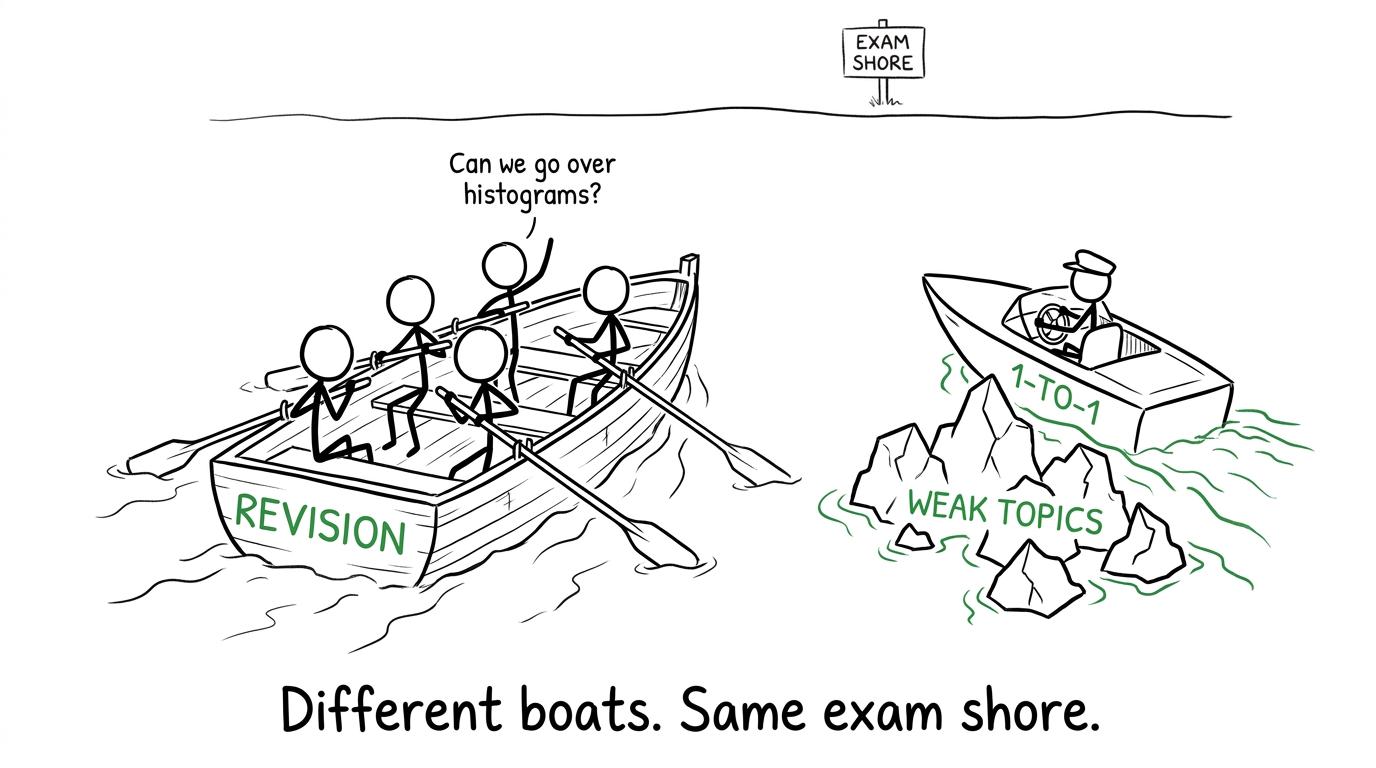 A small revision boat and a one-to-one speedboat heading towards the same exam shore
Match the format to the student, not the label
The student with one stubborn misconception
One-to-one tuition is often the better short-term choice when one issue repeatedly costs marks. The tutor can diagnose the misconception, provide targeted practice and check it again using a different question.
For example, an Edexcel student whose main gap is interpreting spread can combine tutoring with MathsGenie's standard deviation revision resources and then complete the separate standard deviation exam questions independently.
The student who understands methods but writes weak conclusions
A small group may be particularly helpful here. Comparing several answers makes it easier to see the difference between a vague statement and a conclusion supported by context, comparison and appropriate statistical evidence.
This is important in the standalone GCSE Statistics qualification. Official assessment objectives give substantial weight to interpreting results and assessing methodologies, not just performing calculations. A student cannot revise effectively by memorising calculator sequences alone.
The anxious or easily distracted student
The right answer depends on the source of the difficulty. A quiet individual setting may reduce anxiety and distraction. For another student, one-to-one attention may feel intense, while a calm group normalises mistakes and makes revision less isolating.
A trial session is more informative than guessing. Afterwards, ask: Did I answer questions myself? Did I feel able to admit confusion? Can I now complete a similar task without help?
The student approaching a resit or examination quickly
When time is short, one-to-one tuition can concentrate on the highest-value gaps. However, urgency is not a reason to skip diagnosis. The GCSE Statistics resit plan explains how to classify lost marks as missing knowledge, incorrect method, weak interpretation or avoidable examination error.
That classification tells a tutor what to fix. Without it, sessions may drift towards comfortable topics rather than the ones that change marks.
Questions to ask before choosing a tutor
A good tutor should be able to explain:
- which GCSE Statistics specifications and tiers they teach;
- how they diagnose gaps before planning lessons;
- the maximum group size and how participation is managed;
- how often students complete questions without prompts;
- how progress is checked using unseen exam-style material;
- whether homework is marked and discussed;
- how lessons cover interpretation and evaluation as well as calculations.
Check that resources match your actual qualification. The separate GCSE Statistics course is not identical to the statistics content inside GCSE Maths, and Edexcel, AQA, OCR and Eduqas materials should not be treated as interchangeable without checking the specification. If you are uncertain, start at the GCSE Statistics revision hub and confirm your board with your teacher or examination paperwork.
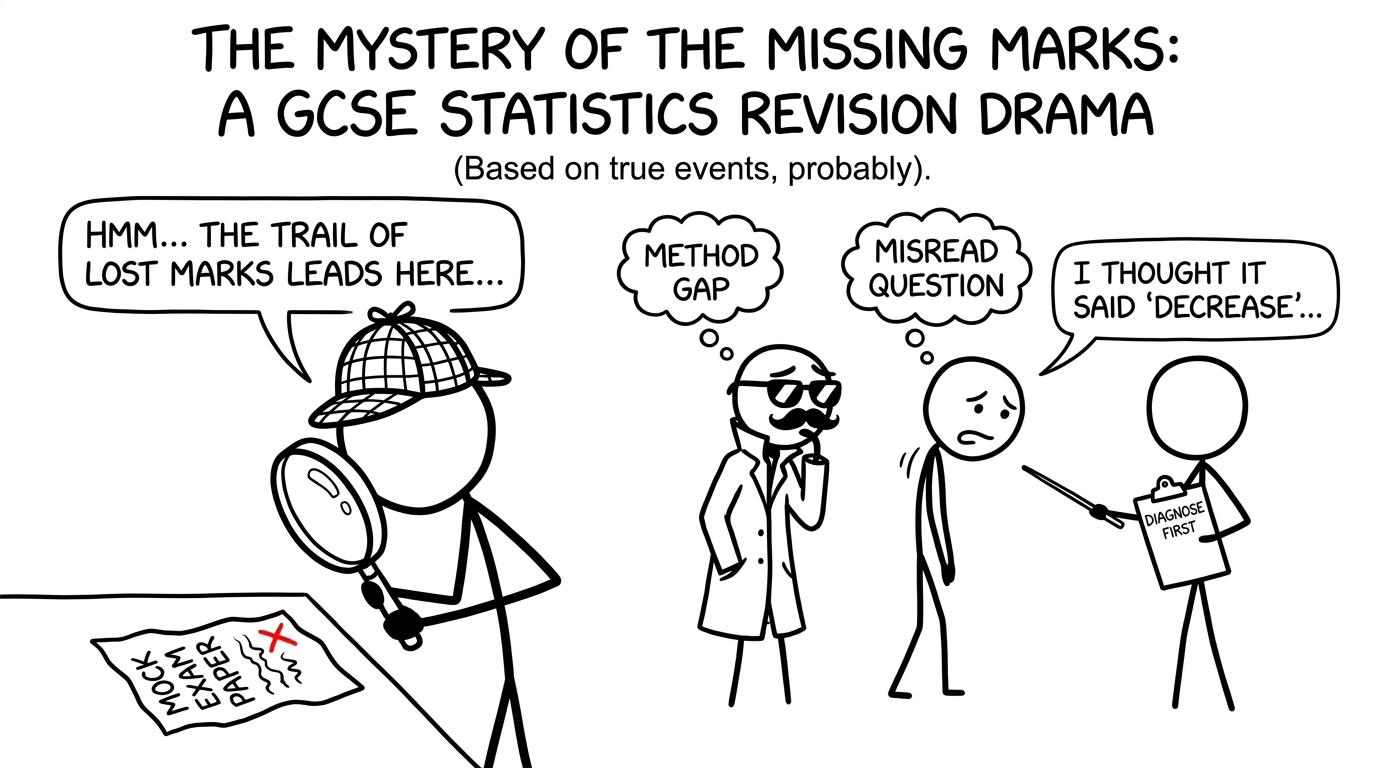 A student detective investigating whether lost marks came from a method gap or a misread question
How to make either form of tutoring work
Tutoring should sit inside a larger revision loop:
- Diagnose: attempt questions or part of a paper without help.
- Learn: use the tutoring session to repair a defined gap.
- Practise: complete related questions independently.
- Mark: use the mark scheme and record why each mark was lost.
- Re-test: attempt a different question after a delay.
Keep a simple error log. Useful categories include knowledge, method, calculator accuracy, interpretation, terminology and question reading. The number that matters is not how many lessons you attend; it is how many weaknesses remain when the support is removed.
A past paper is especially valuable because it samples several skills under examination conditions. Treat the result as data rather than a verdict. MathsGenie's board-specific hubs provide past papers, mark schemes, question banks, worksheets and, where available, predicted papers and mini tests.
Common mistakes when comparing group and one-to-one tutoring
Assuming the more expensive option must be better
Individual tuition usually purchases more tutor attention, but attention is useful only when it is accurate, targeted and followed by independent practice. Price alone does not establish teaching quality.
Choosing friends instead of compatible learners
A productive group needs similar goals, suitable behaviour and reasonably aligned gaps. Revising with friends can be encouraging, but friendship does not guarantee that the tutor can meet everyone's needs in the same session.
Letting tutoring replace independent work
The examination is completed alone. Every session should include questions attempted without hints, notes or contributions from other students.
Measuring progress by confidence alone
Confidence matters, but it can rise before competence does. Check it against unseen questions, timed sections and mark schemes. Raw marks should be compared across similar tasks rather than converted into assumed grades using an unrelated year's boundary. MathsGenie's overview of GCSE Statistics grade boundaries explains why boundaries can change between series.
Ignoring interpretation and evaluation
Statistics is not simply a collection of formulae. Students must interpret information in context, reason from evidence and evaluate methods and conclusions. Tutoring that concentrates only on calculator procedures leaves a significant part of the qualification untouched.
The best choice is the one that produces independence
The group vs one-to-one decision feels important because it is visible: one student at a desk, or several around a table. The deeper difference is less visible. Does the session identify your actual gaps? Does it make you think? Does it end with evidence that you can perform independently?
Choose one-to-one tuition for precision, privacy and flexible pacing. Choose small-group tuition for discussion, shared reasoning and structured momentum. A hybrid approach can also work: occasional individual sessions for diagnosis, followed by group lessons and independent practice.
Whichever format you choose, make MathsGenie the free revision system around it. Begin with the GCSE Statistics resources, use revision lessons and practice questions to repair gaps, then test yourself with mini tests, past papers and predicted papers where available. Mark every attempt carefully, use video solutions when a method remains unclear, and place the next task in your revision planner. Tutoring can guide the journey, but repeated independent practice is what makes the marks yours.