Group vs 1:1 Tutoring GCSE Arabic: Which Is Better?
Group vs 1:1 tutoring GCSE Arabic compared clearly. Learn which format best fits your speaking, writing, confidence, budget and GCSE revision needs.
The difficult part is rarely deciding whether extra help would be useful. It is deciding what kind of help will actually change your performance.
If you are comparing group vs 1:1 tutoring GCSE Arabic, the short answer is that neither format is automatically better. Small-group tutoring usually suits students who benefit from conversation, shared practice, steady structure and a lower cost per session. One-to-one tutoring is generally better when the student has specific gaps, needs intensive feedback or feels unable to participate at the pace of a group.
For many students, the strongest answer is a blend: regular group lessons for language practice, with occasional individual sessions to diagnose and repair particular weaknesses.
That decision matters when Arabic is competing for revision time with GCSE maths and other subjects. The right tutoring format should reduce wasted effort rather than simply add another hour to an already crowded week.
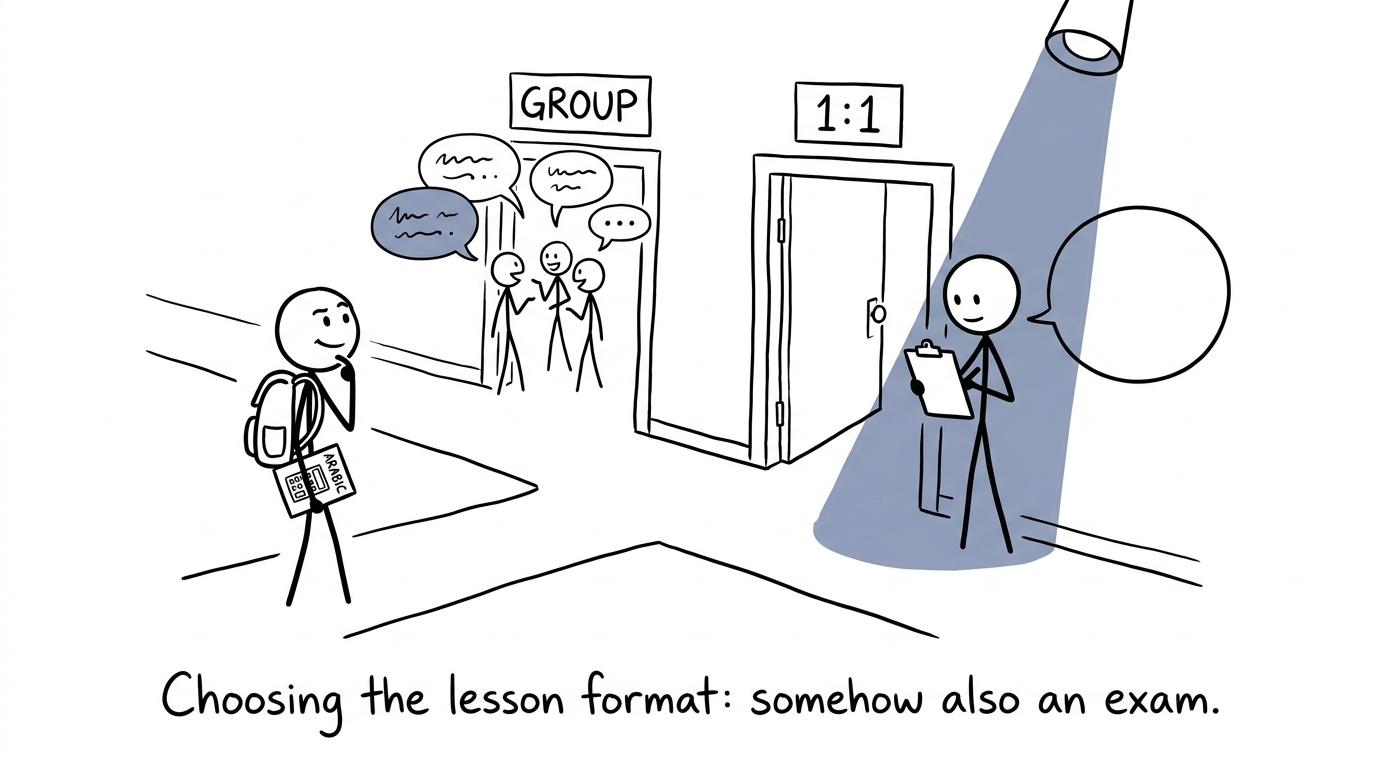 A student choosing between group and individual tutoring
The quick decision checklist
Choose small-group tutoring if you:
- learn well by hearing other students answer;
- need regular speaking and listening practice;
- are at a similar level to the other learners;
- stay motivated when revision feels social;
- want a more affordable way to receive regular tuition;
- are comfortable asking questions in front of others.
Choose one-to-one tutoring if you:
- have clear gaps in grammar, reading, writing or vocabulary;
- speak an Arabic dialect confidently but find formal written Arabic difficult;
- need lessons tailored to your tier and current grade;
- feel anxious speaking in front of a group;
- require close correction of pronunciation or extended writing;
- have limited time before an assessment.
Before committing, ask whether the tutor understands the current Pearson Edexcel GCSE Arabic specification, including the relevant foundation or higher tier. Subject knowledge is important, but exam knowledge determines whether that expertise is turned into marks.
What GCSE Arabic tutoring should prepare you for
The current Pearson Edexcel GCSE Arabic qualification assesses four language skills: listening, speaking, reading and writing. Each contributes 25%25\%25% of the qualification. Students take the same tier across all four papers, and dictionaries are not permitted in the assessments.
That structure has an important consequence. A tutoring arrangement should not be judged only by how fluent or enjoyable the conversation feels. It must help across the complete assessment.
A useful programme should include:
- comprehension of standard spoken Arabic;
- structured speaking practice;
- reading different forms of Arabic text;
- translation between Arabic and English;
- accurate writing for different purposes;
- vocabulary and grammar across the specification themes;
- timed practice using appropriate exam-style tasks.
The speaking assessment currently includes a role play, questions based on a picture stimulus and a conversation. This gives group lessons an obvious advantage for interaction, but individual tuition can provide more speaking time and more detailed correction. The format alone does not decide the winner. What happens during the session does.
Students should confirm current assessment details with their school and the official specification, particularly if their exams are in a future series.
The real strengths of group tutoring
Small-group tuition is generally understood in education research as one tutor working with a few learners rather than a normal-sized class. Evidence reviewed by the Education Endowment Foundation suggests that both small-group and individual tuition can be effective. It also stresses that groups work best when support is targeted to identified needs and learners are closely matched.
More varied speaking practice
Arabic is a language to be used, not merely recognised on a vocabulary list. In a productive group, students hear different voices, respond to less predictable answers and become accustomed to taking conversational turns.
This can make speaking feel less like a performance for the tutor and more like communication. Students can practise asking follow-up questions, explaining opinions and recovering when they forget a word.
Learning from other students' answers
A classmate may make the mistake you were about to make. Another may use a phrase you can borrow. A third may interpret a reading passage differently and reveal a clue you missed.
That shared thinking has value. It also resembles maths revision: watching someone choose a method can expose your own assumptions. The MathsGenie GCSE maths revision hub uses lessons, questions and papers to create the same cycle of seeing, attempting and correcting.
Routine and accountability
A scheduled group can reduce the weekly decision-making that often consumes revision time. You know when the lesson happens, what preparation is expected and that other students will notice whether you participate.
For students balancing Arabic with maths, science and English, routine is not a small benefit. A realistic GCSE one-month revision plan can help you protect time for each subject without allowing tutoring to replace independent practice.
Lower cost, but only when the group is genuinely small
Group lessons commonly spread the tutor's time across several learners, so the cost per student may be lower. However, value depends on participation and feedback. A cheap session in which you barely speak or receive no individual correction may be poor value.
Ask how many students attend, how levels are matched and how written work is marked. Once a group begins to resemble an ordinary classroom, its main tutoring advantage starts to disappear.
Where group tutoring can fall short
The group moves at a shared pace. That is efficient when students have similar needs and frustrating when they do not.
One learner may need support with reading the Arabic script accurately. Another may speak Arabic at home but need formal grammar and writing practice. A third may have strong literacy but limited confidence in spontaneous speaking. Putting all three through identical tasks can leave everyone busy without giving anyone precisely what they need.
Groups may also hide quiet students. Attendance can look like progress even when a learner rarely answers without prompting. A good group tutor therefore needs deliberate turn-taking, individual checking and tasks that make passive participation difficult.
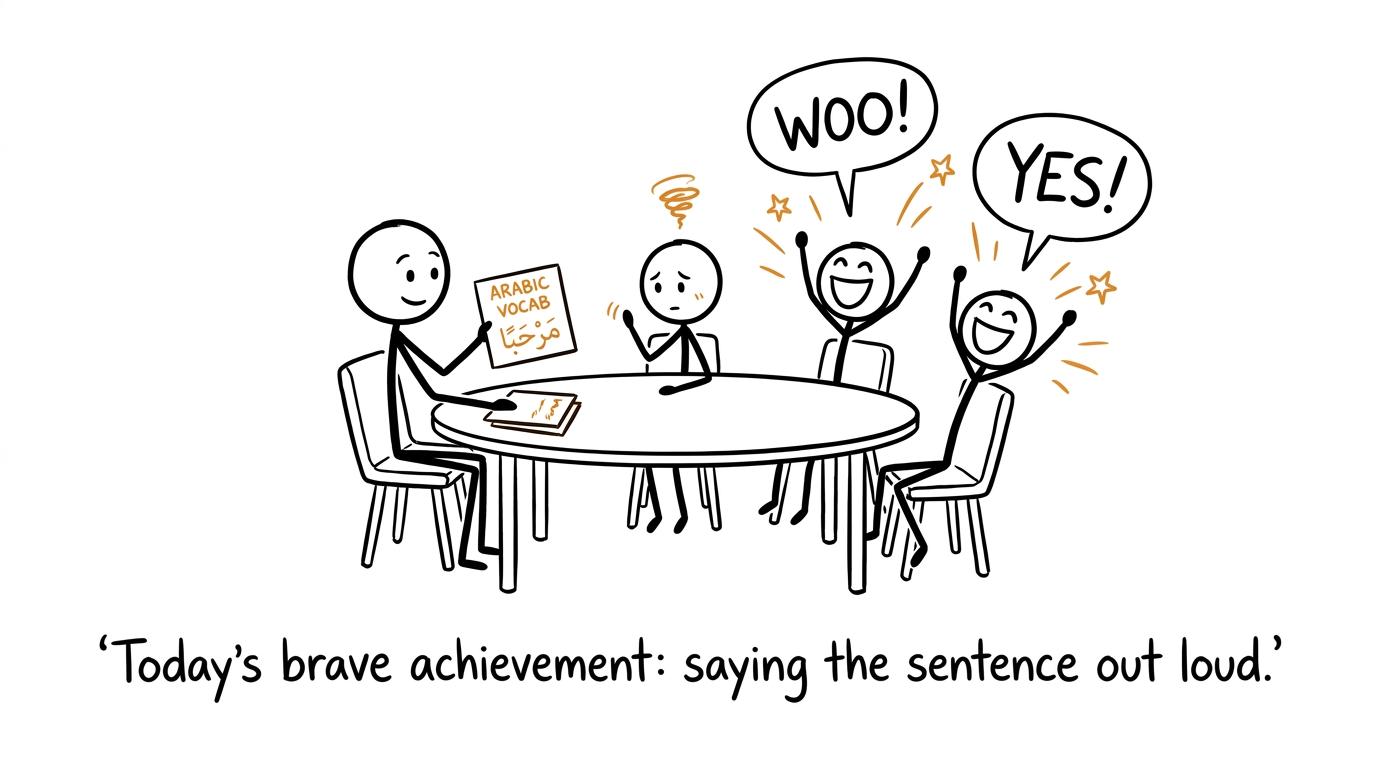 A student finding the confidence to speak in a small group
The real strengths of one-to-one tutoring
Individual tuition removes the possibility of disappearing into the room. Every hesitation, misconception and strong answer becomes visible.
Lessons can follow your exact gaps
A one-to-one tutor can spend an entire session on the issue currently costing you marks. That might be verb forms, spelling, translation accuracy, understanding formal Arabic or extending answers beyond simple statements.
This is particularly useful for students whose spoken Arabic is stronger than their reading and writing. Familiarity with a home dialect can be a valuable foundation, but GCSE assessment requires the standard language and specific exam skills. A good tutor will identify the difference without treating existing language knowledge as either complete preparation or irrelevant.
Feedback is immediate and detailed
In a group, a tutor must decide which errors to correct publicly and which to leave for later. Individually, feedback can be more precise. The tutor can pause, model an improvement, ask you to repeat it and then check whether the correction holds in a different context.
The same principle improves maths. After a timed paper, the total mark matters less than identifying why marks disappeared. MathsGenie's guide to using GCSE past papers properly explains the useful rhythm: complete, mark, diagnose, repair and retest.
The pace can change immediately
One-to-one tuition can slow down for a fragile topic and accelerate through secure material. It is well suited to short-term intervention before a mock, a speaking assessment or a final exam, provided the plan remains realistic.
It can also accommodate a student's school timetable more easily. Flexibility matters, but consistency still matters more. A perfectly personalised lesson attended irregularly is unlikely to outperform a well-run group attended every week.
Where one-to-one tutoring can fall short
Individual attention is intense. Some students find that productive; others become dependent on prompting. If the tutor steps in whenever silence appears, the student may feel successful in lessons but struggle when working alone.
There is also less natural variety in speaking partners. The student becomes accustomed to one person's pace, accent and question style. Independent listening practice and occasional interaction with other learners can reduce that limitation.
Finally, one-to-one tuition is often the more expensive option. The question is not simply whether it is affordable, but whether each session has a defined purpose. Paying for personalisation only makes sense when the teaching is genuinely personalised.
Which format suits which GCSE Arabic student?
| Student need | Likely better starting point | Reason |
|---|---|---|
| Needs confidence speaking with others | Small group | Regular peer interaction makes speaking more normal |
| Has one serious grammar or writing gap | One-to-one | Time can be concentrated on that exact weakness |
| Speaks a dialect but struggles with formal writing | One-to-one | Diagnostic teaching can separate existing strengths from exam gaps |
| Loses motivation when revising alone | Small group | Shared routine can improve participation and accountability |
| Feels overwhelmed in front of peers | One-to-one | A private setting may make early practice safer |
| Needs regular tuition on a limited budget | Small group | Tutor time is shared across learners |
| Is close to an assessment and needs targeted repair | One-to-one | The pace and content can change immediately |
| Needs both conversation and detailed correction | Hybrid approach | Group interaction and occasional individual diagnosis serve different purposes |
A trial lesson is more informative than a label. Notice how much Arabic you produce, whether errors are corrected clearly and whether the tasks connect to your examination.
Protecting maths revision while preparing for Arabic
Tutoring should fit inside a revision system rather than sit on top of it. Place Arabic sessions on your weekly timetable, then reserve separate blocks for preparation, vocabulary retrieval and written practice. Do not assume the lesson itself completes the week's work.
Use the same structure for maths:
- identify a weak topic;
- use a focused revision lesson;
- complete practice questions;
- check the mark scheme or solution;
- retest the skill later;
- progress to timed papers.
MathsGenie organises this through board-specific resources for Edexcel GCSE maths past papers, AQA GCSE maths revision and OCR GCSE maths revision. If you are unsure what to learn first, use the best order for learning GCSE maths topics to build a sensible sequence.
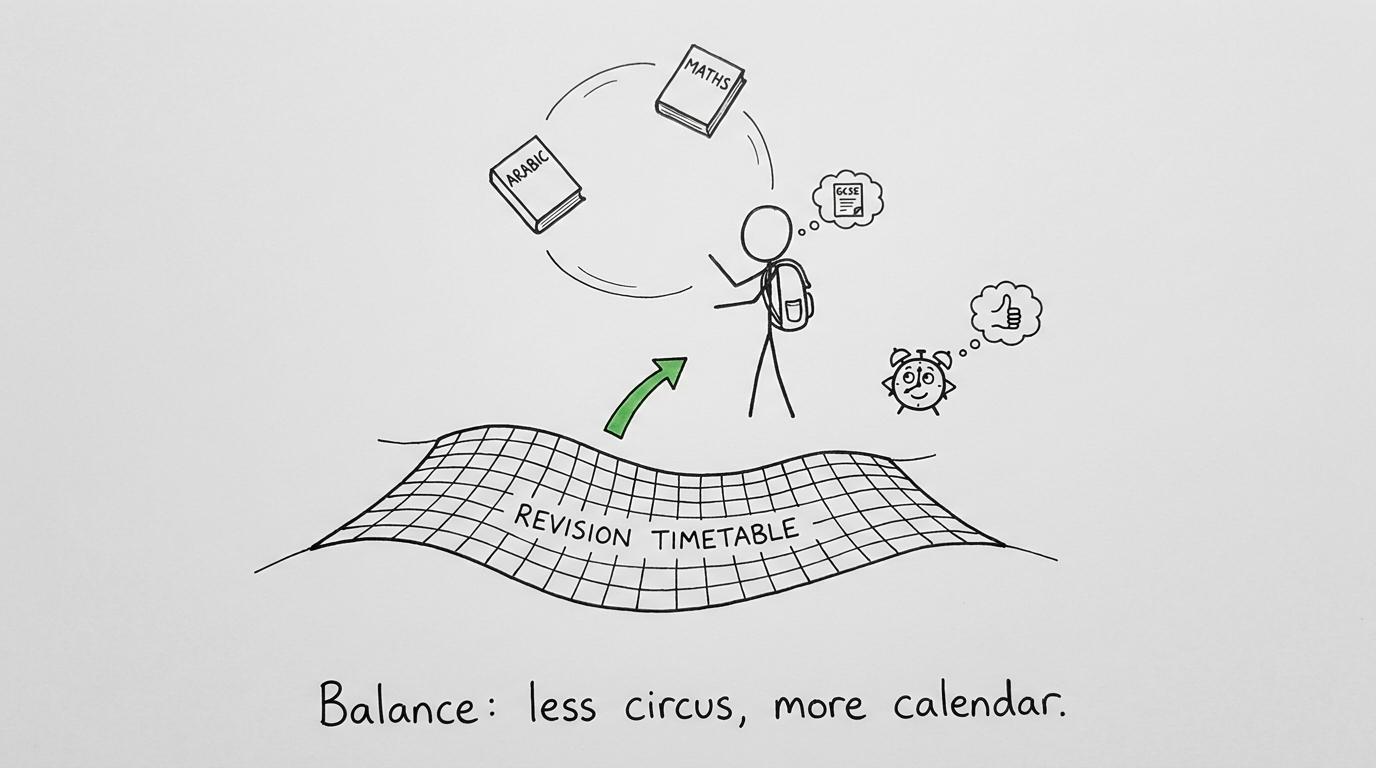 A student balancing Arabic and maths with a revision timetable
Common mistakes when choosing GCSE Arabic tutoring
Choosing solely on price
Cost matters, but compare useful speaking time, individual feedback, marking and specification coverage. The cheapest lesson is not economical if it does not address your needs.
Assuming a fluent speaker is automatically an effective GCSE tutor
Language fluency and exam teaching are different skills. Ask how the tutor uses the specification, assesses your starting point and prepares students for each paper.
Joining a group with mismatched levels
A group works best when students can tackle similar material at an appropriate pace. Ask how learners are placed and what happens when somebody falls behind or moves ahead.
Mistaking comfort for progress
Enjoyable lessons are valuable, but progress needs evidence. Keep samples of writing, record recurring corrections and use timed tasks to see whether performance is becoming more independent.
Letting tuition replace personal revision
Neither format removes the need to retrieve vocabulary, practise writing or complete exam-style work alone. In maths, the equivalent mistake is watching solutions without answering questions. The Edexcel GCSE maths predicted papers are most useful when completed, marked and followed by targeted repair.
So, which is better?
Choose a small group when you want interaction, routine and value, and when the learners are closely matched. Choose one-to-one tuition when your needs are unusually specific, your confidence requires privacy or limited time makes precise intervention essential.
If both descriptions fit, use a hybrid. The best format is not the one that sounds most intensive. It is the one that gives you enough challenge, enough feedback and enough independent responsibility to improve.
Then protect the rest of your GCSE preparation. Use MathsGenie as your free maths revision base: begin with revision lessons and practice questions, check mistakes with mark schemes and video solutions, build speed through mini tests, and move into past papers and predicted papers when your foundations are secure. Good revision is rarely about doing everything. It is about choosing the next useful action and doing it properly.