Is a Grade 6 in GCSE Dance Good for Sixth Form?
Grade 6 GCSE Dance sixth form entry is often enough. Check course rules, audition expectations, general GCSE requirements and how to plan your next move.
A results sheet can make one number feel as if it decides everything. It rarely does. If you are searching for grade 6 GCSE Dance sixth form entry advice, the short answer is reassuring: a grade 6 is enough for many A Level Dance and Level 3 performing arts courses. Some providers explicitly ask for a grade 6, while others accept a grade 4 or 5, relevant dance experience or a successful audition.
But there is no single national entry rule. Your sixth form or college sets its own subject-specific and general admissions criteria. That means a grade 6 is a strong starting point, not an automatic offer. You must check the exact course page, including its requirements for English, maths, overall GCSE results and practical experience.
The quick sixth form entry checklist
Before worrying about whether your result is good enough, check these points:
- Is the course A Level Dance, a BTEC or another Level 3 performing arts qualification?
- Does it specify a minimum GCSE Dance grade?
- Is GCSE Dance required, recommended or optional?
- Is there an audition, workshop, interview or video submission?
- What are the provider's general sixth form entry requirements?
- Does it require particular grades in GCSE English or maths?
- Do you have relevant training or performance experience outside school?
- Is the course definitely running in your intended year of entry?
The last point matters because sixth form options can change according to staffing and student numbers. Use the current prospectus for your year, rather than relying on an older screenshot or what a friend remembers.
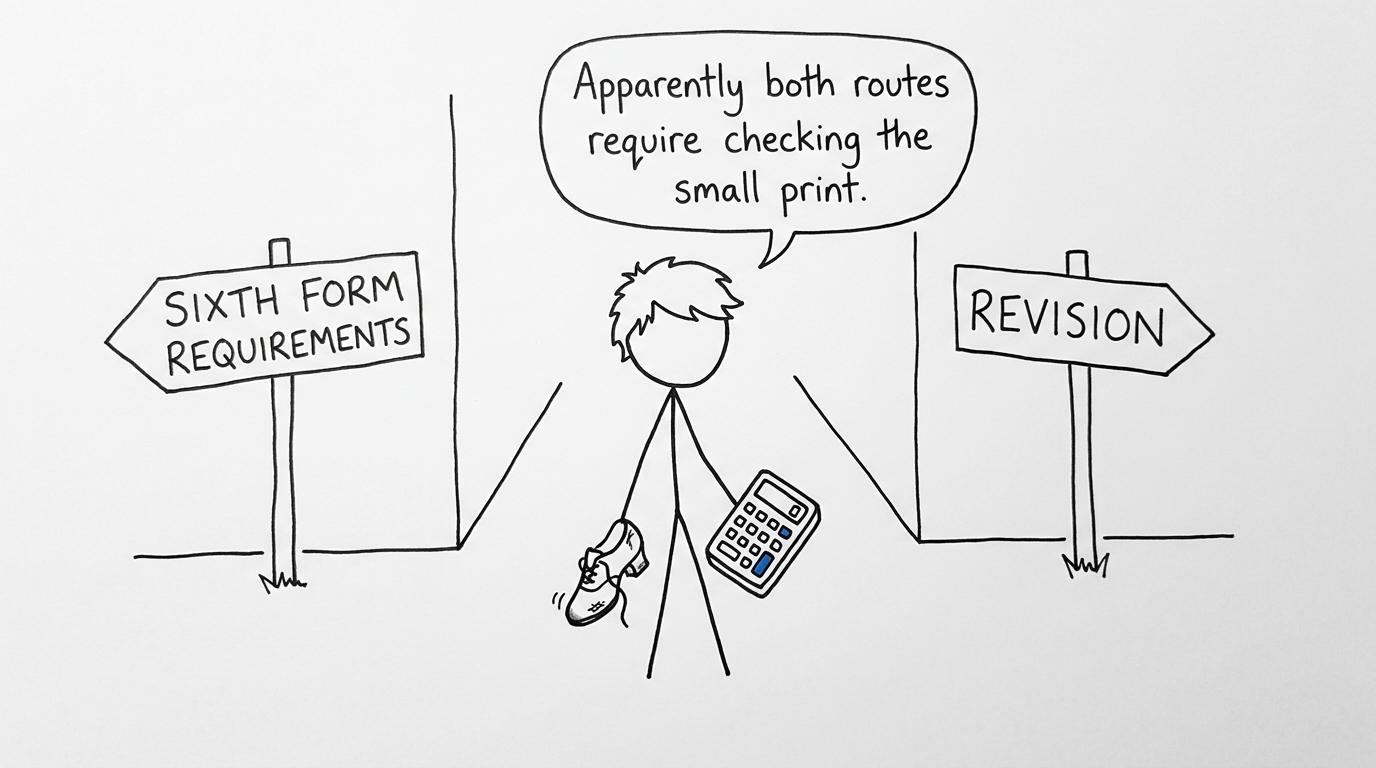 A student checks the small print while choosing between sixth form applications and revision
Is a grade 6 in GCSE Dance good?
Yes. A grade 6 is a positive GCSE result and sits above grades 4 and 5 on England's 9-1 grading scale. It shows that you have developed a meaningful level of knowledge and skill across the assessed course.
For example, AQA GCSE Dance combines practical performance and choreography with written dance appreciation. A grade 6 therefore reflects more than the ability to perform confidently. It also indicates experience of creating movement, analysing dance and connecting practical decisions to artistic intentions.
That is useful preparation for A Level Dance, where performance and choreography continue alongside substantial critical engagement. The course is not simply an extended dance lesson. It asks students to investigate practitioners, professional works and choreographic approaches, then communicate their understanding clearly in writing and performance.
A grade 6 suggests that you have a credible foundation for that step. Whether it secures a place depends on the institution.
Why the exact sixth form matters
AQA's A Level Dance specification does not impose a previous-learning requirement. It recommends knowledge and skills associated with GCSE Dance or an equivalent course, but leaves entry decisions to individual schools and colleges.
Published entry criteria demonstrate what that discretion looks like. Some sixth forms ask for grade 6 in GCSE Dance. Others set the threshold at grade 4 or 5, while some allow applicants without GCSE Dance to demonstrate substantial practical experience. Auditions and English requirements also appear in certain admissions policies.
So two students with the same grade can receive different decisions from two providers. This is not inconsistency in the qualification. It is the result of each provider designing admissions criteria around its course, timetable and expectations.
Treat the course page as the specification for your application. Look for two separate layers:
Subject-specific requirements
These relate directly to Dance. They might include:
- a minimum GCSE Dance grade;
- previous training in one or more dance styles;
- an audition or practical workshop;
- a video submission;
- evidence of choreography or performance experience;
- a discussion with the course leader.
Meeting a listed grade 6 requirement normally means you have cleared that particular academic threshold. You may still need to complete the practical or application elements.
General entry requirements
These apply across the sixth form or college. A provider may require a particular number of GCSEs at specified grades, sometimes including English Language and maths. Another may calculate an average GCSE score or set different requirements for A Level and vocational programmes.
This is where students sometimes get caught out. They focus entirely on Dance and overlook the wider offer conditions. A grade 6 in Dance may meet the subject requirement while a missing maths or English grade affects general admission.
What if your preferred course asks for a higher grade?
If the published requirement is grade 7, do not assume that a grade 6 will automatically be accepted. Equally, do not silently remove the course from your list.
Contact the admissions team or Dance department and ask a precise question. Explain your achieved or predicted grade, then ask whether applicants are considered through an audition, portfolio, teacher reference or relevant external training. The provider may apply its requirement firmly, but only it can give you a reliable decision.
If you have not yet sat the exam, use the requirement as a target rather than a verdict. Ask your Dance teacher which assessment area is currently limiting your grade and what evidence supports the prediction. Focused feedback is far more useful than vaguely trying to “work harder”.
It is also sensible to identify a second course whose published criteria already match your profile. A backup is not an admission of defeat. It is what careful applicants do when outcomes depend on examinations, auditions and course availability.
What if you did not take GCSE Dance?
You may still have options. Because AQA does not prescribe GCSE Dance as a formal prerequisite for its A Level specification, individual providers can consider equivalent experience. Some course criteria explicitly allow this.
Relevant evidence might include sustained dance training, performances, choreography, graded qualifications or participation in a recognised dance programme. What counts, and how it is assessed, remains the provider's decision.
Ask what you need to submit before applying. “Dance experience required” could mean an informal conversation at one college and a structured audition at another. Do not guess.
Why your GCSE Maths result still matters
Dance may be the subject you want to pursue, but your maths grade can still influence access to sixth form. Many providers include GCSE maths within their general admissions criteria. The exact grade varies, so check the current policy for every institution on your list.
If your maths result is uncertain, the useful response is not to revise every topic equally. Start by identifying where marks are being lost. The MathsGenie GCSE Maths homepage provides free revision lessons and topic questions, while the GCSE Maths topics by exam board and tier guide helps you confirm what applies to Edexcel, AQA, OCR or Eduqas.
A simple revision cycle works well:
- complete a short assessment;
- mark it honestly;
- identify the two or three topics costing the most marks;
- review each method through a revision lesson;
- answer fresh practice questions;
- return to the skill later without notes.
The GCSE mini tests make this manageable when Dance rehearsals and other subjects already occupy your week. If you are working around grade 6 in maths too, the GCSE Maths self-assessment checklist can help you locate higher-tier gaps rather than relying on instinct.
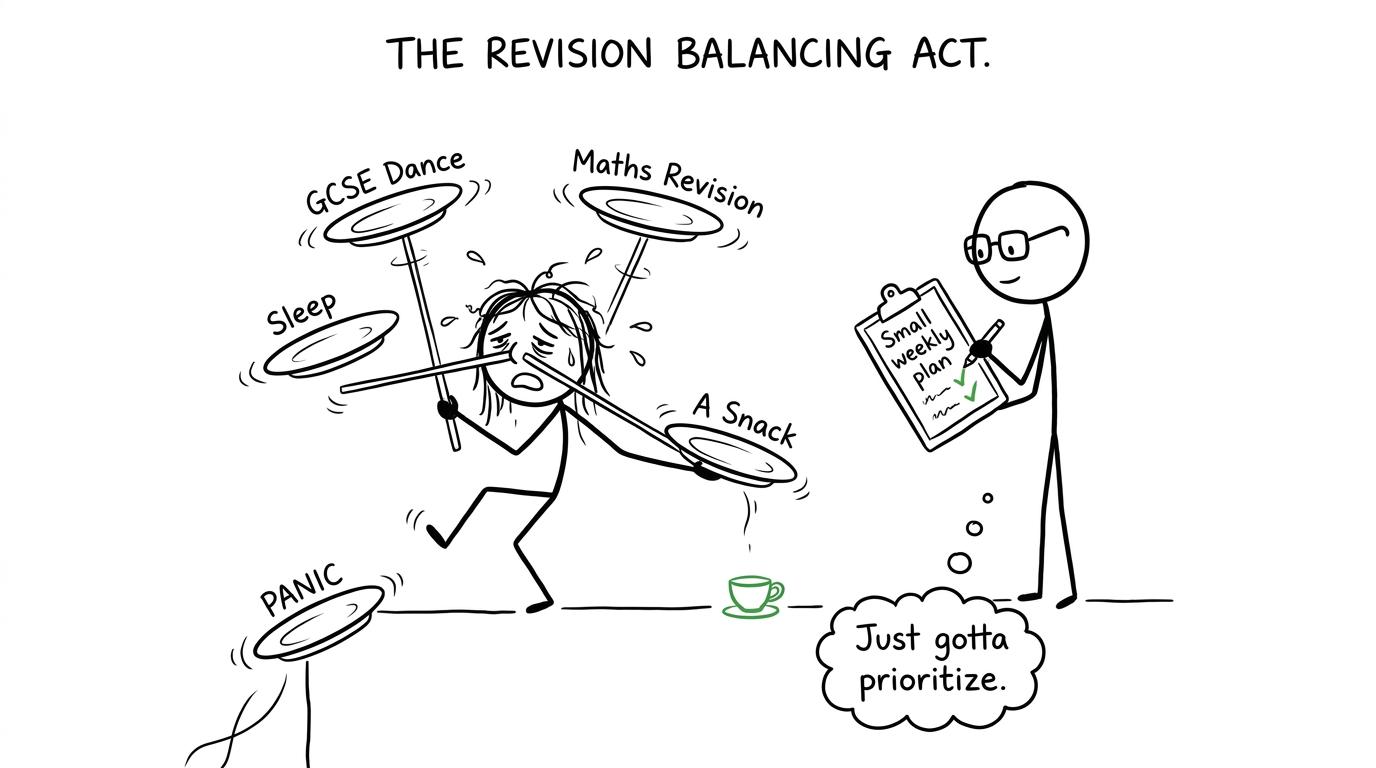 A student replaces spinning plates of revision panic with a small weekly plan
Balancing Dance preparation with maths revision
Practical subjects create a particular revision problem: rehearsals have fixed times, while written revision expands to fill whatever time remains. Without a plan, maths is often postponed until the evening, when concentration is weakest.
Build your week around commitments you cannot move. Then add short, specific maths sessions. “Revise maths” is too vague. “Complete one mini test, mark it and repair one topic” gives the session a finish line.
Once your topic knowledge is stable, use papers to practise timing and decision-making. Edexcel students can work from the Edexcel GCSE Maths past papers, including mark schemes and solutions. The guide to using Edexcel past papers properly explains how to convert mistakes into targeted revision rather than merely recording a score.
Nearer the exams, GCSE predicted papers provide fresh exam-style practice. They should supplement specification coverage and past-paper work, not replace them. If an exam is close, the GCSE Maths night-before plan offers a calmer alternative to an unfocused late-night session.
Common mistakes when judging sixth form eligibility
Assuming every provider uses the same grade
There is no universal minimum GCSE Dance grade for every sixth form. Requirements can differ even between nearby institutions. Check each current course page separately.
Looking only at the Dance requirement
You may meet the subject threshold but miss an overall GCSE, English or maths condition. Read the general admissions policy as well as the Dance description.
Treating an audition as a formality
Where an audition is required, prepare for it carefully. Confirm the format, clothing, music, length, style and deadline directly with the provider.
Confusing predicted and achieved grades
An application may be considered using predicted grades, but an eventual offer can remain conditional on achieved results. Read the wording of the offer and ask if anything is unclear.
Trusting old requirements
Entry criteria and course availability can change. Use information published for your intended entry year and confirm uncertainties with admissions staff.
Letting one grade distract from every other subject
A good Dance grade does not remove the need to secure the wider GCSE profile required by your chosen provider. Protect your English and maths preparation alongside rehearsals.
Your next move
A grade 6 in GCSE Dance is good enough for many sixth form and college Dance courses, including courses that explicitly set grade 6 as their subject threshold. It may exceed the requirement elsewhere. But it cannot answer the admissions question on its own because general GCSE conditions, practical experience and auditions vary.
Make a shortlist, read each current admissions policy and record every condition in one place. If a rule is ambiguous, ask the provider rather than interpreting it optimistically or pessimistically.
Then turn your attention to what remains within your control. MathsGenie gives you free revision lessons, practice questions, mini tests, past papers, predicted papers, mark schemes and video solutions. Choose your exam board and tier, identify the marks you are losing and repair one weakness at a time. A sixth form application is built from several results and calm, targeted revision gives each of them the best chance to support where you want to go next.