Grade 5 GCSE Religious Studies Sixth Form Guide
Grade 5 GCSE Religious Studies sixth form guidance: check whether your result meets course requirements and what to confirm before applying.
The hardest part of results day is often not the grade itself. It is the story your mind builds around it: one number becomes a verdict on sixth form, future courses and everything that follows.
If you are searching for grade 5 GCSE Religious Studies sixth form guidance, the direct answer is reassuring: a grade 555 is enough for many sixth-form and college courses, including A Level Religious Studies at some providers, but it is not enough for every course or institution. Entry requirements are set locally. Some providers accept a grade 555 in Religious Studies, some ask for a grade 666, and others focus on English or another essay-based subject instead.
The result matters, but the exact course requirements matter more.
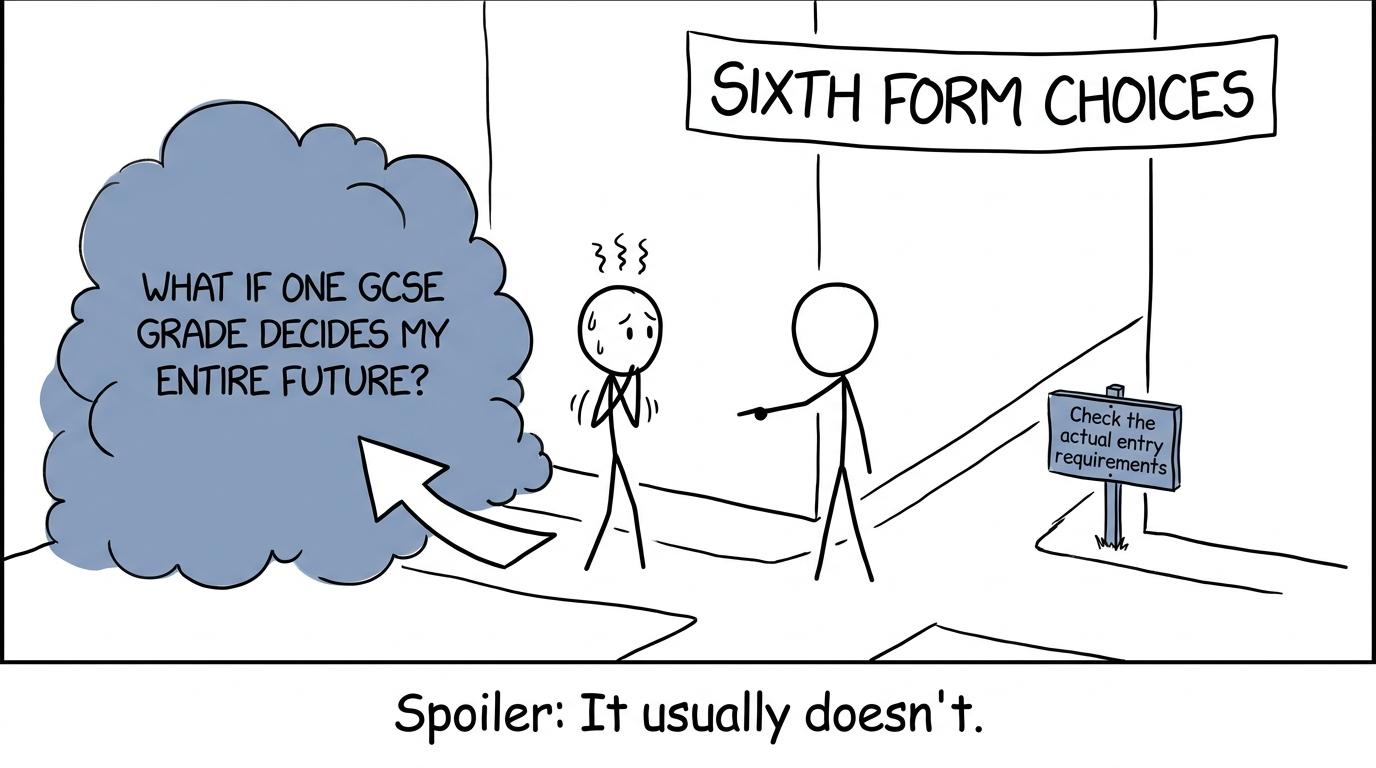 A student discovers that checking sixth-form requirements is more useful than imagining every possible disaster
The quick sixth-form entry checklist
Before deciding whether your grade is good enough, check five separate things:
- the provider's general sixth-form or college entry requirements;
- the subject-specific requirement for the course you want;
- any separate conditions for GCSE English and maths;
- whether Religious Studies must be a full-course GCSE;
- whether applications below the published requirement are considered individually.
A useful rule is to read the current prospectus rather than relying on what a friend, older sibling or teacher remembers. Requirements can differ between providers and may be updated for a new admissions year.
MathsGenie's wider guide to GCSE Religious Studies grades and sixth-form entry can also help you interpret the different conditions you may encounter.
Is a grade 5 in GCSE Religious Studies good?
Yes. In England's GCSE grading scale, a grade 444 is recognised as a standard pass. A grade 555 therefore sits above that threshold and represents a credible achievement in a subject requiring knowledge, evaluation and extended written argument.
However, the word "good" has two meanings here.
As an achievement, a grade 555 is good. As an admissions result, it is good enough only when it satisfies the rules for your intended programme. A student applying for a vocational Level 333 course may face different conditions from somebody applying for three A Levels at a selective sixth form.
This distinction prevents a common mistake: treating one grade as if it decides the whole application. Admissions teams may consider your overall GCSE profile, English and maths results, relevant subject grades and whether you meet the conditions for each chosen course.
For a broader explanation, see what a grade 5 means at GCSE.
Is grade 5 enough for A Level Religious Studies?
A grade 555 can be enough, but there is no single national GCSE entry grade for A Level Religious Studies.
Current published entry requirements demonstrate the variation clearly. Some sixth forms specify grade 555 in GCSE Religious Studies alongside a grade 555 in English Language. Others require grade 666 in Religious Studies, English Literature or another essay-based subject. Some colleges do not require GCSE Religious Studies at all, provided that the applicant meets their general entry conditions and demonstrates suitable written skills.
This variation exists because schools and colleges set their own admissions criteria. The exam board you would study at A Level, such as AQA, OCR or Eduqas, does not create one universal admissions threshold for every provider.
What if the course asks for a grade 6?
If the published condition is grade 666 and you receive grade 555, you have missed that stated requirement. Do not assume this means an automatic rejection, but do not assume the provider will ignore it either.
Contact the admissions team or subject leader promptly. Ask whether:
- the requirement is absolute or normally expected;
- your English result could demonstrate the necessary essay-writing ability;
- your overall GCSE profile will be considered;
- a waiting-list or review process operates after results day;
- another suitable subject combination is available.
Keep the conversation factual. A grade 555 does not become a grade 666 because you were close to a boundary, but a provider may have discretion where places, policies and the rest of your application allow it.
Will a Religious Studies grade affect other A Levels?
Usually, GCSE Religious Studies matters most when it is named in the entry criteria for Religious Studies or another essay-based course. For many other A Levels, it may simply contribute to the required number of GCSE passes.
For example, an application might require several GCSEs at grades 999-444 or 999-555, plus particular results in the subjects being continued. In that situation, a grade 555 in Religious Studies may strengthen the overall profile even when it is not directly related to the chosen A Levels.
The decisive grades may be elsewhere:
- English courses may specify English Language or English Literature;
- science courses commonly specify particular science results and sometimes maths;
- A Level Maths frequently requires a higher GCSE Maths grade than the provider's general entry threshold;
- humanities may accept Religious Studies, History, Geography or English as evidence of written ability.
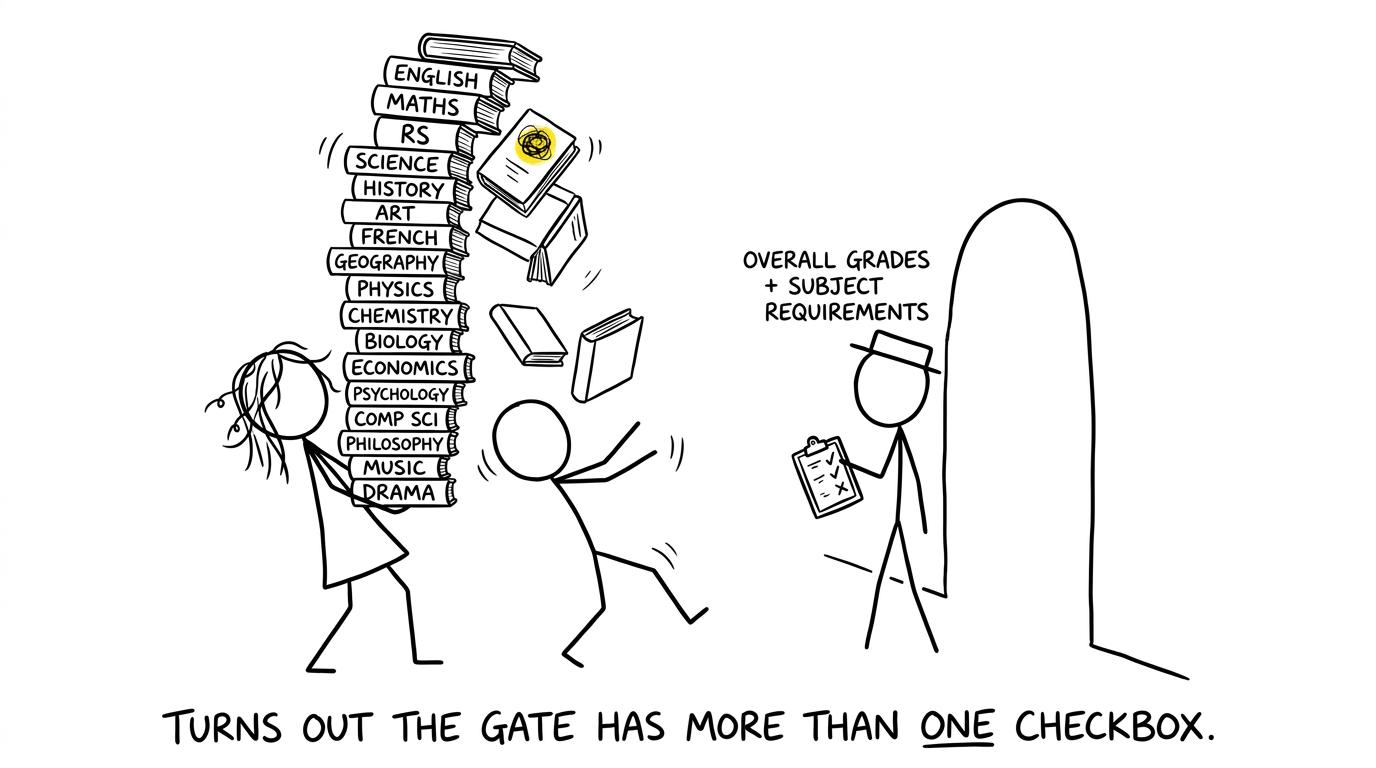 An admissions checklist reveals that one GCSE result is only one of several boxes
Why your GCSE Maths grade may be more important
If your planned course has no Religious Studies condition, check its English and maths requirements next. These subjects frequently appear in general sixth-form admissions criteria, while particular A Levels can demand stronger subject-specific results.
This is especially important if you are considering A Level Maths. A grade 555 in Religious Studies cannot compensate automatically for a GCSE Maths result below the course's stated minimum. Many A Level Maths courses expect at least grade 666, and some ask for grade 777 or apply additional guidance. Your chosen provider's current prospectus is the final authority.
If maths is the grade that could determine your next step, use the GCSE Maths revision hub to select your exam board, including Edexcel, AQA, OCR and Eduqas. You can then work through revision lessons, practice questions, worksheets, mini tests and papers at the correct tier.
Foundation tier awards grades up to grade 555, while higher tier provides access to grades 444-999, subject to the awarding arrangements for the examination. The GCSE maths topics by exam board and tier guide helps you identify what belongs in your revision plan.
How to decide whether your result supports the course you want
Do not ask only, "Is grade 555 enough?" Ask a more precise question: "Does my complete results profile meet every condition for this programme?"
Check the general entry rule
Look for the total number of GCSEs required and the permitted grade range. Confirm whether English Language and maths must be included. If the policy uses an average GCSE score or admissions score, read the provider's explanation carefully rather than calculating it from an unofficial formula.
Check every chosen subject separately
Three A Level choices can mean three different sets of requirements. Religious Studies may accept grade 555, while Maths or a science may need a higher result in its corresponding GCSE.
Write the requirements beside each choice. This turns an anxious impression into a visible checklist.
Confirm which English qualification counts
Some providers name English Language, some accept English Literature, and others specify either qualification. This detail can change the outcome of an application, particularly for Religious Studies and other writing-heavy subjects.
Ask about alternatives before results day
Choose a sensible reserve course or provider. A backup is not an admission of failure. It is a way of preserving your options when admissions rules, course capacity and final results meet on the same morning.
Turning uncertainty into a practical revision plan
Once you know the grades your courses require, revision becomes less abstract. You are no longer trying to "do better at everything". You are protecting particular options.
Begin with the subjects that create an entry risk. In maths, complete a mixed set of questions and mark it honestly. Group lost marks by topic, then use a simple cycle:
- revisit the relevant revision lesson;
- complete targeted practice questions;
- use the mark scheme to identify missing method or accuracy;
- repeat the weak question type after a short gap;
- move to timed papers when individual skills are secure.
The one-month GCSE Maths revision plan provides a structured rhythm for this process. If you currently have grade 555 in maths and need to understand your next step, read the guide to the meaning of a grade 5 in GCSE Maths.
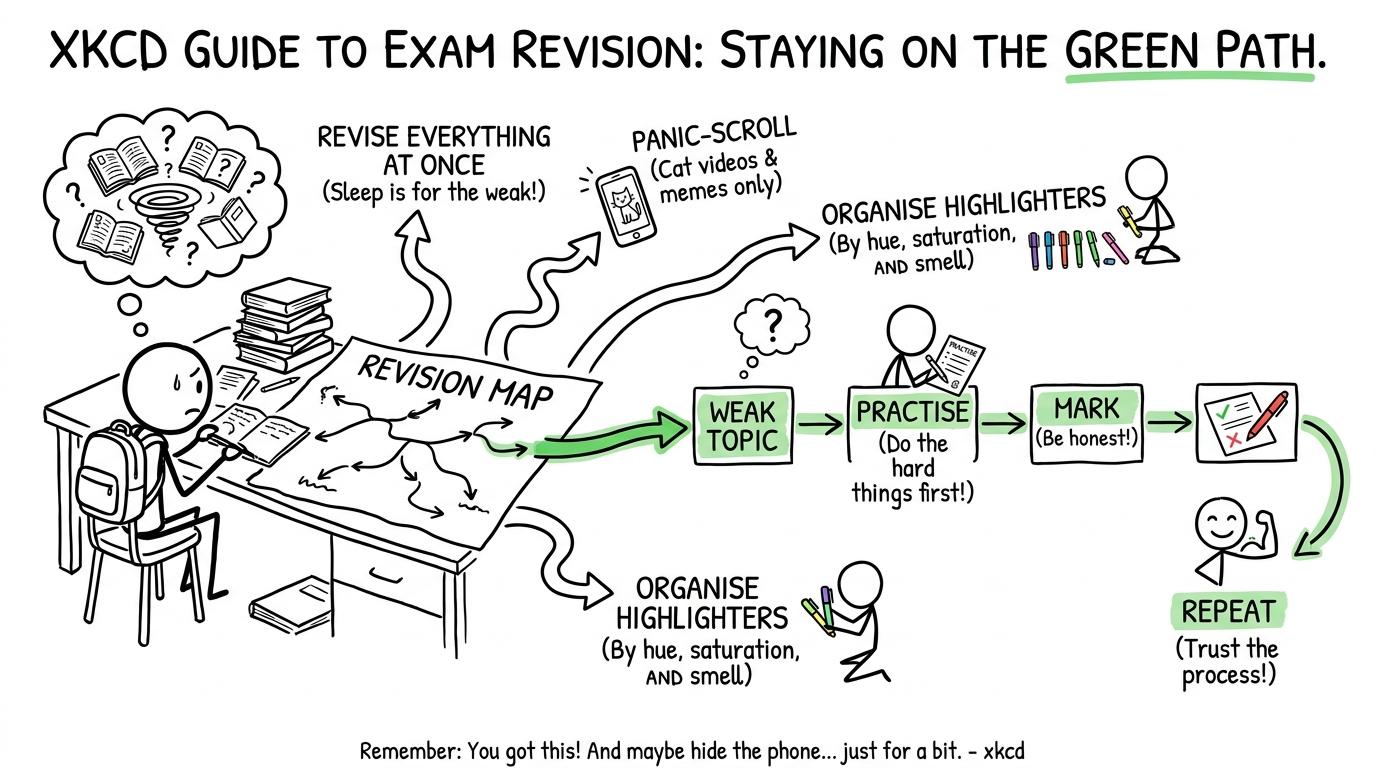 A revision map offers one useful route and several impressive-looking ways to avoid revision
Common mistakes when judging sixth-form eligibility
Looking only at the overall requirement
Meeting the general rule does not guarantee entry to every subject. Always check the additional criteria for each A Level or vocational course.
Assuming every sixth form uses the same grades
One provider may accept grade 555 in Religious Studies; another may require grade 666 or focus on English. Advice is useful, but the current admissions policy is decisive.
Confusing a pass with guaranteed admission
A grade 555 is a respectable result, but admission can also depend on the complete grade profile, subject conditions, course suitability and available places.
Ignoring English and maths
A strong Religious Studies result cannot replace an English or maths condition unless the provider explicitly says it can. Check these core qualifications separately.
Waiting until results day to investigate
Research your first choice and realistic alternatives now. Save the admissions contact details and know which questions you would ask if one grade falls short.
Revising every topic equally
Equal time does not always produce equal value. Diagnose weak areas and concentrate on topics where additional practice is most likely to recover marks. Later, use past papers to test whether those improvements survive under exam conditions.
Your grade is information, not a verdict
A grade 555 in GCSE Religious Studies is enough for many sixth-form routes. It may meet the precise requirement for A Level Religious Studies, count towards a general GCSE total or support an application to another essay-based subject. But some providers set grade 666 or additional English conditions, so the only reliable answer comes from checking the course you actually want.
Once you have done that, focus your energy where it can still change the outcome. MathsGenie gives you free revision lessons, practice questions, mini tests, mark schemes, video solutions, predicted papers and past papers. Start with the GCSE Maths revision resources, follow a focused plan, and make each practice session protect the sixth-form choices that matter to you.
If A Level Maths is part of that future, you can later use the Edexcel A Level Maths past papers to continue the same cycle: attempt, mark, understand and improve.